

Anthroposophical Foundations
for a Renewed Christian-religious Work
GA 342
14 June 1921, Stuttgart
Translated by Steiner Online Library
Fourth Lecture
[ 1 ] Rudolf Steiner: I think this will be another kind of discussion session, and I imagine you’ll have quite a lot on your minds. So please feel free to speak your minds openly on all topics!
[ 2 ] Emil Bock: The issue of culture is close to our hearts because we cannot shape the new form of culture on our own.
[ 3 ] Rudolf Steiner: Well, it will of course be necessary to develop some symbolic elements in this direction; that simply means that, in the ritual we have been discussing, we will, so to speak, work out individual examples of ritual forms. The nature of the ritual is such that one arrives at it when one has the necessary prerequisites. Of course, this is very much a matter of becoming accustomed to the pictorial shaping of that which we are so used to viewing intellectually today. And Mr. Uehli, I believe, said a few things today—didn’t he?—about a ritual-like practice as it is carried out in the Waldorf school. The fact that the cultic aspect is difficult to shape may already be evident to you from the fact that, for a long time, all cultic practice has been limited to adopting the traditional. All forms of cultic practice we have today are actually ancient, merely modified in one way or another. And during the period in which humanity lost its ability to create imagery, during that time, cultural life was, in a certain sense, also suppressed. Perhaps it will help you understand cultural life if we add a few more points to what we said this morning regarding a completely different approach to cultural life.
[ 4 ] You know, of course, that wherever genuine community—inner community—is sought, ritual plays a certain role. I’d just like to remind you that when the somewhat questionable Salvation Army movement was spreading, even that movement sought a certain form of ritual; and it is also well known that even the temperance movement has very sparse substitutes for ritual. Wherever the goal is to achieve a genuine community movement, there is a striving for some form of ritual.
[ 5 ] Well, as you know, the Masonic movement in modern times is indeed a very extensive community. Isn’t it true that this Masonic movement also seeks to foster community-building through its rituals, and one could certainly say that the Masonic movement demonstrates what rituals become when they evolve into a purely materialistic movement? For in reality, the Masonic movement is the materialistic form of a spiritual movement.
[ 6 ] You see, the secret of human nature is essentially at the heart of the Masonic movement’s rituals and symbols. If you observe human beings and wish to study the true nature of humanity in its relationship to the world, then today a materialistically minded researcher will tell you: Human beings essentially have the same muscular structures and the same skeletal structures as higher animals, and even the same number of these organic structures—they are a more highly developed animal, a transformed animal. After all, this is precisely what, more or less clearly articulated, underlies our current understanding. This understanding is immediately swept aside when one considers how human beings integrate themselves into the entire cosmos in a completely different way [than animals]. The essential characteristic of the animal—if one disregards individual variations, which are, of course, everywhere—is that its spinal axis is oriented horizontally. Please do not misunderstand what I mean by this. Of course, an animal can stand upright like a kangaroo, and as a result, its spinal axis may appear to form an angle with the horizontal. But this is not actually determined by its organic constitution. Similarly, certain birds, such as parrots, can assume a more or less upright posture; yet the animal’s physical structure is not designed to raise the spinal axis above the horizontal plane. In contrast, the essential characteristic of the human being is the formation of the spinal axis in a vertical direction. Humans have thus formed their spinal line in a vertical direction. This is one of the essential characteristics that distinguishes humans from the animal kingdom. You simply have to bear in mind that a being in the world cannot be considered in isolation.
[ 7 ] You see, when someone looks at a magnetic needle, it would not occur to them to say that this magnetic needle points in a certain direction because of something that exists only within it; rather, they would quite naturally say that the Earth has a magnetic north and south pole, and that the magnetic needle is aligned with the entire Earth. It is only when it comes to the organic realm that people feel compelled to explain everything within the organism solely in terms of the organism itself, without relating the human being to the entire universe at all. But those who see through these things also relate the organism to the entire universe. The situation is actually this: systems of forces run through the entire universe; [some] circle the Earth [horizontally], [while others act] in such a way that these horizontal forces are interwoven with forces that run in a radial direction, so that the human being aligns his spinal column in the direction of the radial forces. In this way, he integrates himself into the universe quite differently than the animal does, which aligns its spine—that is, its most important physical axis—horizontally, that is, parallel to the Earth’s surface. Well, many other things are based on this as well.
[ 8 ] You see, the human brain, which weighs between 1,300 and 1,400 grams, would—if it exerted its full weight—immediately crush all the blood vessels located beneath it. The brain is certainly capable [due to its weight] of crushing the blood vessels. Why doesn’t the brain crush them? Because the brain is embedded in cerebrospinal fluid. The cerebrospinal fluid oscillates through the subarachnoid space formed internally by the spinal column; there, under the influence of breathing, the cerebrospinal fluid flows up and down. The entire brain floats in the cerebrospinal fluid. From physics, you may know that a body loses as much weight as the volume of fluid it displaces, so that instead of exerting a pressure of 1,300 to 1,400 grams, the brain exerts a pressure of at most 20 grams on the blood vessels. So you see, the human brain is designed not to remain weighed down by its own heaviness, but to have buoyancy, to free itself from that heaviness. This is only possible when a person’s spine is vertical. In animals, the entire weight of the brain exerts pressure, precisely because the subarachnoid space extends horizontally into the brain. The resulting circulation takes place in a completely different way.
[ 9 ] One must not merely consider the physical structure of human beings, but must also consider their place in the universe. Thus, one can say: When one considers the exceptional position of human beings in the universe, several important themes emerge above all else. (A diagram is drawn on the board.)
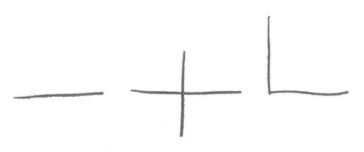
[ 10 ] First, the line parallel to the Earth’s surface—the horizontal. Second, what distinguishes humans from animals is that in humans, the spine stands vertically relative to the horizontal. You have thus drawn two lines; first, the horizontal line, and second, the right angle. When one is aware of the significance of the horizontal line—which, in essence, gives rise to animality—and of the significance of the right angle for humanity’s place in the universe, then one associates certain ideas with the horizontal line and the right angle, which can thereby become symbols.
[ 11 ] Freemasonry, which seeks to characterize the essence of humanity, includes the level and the right angle among its symbols. The other symbols, too, are clearly modeled after the forces of the universe. How they are modeled after the forces of the universe will become clear to you from the following discussion.
[ 12 ] You see, if we imagine the Earth here; the human being moves on the Earth—let’s put it that way—so I’ll draw it radially. Then it is the case that the human being has his direction here along the vertical axis, and that the way he connects to the center of the Earth forms a triangle. You also find the triangle as a symbol in the Masonic tradition. Everything in Freemasonry—in the first degree—is derived from the human form. There you see the development of symbolism. Symbolism, where it occurs in reality, is not arbitrarily invented. One arrives at symbolism only by studying it in relation to reality. Symbolism is rooted in the universe; it is there somewhere. The same is true of the ritual.
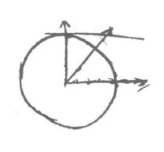
[ 13 ] You see, in the course of a person’s earthly life between birth and death, human beings are constituted in such a way that they possess within themselves the forces that are constantly killing them. These are the forces that solidify the human being, which are active in the formation of the skeletal system, and which, when they develop pathologically, can lead to sclerosis, gout, diabetes, and so on. Human beings possess these forces within themselves; I would call them the solidifying forces. That is one system of forces. The other system of forces that human beings possess is the one that continually rejuvenates them. It is the system of forces that is particularly evident when one suffers from pleurisy, febrile illnesses, and everything that burns within a person. In the anthroposophical worldview, I have called the solidifying forces “Ahrimanic forces,” and the forces that lead to fever—which are thus heat forces—“Luciferic forces.” Both forces must be kept in a constant balance within the human being. If they are not kept in balance, they lead the human being physically, psychically, and spiritually to some destructive extreme. If the forces of fever and the solidifying forces—the forces of salt formation—were not constantly kept in physiological balance, human beings would inevitably develop either sclerosis or fever. If a person develops only the powers of reason, if they lean solely toward intellectualism, they fall prey to the Ahrimanic; if they develop only the fiery elements—passion and emotion—then they fall prey to the Luciferic. And so human beings are always caught between two polarities and must maintain a balance. But consider how difficult it is to maintain that balance. The pendulum, which is supposed to be in equilibrium, always tends toward one extreme or the other. These are the three tendencies within the human being: the tendency toward balance, the tendency toward warmth, and the tendency toward solidification. The human being must maintain its upright posture, so that one can symbolically view the human being as a being that constantly strives to remain upright against the forces that continually endanger its life.
[ 14 ] This represents the third degree of Freemasonry. The Freemason who is initiated into the third degree is shown, symbolically, how humanity is threatened by three hostile forces that approach him and endanger his life. This is done in various ways. The simplest form is as follows: A man is presented in a coffin, and three murderers creep up on him, intent on killing him. By witnessing this threefold danger in which the man finds himself, he is made to realize that he is in mortal danger at every moment and must rise above it.
[ 15 ] In this symbolic attire, a person experiences a kind of genuine ritual; ceremonially, they experience something truly important that is connected to life. And indeed, it is true that one must strive to get to know life, for it is from life itself that the symbols emerge. Freemasonry does have its dark side in that, although these symbols are used and ritual acts are performed—in Blue Masonry in the first three degrees, and in High-Degree Masonry there are many other elements—and although this ceremonial is drawn from ancient traditions, these traditions are no longer understood. There is no longer any connection whatsoever to the origins, which I wanted to outline for you briefly just now. People merely look at the ceremonial, and—and this is the danger—they become fixated on the ceremonial; they are not guided into the ceremonial in such a way as to arrive at the spiritual through it.
[ 16 ] You see, another example of how, even relatively late—as late as the 18th century—people still had a very vivid sense of the pictorial representation of the world’s mysteries is this: You see, when you open certain books with illustrations that were still common in the 18th century—which were used to draw people’s attention to that which cannot be grasped by intellectual concepts—you’ll find a recurring image: a man depicted with a bull’s head and a woman depicted with a lion’s head. The man with the bull’s head and the woman with the lion’s head stand side by side. At first glance, this is shocking to those who do not understand it. But the fact is that we human beings are actually constituted in such a way that we are most perfect in form within our physical body. That is where we are truly human. The physical body, as you will find described in my Occult Science, is the one that goes back to the most ancient structures; it is the most perfect. The human etheric body is shaped like the physical body. If one could remove the physical body from the etheric body—leaving it to adapt only to the astral body—then this etheric body would probably take on an animal form, much to the chagrin of many people, for it would then become the expression of the emotional and the passionate. It is shaped in a wide variety of ways in different people.
[ 17 ] If one considers the male head—the etheric head—as an expression of what lives in the emotional nature, then even as a type, as an average, there is something Taurus-like in the male head. In the female head, as soon as one considers the etheric head, there is something lion-like. These are average forms. One can also perceive this morally when one engages with what female nature encompasses, as it is a type of the lion-like. One can sense the bull in the man and the lion in the woman.
[ 18 ] These are things that seem to be merely figurative, but they are drawn from the supersensible nature [of the human being]. When the astral body is separated from the physical body and observed, it takes on complex plant-like forms, and the human ego is a being of purely mineral, crystalline form; it is entirely geometrically shaped. So one can say: In terms of form, the human being is human in the physical body, animal-like in the etheric body, plant-like in the astral body, and mineral-like in the “I.” When one understands all these things, one realizes how, in an earlier clairvoyant state, people truly knew of higher worlds and how these images took shape from within those higher worlds.
[ 19 ] Well, this is simply meant to illustrate how symbols came into being and how they have traditionally been passed down. In our time, it is only possible to arrive at symbols by immersing oneself with great devotion in the mysteries of the world; and today, a cult or a system of symbolism can truly arise only from anthroposophy.
[ 20 ] For you see, it is indeed necessary to start with the basic elements. The first is that, in a certain sense, one must grow into the genius of language itself. Our language has, after all, taken on a terribly external, abstract form precisely where civilization is at its highest. Today we speak without feeling as we speak. You see, the way we speak today is actually something terribly inhuman, because we no longer live within our language at all. Take, for example, the German word “Kopf.” When we feel it, we simultaneously feel how it is thoroughly connected to the round shape, to the rounded. In contrast, take the Romance word “testa,” which is connected to testifying, bearing witness, or establishing something. It thus springs from an entirely different foundation. And if one senses what lies within these two words, one also senses the difference between the Romance and the Germanic elements. The Germanic element forms the word from plasticity; the Romance, or Latin, element forms it from expressions of the soul. Take the word “Fuß” (foot)—it is related to “Furche” (furrow); “pied” is related to the act of standing upright. This runs throughout the language, and one can sense it everywhere—how the particular worldview actually comes to light in the genius of the language. Consider how strongly people in Goethe’s time still felt the pictorial nature of language. Recall the scene where the poodle appears on stage, running after Faust and Wagner, and where Wagner speaks of the poodle and says, “He doubts”—by which he means that the dog is wagging its tail; with the word “doubt,” he expresses the movement of the tail. If you look at what still lives in the imagery there and compare it with our abstractions today—how the word “doubt” contains this wagging, this back-and-forth swaying—then you can truly begin to appreciate the vivid, pictorial way in which this linguistic genius worked.
[ 21 ] This is the first element of the pictorial life of the soul when one immerses oneself in the pictorial nature of language. It is truly the case that one grows into the pictorial nature of language if one is only willing to do so; and growing into the pictorial nature of language is in itself a good education for the soul. Today we speak in the abstract; words no longer mean anything to us. You see, in my homeland, a certain kind of lightning—seen in a particular way—is called “Himmlatzer.” I’d like to know how one could fail to sense the image of lightning in “Himmlatzer”; after all, the word paints a picture. And so it is also entirely possible, if one delves deeper into dialectal expressions and dialects, to grow even more into the imagery. One really ought to train oneself to find the imagery in language. Today it’s sometimes almost impossible to express anything one has, because the imagery of language has been lost. Of course, one must disregard all artificially contrived things. Anyone who engages in such flights of fancy ends up just like Falb did. He was once walking with a friend and talking animatedly—and stepped into a pond, and thought to himself—pond?—temple!—Of course, one must not engage in such flights of fancy by seeking external similarities. One must delve into the imagery of language from within. Then one will truly understand the word “two.” Originally, “two” was not conceived as adding one and one together, but rather as splitting the one in two. The older conception of numbers is based on analysis, not synthesis. You can still trace this, for example, in Arabic arithmetic as late as the 12th century A.D.
[ 22 ] An interesting little book by our friend Ernst Müller has just been published about Abraham Ibn Esra—I’ll give you the exact title tomorrow—which deals with numbers and is extraordinarily interesting for understanding the earlier way of forming numbers. [If one follows this line of thought,] one will discover, without resorting to speculation, the similarity between the word “two” and the word “doubt”; one is also led to the final sound “el.” In this way, one can find one’s way into the pictorial nature of language. This is the ABC of pictorial imagination.
[ 23 ] The next step is to familiarize oneself with the entire complex nature of, for example, the human being. I have given a few examples today. As I said, if one arrives at true knowledge in this way, the images first emerge for the symbolism, and in turn, one comes to truly understand historical life. Then you will also be able to visualize ritual acts in your imagination.
[ 24 ] Take the following example. You see, the Greeks did not yet have the ability to conceive of concepts entirely separate from things. Just as we perceive colors, so did the Greeks perceive concepts in things; for them, they were perceptions. If we start from this premise, we can truly come to understand how humanity has changed since the time of the Greeks. If, for example, one wanted to depict a kind of altar that would be more suitable for the Greeks, one would depict it in bright colors. If one wanted to depict an altar suitable for a person who lives more in the modern world—one who is not attuned to vivid colors (after all, the Greeks did not perceive color in the same way we do)—one would have to build it today using more blue tones.
[ 25 ] If one were to present a worship service to a congregation today, it would have to be designed to be extremely simple. A complicated worship service would not satisfy people today, so it must be designed to be extremely simple. Above all, we need the worship service to express, in every aspect, the inner transformation of the human being. This inner transformation of the human being—which one might call the “Christification” of the human being—for the human being is not, in fact, born in such a way that he is already, from the outset, Christified by heredity; he must find the Christ within himself—could now be symbolically expressed in the most diverse ways through simple but effective ritual acts.
[ 26 ] Let me give an example: If someone were to compose a verse, that verse would consist of seven lines. The first three lines would essentially describe human beings as they still stand under the influence of hereditary conditions—that is, how they are born from the father principle of the world. The fourth line, the middle one, would then describe how these hereditary principles are overcome by the soul principles. And the last three lines would describe how human beings thereby become perceivers of the spiritual. Now, one could read these seven lines to a congregation in such a way that the first three lines are presented in a somewhat more abstract, rougher language; for the middle, fourth line, one transitions to a somewhat warmer language; and the last three lines are recited in elevated language, with a raised tone. And in this, one would have, in a simple way, a liturgical act that would represent the process of a person being transformed by Christ and becoming spiritual.
[ 27 ] It doesn’t matter at all whether you explain something like this afterward—you certainly shouldn’t do that—but rather, you should let people feel it. The image should be felt, and one should act accordingly. In this way, you can see how it is, after all, possible to rise to the level of the spiritual. Then one must develop a sense of how everything related to the intellectual is akin to light, and how everything related to love is akin to warmth. Now consider what a powerful tool you have in language when, wherever you wish to express something that leans toward the intellectual, you associate it with light. When you say, “Wisdom illuminates humanity,” you have said something true. You will feel how the intellectual is in fact the light that has been captured and transformed into thought. Similarly, images drawn from conditions of warmth are used everywhere when speaking of love. So when you say, “A shared idea spreads warmly throughout a community of people,” you have the image of warmth within it, but you have spoken truthfully. In this way, when you sense the inner wisdom of language, you enter into the realm of imagery.
[ 28 ] This is one such path, and I intend to give you very detailed examples later, when we meet again. One can even develop a modern religious practice based on these principles. Today I just wanted to give you a practical idea of how one is actually introduced to this. But it always concerns our—forgive me for using such a harsh expression—emaciated souls. After all, we are not really human beings; we have become so dead through our materialistic education. People today perceive everything as separate. They do not feel at all that their nerves receive the light, that their nerves are illuminated by the light. They believe that vibrations are at work. But thought is formed in the light. It is not merely an image, but reality, when one says: “Human beings are illuminated by thoughts.”
[ 29 ] People know far too little about this, which is why they cannot form a vivid mental image. But I believe that if, for example, you read through my book Occult Science and immerse yourself in how I depict the three metamorphoses—the Moon, the Sun, and Saturn—in order to visualize how all of this unfolds in images, then you will enter [into visual imagination] quite naturally. If you do not get stuck at the level of abstraction—or even believe that I have constructed or invented something—but instead feel the necessity that it must be depicted in this way, then you already have in that a school for visual imagination. And there is cause everywhere to move on to ritual acts. From [what I have described], one must also acquire a sense of the inner numerical structure of the universe.
[ 30 ] Today, of course, people often laugh at you when you talk about the number seven or the number three. But these numbers can, after all, simply be derived empirically from the universe. I would like to know how anyone could not think of the number three when thinking about human beings. Human beings are, after all, threefold beings, and the number three arises everywhere if one thinks correctly. For example, when speaking to a group of children—or a group of older children—and saying, “May the light illuminate your thinking,” one has not finished speaking unless one immediately adds, “May life permeate your feeling,” or “penetrate you”; and “The fire, may your will empower you.” These elements come together of their own accord, and this then flows into the form of the ritual. One must develop a sense that something is incomplete if one says only, “May the light, your thinking, illuminate you”—it is just as if I were to place a human head there all by itself. That cannot be; I cannot imagine anyone simply placing a human head there—that cannot exist; the other part belongs to it. So I must also have that feeling when I say, “The light, your thinking, may illuminate you”—that is not complete; I must also say, “Life, your feeling, may permeate you” and “The fire, your will, may empower you.” If I take only one, I have just as much as if I had only the human head. This naturally leads one to think of the other as well. Then one enters into this self-creative aspect of the numerical organization of the world, and thus the ritual form arises from the matter itself:
May the light, your thoughts, illuminate you
May life, your feelings, permeate you
May the fire, your will, empower you
[ 31 ] That is, after all, the basis of what Mr. Uehli must have told you today [about the Sunday activities at the Waldorf School]. It’s implicit in the formula; that’s actually how it’s structured everywhere. It’s so hard to understand when it happens in real life.
[ 32 ] You see, if you were to take a piece out of my Philosophy of Freedom—a chapter, for example—it would be almost as if you were to cut off a limb from a person. It is conceived solely as a whole, for it is a special form of thought; it is not composed of individual parts, but has been allowed to grow organically. And that can be further developed.
[ 33 ] Paul Baumann: Doctor, could you tell us something about the musical aspect of the cult?
[ 34 ] Rudolf Steiner: The situation is this: We human beings are placed in the world in such a way that—to put it figuratively (the diagram is drawn on Board 2)—on the one hand, we are a head organization. This head organization is essentially determined by the fact that the external world penetrates into it and is blocked everywhere. Everything that penetrates from the world into the head is actually reflected within the head, and what we perceive on the outside is this reflection—it is what we usually have within our waking consciousness. And if you consider the human anatomy—specifically what is formed by the eye, but also by the other sense organs—you will find that all of this tends to be bounded at the back; something is reflected. On the other hand, the human being develops the skeletal system, the muscular system, and so on. In the case of the head, we actually have the round, enclosed cranial cavity. Then there are the long bones, the muscles, and so on (see Plate 2). The head is, in fact, completely impervious to what acts upon it, just as a mirror is impervious to light; that is why it reflects. This is different in what is called, in the broadest sense, the “limb-metabolic organism”; there, what constitutes the long bones and muscles is grasped by the world, so that one can say: In the organization of the head, everything is repelled, but the limbs take in, so that the processes of the limb-metabolic organism are actually brought about from the outside through the way I am integrated into the world organism. Nothing is repelled there; it is, so to speak, organized through, it is taken in. And this then accumulates, accumulating particularly in the lungs. The lungs are such an accumulating organ, where the outer world takes shape. And a second, already filtered accumulation is found in the auditory organ. The auditory organ is actually a lung at a higher level. Anyone with a sense for this can see for themselves, even from the structure of the external ear, that it is not formed in the same way as the eye. The eye is formed from the outside in. The ear is enclosed and surrounds what is the actual sensory organ. So everything that is visible in the ear is formed in such a way that the human being is composed of two vertices. One vertebra is thrown back, reflects itself, and actually retreats into itself; and the other forms an organism, shapes the form, moves toward it, and they then collide here (see Plate 2), so that everything coming from the outside toward the inside is reflected here and provides ordinary memory—for example, the memory of images seen. In contrast, what builds up the human being is movement—it is movement through and through—it consists of forms of vibration that flow within him. I have told you about the cerebrospinal fluid, haven’t I? After all, the human being is 92% water and only 8% solid; what is solid merely integrates itself. The whole is nothing but movement. What organizes the human being out of this movement does so through the Word. Human beings are truly the Word made flesh in the most literal sense, and this Word made flesh collides with what is reflected there, so that we can say: We are first and foremost constituted by the visual, which, however, is entirely organized toward being reflected back; and then we are constituted by the auditory, by that which shapes the human being—sound formed into words, which then accumulates in hearing and becomes the heard sound.
[ 35 ] Human beings become aware of the external world through the direct or transformed visible. Through that which becomes sound within the human being—that which becomes musical—the human being is the being who rises from the sphere of the musical and is fertilized by the sphere of the optical, of the visible, so that the musical is indeed that which continues to work within us from the world outside. We are built up by music; our body is music made flesh. This is true in the fullest sense. And light shines in here (see Plate 2) and is reflected. This also accounts for the great difference between the ordinary memory we have of the external world—where we retain the visual—and musical memory. Musical memory is something entirely different—this will also seem marvelous to you—musical memory arises in the opposite way; it arises through the accumulation of the flowing tone; there, the human being reflects his own nature back into himself. It is, therefore, that which acts musically within the human being—his innermost nature.
[ 36 ] Now consider: we present images in various ways—whether by placing them visibly before people in worship, or by evoking them through speech—and then we imbue these images with music, whether instrumental or vocal. It is nothing other than the fundamental juxtaposition of the two main world principles. What the human being is as a being of light is brought into connection with what the human being is as a being of sound. And the ritual thereby [.. gap] becomes a polarity. However, this is already the case with the spoken word, and the older cults therefore did not use abstract speech, but rather recitative, which already has a certain song-like quality. And this recitative, which played such a major role even in the ancient Mass—because the Mass was sung—was intended to represent the interpenetration of the luminous with the sonic, so that the musical element in the cult is that which is most essentially internalized by human beings—that which thus fosters the mystical element—while the rest is that which fosters the pantheistic, the outpouring of the human being into the universe.
[ 37 ] This gives us the opportunity, on the one hand, to drive human beings toward expansion through all that is luminous and intellectual, and, on the other hand, to lead them toward introspection and the reception of the supersensible through music. And while, for example, the non-musical, luminous aspect of the cult is suited to instilling in us a sense of the world, the musical aspect is suited to deepening our sense of the self all the way to the divine; and the ideal would be to pursue the luminous aspect to a certain degree and then allow it to merge into the musical, to let it merge quite organically into the musical. In this way, one would indeed have shaped the human being in his constitution through the cult.
[ 38 ] Gottfried Husemann asks whether traditional church music—such as Bach’s—is still needed. Wouldn’t the new form of worship also require a new kind of music?
[ 39 ] Rudolf Steiner: Isn’t it true that when one is compelled to do something quickly today, one ends up reviving these older musical forms? But it is certainly true that people can no longer develop a truly inner relationship to these older forms, just as an adult cannot develop the same forms of life as a child. It is absolutely necessary that music be shaped anew out of today’s sensibilities. Of course, one must begin where one has the opportunity to do so. You must have already noticed that where we practice eurythmy and immerse ourselves in music, our friends have already discovered quite good musical forms based on the musical sensibility of our time. This will be due to the fact that people will increasingly relearn music, just as they do in the field of painting. There are, of course, tentative attempts that need not be condemned; rather, one must recognize that they are indeed tentative attempts—and this is true in music as well, for example with Debussy, who immerses himself in the individual note, who lives within the individual note. But it must not become tone painting. What will happen is that people will increasingly experience what emerges as a mystery within the individual note, and they will then seek to analyze that individual note. Perhaps the scale will have to be expanded, with a few notes added, but it will be enriched primarily by experiencing the character of the individual note. And this will open up special musical possibilities. [To Mr. Baumann:] You hope, too, that people will then be able to experience melodies within the individual note itself? — It is indeed the case that this is possible. Therein lies an opportunity for training. Anthroposophical musicians will have to meet the others halfway. I am, in fact, convinced that anthroposophical musicians still have a great deal of work to do, and that anthroposophical musicians, in particular, will have a great mission. Early music was actually at an impasse before Wagner. But Wagner didn’t really advance music. He expanded music by introducing it into a side current. One may find that grand and ingenious, but it is still a side current. We will have to take up the pre-Wagnerian development of music and find precisely there what can also contribute greatly to worship. Until then, it will of course be very good to use older works. There are actually some truly wonderful pieces out there, in both Protestant and Catholic church music. For modern people, the relationship will no longer be an entirely internal one; one will have to make an effort to immerse oneself in the music itself.
[ 40 ] Emil Bock asks a question concerning the Quaker movement.
[ 41 ] Rudolf Steiner: I have always had the feeling that the Quakers are, in fact, a movement that stems specifically from the Anglo-American tradition. I could not find any significant predispositions in Central Europe for this particular kind of community-building that is evident in Quakerism. I have not yet experienced this endeavor firsthand and therefore, of course, cannot know whether there might be anything fruitful in it or not, but I doubt that anything resembling Quakerism can grow out of the Central European spirit. For you see, the Anglo-American element actually experiences the religious in a form that is entirely different from how Central Europeans can experience it. The Central European experiences the religious first and foremost through thought. That is the primordial phenomenon. It is a mysticism thoroughly illuminated by intellectual light. It is present everywhere, even where very radical religious forms and sectarian movements arise. In Central Europe, you will find mysticism illuminated by the light of thought everywhere, whereas the Anglo-American allows the religious element to remain immersed in the instinctive nature of human beings. Of course, this manifests itself in various ways, and it would be interesting to investigate, in some way, the ethnic backgrounds from which the Quakers are drawn. One must go back to the instinctive, the blood-related; there one will find the underlying foundations. You will see that one is sure to find something there akin to an instinctive predisposition, but the Central European never bases anything that fosters community on such instinctive predispositions.
[ 42 ] There really is a clear difference between the West, the Center, and the East. In the West, people seek the Higher more or less in the subconscious; in the Center, they seek it in the conscious mind; and in the East, they seek it in the superconscious—there, people are always looking upward. Americans, in particular, look toward the earth and expect everything from it, while Russians—and Asians even more so—are actually always looking upward. Central Europeans look straight ahead. It is certainly true that, particularly in the religious sphere, we could stray onto dangerous paths if we were to imitate what is essentially a Western element. We must not do that in any field. After all, it has caused us great harm in the natural sciences and, in the religious sphere in particular, leads to stagnation. In this regard, we must work more with the soul than with the body.
[ 43 ] Emil Bock: We’ve heard that there are already rituals that have been performed on occasion—a baptismal ritual, a funeral ritual, and a section of a reworked Mass. I’d like to ask whether there’s a possibility that we could become familiar with such pieces as a way of immersing ourselves in them?
[ 44 ] Rudolf Steiner: Certainly, these things could be considered as starting points. The funeral ritual came about because a member of our movement wanted to have such a funeral ritual. Of course, we had to build upon the customary funeral rituals, but by translating the customary ritual—not in a lexicographical sense, of course, but correctly—something fundamentally different emerged. I would like to request these materials and would very much like to use them as the basis for our course discussions. I will simply ask our friend to transcribe them and perhaps send them here; that is certainly possible. Regarding the Mass, I initially provided only a translation of the [Catholic] Mass, but it has actually become something new. However, I have only gotten as far as the Offertory in the translation; it is not yet finished. In the Old Catholic service, the Mass is, of course, celebrated in the local language. Our friend has gone so far as to read the Mass up to the Offertory in this translation during the Old Catholic service.
[ 45 ] These things take time, and we have little time. But all of this can truly be made available to you. It would, of course, be necessary to create a new baptismal ritual in particular; for the old baptismal ritual is not entirely suitable, since it was originally designed to baptize adults and was then applied to children. If we wish to baptize children today, a [new] ritual must first be devised. Elements for this already exist, which I can also make available to you. Baptismal rituals have evolved from baptisms for adults. When one baptizes a child, one is speaking to someone who is unconscious, and the act must be appropriate to that. The child knows nothing of it. We must not go so far as to rebel against infant baptism itself; we can remain on that ground. But certain aspects of the ritual need to be renewed. If you take the baptism of St. John, for example, it is based on the fact that the person was immersed in water—the adult was immersed. You know, of course, that in the process a person can be brought to that point [of consciousness] where their earthly life appears to them as a mere tableau. His life appears to him as a kind of tableau, and through this he inevitably experiences that he belongs to a spiritual world. He gains the experience of belonging to a spiritual world. This is, in fact, also expressed in the baptismal ritual. We cannot do this with a child. We must have a ritual for the child that expresses how the child is welcomed into our community, and the communal, religious, supersensible substance that lives within the congregation must flow over the child. We must express this in the baptismal rite, and indeed, this can happen.
[ 46 ] You see, there has, of course, been no reason so far within the anthroposophical movement to actually develop these things in concrete terms, for the simple reason that we wanted to avoid doing so. There have been quite a few instances where people wanted to introduce such things. I have always rejected this because, of course, it would have killed the anthroposophical movement right from the start. We simply had to stick to what we were reasonably allowed to do.
[ 47 ] Twenty years ago, it was even more the case; today, it is less so that the Catholic Church regarded ritual as its monopoly. We would have been wiped out immediately, and therefore there was little reason to develop the ritual in that direction. The other aspect—where, however, the form of a ritual had been established—was interrupted by the war, when it was no longer possible to continue; for as soon as these practices had been carried on, we would have been treated as a secret society.
[ 48 ] These are the reasons why the ritual aspect has not been developed within the anthroposophical movement. But in your movement, it will be possible to develop it, for it will be possible to regard it as something entirely natural that the ritual aspect be developed within a religious movement. Even though Protestantism has a certain aversion to anything resembling a cult, I nevertheless believe that [the necessity of the ritual] could once again be felt.
[ 49 ] A participant: First of all, Catholics have more sacraments than Protestants. What is the reason for this, and what is the true meaning of the ritual of the Lord’s Supper?
[ 50 ] Rudolf Steiner: What lies at the heart of Catholic dogma can indeed be traced back to certain forms of ancient knowledge. It is imagined that between birth and death, a human being passes through seven stages. First, birth itself; then what is called coming of age, puberty; then what is called the awakening to inner life around the age of 20; then the feeling of not fitting into the world, of not being fully human—that is the fourth. And then, isn’t that right, the gradual growing into the spiritual. These concepts have since become somewhat fluid, but one used to conceive of the entire human life—including the social aspect—as consisting of seven stages, and one imagined that between birth and death, a person grows out of the spirit. The Catholic Church, after all, does not recognize pre-existence in modern times. There is only one thought of God, and this growing out of the thought of God is depicted in seven stages. These seven stages must each be counterbalanced by different forces. Birth is an evolution; coming of age is an evolution; every form of evolution is counterbalanced by a form of involution: baptism corresponds to birth, and confirmation to puberty. Each sacrament is the inverse of a natural stage in evolution. One could say that Catholic doctrine presents seven stages of evolution, to which it contrasts seven stages of involution, and these are the seven sacraments, four of which are earthly: namely, Baptism, Confirmation, the Eucharist, and Penance. These four are as universal to humanity as the physical body, the etheric body, the astral body, and the “I.” As you ascend further, you arrive at the spiritual self, the life spirit, and the spiritual human. Just as light shines in from the spiritual world, so too are the last three sacraments those that enter into the social realm: marriage, Holy Orders, and Extreme Unction. The penetration of the spiritual world is expressed in the ordination of priests. These, then, are the seven sacraments, the last of which are Extreme Unction, the ordination of priests, and marriage. The sacraments are simply the inverse processes of the natural processes that take place within the human being, and the corresponding liturgical rites are structured accordingly.
[ 51 ] The concept of the seven sacraments is certainly not an arbitrary one. Rather, it is arbitrary to limit these seven sacraments to just two. This happened at a time when people no longer had a sense of the world’s inner numerical constitution. It is these things, of course, that turn truly serious Catholic priests—especially members of religious orders—into such scorners of Protestantism. They regard it across the board as rationalism, as something that knows nothing anymore. There are genuinely spiritual souls among the religious—the Jesuits, aren’t they? They are, after all, prepared for this—I found one among the monks of Monte Cassino, Father Storkeman, with whom I also spoke about Dionysius the Areopagite, and who showed me the altar where he usually celebrates Mass. He spoke to me about his feelings during Mass, and it was clear that this has nothing to do with the ordinary practice of the Catholic Church.
[ 52 ] And another time, in Venice, there was a patriarch—a truly dreadful fellow. Another, a younger cleric, was preaching, and I could sense in a mysterious way that the one who had preached was truly inspired by the Spirit. The sermon was also truly something quite exquisite. It is precisely through the ceremonial that certain individuals stand out as being out of place. I also saw someone celebrating Mass on the lower ground floor [of a church] in Naples, where, during the transubstantiation, I could truly see that which underlies the Catholic doctrine of transubstantiation. It is indeed true: When transubstantiation is performed by a true priest, the host takes on an aura. Well, believe it or not, I can only tell you this.
[ 53 ] There is no need to hold back [from saying this]: There is an inner reality inherent in religion; that is undoubtedly the case. One sees the flaws in Catholicism precisely when one considers, on the other hand, what it once was and what has been lost in the age of rationalism. It makes no sense that [Protestantism] has removed two of the seven sacraments; there is no rationale for that.
[ 54 ] Emil Bock: Might we also ask what significance the laying on of hands had in the early Christian era?
[ 55 ] Rudolf Steiner: You must realize that humanity has undergone a process of development and that certain spiritual forces that existed in pre-human times have been steadily declining as human beings have become more intellectual and developed their freedom. Compared to natural life, certain forces have indeed declined, and that is why we do not understand many things recounted in biblical history, which have a meaning entirely different from what people associate with them today. I would like to draw your attention, for example, to how mean—repulsively mean—the modern era interprets something like Socrates’ relationship with his students. People speak of a kind of homosexuality, whereas this points to an aspect of the soul’s powers where something was brought about not only through the word but also through Socrates’ mere presence with his students. His presence meant something to them. It is a disgusting slander of these things when the concepts of homosexuality are applied today to such matters in Greek culture. And the same is true of the touch involved in the laying on of hands. The human hand essentially has not only a sensory significance, but it also radiates energy, and this radiation was stronger in earlier times; it can take on a healing quality. I have often expressed this in a specific way in my lectures: Human life is a whole, and childhood is inseparable from later life. No one attains the power to bless in later life who was not able to pray in childhood. Anyone who has never folded their hands in prayer during their youth can never hold their hands in a gesture of blessing. The laying on of hands was simply an initiation rite [… gap in the postscript]; what is involved there is involved in the laying on of hands. This was something that used to be cultivated, and the healing effect of the laying on of hands is something that should certainly be taken into account. Isn’t it true that people today are no longer in the same situation; they are not encouraged at all in their youth to cultivate such things. Such things used to be cultivated; that was once a reality. However, it is by no means out of the question that in a more spiritual future these things will be cultivated again. Wouldn’t you consider that desirable? — Folding one’s hands is a preparation for blessing. Similarly, for example, in traditional Catholicism it was certainly taught: If you learn to kneel, you learn to say the “dominus vobiscum” in the proper way. — Does that seem strange to you? — You know, of course, how to say the “dominus vobiscum.” It is learned through kneeling; otherwise, it lacks power.
[ 56 ] A participant: It was said that priests held an extraordinary leadership position in Egyptian religion. We have heard that initiates guided humanity and that they worked through real thoughts. The question is how this would need to be adapted today in light of the New.
[ 57 ] Rudolf Steiner: Yes, it must become new insofar as we [must not] return to this deeply unconscious, atavistic element, but rather we must move through the much more conscious realm, taking greater account of the fact that every human being must develop into a personality. Even today in Catholicism, the priest’s personality is completely suppressed. When the stole is crossed, the priest is merely a figurehead of the Church; he is no longer a human being. We must not perpetuate this practice. In the Egyptian priesthood in particular, much of the system was based on the fact that, as long as the high priest was alive, the others were allowed to be nothing more than figureheads. Only when he died could another take his place. There was always only one. We must rule out all of that today.
[ 58 ] A participant: What about the priest's vestments?
[ 59 ] Rudolf Steiner: Liturgical vestments came into being through the process of visualizing the coloring of a personal feeling in relation to reality—for example, visualizing the blessing priest. This naturally imparts a very specific coloring to the astral body, and the liturgical vestments are designed accordingly. Isn’t that right? Blessing involves the merging of one’s own personality into the supersensible world and allowing the blessing to flow out to the congregation; this results in a blue undergarment and a red outer garment. One simply models the astral body. The same applies to the other actions, such as prayer and so on. For example, one imagines an outpouring of the spiritual. This can be traced quite precisely: the coloring of the astral body—the priestly vestment. The liturgical vestment is simply the coloring of the astral body. This could certainly be recreated, and the only question is to what extent humanity is mature enough to accept such a thing again.
[ 60 ] I had an excellent Protestant clergyman as a friend who had one great ideal—that is to say, he had many very fine ideals, but among them was one in particular: the abolition of the Luther coat. He wanted to walk around like an ordinary dandy. It embarrassed him that he could not walk around like a dandy while he was a pastor. Therefore, it was very painful for him not to be able to walk around in this modern, aesthetic men’s attire, where one is strapped into two stove pipes. This monstrosity is, after all, regarded today as the only possible attire, and anything else that might emerge is viewed as sheer folly. The greatest folly is our men’s suit. A humanity that puts on a tailcoat and a top hat—it is immediately apparent that such a humanity cannot have any understanding of liturgical vestments. This must be re-instilled in humanity. Perhaps when women can also enter this profession—when female preachers emerge—there will be a way to move more toward liturgical vestments. For women will have to do something to reach the pulpit. But men today still want to do it the way a Swiss orator did. He, for example, thought it appropriate—not to deliver sermons, mind you, but to give speeches—by pacing back and forth at the lectern with a cigarette in his mouth. That is how he delivered his lectures.
[ 61 ] Don’t you agree? You know, after all, that ceremonial robes were not limited to the church, for judges also wore ceremonial robes—and if you were to ask a judge today to put on the old ceremonial robes, he would certainly protest—and even court ceremonial was accompanied by a kind of ceremonial attire. And finally, at the universities, there are still the rectors’ robes, which are always passed down from one rector to the next. In this regard, we need only change our aesthetic expectations, and then it will work out just fine.