

On Health and Illness
GA 348
13 January 1923, Dornach
Translate the original German text into any language:
Versions Available:
On Health and Illness, tr. SOL
Vierzehnter Vortrag
Fourteenth Lecture
Fragen: 1. Es wird gefragt, wie das wirke, wenn ein Mensch Pflanzennahrung oder Fleischnahrung zu sich nimmt, und wenn er Nikotin genießt.
Questions: 1. The question is asked about the effects of a person consuming a plant-based or meat-based diet and using nicotine.
2. In bezug auf Befruchtung: Woher es komme, daß Frauen Söhne bekommen, wenn von den Vorfahren niemand Söhne bekommen habe, und wie es zu erklären sei, daß jemand zweimal hintereinander Zwillinge bekommen habe. Ferner welchen Einfluß zum Beispiel Absinth, Schnaps auf den Samen habe.
2. Regarding conception: Why it is that women give birth to sons when none of their ancestors had sons, and how to explain that someone has given birth to twins twice in a row. Furthermore, what effect, for example, absinthe or schnapps has on semen.
3. In bezug auf das Alter von Wespen und Bienen; es bestehe ein Unterschied.
3. Regarding the age of wasps and bees; there is a difference.
[ 1 ] Dr. Steiner: Diese Sachen, die ich besprochen habe, gelten natürlich nur, wenn ich von Bienen gesprochen habe, für die Bienen, nicht für die Wespen. Bei den Bienen ist es etwas anders als bei den Wespen. Das gilt für die Bienen, nicht für die Wespen.
[ 1 ] Dr. Steiner: The things I’ve discussed, of course, only apply—when I’ve been talking about bees—to bees, not to wasps. With bees, it’s a little different than with wasps. This applies to bees, not to wasps.
[ 2 ] Nun wollen wir einmal versuchen, auf diese Fragen einzugehen. Die erste Anregung war diese, etwas zu sprechen über den Einfluß des Nikotins, also des Giftes, das durch das Rauchen, den Tabak überhaupt, in den menschlichen Körper eingeführt wird. Sehen Sie, da muß man erstens sich klar sein darüber, worin sich die Wirkung dieses Nikotins zeigt. Die Wirkung des Nikotins zeigt sich vor allen Dingen in der Herztätigkeit, so daß durch das Nikotin eine größere, eine stärkere Herztätigkeit hervorgerufen wird. Das heißt aber, da das Herz nicht selber eine Pumpe ist, sondern nur anzeigt, was im Körper vorgeht - das Herz schlägt schneller, wenn das Blut schneller zirkuliert —, daß das Nikotin eigentlich auf die Blutzirkulation wirkt und die Blutzirkulation lebhafter macht. Man muß sich also darüber klar sein, daß durch die Einführung von Nikotin in den menschlichen Körper die Blutzirkulation zu einer lebhafteren gemacht wird. Dadurch wird eine stärkere Herztätigkeit hervorgerufen.
[ 2 ] Now let’s try to address these questions. The first suggestion was to talk a little about the effects of nicotine—that is, the toxin that is introduced into the human body through smoking, or tobacco in general. You see, first of all, we must be clear about how the effects of nicotine manifest themselves. The effects of nicotine are evident above all in heart activity, such that nicotine causes increased, more vigorous heart activity. However, since the heart itself is not a pump but merely indicates what is happening in the body—the heart beats faster when the blood circulates more rapidly—this means that nicotine actually acts on blood circulation and makes it more vigorous. It is therefore important to understand that the introduction of nicotine into the human body makes blood circulation more vigorous. This, in turn, results in increased cardiac activity.
[ 3 ] Nun muß man diese ganzen Vorgänge im menschlichen Organismus verfolgen. Sie müssen durchaus sich darüber klar sein, daß alles das, was im menschlichen Organismus vor sich geht, eigentlich streng geregelt ist. Man kann sich zum Beispiel nichts Wichtigeres vorstellen für den menschlichen Organismus, als daß man, wenn man an den Puls greift, bei einem ziemlich erwachsenen Menschen, auch später noch im menschlichen Alter, in der Minute durchschnittlich etwa so um 72 Pulsschläge herausbekommt.
[ 3 ] Now we must examine all these processes in the human organism. You must be absolutely clear that everything that takes place in the human organism is, in fact, strictly regulated. For example, one cannot create a mental image of anything more important for the human organism than the fact that, when you take the pulse of a fairly adult person—even later in life—you will find an average of about 72 beats per minute.
[ 4 ] Dagegen hat der Mensch - ich habe Ihnen das schon einmal gesagt — etwa 18 Atemzüge. Das ist also in der Minute der Fall. Wenn Sie 18 mit 4 multiplizieren, bekommen Sie 72. Das heißt, im Durchschnitt geht der Blutstoß viermal so schnell durch den Körper als der Atmungsstoß. Natürlich ist das nur eine Durchschnittszahl, denn für jeden Menschen ist das verschieden. Und darauf beruht gerade der Unterschied der Menschen untereinander, daß sie dieses Verhältnis verschieden haben. Aber im Durchschnitt ist es wie 1 zu 4, also viermal so starke Blutzirkulation wie Atmungsrhythmus.
[ 4 ] In contrast, a person—as I’ve told you before—takes about 18 breaths. That’s per minute. If you multiply 18 by 4, you get 72. This means that, on average, the blood flows through the body four times as fast as the breath. Of course, this is only an average, because it varies from person to person. And this is precisely what accounts for the differences between people—the fact that this ratio varies from person to person. But on average, it’s about 1 to 4—meaning the blood circulation is four times as strong as the respiratory rhythm.
[ 5 ] Wenn ich nun Nikotin in den menschlichen Organismus hineinbringe, so kann ich es aus zwei Gründen hineinbringen: Erstens aus der Leidenschaft für den Tabak; zweitens aber kann ich es auch hineinbringen als Heilmittel. Alles dasjenige, was auf der einen Seite Gift ist, ist nämlich auf der anderen Seite ein Heilmittel. Alles, könnte man sagen, ist Gift und Heilmittel. Denn natürlich, wenn Sie zum Beispiel ein paar Eimer Wasser auf einmal austrinken, so ist es ein Gift, während es in der entsprechenden Menge ein Nahrungsmittel ist, und wenn man es gar in merkwürdig kleinen Mengen einführt, kann es sogar ein Heilmittel sein. Wasser ist überhaupt ein starkes Heilmittel durch allerlei Methoden, die man dabei anwendet. Also selbst von den gewöhnlichsten Stoffen kann man sagen: Dasjenige, was Gift ist, kann zugleich Heilmittel sein. Und deshalb muß man die Wirkung kennen, die ein solcher Stoff, eine solche Substanz auch auf den menschlichen Organismus hat.
[ 5 ] If I introduce nicotine into the human body, I can do so for two reasons: first, out of a passion for tobacco; second, however, I can also introduce it as a remedy. Everything that is a poison on the one hand is, in fact, a remedy on the other. Everything, one might say, is both a poison and a remedy. For, of course, if you drink a few buckets of water all at once, for example, it is a poison, whereas in the appropriate amount it is a food, and if you take it in remarkably small quantities, it can even be a remedy. Water, in fact, is a powerful remedy through all sorts of methods that are applied to it. So even of the most common substances, one can say: What is a poison can at the same time be a remedy. And that is why one must know the effect that such a substance has on the human organism.
[ 6 ] Bringe ich also Tabak in den menschlichen Organismus, so regt er zunächst die Blutzirkulation an. Das Blut wird lebhafter, zirkuliert lebhafter. Jetzt regt er aber nicht in demselben Maße die Atmung an. Die Atmungsstöße, die bleiben dieselben. Aber nun paßt der Blutkreislauf nicht mehr mit der Atmung zusammen. Wenn der Mensch Nikotin in seinen Körper hineinbringt, müßte er eine andere Blutzirkulation haben als er hat.
[ 6 ] So when I introduce tobacco into the human organism, it first stimulates blood circulation. The blood becomes more vigorous and circulates more vigorously. However, it does not stimulate respiration to the same degree. The respiratory rhythms remain the same. But now the blood circulation no longer synchronizes with respiration. When a person introduces nicotine into their body, their blood circulation should be different from what it actually is.
[ 7 ] Sagen wir also zum Beispiel, es wäre ein Mensch gerade auf den Durchschnitt abgestimmt — das gibt es zwar nicht, aber nehmen wir an, er wäre es: er sollte 18 Atemzüge und 72 Pulsschläge haben. Nun hat er dadurch, daß er Nikotin genießt, sagen wir, 76 Pulsschläge. Dadurch hat er kein richtiges Verhältnis zwischen den Pulsschlägen und den Atemzügen. Die Folge davon ist, daß, während sich mit jedem Pulsschlag eine bestimmte Menge Sauerstoff mit dem Blut verbinden sollte, das Blut nicht genügend Sauerstoff erhält. Die Folge der Nikotinvergiftung ist also, daß das Blut zu große Mengen Sauerstoff aufnehmen will, das heißt, daß das Blut zu viel Sauerstoff beansprucht. Die Atmung gibt nicht so viel Sauerstoff her. Daher kommt es, daß eine ganz geringe Atemnot eintritt. Natürlich ist die Atemnot so gering, daß sie im einzelnen nicht bemerkt wird, denn ich habe Ihnen schon gesagt, der menschliche Körper kann im ganzen viel aushalten. Aber dasjenige, was durch den Nikotingenuß hervorgerufen wird, das ist immer eine bestimmte, ganz kleine Atemnot. Diese ganz kleine Atemnot verursacht nämlich bei jedem Atemzug ein Angstgefühl. Jede Atemnot verursacht Angstgefühl. Wenn man nun Angst hat und man trägt diese Angst mit sich herum, dann beherrscht man sie eher, als diese furchtbar kleine Angst, die man da bekommt, die ganz unbewußt bleibt. Das sind ja gerade die Krankheitsursachen, daß so etwas wie Angst oder Furcht oder Schreck unbemerkt bleibt.
[ 7 ] So let’s say, for example, that a person were perfectly in line with the average—which doesn’t actually exist, but let’s assume it were the case: he should have 18 breaths and 72 heartbeats. Now, because he consumes nicotine, he has, say, 76 heartbeats. As a result, there is no proper balance between his heart rate and his breathing. The consequence of this is that, while a certain amount of oxygen should bind to the blood with each heartbeat, the blood does not receive enough oxygen. The consequence of nicotine poisoning is therefore that the blood tries to absorb too much oxygen—that is, the blood demands too much oxygen. Breathing does not supply that much oxygen. This is why a very slight shortness of breath occurs. Of course, the shortness of breath is so slight that it goes unnoticed on an individual basis, because, as I’ve already told you, the human body can endure a great deal overall. But what is caused by nicotine consumption is always a specific, very slight shortness of breath. This very slight shortness of breath, in fact, causes a feeling of anxiety with every breath. Any shortness of breath causes a feeling of anxiety. Now, if you’re anxious and you carry that anxiety around with you, you’re more likely to control it than that terribly slight anxiety you experience, which remains completely unconscious. These are precisely the causes of illness—that things like anxiety, fear, or shock go unnoticed.
[ 8 ] Nun bleibt bei dem, der fortwährend raucht, fortwährend die Ursache da, daß er immer, ohne daß er es merkt, ganz ausgefüllt ist von einer gewissen Angst. Nun wissen Sie aber, wenn Sie Angst kriegen, daß dann Ihr Herz pumpert. Nun, das wird Sie zu der Erkenntnis führen, daß bei einem, der sich durch Nikotin fortwährend vergiftet, das Herz eigentlich fortwährend etwas zu schnell geht. Aber wenn es etwas zu schnell geht, dann wird es auch verdickt, geradeso wie mein Bizeps, mein Oberarmmuskel dick wird, wenn ich ihn fortwährend anstrenge. Das ist unter Umständen nicht so schlimm, wenn es nicht zu einem Reißen der inneren Gewebe kommt. Aber wenn einmal der Herzmuskel — das ist auch ein Muskel — durch seine Tätigkeit zu dick wird, dann drückt er überall auf die anderen Organe. Und die Folge davon ist in der Regel, daß dann vom Herzen aus wiederum die Blutzirkulation gestört wird. Die Blutzirkulation kann nicht vom Herzen eingeleitet werden, aber gestört werden kann sie, wenn das Blut ein verdicktes Herz findet.
[ 8 ] Now, for someone who smokes constantly, the underlying cause remains that—without even realizing it—they are always completely filled with a certain kind of anxiety. But you know that when you get anxious, your heart starts pounding. Well, this will lead you to the realization that in someone who is constantly poisoning themselves with nicotine, the heart is actually beating a little too fast all the time. But if it beats a little too fast, it also thickens, just as my bicep—my upper arm muscle—thickens when I constantly strain it. Under certain circumstances, this isn’t so bad, as long as it doesn’t lead to a tear in the internal tissues. But once the heart muscle—which is also a muscle—becomes too thick due to its activity, it puts pressure on all the other organs. And the result of this is usually that blood circulation is then disrupted by the heart itself. Blood circulation cannot be initiated by the heart, but it can be disrupted when the blood encounters a thickened heart.
[ 9 ] Wenn nun das Herz verdickt wird, dann ist die nächste Folge davon, daß nämlich die Nieren krank werden, weil durch das Zusammenstimmen wiederum von Herz- und Nierentätigkeit die ganze menschliche Leibesorganisation in Ordnung gehalten ist. Das Herz und die Nieren müssen immer zusammenstimmen. Es muß natürlich alles im Menschen zusammenstimmen, aber Herz und Niere sind in unmittelbarer Verbindung. Man merkt gleich, wenn im Herzen etwas nicht richtig ist, kommt die Niere auch nicht mehr in der richtigen Weise in Ordnung, und dann wird nicht mehr in der richtigen Weise abgesondert. Dann kommt Unrichtiges in die Urinabsonderung hinein, und die Folge davon ist, daß der Mensch ein viel zu schnelles Lebenstempo einschlägt und sich deshalb furchtbar rasch abnutzt. Und so wird derjenige, der eben für seine Leibesverhältnisse zu viel Nikotin in seinen Leib hineinkriegt, daran langsam zugrundegehen. Er geht eigentlich langsam zugrunde an allerlei inneren, das Herz beeinflussenden Angstzuständen.
[ 9 ] If the heart becomes thickened, the next consequence is that the kidneys become diseased, because the entire human physical system is kept in order through the harmonious coordination of heart and kidney function. The heart and the kidneys must always work in harmony. Of course, everything in the human body must be in harmony, but the heart and kidneys are directly connected. One notices immediately that when something is not right with the heart, the kidneys also fail to function properly, and then waste products are no longer excreted as they should. Abnormalities then creep into urine excretion, and the result is that a person adopts a much too fast pace of life and therefore wears himself out terribly quickly. And so, anyone who consumes too much nicotine for his physical constitution will slowly perish as a result. He is actually slowly perishing from all sorts of internal states of anxiety that affect the heart.
[ 10 ] Nun kann man ja eigentlich gerade Angstzustände in ihrer Wirkung auf die seelischen Tätigkeiten sehr leicht beurteilen. Man wird bei denjenigen Leuten, die zu viel Nikotin in ihren Körper hineinbringen, eben merken, daß allmählich auch ihre Gedankenkraft beeinträchtigt wird. Die Gedankenkraft wird dadurch beeinträchtigt, daß der Mensch, wenn er durch irgend etwas in Angst herumgeht, ja nicht mehr ordentlich denken kann. So daß also bei solchen Menschen gewöhnlich die Nikotinvergiftung auch dadurch erkannt werden kann, daß man findet, ihre Gedanken kommen nicht mehr ganz in Ordnung. Sie urteilen gewöhnlich viel zu rasch. Sie steigern dann dieses viel zu rasche Urteilen manchmal bis zu Verfolgungswahngedanken. So also kann man sagen, daß tatsächlich der Nikotingenuß, wenn er als Genuß figuriert, die menschliche Gesundheit untergräbt.
[ 10 ] In fact, it is actually very easy to assess the effects of anxiety on mental processes. In people who ingest too much nicotine, one will notice that their ability to think clearly is gradually impaired. Mental faculties are impaired because, when a person is anxious about something, they can no longer think clearly. Thus, nicotine poisoning in such individuals can usually be recognized by the fact that their thoughts are no longer entirely coherent. They tend to judge things far too quickly. This tendency to judge too quickly sometimes escalates to delusions of persecution. Thus, it can be said that nicotine consumption—when treated as a pleasure—actually undermines human health.
[ 11 ] Aber, meine Herren, Sie müssen überall, bei allen diesen Sachen die andere Seite betrachten. Nicht wahr, daß die Menschen rauchen, das ist ja erst in der Entwickelung der Menschheit aufgekommen. Ursprünglich haben die Menschen nicht geraucht. Der Tabakgenuß ist etwas, was erst im Laufe der Zeit heraufgekommen ist. Nun, man muß die andere Seite betrachten.
[ 11 ] But, gentlemen, you must consider the other side of the issue in all these matters. Isn’t it true that smoking is something that only emerged in the course of human development? Originally, people did not smoke. Tobacco use is something that has only emerged over time. Well, one must consider the other side.
[ 12 ] Nehmen Sie an, das, was ich früher als ein Manko hingeschrieben habe, ist eingetreten beim Menschen. Er hat statt 72 Pulsschlägen nur 68. Nehmen Sie also an, der Mensch, der einen zu wenig lebhaften Blutkreislauf hat, fängt jetzt an zu rauchen. Ja, sehen Sie, da muß man zunächst sich klar darüber sein, daß da jetzt auch der Blutkreislauf angeregt wird — aber von 68 auf 72, auf das Richtige wird er angeregt, so daß dann Atmung und Blutkreislauf zusammenstimmen. Wenn also einer zu einem Arzt kommt und sich krank fühlt nach irgendeiner Richtung, und der Arzt bemerkt, die Krankheit kommt von einem zu schwachen Blutkreislauf, so kann er ihm sogar das Rauchen anraten.
[ 12 ] Suppose that what I previously described as a shortcoming has actually occurred in a person. Instead of 72 heartbeats per minute, this person has only 68. So suppose that this person, who has a circulation that is not vigorous enough, now starts smoking. Yes, you see, one must first be clear that this will now also stimulate the blood circulation—but from 68 to 72, to the correct level, so that breathing and blood circulation are then in harmony. So if someone goes to a doctor feeling ill in some way, and the doctor determines that the illness stems from poor blood circulation, the doctor might even advise them to smoke.
[ 13 ] Sehen Sie, ich habe Ihnen gesagt: Wenn der Blutkreislauf zu schnell ist im Verhältnis zum Atmen, hat man es mit furchtbaren Angstzuständen zu tun, die aber nicht bewußt werden. Wenn aber einer einen zu schwachen Blutkreislauf von irgend etwas anderem hat, dann drückt sich das dadurch aus, daß er herumgeht und irgend etwas will, aber er weiß nicht, was er will. Das ist geradeso eine charakteristische Krankheitserscheinung, daß es Menschen gibt, die herumgehen und etwas wollen, die aber nicht wissen, was sie wollen. Bedenken Sie doch nur, wie viele Menschen es gibt, die so herumgehen und nicht wissen, was sie wollen! Die sind dann, wie man sagt, unbefriedigt im Leben. Nicht wahr, es sind solche Leute, die in irgendeinen Beruf hineinkommen, aber er ist ihnen nicht recht und so weiter. Das rührt von einer zu schwachen Blutzirkulation her. Und wenn man also solch einen Menschen hat, dann kann man sagen: Es ist sogar gut, ihm etwas Nikotin beizubringen, ihn durch Nikotin zu heilen. Und da ihm das Rauchen angenehm ist, so braucht man ihm nicht Nikotin als Medizin zu geben, sondern man kann ihm sogar anraten, er solle rauchen, wenn er früher kein Raucher war.
[ 13 ] You see, I told you: If blood circulation is too fast in relation to breathing, one experiences terrible anxiety, which, however, remains unconscious. But if someone has a circulation that’s too weak due to some other cause, this manifests itself in the fact that they walk around wanting something, but they don’t know what they want. It’s just as much a characteristic symptom of illness that there are people who walk around wanting something but don’t know what they want. Just think about how many people there are who walk around like that, not knowing what they want! They are, as they say, dissatisfied with life. Isn’t that right? These are the kinds of people who end up in some profession, but it doesn’t quite suit them, and so on. This stems from poor blood circulation. And so, when you have a person like that, you can say: It’s actually good to introduce them to nicotine, to heal them through nicotine. And since they enjoy smoking, you don’t need to give them nicotine as medicine; instead, you can even advise them to smoke if they weren’t a smoker before.
[ 14 ] Es ist tatsächlich so, daß in der neueren Zeit die Menschen immer zahlreicher geworden sind, die eigentlich nicht wissen, was sie wollen. Und das ist auch sehr leicht in der neueren Zeit, daß die Menschen nicht wissen, was sie wollen, denn die Mehrzahl der Menschen so seit drei, vier Jahrhunderten hat sich eigentlich abgewöhnt, irgendwie sich geistig mit etwas zu beschäftigen. Sie gehen in ihr Büro, beschäftigen sich mit dem, was sie eigentlich nicht gerne mögen, aber was ihnen Geld bringt, und sitzen ihre Bürostunden ab, sind meinetwillen auch ganz fleißig, aber sie haben gar kein richtiges Interesse außer demjenigen, daß sie ins Theater gehen, Zeitungen lesen. So weit ist es ja allmählich gekommen. Das Bücherlesen ist ja heute zum Beispiel schon eine Seltenheit.
[ 14 ] It is indeed true that in recent times there has been a growing number of people who do not really know what they want. And it’s also very easy in modern times for people not to know what they want, because for the past three or four centuries, the majority of people have actually lost the habit of engaging intellectually with anything. They go to their offices, deal with things they don’t really like but that bring them money, and sit through their workdays—they’re quite diligent, for all I care—but they have no real interests beyond going to the theater or reading newspapers. That’s how far things have gradually come. Reading books, for example, is already a rarity these days.
[ 15 ] Das alles kommt aber davon, weil die Leute eigentlich gar nicht wissen, was sie wollen. Es muß ihnen erst vorgeschrieben werden, was sie wollen. Und wenn man Zeitungen liest, ins Theater geht, so regt das zwar die Sinne und den Verstand an, aber nicht das Blut. Das ist eben gerade das: Wenn man sich hinsetzen muß und irgendwie ein schweres Buch liest, da wird das Blut angeregt. Sobald man sich anstrengen muß, um etwas zu verstehen, wird das Blut angeregt. Aber das wollen ja die Leute heute nicht mehr. Die wollen nicht sich anstrengen, um etwas zu verstehen. Das ist etwas, was den Leuten ganz zuwider ist. Sie wollen nichts verstehen! Und dadurch, wenn sie nichts verstehen wollen, wird ihr Blut dick gemacht, Das dicke Blut geht dann langsamer, und die Folge davon ist, daß sie fortwährend ein Mittel brauchen, um dieses tatsächlich immer dicker werdende Blut in Gang zu bringen. In Gang wird es gebracht, wenn sie den Glimmstengel, den Nikotinstengel in den Mund stecken; aber dünner wird es nicht, nur die Blutzirkulation wird immer schwerer. Und die Folge kann dann sein, daß sie in einem Alter, wo das noch nicht der Fall zu sein brauchte, allerlei Alterserscheinungen kriegen.
[ 15 ] But all of this stems from the fact that people don’t really know what they want. First, they have to be told what they want. And when you read newspapers or go to the theater, that may stimulate the senses and the mind, but not the blood. That’s exactly the point: when you have to sit down and read a difficult book, that’s when the blood gets pumping. As soon as you have to make an effort to understand something, the blood starts flowing. But that’s exactly what people don’t want anymore these days. They don’t want to make an effort to understand anything. That’s something people find utterly repulsive. They don’t want to understand anything! And as a result—because they don’t want to understand anything—their blood becomes thick. The thick blood then flows more slowly, and the consequence of this is that they constantly need a stimulant to get this blood—which is actually getting thicker and thicker—moving again. It is kept moving when they put that cigarette, that nicotine stick, in their mouths; but it doesn’t get any thinner—only the blood circulation becomes increasingly difficult. And the result can then be that, at an age when this need not yet be the case, they develop all sorts of signs of aging.
[ 16 ] Man sieht daraus, wie der menschliche Körper außerordentlich fein in seiner Tätigkeit ist. Nicht nur, wenn man das Blut untersucht, bekommt man etwas heraus, sondern man bekommt auch etwas heraus, wenn man die Art und Weise, wie sich ein Mensch verhält, ob er langsam oder schnell denkt, untersucht.
[ 16 ] This shows how extraordinarily subtle the human body is in its functioning. One can gain insight not only by examining the blood, but also by examining the way a person behaves—whether they think slowly or quickly.
[ 17 ] Also Sie sehen, meine Herren: Derjenige, der etwas wissen will über die Wirkung des Nikotins, der muß eben den ganzen Blutkreislauf und die Atmung genau kennen.
[ 17 ] So you see, gentlemen: Anyone who wants to know about the effects of nicotine must have a thorough understanding of the entire circulatory system and respiration.
[ 18 ] Nun erinnern Sie sich, was ich Ihnen neulich ausführlich gesagt habe: Das Blut selber wird aber erzeugt in dem Knochenmark; da kommt es eigentlich heraus. Nun, wenn das Blut in dem Knochenmark erzeugt wird und man bringt das Blut in eine zu große Bewegung, dann muß das Knochenmark auch schneller arbeiten als es sollte. Die Folge davon ist, daß die Knochen nicht mehr nachkommen in ihrer Arbeit, und dann bilden sich innerhalb der Knochen diejenigen Tiere aus, diejenigen kleinen Tiere, die uns eigentlich im Leben auffressen. Es hat Ärzte gegeben, wie zum Beispiel Metschnikow, die glaubten, daß überhaupt diese Osteophagen—so nennt man sie, diese kleinen Kerle—, die Ursache des menschlichen Todes sind. Wenn es keine Osteophagen gäbe, sagte der Metschnikow, dann würden wir ewig leben. Er meinte, daß die uns richtig auffressen. Nun, Tatsache ist, daß, je älter wir werden, desto mehr Osteophagen da sind. Also wahr ist es schon, daß unsere Knochen nach und nach aufgefressen werden von den Osteophagen. Aber auf der anderen Seite ist es geradeso, als wenn man eben einen Acker gut düngt: dann wächst mehr darauf, als wenn man ihn schlecht düngt. Und so etwas wie zum Beispiel Nikotin in den Körper hineinbringen, das bedeutet, daß man die Knochen schlecht macht für uns, aber für die Osteophagen, für diese Menschenfresser, Knochenfresser, macht man sie gerade gut. Was für uns Menschen ein Schlechtes ist, ist für diese kleinen Tiere das Allerbeste, was man machen kann.
[ 18 ] Now, remember what I told you in detail the other day: The blood itself is produced in the bone marrow; that is where it actually comes from. Now, if the blood is produced in the bone marrow and you cause the blood to circulate too rapidly, then the bone marrow must also work faster than it should. The result is that the bones can no longer keep up with the workload, and then those little creatures—the ones that actually eat us alive—form inside the bones. There have been doctors, such as Mechnikov, who believed that these osteophages—that’s what they’re called, these little guys—are the very cause of human death. If there were no osteophages, Mechnikov said, we would live forever. He believed that they literally eat us away. Well, the fact is that the older we get, the more osteophages there are. So it is certainly true that our bones are gradually eaten away by the osteophages. But on the other hand, it’s just like when you fertilize a field well: more grows on it than if you fertilize it poorly. And introducing something like nicotine into the body, for example, means that you’re making the bones bad for us, but for the osteophages—these man-eaters, bone-eaters—you’re actually making them better. What is bad for us humans is the very best thing you can do for these little creatures.
[ 19 ] So ist es eben in der Welt. Wenn einer bequem denken will, denkt er, die Welt ist von einem Herrgott gemacht, und da muß alles gut sein. Nun kann man sagen: Ja, warum hat denn der Herrgott neben den Knochen gleich die Osteophagen wachsen lassen? Wenn er die Osteophagen nicht hätte wachsen lassen, würden wir nicht aufgefressen werden während des Lebens; da könnten wir unsere Knochen so schlecht behandeln, daß sie zuletzt nur an irgend etwas anderem zugrundegehen; sie würden aber jedenfalls jahrhundertelang halten können, wenn diese kleinen Viecher da nicht drinnen wären.
[ 19 ] That’s just the way the world is. If someone wants to take the easy way out, they think the world was made by God, and so everything must be good. Now one might ask: Well, why did God let osteophages grow right alongside our bones? If He hadn’t let the osteophages grow, we wouldn’t be eaten away during our lives; we could treat our bones so badly that they’d eventually perish from some other cause; but they’d certainly last for centuries if those little creatures weren’t inside them.
[ 20 ] Aber das nützt einem nichts, wenn man nur so bequem denkt. Es nützt einem bloß, wenn man wirklich auf die Tatsachen eingeht, und wenn man weiß, daß eben diejenigen feinen Kräfte, die an der Knochenentstehung beteiligt sind, ihre Feinde haben, daß eben auch ihre Schöpfung da ist, denn das sind eben diese Osteophagen, die wir zu Millionen in uns haben. Je älter Sie werden, desto mehr haben Sie diese Osteophagen in sich, Sie haben immer Menschenfresser in sich, wenn sie auch klein sind. Die großen Menschenfresser sind nicht die allergescheitesten; die allergescheitesten sind diejenigen, die wir auf diese Weise da in uns tragen, und die also tatsächlich einen wiederum günstigen Boden gewinnen, wenn man eben Nikotin in den Körper hineinbringt.
[ 20 ] But that doesn’t help anyone if you just think that way out of convenience. It’s only helpful if you really engage with the facts, and if you know that the very subtle forces involved in bone formation have their enemies—that their own creation is also present—for these are precisely the osteophages that we harbor by the millions within us. The older you get, the more of these osteophages you have inside you; you always have these “man-eaters” inside you, even if they are small. The large “man-eaters” aren’t the smartest; the smartest are the ones we carry within us in this way, and which thus actually find a favorable environment again when nicotine is introduced into the body.
[ 21 ] Sehen Sie, daraus können Sie aber erkennen, daß es eben außerordentlich wichtig ist, den ganzen Menschen gründlich zu verstehen, wenn man überhaupt sagen will, wie irgendein Stoff im menschlichen Körper wirkt.
[ 21 ] You see, this shows that it is extremely important to thoroughly understand the whole person if one is to say anything at all about how a substance acts in the human body.
[ 22 ] Nun ißt ja der Mensch fortwährend. Er ißt Tierisches, und er ißt Pflanzliches. Ich habe Ihnen schon einmal gesagt: Es fällt mir gar nicht ein, irgendwie zu agitieren für diese oder jene Nahrungsweise, sondern ich sage nur, wie sie wirkt. Und es ist oftmals vorgekommen, daß Vegetarier zu mir gekommen sind und gesagt haben, sie fühlen sich manchmal so zu einer leisen Ohnmacht geneigt und so weiter, und da sagte ich ihnen: Ja, das rührt eben davon her, daß Sie kein Fleisch essen. — Nicht wahr, man muß die Dinge ganz objektiv betrachten. Man muß nicht irgend etwas erzwingen wollen. Aber «objektiv betrachten» — was heißt das mit Bezug auf Pflanzenessen und Fleischessen? Sehen Sie, meine Herren, betrachten Sie eine Pflanze. Eine Pflanze bringt es dazu, daß sie ihren Keim, der in die Erde gesenkt wird, bis zu den grünen Blättern und farbigen Blumenblättern entwickelt. Und nun vergleichen Sie so etwas, was Sie von der Pflanze bekommen - also entweder, sagen wir, Sie pflücken direkt Ahren ab oder Sie pflücken Kraut ab und machen das zu irgendeinem Kohlgemüse oder dergleichen, indem Sie eskochen -, vergleichen Sie das mit dem Fleisch, mit dem Muskelfleisch der Tiere, es ist ein ganz anderer Stoff, nicht wahr. Aber in welchem Verhältnis stehen diese zwei Stoffe?
[ 22 ] Well, people eat all the time. They eat animal products, and they eat plant-based foods. I’ve told you before: It would never occur to me to advocate for one diet or another; I’m simply describing its effects. And it has often happened that vegetarians have come to me and said they sometimes feel on the verge of fainting and so on, and I’ve told them: Yes, that’s precisely because you don’t eat meat. — Isn’t it true that one must view things quite objectively? One mustn’t try to force anything. But “view objectively”—what does that mean in relation to eating plants and eating meat? Look, gentlemen, consider a plant. A plant manages to develop its seed, which is sown into the earth, all the way to green leaves and colorful petals. And now compare what you get from the plant—that is, either, let’s say, you pick the ears of grain directly, or you pick the greens and turn them into some kind of cabbage dish or the like by boiling them—compare that with meat, with the muscle tissue of animals; it’s a completely different substance, isn’t it? But what is the relationship between these two substances?
[ 23 ] Sie wissen }a, es gibt Tiere, die sind einfach gute vegetarische Wesen. Es gibt doch Tiere, die kein Fleisch essen. Sagen wir also zum Beispiel unsere Kühe, die essen kein Fleisch. Pferde sind auch nicht auf Fleisch erpicht; die fressen ja auch nur Pflanzen. Nun müssen Sie sich klar sein: Das Tier, das schoppt nicht bloß immer die Nahrung in sich hinein, sondern es stößt auch fortwährend das, was in seinem Körper ist, heraus. Bei den Vögeln wissen Sie, daß es so etwas gibt wie die Mauserung. Da verlieren die Vögel ihre Federn und müssen sie durch neue ersetzen. Sie wissen, daß die Hirsche ihre Geweihe abwerfen. Und Sie schneiden sich die Nägel ab; die wachsen wieder nach. Aber dasjenige, was da so sichtbar äußerlich auftritt, das ist ja fortwährend da! Wir stoßen fortwährend Haut ab. Ich habe Ihnen das schon einmal auseinandergesetzt. Und in einem Zeitraum von etwa sieben bis acht Jahren haben wir den ganzen Körper abgestoßen und durch einen neuen ersetzt. Das ist aber bei den Tieren auch der Fall.
[ 23 ] You know, there are animals that are simply vegetarian by nature. There are, after all, animals that don’t eat meat. Take our cows, for example—they don’t eat meat. Horses aren’t keen on meat either; they, too, eat only plants. Now you have to realize this: An animal doesn’t just constantly take in food; it also constantly expels what’s inside its body. With birds, you know there’s such a thing as molting. That’s when birds lose their feathers and have to replace them with new ones. You know that deer shed their antlers. And you cut your nails; they grow back. But what appears so visibly on the outside is actually always there! We are constantly shedding skin. I’ve explained this to you before. And over a period of about seven to eight years, we’ve shed our entire body and replaced it with a new one. But this is also the case with animals.
[ 24 ] Also betrachten Sie eine Kuh oder einen Ochsen: Ja, wenn Sie ihn nach Jahren betrachten, so ist ja das Fleisch, das in ihm drinnen ist, ein ganz anderes. Beim Ochsen ist es etwas anders als beim Menschen; es geht das Auswechseln sogar schneller. Es ist also ein anderes Fleisch da. Woraus ist aber das Fleisch geworden? Das müssen Sie sich fragen. Das ist ja aus lauter Pflanzenstoffen geworden! Der Ochse hat selber aus Pflanzenstoffen Fleisch in seinem Körper erzeugt. Das ist ja das Allerwichtigste, was man dabei bedenken muß. Also der tierische Körper ist imstande, aus dem Pflanzlichen Fleisch zu machen.
[ 24 ] So take a cow or an ox, for example: Yes, when you look at it after several years, the flesh inside it is completely different. With an ox, it’s a little different than with a human; the renewal process actually happens even faster. So there is different flesh there. But what has the flesh become? You have to ask yourself that. It has become nothing but plant matter! The ox itself has produced flesh in its body from plant matter. That is the most important thing to keep in mind here. So the animal body is capable of turning plant matter into flesh.
[ 25 ] Nun, meine Herren, Sie können Kohl noch solange kochen, dann kriegen Sie noch immer kein Fleisch daraus! Das gibt es nicht, daß Sie Fleisch kriegen in Ihrer Pfanne oder in Ihrem Haferl! Ebensowenig hat schon jemals einer einen Kuchen gebacken so, daß daraus Fleisch geworden ist. Also das kann man nicht durch äußere Kunst machen. Aber, im Grunde genommen, im tierischen Körper wird das gemacht, was man äußerlich nicht machen kann. Es wird eben einfach Fleisch erzeugt im tierischen Körper. Ja, dazu müssen die Kräfte eben erst im Körper sein. Unter unseren technischen Kräften haben wir keine solchen, durch die wir einfach aus Pflanzen Fleisch machen können. Das haben wir nicht. Also in unserem Körper und im tierischen Körper sind Kräfte, welche aus Pflanzensubstanz, Pflanzenstoffen Fleischstoffe machen können.
[ 25 ] Well, gentlemen, you can cook cabbage all you want, but you’ll still never get any meat out of it! It’s impossible for you to get meat in your frying pan or in your mug! Just as no one has ever baked a cake that turned into meat. So that can’t be achieved through external means. But, basically, what can’t be done externally is done within the animal’s body. Meat is simply produced within the animal’s body. Yes, for that to happen, the necessary forces must first be present in the body. Among our technical capabilities, we do not possess any that would allow us to simply turn plants into meat. We do not have that. So, in our bodies and in animal bodies, there are forces capable of transforming plant matter and plant substances into meat substances.
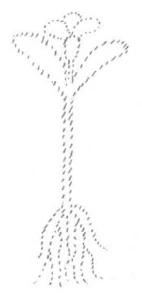
[ 26 ] Jetzt betrachten Sie eine Pflanze. Das soll die Pflanze sein (siehe Zeichnung). Da ist sie noch auf der Wiese oder auf dem Feld. Bis daher haben die Kräfte gewirkt, haben grüne Blätter, Blüten hervorgebracht und so weiter. Nun denken Sie sich, eine Kuh frißt nun diese Pflanze.
[ 26 ] Now look at a plant. This is supposed to be the plant (see drawing). There it is, still in the meadow or in the field. Up to this point, the forces have been at work, producing green leaves, flowers, and so on. Now imagine a cow eating this plant.
[ 27 ] Wenn die Kuh oder der Ochse diese Pflanze frißt, dann wird sie in ihm zu Fleisch. Das heißt, er hat die Kräfte, durch die er aus dieser Pflanze Fleisch machen kann, in sich.
[ 27 ] When a cow or an ox eats this plant, it turns into meat inside the animal. This means that the animal possesses the powers that enable it to turn this plant into meat.
[ 28 ] Nun denken Sie sich, diesem Ochsen fiele es auf einmal ein, zu sagen: Das ist mir zu langweilig, daß ich da herumgehen und mir erst diese Pflanzen abbeißen soll. Das kann für mich ein anderes Vieh machen. Ich fresse gleich dieses Vieh! Nun schön, der Ochse würde anfangen Fleisch zu fressen. Aber er kann doch das Fleisch selber erzeugen! Er hat die Kräfte dazu in sich. Was geschieht also, wenn er statt Pflanzen Fleisch direkt frißt? Er läßt die ganzen Kräfte ungenützt, die in ihm Fleisch erzeugen können! Wenn Sie irgendwo eine Fabrik sich denken, durch die irgend etwas erzeugt werden soll, und Sie erzeugen nichts, aber bringen die ganze Fabrik in Tätigkeit — denken Sie sich einmal, was da für Kraft verlorengeht! Es geht ja ungeheure Kraft verloren. Aber, meine Herren, die Kraft, die im tierischen Körper verlorengeht, die kann ja nicht einfach verlorengehen. Der Ochse ist endlich ganz angestopft von dieser Kraft; die tut etwas anderes in ihm, als aus Pflanzenstoffen Fleischstoffe zu machen. Diese Kraft, die bleibt bei ihm, die ist ja da. Die tut etwas anderes in ihm. Und das, was sie tut, das erzeugt in ihm allerlei Unrat. Statt daß Fleisch erzeugt wird, werden schädliche Stoffe erzeugt. Der.Ochse würde also, wenn er anfangen würde, plötzlich ein Fleischfresser zu werden, sich mit allen möglichen schädlichen Stoffen ausfüllen. Namentlich mit Harnsäure und mit Harnsäuresalzen würde er sich ausfüllen.
[ 28 ] Now imagine that it suddenly occurred to this ox to say: “It’s too boring for me to have to go around there and first nibble on these plants. Some other animal can do that for me. I’ll just eat that animal instead!” Well then, the ox would start eating meat. But he can produce the meat himself! He has the powers within him to do so. So what happens if, instead of plants, he eats meat directly? He leaves all the powers that can produce meat within him unused! Imagine a factory somewhere that’s supposed to produce something, and you produce nothing but put the entire factory into operation—just imagine what a waste of energy that is! An immense amount of energy is indeed lost. But, gentlemen, the energy that is lost in the animal’s body cannot simply vanish. The ox is ultimately completely filled with this energy; it does something else within him besides turning plant matter into meat. This energy remains within him; it is certainly there. It does something else within him. And what it does produces all kinds of waste within him. Instead of producing meat, it produces harmful substances. So if the ox were to suddenly start becoming a carnivore, it would fill itself with all kinds of harmful substances. In particular, it would fill itself with uric acid and uric acid salts.
[ 29 ] Nun haben solche Harnsäuresalze nämlich auch ihre besonderen Gewohnheiten. Die besonderen Gewohnheiten der Harnsäuresalze sind, daß sie eine Schwäche haben gerade für das Nervensystem und für das Gehirn. Und die Folge davon würde sein, wenn der Ochse direkt Fleisch fressen würde, daß sich in ihm riesige Mengen von Harnsäuresalzen absondern würden; die würden nach dem Gehirn gehen und der Ochse würde verrückt werden. Wenn wir das Experiment machen könnten, eine Ochsenherde plötzlich mit Tauben zu füttern, so würden wir eine ganz verrückte Ochsenherde kriegen. Das ist so der Fall. Trotzdem die Tauben so sanft sind, würden die Ochsen verrückt werden.
[ 29 ] Now, such uric acid salts also have their own particular characteristics. The peculiar behavior of uric acid salts is that they have a particular affinity for the nervous system and the brain. And the consequence of this would be that if the ox were to eat meat directly, enormous quantities of uric acid salts would be secreted within it; these would travel to the brain, and the ox would go mad. If we could conduct an experiment in which we suddenly fed a herd of oxen pigeons, we would end up with a completely crazed herd of oxen. That is indeed the case. Even though pigeons are so gentle, the oxen would go mad.
[ 30 ] Sehen Sie, eine solche Sache spricht natürlich gegen den Materialismus, denn wenn die Ochsen bloß Tauben fressen würden, so müßten die Ochsen sanft werden wie die Tauben, wenn bloß das Materielle wirksam wäre — sie werden das ganz gewiß nicht, sondern sie werden furchtbar leidenschaftliche und wütende Kerle werden. Nun denken Sie einmal, das wird ja schon dadurch bestätigt, wie leidenschaftlich die Rosse werden, wenn man ihnen nur ein bißchen Fleisch gibt; gleich fangen sie an, wild zu werden, weil sie eben auch nicht Fleischnahrung gewohnt sind.
[ 30 ] You see, something like this naturally speaks against materialism, for if the oxen were to eat only pigeons, they would have to become as gentle as the pigeons if only the material aspect were at work—they certainly do not become that, but instead become terribly passionate and furious creatures. Now just think about it: this is confirmed by how passionate the horses become when you give them even a little meat; they immediately start to go wild, precisely because they aren’t used to a meat-based diet.
[ 31 ] Nun, meine Herren, das geht natürlich auf den Menschen über. Es ist sehr interessant in der Geschichte: Ein Teil der Bevölkerung von Asien ißt streng vegetarisch. Das sind nämlich sanfte Leute, die wenig Krieg führen. Erst in Vorderasien hat man angefangen Fleisch zu essen, und da begann auch die Kriegswut. Und die Sache ist diese, daß einfach diejenigen asiatischen Völker, die also kein Fleisch essen, die Kräfte, die sonst unverbraucht, unbenutzt gelassen werden, zum Umwandeln von Pflanzenstoffen in Fleischstoff verwenden. Und die Folge davon ist, daß sie sanft bleiben, währenddem die anderen Völker, welche Fleisch essen, eben nicht so sanft bleiben.
[ 31 ] Well, gentlemen, this naturally carries over to human beings. It’s very interesting to note in history: A portion of the population of Asia follows a strict vegetarian diet. These are, in fact, gentle people who wage little war. It was only in the Near East that people began to eat meat, and that is also where the lust for war began. And the point is this: those Asian peoples who do not eat meat simply use the energy—which would otherwise remain unspent and unused—to convert plant matter into animal matter. And the result is that they remain gentle, whereas the other peoples who eat meat do not remain so gentle.
[ 32 ] Nun, nicht wahr, muß man aber sich darüber klar sein, daß ja die Menschen zu solchen Überlegungen, wie wir sie jetzt machen, erst nach und nach reif geworden sind. Als die Menschen angefangen haben, Fleisch zu essen, konnte man sich das ja nicht so überlegen, wie wir es jetzt gerade gemacht haben. Das ist alles aus dem Gefühl und aus dem Instinkt hervorgegangen.
[ 32 ] Well, isn't that so? But we have to realize that humans have only gradually come to be capable of the kind of reasoning we're engaging in now. When people first started eating meat, they couldn’t think about it the way we just did. It all stemmed from emotion and instinct.
[ 33 ] Sehen Sie, der Löwe frißt fortwährend Fleisch; er ist kein Pflanzenfresser. Der Löwe hat ein sehr kurzes Gedärm, Und diejenigen Tiere, die Pflanzenfresser sind, die haben ein sehr langes Gedärm. Da ist der Darm sehr lang. Aber so ist es auch beim Menschen. Wenn der Mensch einfach in irgendeiner Rasse oder irgendeinem Volk geboren ist und alle seine Vorfahren Fleisch gegessen haben, dann ist ja der Darm schon kürzer geworden, schon zu kurz geworden für den bloßen Vegetarismus. Und dann muß der Mensch erst all das durchmachen, was ihn befähigt, trotzdem seine Gesundheit aufrecht zu erhalten, wenn er bloß Pflanzen ißt.
[ 33 ] You see, the lion eats meat all the time; it is not a herbivore. The lion has a very short intestine, whereas herbivorous animals have a very long intestine. The intestine is very long there. But it’s the same with humans. If a person is simply born into a particular race or people, and all of their ancestors ate meat, then their intestine has already become shorter—already too short for a strictly vegetarian diet. And then that person must first go through everything necessary to enable them to maintain their health despite eating only plants.
[ 34 ] Gewiß, es ist heute schon durchaus möglich, Vegetarier zu sein. Und es hat sehr viel für sich. Namentlich hat man einen gewissen Nutzen vom bloßen Pflanzenessen, nicht Fleischessen: man wird nicht so schnell müde. Von innen heraus wird man nicht so schnell müde, weil eben nicht solche Harnsalze und Harnsäuren abgesondert werden. Man wird nicht so schnell müde und behält einen freieren Kopf, kann daher auch leichter denken, wenn man überhaupt denkt. Derjenige, der nicht denken kann, dem nützt es natürlich auch nichts, wenn er seinen Kopf frei bekommt von Harnsäuresalzen, denn, nicht wahr, es ist notwendig, daß die ganze menschliche Organisation zusammenstimmt. Nun also, es kann sich der Mensch heute durch eine Überwindung zum Pflanzenesser machen. Dann verwendet er die Kräfte, die bei den meisten Menschen, die heute Fleisch essen, eben einfach nicht verwendet werden.
[ 34 ] Certainly, it is already entirely possible to be a vegetarian today. And there is a great deal to be said for it. In particular, there is a certain benefit to eating only plants rather than meat: one does not tire as quickly. One does not tire as quickly from within, precisely because such urinary salts and uric acids are not secreted. You don’t get tired as quickly and keep a clearer head, so you can think more easily—if you think at all. Of course, it does no good for someone who cannot think to clear their head of uric acid salts, because, after all, it is necessary for the entire human organism to function in harmony. So, today, a person can, through an act of will, become a plant-eater. Then they utilize the energies that, in most people who eat meat today, simply go unused.
[ 35 ] Sehen Sie, ich will Sie auf eine eigentümliche Erscheinung aufmerksam machen. Das ist folgendes. Wenn Sie heute in der Welt Umschau halten, so werden Sie finden: Es gibt eine Krankheit, die die menschliche Gesundheit rasch untergräbt; das ist die sogenannte Diabetes, Zuckerkrankheit. Da wird zuerst im Urin Zucker gefunden, und der Mensch unterliegt dann sehr bald der Zerstörung des Körpers durch zu viel Zuckererzeugung. Die Krankheit ist eigentlich recht fatal. Der Zucker ist zugleich dasjenige, was den Menschen innerlich stark hält, wenn der Zucker in der richtigen Weise in den Organismus übergeführt wird.
[ 35 ] You see, I want to draw your attention to a peculiar phenomenon. It is this: If you look around the world today, you will find that there is a disease that rapidly undermines human health; this is what is known as diabetes, or sugar disease. Sugar is first detected in the urine, and the person then very soon succumbs to the destruction of the body caused by excessive sugar production. The disease is actually quite fatal. At the same time, sugar is what keeps a person strong internally when it is properly absorbed into the body.
[ 36 ] Das können Sie sogar äußerlich statistisch nachweisen. In Rußland wird viel weniger Zucker gegessen als in England, und das macht den ganzen Unterschied zwischen dem russischen Volk und dem englischen Volke. Die Engländer sind selbstbewußt und egoistisch; die Russen sind schwächlich, zwar unegoistisch, aber schwächlich. Das hängt damit zusammen, daß in Rußland wenig Zucker, in England sehr viel Zucker gegessen wird zum Beispiel in den Nahrungsmitteln. Aber der menschliche Leib braucht eine Menge Zucker, die er verarbeiten muß. Wie einen dauernd die Knochen stützen, so stützen einen fortwährend die Zuckermengen, die man im Körper herumschlenkert. Wenn aber zu viel Zucker in den Urin hineingeht, so geht zu wenig in den Körper hinein, und die Gesundheit wird untergraben. Das ist die Zuckerkrankheit.
[ 36 ] You can even prove this statistically. In Russia, people consume much less sugar than in England, and that makes all the difference between the Russian people and the English people. The English are self-assured and selfish; the Russians are weak—albeit unselfish—but weak nonetheless. This is related to the fact that in Russia, people consume little sugar, whereas in England they consume a great deal of sugar, for example in their food. But the human body needs a certain amount of sugar, which it must process. Just as bones constantly support us, so do the amounts of sugar that circulate in the body. But if too much sugar enters the urine, too little enters the body, and health is undermined. That is diabetes.
[ 37 ] Nun ist es so, daß die Zuckerkrankheit heute häufiger bei Juden auftritt als bei Nichtjuden. Gewiß, es haben ja auch andere die Zuckerkrankheit, aber heute haben sie besonders die Juden häufig. Dieses Volk neigt nämlich zur Zuckerkrankheit. Der Jude nimmt etwas schwer Zucker auf, braucht ihn aber auf der anderen Seite. Also müßte eigentlich die jüdische Diät dahingehen, dem menschlichen Körper möglichst zu erleichtern, den Zucker in ihm zu verwenden, nicht gleich abzuführen.
[ 37 ] The fact is that diabetes is more common among Jews today than among non-Jews. Certainly, others also have diabetes, but today it is particularly common among Jews. This people, in fact, is prone to diabetes. Jews have some difficulty absorbing sugar, but on the other hand, they need it. Therefore, the Jewish diet should actually be aimed at making it as easy as possible for the human body to utilize the sugar within it, rather than immediately excreting it.
[ 38 ] Wenn Sie das Alte Testament lesen, da werden Sie allerlei Speisevorschriften finden, Speisevorschriften, die heute noch beachtet werden in denjenigen Restaurants in den Städten, wo «koscher» daraufsteht. Sie werden solche Restaurants kennen; da steht mit jüdischen Buchstaben «koscher» drauf. Da wird also koscher gekocht. Das wird nach den alten mosaischen Speisevorschriften gemacht. Und wenn Sie prüfen, was da eigentlich zugrunde liegt, dann werden Sie finden, daß dem zugrunde liegt, daß der Jude möglichst so essen soll, daß er den Zucker verarbeiten kann, weil dieses Volk schwer den Zucker verarbeiten kann. Namentlich das Verbot von Schweinefleisch - das Schweinefleisch erschwert außerordentlich die Zuckerverarbeitung im Menschen — war darauf berechnet, die Zuckerkrankheit, Diabetes, zu verhindern. Man muß das Alte Testament sogar medizinisch lesen können; dann wird es furchtbar interessant. Es ist außerordentlich interessant, dem nachzugehen, worauf die einzelnen Verbote und die koschere Zubereitung von dem oder jenem berechnet sind. Sogar das sogenannte Schächten, die besondere Art, zum Beispiel Geflügel zu töten, Schächten überhaupt, ist darauf berechnet, daß so viel Blut noch in dem Fleisch bleibt, das der Jude genießt, daß er die richtige Zuckerbereitung für sich haben kann.
[ 38 ] When you read the Old Testament, you’ll find all kinds of dietary laws—laws that are still observed today in restaurants in cities that are labeled “kosher.” You’re probably familiar with such restaurants; they have the word “kosher” written on them in Hebrew letters. So the food there is prepared kosher. It is made according to the ancient Mosaic dietary laws. And if you examine what actually underlies these laws, you will find that the underlying principle is that Jews should eat in such a way as to be able to process sugar, because this people has difficulty processing sugar. In particular, the prohibition against pork—which makes it extremely difficult for the human body to process sugar—was designed to prevent diabetes. One must even be able to read the Old Testament from a medical perspective; then it becomes incredibly interesting. It is exceptionally fascinating to explore the reasons behind the individual prohibitions and the kosher preparation of this or that food. Even the so-called shechita—the specific method of slaughtering poultry, for example, or shechita in general—is designed to ensure that enough blood remains in the meat consumed by Jews so that they can properly metabolize sugar.
[ 39 ] Nun werden Sie wissen, daß gerade in der letzten Zeit allmählich die Juden ihre Speisegebote nicht mehr beachten, aber sie bleiben ja doch in ihrem Volkszusammenhang drinnen; und das bekommt ihnen schlecht, denn es sind eigentlich Volksgebote. Und dadurch kriegen sie leichter die Zuckerkrankheit als andere Menschen. Das ist die Geschichte.
[ 39 ] Now, you may know that, especially in recent times, Jews have gradually stopped observing their dietary laws, but they still remain within their ethnic community; and that is bad for them, because these are actually communal laws. And as a result, they are more prone to diabetes than other people. That’s the story.
[ 40 ] Also wir können schon sagen, man sieht, daß die Fleischnahrung im Menschen unverbrauchte Kräfte erzeugt, die sich dann dazu anschicken, in unrichtiger Weise im menschlichen Körper zu wirken und Unrat in ihm zu erzeugen. Nun ist es natürlich so, daß dieser Unrat ja auch wiederum fortgeschafft werden kann. Aber es ist manchmal eine sehr komplizierte Geschichte. Man kann schon sagen: Manche Dinge, richtig ausgesprochen, die nehmen sich ganz sonderbar aus. Man lernt Leute kennen, die arbeiten in ihrer Art den Winter hindurch, essen aber auch in ihrer Art den Winter hindurch, indem sie gerade soweit mit Lust essen, daß sie noch eine kleine Magenverstimmung jeden Tag haben, die sie dann durch die nötigen Schnäpse, die sie trinken, im Zaum halten. Aber kaum kommt der April oder Mai heran, dann sind sie für Karlsbad reif oder für irgendein anderes Bad. Dann haben sie nämlich in ihrem Organismus, in ihrem Körper, eine ganze Menge von Unrat angesammelt, und jetzt handelt es sich darum, daß sie eigentlich einen Ausmister brauchen, Es muß ausgemistet werden. Nun gehen sie nach Karlsbad. Und Sie wissen ja, wie das Karlsbader Wasser wirkt; das bewirkt eine ganz lebhafte Diarrhöe. Da wird auch entsprechend ausgemistet. Nun misten sie aus, und dann können sie, wenn sie zurückkommen, wieder anfangen. Aber sie erreichen in der Regel nichts anderes, als daß sie dann jedes Jahr nach Karlsbad gehen müssen. Denn wenn sie einmal verhindert werden, nach Karlsbad zu gehen, kriegen sie gleich so etwas wie Diabetes, Zuckerkrankheit, und dergleichen.
[ 40 ] So we can certainly say that it is evident that a meat-based diet generates unused energy in humans, which then tends to act improperly within the human body and produce waste within it. Now, of course, this waste can also be eliminated. But it’s sometimes a very complicated matter. One could certainly say: Some things, when put into words, sound quite strange. You meet people who work in their own way throughout the winter, but who also eat in their own way throughout the winter—eating with just enough appetite to give themselves a slight upset stomach every day, which they then keep in check with the necessary shots of schnapps they drink. But as soon as April or May rolls around, they’re ready for Karlsbad or some other spa. By then, they’ve accumulated a whole lot of waste in their bodies, and now the issue is that they actually need a good cleansing—it has to be cleansed out. So they go to Karlovy Vary. And you know, of course, how the water there works; it causes quite a vigorous bout of diarrhea. That takes care of the cleansing. So they cleanse themselves, and then, when they return, they can start all over again. But as a rule, they achieve nothing other than having to go to Karlsbad every year. Because if they’re ever prevented from going to Karlsbad, they immediately develop something like diabetes, sugar disease, and the like.
[ 41 ] Nicht wahr, wenn man so gesellschaftlich sich ausdrückt, dann sieht es leidlich aus, wenn man sagt: der geht nach Karlsbad. Aber in Wirklichkeit bedeutet das eigentlich, einen anstellen, der mit Misteimern den Körper wieder in Ordnung bringt. Und das tun die Schlucke von Karlsbader Wasser und die Einwirkung des Bades. Die bewirken also, daß da gründlich ausgemistet wird. Dann geht es wiederum eine Zeitlang.
[ 41 ] Isn't it true that, when you express yourself in such sophisticated terms, it sounds quite respectable to say, “He's going to Karlsbad.” But in reality, that actually means hiring someone to get your body back in shape with buckets of manure. And that's what the sips of Karlsbad water and the effects of the baths do. So they cause a thorough cleansing to take place. Then you’re good to go for a while.
[ 42 ] Ja, meine Herren, auf diese Weise kann man natürlich die Volksgesundheit nicht gerade heben. Schließlich ist es ja eigentlich so, daß nach der Art und Weise, wie so jemand ißt, der nach Karlsbad oder einem ähnlichen Bad gehen kann, die Sachen schon alle auf den Markt gebracht werden. Der andere, der nicht nach Karlsbad geht, muß auch essen. Bei dem wird dann nicht ausgemistet, wenn er nicht das Geld hat, nach Karlsbad zu gehen. Er kriegt ja nichts anderes zu essen. Daher muß schon bei der Medizin angefangen werden, das soziale Leben in die richtigen Bahnen zu bringen.
[ 42 ] Yes, gentlemen, of course this is no way to improve public health. After all, the reality is that the way someone who can afford to go to Karlsbad or a similar spa eats is what determines what’s available on the market. The other person, who doesn’t go to Karlsbad, has to eat, too. For that person, things aren’t cleaned up if he doesn’t have the money to go to Karlsbad. He doesn’t get anything else to eat. That’s why we have to start with medicine to get social life back on the right track.
[ 43 ] Nun, darüber könnte man natürlich noch lange reden! Was ich heute noch vergessen haben sollte, das will ich Ihnen noch im Laufe der Zeit sagen.
[ 43 ] Well, of course we could talk about that for a long time! If there’s anything else I’ve forgotten to mention today, I’ll be sure to tell you as time goes on.
[ 44 ] Mit dem Absinth — das will ich nur noch hinzufügen - ist es so, daß er eigentlich ganz ähnlich wirkt wie der Alkohol im Wein zum Beispiel, und zwar liegt der Unterschied nur darinnen, daß beim Alkohol direkt das Stoffliche ruiniert wird — der Schlaf gleicht wieder etwas aus —, während beim Absinth auch noch der Schlaf ruiniert wird. Beim Absinth ist es so, daß der Mensch gerade, während er schläft, den eigentlichen Katzenjammer kriegt und am Schlaf verhindert wird. Und man muß schlafen, wenn man den Alkohol trinkt. Gewöhnlich muß ja — das bezeugt schon die Redensart — ein Räuschchen ausgeschlafen werden. Also auf den Alkoholgenuß wirkt eigentlich das Schlafen günstig; das gleicht aus. Und dadurch ist der Absinth schädlicher als der gewöhnliche Alkohol, daß das beim Absinth nicht der Fall ist; da wird auch der Schlaf noch ruiniert.
[ 44 ] As for absinthe—and I just want to add this—it actually has a very similar effect to the alcohol in wine, for example; the only difference is that alcohol directly ruins the physical body—sleep compensates for this to some extent—whereas absinthe also ruins sleep. With absinthe, a person actually experiences the full hangover while sleeping and is prevented from sleeping. And one must sleep after drinking alcohol. Usually—as the saying attests—one must sleep off a little buzz. So sleep actually has a beneficial effect on alcohol consumption; it helps restore balance. And that is why absinthe is more harmful than ordinary alcohol: with absinthe, that is not the case; it also ruins one’s sleep.
[ 45 ] Nun brauchten Sie nur einmal zu beobachten, wie im Schlafe zum Beispiel unsere Haare schneller wachsen. Derjenige, der sich rasiert zum Beispiel, der weiß, daß, wenn er einmal einen Tag sehr lange geschlafen hat, er sich schnellstens rasieren muß. Haben Sie das nicht auch schon bemerkt? (- Doch! -) Wenn die seelische Tätigkeit nicht da ist im Körper, dann geht das sehr rasch. Der Schlaf ist ja dazu da, daß er gerade die Wachstumskräfte im physischen Körper anregt. Nun, der Absinth, der wirkt aber noch in den Schlaf hinein. Und bei den Absinthsäufern ist es so, daß nicht einmal im Schlaf ein Ausgleich geschaffen wird. So daß selbst im Schlaf für die Frauen, wenn sie Absinth trinken, das Blut ruiniert wird, die roten Blutkörperchen, und für die Männer die weißen Blutkörperchen ruiniert werden.
[ 45 ] Well, you only need to observe, for example, how our hair grows faster while we sleep. Anyone who shaves, for example, knows that if they’ve slept very late one day, they have to shave as quickly as possible. Haven’t you noticed that, too? (- Yes! -) When mental activity isn’t present in the body, it happens very quickly. Sleep is, after all, meant to stimulate the growth forces in the physical body. Now, absinthe, however, continues to have an effect even into sleep. And for absinthe drinkers, not even during sleep is a balance restored. So that even during sleep, for women who drink absinthe, the blood—specifically the red blood cells—is ruined, and for men, the white blood cells are ruined.
[ 46 ] Aber nun kommt gerade noch etwas anderes dazu. Beim Absinthtrinken wird dadurch, daß es bis in den Schlaf hinein wirkt, die monatliche Periode außerordentlich stark beeinflußt, Und es kommen dann die Unregelmäßigkeiten beim Absinthtrinken, aber noch mehr bei der Nachkommenschaft. Und die Folge davon ist, daß die Absonderung, die jederzeit regelmäßig alle vier Wochen stattfinden sollte, unregelmäßig vor sich geht.
[ 46 ] But now there’s something else to consider. When drinking absinthe, because its effects last into sleep, the menstrual cycle is extremely strongly affected. This leads to irregularities in those who drink absinthe, but even more so in their offspring. And the result is that the menstrual flow, which should occur regularly every four weeks, becomes irregular.
[ 47 ] Also das Wesentliche, was man über den Absinth sagen kann, ist, daß er ja ähnlich wirkt wie der gewöhnliche Alkohol in Wein, Bier oder Schnaps, daß er aber auch noch den Schlaf ruiniert.
[ 47 ] So, the main thing that can be said about absinthe is that it has a similar effect to the alcohol found in wine, beer, or hard liquor, but that it also ruins your sleep.
[ 48 ] Nun möchte ich Ihnen geschwind noch - man kann ja solche Sachen weiter ausführen — über die andere Frage mit den Zwillingen etwas sagen. Die Befruchtung geschieht geradeso bei den späteren Zwillingsgeburten wie bei den Geburten, wo nur ein Mensch geboren wird. Also die Befruchtung geschieht immer so, daß in die weibliche Eizelle ein männliches Samenkörperchen eindringt, nachher gleich sich die Bahn schließt, und da drinnen gehen dann die weiteren Vorgänge vor sich.
[ 48 ] Now I’d like to quickly say a few words—though one could go into more detail on such matters—about the other question concerning twins. Fertilization occurs in exactly the same way in twin births as it does in births where only one child is born. In other words, fertilization always takes place when a male sperm cell penetrates the female egg cell, after which the opening closes immediately, and the subsequent processes then take place inside.
[ 49 ] Aber sehen Sie, die Zahl der Nachkommen ist eigentlich durch etwas ganz anderes bestimmt, als etwa durch die Zahl der männlichen Samenkerne. Es kommt nur ein Samenkern hinein in die weibliche Eizelle, während auf die Nachkommenschaft die ganze Welt Einfluß hat. Es wird von den Kräften der ganzen Welt heraus die Nachkommenschaft bewirkt. Und da kann es namentlich zum Beispiel vorkommen, daß kurz nach der Befruchtung die Frau denselben Einflüssen ausgesetzt ist - es wird etwas kurios sein, was ich Ihnen jetzt sage, aber es ist das trotzdem eine Wahrheit -, denselben Einflüssen aus dem Weltenall ausgesetzt ist. Nehmen Sie an — natürlich muß da alles zusammenstimmen -, aber nehmen Sie an, die Befruchtung geschieht gerade beim abnehmenden Mond. Dann ist beim abnehmenden Mond die Frau gewissen Kräften im Weltenall ausgesetzt, die von einem Stückchen Mond herrühren. Jetzt aber ist es bei der Befruchtung so, daß die ersten Vorgänge, in den ersten drei Wochen, eigentlich ganz unbestimmt sind. Da kann man gar nichts sagen, nicht wahr. Nach drei Wochen ist der Mensch erst ein kleines Fischchen. Vorher ist alles ganz unbestimmt. Wenn nun drei Wochen verlaufen, also immer so, daß aus dem Menschenkeim alles Mögliche werden kann, wenn das nun gerade paßt, daß die Frau auch noch hineinkommt in den zunehmenden Mond, dann sind dieselben Einflüsse da von außen her, und dann hat schon ein bißchen gewirkt der abnehmende Mond, ein bißchen wirkt der zunehmende Mond, und die Zwillingsgeburt kann entstehen.
[ 49 ] But you see, the number of offspring is actually determined by something entirely different than, say, the number of male sperm cells. Only one sperm cell enters the female egg cell, while the entire world influences the offspring. The offspring are brought about by the forces of the entire world. And it can happen, for example, that shortly after fertilization, the woman is exposed to the same influences—what I am about to tell you may sound a bit strange, but it is nonetheless the truth—the same influences from the universe. Suppose—of course, everything has to align here—but suppose that fertilization occurs precisely during the waning moon. Then, during the waning moon, the woman is exposed to certain forces in the universe that originate from a fragment of the moon. But with conception, the initial processes—during the first three weeks—are actually quite indeterminate. You can’t really say anything about it, can you? After three weeks, the human being is still just a tiny little fish. Before that, everything is completely indeterminate. Now, when three weeks have passed—that is, at a time when the human embryo can develop into anything at all—if it so happens that the woman also enters the waxing moon phase, then the same external influences are at work, and by then the waning moon has already exerted a little influence, the waxing moon exerts a little influence, and a twin birth can result.
[ 50 ] Aber es kann auch so sein, daß zum Beispiel die Frau, sagen wir, etwas Antipathie überhaupt hat gegen das Kinderkriegen, vielleicht eine ganz unbewußte Antipathie; vielleicht ist sie in ihrem Bewußtsein ganz begierig aufs Kinderkriegen, aber unbewußt hat sie eine gewisse Antipathie. Sie braucht nur eine gewisse Antipathie zu haben gerade gegen den Mann, den sie geheiratet hat. Solche Antipathien gibt es nämlich doch auch. Ja, meine Herren, dann hält sie selbst zurück die rasche Entwickelung des sogenannten Embryos, des Menschenkeimes, und dann wirkt dasjenige, was einmal wirken sollte, das wirkt dann mehrmals aus dem Weltenall heraus, und dann können Drillinge entstehen. Es ist sogar schon vorgekommen, daß Vierlinge entstanden sind. Aber das alles wird niemals durch die Befruchtung bewirkt, sondern durch die anderen Einflüsse, die stattfinden, durch die äußeren Einflüsse. Würde nämlich durch die Befruchtung bewirkt werden, daß Zwillinge entstehen, dann wären sie ganz gewiß sehr verschieden voneinander, weil sie dann von verschiedenen männlichen Samenkörperchen herrühren würden. Sie könnten ja auch aus zwei Eiern kommen und so weiter, nicht aus einem Ei. Aber bei Zwillingen ist ja das Auffallende, daß sie bis auf merkwürdige Dinge gleich sind; also zum Beispiel noch das, was in späterem Alter auftritt, entwickelt sich bei Zwillingen gleich. Das ist aus dem Grunde, weil sie aus einem einzigen Ei hervorgehen. Also das müssen Sie festhalten: Bei Zwillingsgeburten ist die Befruchtung nicht anders, sondern es wirken die äußeren Einflüsse da mit.
[ 50 ] But it may also be the case that, for example, the woman has—let’s say—some aversion to having children in general, perhaps a completely unconscious aversion; perhaps, on a conscious level, she is quite eager to have children, but unconsciously she harbors a certain aversion. She need only have a certain aversion specifically toward the man she married. Such aversions do, in fact, exist. Yes, gentlemen, in that case she herself holds back the rapid development of the so-called embryo, the human seed, and then what was once meant to take effect acts out multiple times from the cosmos, and triplets can result. It has even happened that quadruplets have been born. But none of this is ever caused by fertilization itself, but rather by other influences at work—by external influences. For if fertilization were to cause twins to form, they would certainly be very different from one another, because they would then originate from different male sperm cells. They could, after all, come from two eggs and so on, rather than from a single egg. But what is striking about twins is that, apart from a few peculiarities, they are alike; for example, even traits that emerge later in life develop identically in twins. This is because they originate from a single egg. So you must keep this in mind: In the case of twin births, fertilization is no different; rather, external influences play a role here.