

On Health and Illness
GA 348
13 January 1923, Dornach
Translated by Steiner Online Library
Fourteenth Lecture
Questions: 1. The question is asked about the effects of a person consuming a plant-based or meat-based diet and using nicotine.
2. Regarding conception: Why it is that women give birth to sons when none of their ancestors had sons, and how to explain that someone has given birth to twins twice in a row. Furthermore, what effect, for example, absinthe or schnapps has on semen.
3. Regarding the age of wasps and bees; there is a difference.
[ 1 ] Dr. Steiner: The things I’ve discussed, of course, only apply—when I’ve been talking about bees—to bees, not to wasps. With bees, it’s a little different than with wasps. This applies to bees, not to wasps.
[ 2 ] Now let’s try to address these questions. The first suggestion was to talk a little about the effects of nicotine—that is, the toxin that is introduced into the human body through smoking, or tobacco in general. You see, first of all, we must be clear about how the effects of nicotine manifest themselves. The effects of nicotine are evident above all in heart activity, such that nicotine causes increased, more vigorous heart activity. However, since the heart itself is not a pump but merely indicates what is happening in the body—the heart beats faster when the blood circulates more rapidly—this means that nicotine actually acts on blood circulation and makes it more vigorous. It is therefore important to understand that the introduction of nicotine into the human body makes blood circulation more vigorous. This, in turn, results in increased cardiac activity.
[ 3 ] Now we must examine all these processes in the human organism. You must be absolutely clear that everything that takes place in the human organism is, in fact, strictly regulated. For example, one cannot create a mental image of anything more important for the human organism than the fact that, when you take the pulse of a fairly adult person—even later in life—you will find an average of about 72 beats per minute.
[ 4 ] In contrast, a person—as I’ve told you before—takes about 18 breaths. That’s per minute. If you multiply 18 by 4, you get 72. This means that, on average, the blood flows through the body four times as fast as the breath. Of course, this is only an average, because it varies from person to person. And this is precisely what accounts for the differences between people—the fact that this ratio varies from person to person. But on average, it’s about 1 to 4—meaning the blood circulation is four times as strong as the respiratory rhythm.
[ 5 ] If I introduce nicotine into the human body, I can do so for two reasons: first, out of a passion for tobacco; second, however, I can also introduce it as a remedy. Everything that is a poison on the one hand is, in fact, a remedy on the other. Everything, one might say, is both a poison and a remedy. For, of course, if you drink a few buckets of water all at once, for example, it is a poison, whereas in the appropriate amount it is a food, and if you take it in remarkably small quantities, it can even be a remedy. Water, in fact, is a powerful remedy through all sorts of methods that are applied to it. So even of the most common substances, one can say: What is a poison can at the same time be a remedy. And that is why one must know the effect that such a substance has on the human organism.
[ 6 ] So when I introduce tobacco into the human organism, it first stimulates blood circulation. The blood becomes more vigorous and circulates more vigorously. However, it does not stimulate respiration to the same degree. The respiratory rhythms remain the same. But now the blood circulation no longer synchronizes with respiration. When a person introduces nicotine into their body, their blood circulation should be different from what it actually is.
[ 7 ] So let’s say, for example, that a person were perfectly in line with the average—which doesn’t actually exist, but let’s assume it were the case: he should have 18 breaths and 72 heartbeats. Now, because he consumes nicotine, he has, say, 76 heartbeats. As a result, there is no proper balance between his heart rate and his breathing. The consequence of this is that, while a certain amount of oxygen should bind to the blood with each heartbeat, the blood does not receive enough oxygen. The consequence of nicotine poisoning is therefore that the blood tries to absorb too much oxygen—that is, the blood demands too much oxygen. Breathing does not supply that much oxygen. This is why a very slight shortness of breath occurs. Of course, the shortness of breath is so slight that it goes unnoticed on an individual basis, because, as I’ve already told you, the human body can endure a great deal overall. But what is caused by nicotine consumption is always a specific, very slight shortness of breath. This very slight shortness of breath, in fact, causes a feeling of anxiety with every breath. Any shortness of breath causes a feeling of anxiety. Now, if you’re anxious and you carry that anxiety around with you, you’re more likely to control it than that terribly slight anxiety you experience, which remains completely unconscious. These are precisely the causes of illness—that things like anxiety, fear, or shock go unnoticed.
[ 8 ] Now, for someone who smokes constantly, the underlying cause remains that—without even realizing it—they are always completely filled with a certain kind of anxiety. But you know that when you get anxious, your heart starts pounding. Well, this will lead you to the realization that in someone who is constantly poisoning themselves with nicotine, the heart is actually beating a little too fast all the time. But if it beats a little too fast, it also thickens, just as my bicep—my upper arm muscle—thickens when I constantly strain it. Under certain circumstances, this isn’t so bad, as long as it doesn’t lead to a tear in the internal tissues. But once the heart muscle—which is also a muscle—becomes too thick due to its activity, it puts pressure on all the other organs. And the result of this is usually that blood circulation is then disrupted by the heart itself. Blood circulation cannot be initiated by the heart, but it can be disrupted when the blood encounters a thickened heart.
[ 9 ] If the heart becomes thickened, the next consequence is that the kidneys become diseased, because the entire human physical system is kept in order through the harmonious coordination of heart and kidney function. The heart and the kidneys must always work in harmony. Of course, everything in the human body must be in harmony, but the heart and kidneys are directly connected. One notices immediately that when something is not right with the heart, the kidneys also fail to function properly, and then waste products are no longer excreted as they should. Abnormalities then creep into urine excretion, and the result is that a person adopts a much too fast pace of life and therefore wears himself out terribly quickly. And so, anyone who consumes too much nicotine for his physical constitution will slowly perish as a result. He is actually slowly perishing from all sorts of internal states of anxiety that affect the heart.
[ 10 ] In fact, it is actually very easy to assess the effects of anxiety on mental processes. In people who ingest too much nicotine, one will notice that their ability to think clearly is gradually impaired. Mental faculties are impaired because, when a person is anxious about something, they can no longer think clearly. Thus, nicotine poisoning in such individuals can usually be recognized by the fact that their thoughts are no longer entirely coherent. They tend to judge things far too quickly. This tendency to judge too quickly sometimes escalates to delusions of persecution. Thus, it can be said that nicotine consumption—when treated as a pleasure—actually undermines human health.
[ 11 ] But, gentlemen, you must consider the other side of the issue in all these matters. Isn’t it true that smoking is something that only emerged in the course of human development? Originally, people did not smoke. Tobacco use is something that has only emerged over time. Well, one must consider the other side.
[ 12 ] Suppose that what I previously described as a shortcoming has actually occurred in a person. Instead of 72 heartbeats per minute, this person has only 68. So suppose that this person, who has a circulation that is not vigorous enough, now starts smoking. Yes, you see, one must first be clear that this will now also stimulate the blood circulation—but from 68 to 72, to the correct level, so that breathing and blood circulation are then in harmony. So if someone goes to a doctor feeling ill in some way, and the doctor determines that the illness stems from poor blood circulation, the doctor might even advise them to smoke.
[ 13 ] You see, I told you: If blood circulation is too fast in relation to breathing, one experiences terrible anxiety, which, however, remains unconscious. But if someone has a circulation that’s too weak due to some other cause, this manifests itself in the fact that they walk around wanting something, but they don’t know what they want. It’s just as much a characteristic symptom of illness that there are people who walk around wanting something but don’t know what they want. Just think about how many people there are who walk around like that, not knowing what they want! They are, as they say, dissatisfied with life. Isn’t that right? These are the kinds of people who end up in some profession, but it doesn’t quite suit them, and so on. This stems from poor blood circulation. And so, when you have a person like that, you can say: It’s actually good to introduce them to nicotine, to heal them through nicotine. And since they enjoy smoking, you don’t need to give them nicotine as medicine; instead, you can even advise them to smoke if they weren’t a smoker before.
[ 14 ] It is indeed true that in recent times there has been a growing number of people who do not really know what they want. And it’s also very easy in modern times for people not to know what they want, because for the past three or four centuries, the majority of people have actually lost the habit of engaging intellectually with anything. They go to their offices, deal with things they don’t really like but that bring them money, and sit through their workdays—they’re quite diligent, for all I care—but they have no real interests beyond going to the theater or reading newspapers. That’s how far things have gradually come. Reading books, for example, is already a rarity these days.
[ 15 ] But all of this stems from the fact that people don’t really know what they want. First, they have to be told what they want. And when you read newspapers or go to the theater, that may stimulate the senses and the mind, but not the blood. That’s exactly the point: when you have to sit down and read a difficult book, that’s when the blood gets pumping. As soon as you have to make an effort to understand something, the blood starts flowing. But that’s exactly what people don’t want anymore these days. They don’t want to make an effort to understand anything. That’s something people find utterly repulsive. They don’t want to understand anything! And as a result—because they don’t want to understand anything—their blood becomes thick. The thick blood then flows more slowly, and the consequence of this is that they constantly need a stimulant to get this blood—which is actually getting thicker and thicker—moving again. It is kept moving when they put that cigarette, that nicotine stick, in their mouths; but it doesn’t get any thinner—only the blood circulation becomes increasingly difficult. And the result can then be that, at an age when this need not yet be the case, they develop all sorts of signs of aging.
[ 16 ] This shows how extraordinarily subtle the human body is in its functioning. One can gain insight not only by examining the blood, but also by examining the way a person behaves—whether they think slowly or quickly.
[ 17 ] So you see, gentlemen: Anyone who wants to know about the effects of nicotine must have a thorough understanding of the entire circulatory system and respiration.
[ 18 ] Now, remember what I told you in detail the other day: The blood itself is produced in the bone marrow; that is where it actually comes from. Now, if the blood is produced in the bone marrow and you cause the blood to circulate too rapidly, then the bone marrow must also work faster than it should. The result is that the bones can no longer keep up with the workload, and then those little creatures—the ones that actually eat us alive—form inside the bones. There have been doctors, such as Mechnikov, who believed that these osteophages—that’s what they’re called, these little guys—are the very cause of human death. If there were no osteophages, Mechnikov said, we would live forever. He believed that they literally eat us away. Well, the fact is that the older we get, the more osteophages there are. So it is certainly true that our bones are gradually eaten away by the osteophages. But on the other hand, it’s just like when you fertilize a field well: more grows on it than if you fertilize it poorly. And introducing something like nicotine into the body, for example, means that you’re making the bones bad for us, but for the osteophages—these man-eaters, bone-eaters—you’re actually making them better. What is bad for us humans is the very best thing you can do for these little creatures.
[ 19 ] That’s just the way the world is. If someone wants to take the easy way out, they think the world was made by God, and so everything must be good. Now one might ask: Well, why did God let osteophages grow right alongside our bones? If He hadn’t let the osteophages grow, we wouldn’t be eaten away during our lives; we could treat our bones so badly that they’d eventually perish from some other cause; but they’d certainly last for centuries if those little creatures weren’t inside them.
[ 20 ] But that doesn’t help anyone if you just think that way out of convenience. It’s only helpful if you really engage with the facts, and if you know that the very subtle forces involved in bone formation have their enemies—that their own creation is also present—for these are precisely the osteophages that we harbor by the millions within us. The older you get, the more of these osteophages you have inside you; you always have these “man-eaters” inside you, even if they are small. The large “man-eaters” aren’t the smartest; the smartest are the ones we carry within us in this way, and which thus actually find a favorable environment again when nicotine is introduced into the body.
[ 21 ] You see, this shows that it is extremely important to thoroughly understand the whole person if one is to say anything at all about how a substance acts in the human body.
[ 22 ] Well, people eat all the time. They eat animal products, and they eat plant-based foods. I’ve told you before: It would never occur to me to advocate for one diet or another; I’m simply describing its effects. And it has often happened that vegetarians have come to me and said they sometimes feel on the verge of fainting and so on, and I’ve told them: Yes, that’s precisely because you don’t eat meat. — Isn’t it true that one must view things quite objectively? One mustn’t try to force anything. But “view objectively”—what does that mean in relation to eating plants and eating meat? Look, gentlemen, consider a plant. A plant manages to develop its seed, which is sown into the earth, all the way to green leaves and colorful petals. And now compare what you get from the plant—that is, either, let’s say, you pick the ears of grain directly, or you pick the greens and turn them into some kind of cabbage dish or the like by boiling them—compare that with meat, with the muscle tissue of animals; it’s a completely different substance, isn’t it? But what is the relationship between these two substances?
[ 23 ] You know, there are animals that are simply vegetarian by nature. There are, after all, animals that don’t eat meat. Take our cows, for example—they don’t eat meat. Horses aren’t keen on meat either; they, too, eat only plants. Now you have to realize this: An animal doesn’t just constantly take in food; it also constantly expels what’s inside its body. With birds, you know there’s such a thing as molting. That’s when birds lose their feathers and have to replace them with new ones. You know that deer shed their antlers. And you cut your nails; they grow back. But what appears so visibly on the outside is actually always there! We are constantly shedding skin. I’ve explained this to you before. And over a period of about seven to eight years, we’ve shed our entire body and replaced it with a new one. But this is also the case with animals.
[ 24 ] So take a cow or an ox, for example: Yes, when you look at it after several years, the flesh inside it is completely different. With an ox, it’s a little different than with a human; the renewal process actually happens even faster. So there is different flesh there. But what has the flesh become? You have to ask yourself that. It has become nothing but plant matter! The ox itself has produced flesh in its body from plant matter. That is the most important thing to keep in mind here. So the animal body is capable of turning plant matter into flesh.
[ 25 ] Well, gentlemen, you can cook cabbage all you want, but you’ll still never get any meat out of it! It’s impossible for you to get meat in your frying pan or in your mug! Just as no one has ever baked a cake that turned into meat. So that can’t be achieved through external means. But, basically, what can’t be done externally is done within the animal’s body. Meat is simply produced within the animal’s body. Yes, for that to happen, the necessary forces must first be present in the body. Among our technical capabilities, we do not possess any that would allow us to simply turn plants into meat. We do not have that. So, in our bodies and in animal bodies, there are forces capable of transforming plant matter and plant substances into meat substances.
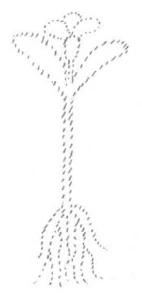
[ 26 ] Now look at a plant. This is supposed to be the plant (see drawing). There it is, still in the meadow or in the field. Up to this point, the forces have been at work, producing green leaves, flowers, and so on. Now imagine a cow eating this plant.
[ 27 ] When a cow or an ox eats this plant, it turns into meat inside the animal. This means that the animal possesses the powers that enable it to turn this plant into meat.
[ 28 ] Now imagine that it suddenly occurred to this ox to say: “It’s too boring for me to have to go around there and first nibble on these plants. Some other animal can do that for me. I’ll just eat that animal instead!” Well then, the ox would start eating meat. But he can produce the meat himself! He has the powers within him to do so. So what happens if, instead of plants, he eats meat directly? He leaves all the powers that can produce meat within him unused! Imagine a factory somewhere that’s supposed to produce something, and you produce nothing but put the entire factory into operation—just imagine what a waste of energy that is! An immense amount of energy is indeed lost. But, gentlemen, the energy that is lost in the animal’s body cannot simply vanish. The ox is ultimately completely filled with this energy; it does something else within him besides turning plant matter into meat. This energy remains within him; it is certainly there. It does something else within him. And what it does produces all kinds of waste within him. Instead of producing meat, it produces harmful substances. So if the ox were to suddenly start becoming a carnivore, it would fill itself with all kinds of harmful substances. In particular, it would fill itself with uric acid and uric acid salts.
[ 29 ] Now, such uric acid salts also have their own particular characteristics. The peculiar behavior of uric acid salts is that they have a particular affinity for the nervous system and the brain. And the consequence of this would be that if the ox were to eat meat directly, enormous quantities of uric acid salts would be secreted within it; these would travel to the brain, and the ox would go mad. If we could conduct an experiment in which we suddenly fed a herd of oxen pigeons, we would end up with a completely crazed herd of oxen. That is indeed the case. Even though pigeons are so gentle, the oxen would go mad.
[ 30 ] You see, something like this naturally speaks against materialism, for if the oxen were to eat only pigeons, they would have to become as gentle as the pigeons if only the material aspect were at work—they certainly do not become that, but instead become terribly passionate and furious creatures. Now just think about it: this is confirmed by how passionate the horses become when you give them even a little meat; they immediately start to go wild, precisely because they aren’t used to a meat-based diet.
[ 31 ] Well, gentlemen, this naturally carries over to human beings. It’s very interesting to note in history: A portion of the population of Asia follows a strict vegetarian diet. These are, in fact, gentle people who wage little war. It was only in the Near East that people began to eat meat, and that is also where the lust for war began. And the point is this: those Asian peoples who do not eat meat simply use the energy—which would otherwise remain unspent and unused—to convert plant matter into animal matter. And the result is that they remain gentle, whereas the other peoples who eat meat do not remain so gentle.
[ 32 ] Well, isn't that so? But we have to realize that humans have only gradually come to be capable of the kind of reasoning we're engaging in now. When people first started eating meat, they couldn’t think about it the way we just did. It all stemmed from emotion and instinct.
[ 33 ] You see, the lion eats meat all the time; it is not a herbivore. The lion has a very short intestine, whereas herbivorous animals have a very long intestine. The intestine is very long there. But it’s the same with humans. If a person is simply born into a particular race or people, and all of their ancestors ate meat, then their intestine has already become shorter—already too short for a strictly vegetarian diet. And then that person must first go through everything necessary to enable them to maintain their health despite eating only plants.
[ 34 ] Certainly, it is already entirely possible to be a vegetarian today. And there is a great deal to be said for it. In particular, there is a certain benefit to eating only plants rather than meat: one does not tire as quickly. One does not tire as quickly from within, precisely because such urinary salts and uric acids are not secreted. You don’t get tired as quickly and keep a clearer head, so you can think more easily—if you think at all. Of course, it does no good for someone who cannot think to clear their head of uric acid salts, because, after all, it is necessary for the entire human organism to function in harmony. So, today, a person can, through an act of will, become a plant-eater. Then they utilize the energies that, in most people who eat meat today, simply go unused.
[ 35 ] You see, I want to draw your attention to a peculiar phenomenon. It is this: If you look around the world today, you will find that there is a disease that rapidly undermines human health; this is what is known as diabetes, or sugar disease. Sugar is first detected in the urine, and the person then very soon succumbs to the destruction of the body caused by excessive sugar production. The disease is actually quite fatal. At the same time, sugar is what keeps a person strong internally when it is properly absorbed into the body.
[ 36 ] You can even prove this statistically. In Russia, people consume much less sugar than in England, and that makes all the difference between the Russian people and the English people. The English are self-assured and selfish; the Russians are weak—albeit unselfish—but weak nonetheless. This is related to the fact that in Russia, people consume little sugar, whereas in England they consume a great deal of sugar, for example in their food. But the human body needs a certain amount of sugar, which it must process. Just as bones constantly support us, so do the amounts of sugar that circulate in the body. But if too much sugar enters the urine, too little enters the body, and health is undermined. That is diabetes.
[ 37 ] The fact is that diabetes is more common among Jews today than among non-Jews. Certainly, others also have diabetes, but today it is particularly common among Jews. This people, in fact, is prone to diabetes. Jews have some difficulty absorbing sugar, but on the other hand, they need it. Therefore, the Jewish diet should actually be aimed at making it as easy as possible for the human body to utilize the sugar within it, rather than immediately excreting it.
[ 38 ] When you read the Old Testament, you’ll find all kinds of dietary laws—laws that are still observed today in restaurants in cities that are labeled “kosher.” You’re probably familiar with such restaurants; they have the word “kosher” written on them in Hebrew letters. So the food there is prepared kosher. It is made according to the ancient Mosaic dietary laws. And if you examine what actually underlies these laws, you will find that the underlying principle is that Jews should eat in such a way as to be able to process sugar, because this people has difficulty processing sugar. In particular, the prohibition against pork—which makes it extremely difficult for the human body to process sugar—was designed to prevent diabetes. One must even be able to read the Old Testament from a medical perspective; then it becomes incredibly interesting. It is exceptionally fascinating to explore the reasons behind the individual prohibitions and the kosher preparation of this or that food. Even the so-called shechita—the specific method of slaughtering poultry, for example, or shechita in general—is designed to ensure that enough blood remains in the meat consumed by Jews so that they can properly metabolize sugar.
[ 39 ] Now, you may know that, especially in recent times, Jews have gradually stopped observing their dietary laws, but they still remain within their ethnic community; and that is bad for them, because these are actually communal laws. And as a result, they are more prone to diabetes than other people. That’s the story.
[ 40 ] So we can certainly say that it is evident that a meat-based diet generates unused energy in humans, which then tends to act improperly within the human body and produce waste within it. Now, of course, this waste can also be eliminated. But it’s sometimes a very complicated matter. One could certainly say: Some things, when put into words, sound quite strange. You meet people who work in their own way throughout the winter, but who also eat in their own way throughout the winter—eating with just enough appetite to give themselves a slight upset stomach every day, which they then keep in check with the necessary shots of schnapps they drink. But as soon as April or May rolls around, they’re ready for Karlsbad or some other spa. By then, they’ve accumulated a whole lot of waste in their bodies, and now the issue is that they actually need a good cleansing—it has to be cleansed out. So they go to Karlovy Vary. And you know, of course, how the water there works; it causes quite a vigorous bout of diarrhea. That takes care of the cleansing. So they cleanse themselves, and then, when they return, they can start all over again. But as a rule, they achieve nothing other than having to go to Karlsbad every year. Because if they’re ever prevented from going to Karlsbad, they immediately develop something like diabetes, sugar disease, and the like.
[ 41 ] Isn't it true that, when you express yourself in such sophisticated terms, it sounds quite respectable to say, “He's going to Karlsbad.” But in reality, that actually means hiring someone to get your body back in shape with buckets of manure. And that's what the sips of Karlsbad water and the effects of the baths do. So they cause a thorough cleansing to take place. Then you’re good to go for a while.
[ 42 ] Yes, gentlemen, of course this is no way to improve public health. After all, the reality is that the way someone who can afford to go to Karlsbad or a similar spa eats is what determines what’s available on the market. The other person, who doesn’t go to Karlsbad, has to eat, too. For that person, things aren’t cleaned up if he doesn’t have the money to go to Karlsbad. He doesn’t get anything else to eat. That’s why we have to start with medicine to get social life back on the right track.
[ 43 ] Well, of course we could talk about that for a long time! If there’s anything else I’ve forgotten to mention today, I’ll be sure to tell you as time goes on.
[ 44 ] As for absinthe—and I just want to add this—it actually has a very similar effect to the alcohol in wine, for example; the only difference is that alcohol directly ruins the physical body—sleep compensates for this to some extent—whereas absinthe also ruins sleep. With absinthe, a person actually experiences the full hangover while sleeping and is prevented from sleeping. And one must sleep after drinking alcohol. Usually—as the saying attests—one must sleep off a little buzz. So sleep actually has a beneficial effect on alcohol consumption; it helps restore balance. And that is why absinthe is more harmful than ordinary alcohol: with absinthe, that is not the case; it also ruins one’s sleep.
[ 45 ] Well, you only need to observe, for example, how our hair grows faster while we sleep. Anyone who shaves, for example, knows that if they’ve slept very late one day, they have to shave as quickly as possible. Haven’t you noticed that, too? (- Yes! -) When mental activity isn’t present in the body, it happens very quickly. Sleep is, after all, meant to stimulate the growth forces in the physical body. Now, absinthe, however, continues to have an effect even into sleep. And for absinthe drinkers, not even during sleep is a balance restored. So that even during sleep, for women who drink absinthe, the blood—specifically the red blood cells—is ruined, and for men, the white blood cells are ruined.
[ 46 ] But now there’s something else to consider. When drinking absinthe, because its effects last into sleep, the menstrual cycle is extremely strongly affected. This leads to irregularities in those who drink absinthe, but even more so in their offspring. And the result is that the menstrual flow, which should occur regularly every four weeks, becomes irregular.
[ 47 ] So, the main thing that can be said about absinthe is that it has a similar effect to the alcohol found in wine, beer, or hard liquor, but that it also ruins your sleep.
[ 48 ] Now I’d like to quickly say a few words—though one could go into more detail on such matters—about the other question concerning twins. Fertilization occurs in exactly the same way in twin births as it does in births where only one child is born. In other words, fertilization always takes place when a male sperm cell penetrates the female egg cell, after which the opening closes immediately, and the subsequent processes then take place inside.
[ 49 ] But you see, the number of offspring is actually determined by something entirely different than, say, the number of male sperm cells. Only one sperm cell enters the female egg cell, while the entire world influences the offspring. The offspring are brought about by the forces of the entire world. And it can happen, for example, that shortly after fertilization, the woman is exposed to the same influences—what I am about to tell you may sound a bit strange, but it is nonetheless the truth—the same influences from the universe. Suppose—of course, everything has to align here—but suppose that fertilization occurs precisely during the waning moon. Then, during the waning moon, the woman is exposed to certain forces in the universe that originate from a fragment of the moon. But with conception, the initial processes—during the first three weeks—are actually quite indeterminate. You can’t really say anything about it, can you? After three weeks, the human being is still just a tiny little fish. Before that, everything is completely indeterminate. Now, when three weeks have passed—that is, at a time when the human embryo can develop into anything at all—if it so happens that the woman also enters the waxing moon phase, then the same external influences are at work, and by then the waning moon has already exerted a little influence, the waxing moon exerts a little influence, and a twin birth can result.
[ 50 ] But it may also be the case that, for example, the woman has—let’s say—some aversion to having children in general, perhaps a completely unconscious aversion; perhaps, on a conscious level, she is quite eager to have children, but unconsciously she harbors a certain aversion. She need only have a certain aversion specifically toward the man she married. Such aversions do, in fact, exist. Yes, gentlemen, in that case she herself holds back the rapid development of the so-called embryo, the human seed, and then what was once meant to take effect acts out multiple times from the cosmos, and triplets can result. It has even happened that quadruplets have been born. But none of this is ever caused by fertilization itself, but rather by other influences at work—by external influences. For if fertilization were to cause twins to form, they would certainly be very different from one another, because they would then originate from different male sperm cells. They could, after all, come from two eggs and so on, rather than from a single egg. But what is striking about twins is that, apart from a few peculiarities, they are alike; for example, even traits that emerge later in life develop identically in twins. This is because they originate from a single egg. So you must keep this in mind: In the case of twin births, fertilization is no different; rather, external influences play a role here.