

On Health and Illness
GA 348
20 January 1923, Dornach
Translated by Steiner Online Library
Fifteenth Lecture
Questions have been raised about how it could be that four mute children were born into a family alongside normal, speaking children. The children’s father is said to have torn out birds’ tongues in his youth; could this be the punishment for that, resulting in him now having four mute children?
Furthermore: that “brain flu” is occurring so frequently right now, causing people to see double; where does this come from?
[ 1 ] Dr. Steiner: Were the children who cannot speak born one after another in this family, or were the others born in between?
[ 2 ] Questioner: Yes, the children who can't speak were born one after the other.
[ 3 ] Dr. Steiner: It’s difficult to talk about a case like this when you don’t know the details exactly. We’ll talk about the case involving encephalitis in a moment. But this other case is very difficult to assess if one doesn’t know the details exactly. A great deal depends on whether, for example, a speaking child was born among mute children, or whether, from a certain point onward, the speaking children were there first and the mute ones came later, or whether the mute ones came first and the speaking ones later, or whether they are mixed together. For the children’s muteness can, of course, stem from all sorts of causes. And if it is true that the children can actually hear—that is, they are merely mute, not deaf-mute (a distinction one sometimes mistakes, of course)—if they can actually hear, and the problem therefore lies in the speech apparatus, then the question is how the father or mother might influence this.
[ 4 ] But without knowing of a specific case like that, it’s actually reckless to talk about it. What you’d need to know is: How old is the mother, and how old is the father? Because a lot depends on whether the parents are already older when they have children, or whether they’re still young. It also matters somewhat whether the mother is older or the father is. A lot depends on that.
[ 5 ] Then, doesn't it all come down to what kind of character these two have? And above all, whether in a case like this—where, as you say, the person in question tore out birds’ tongues in his youth—that fact is relevant at all can only be assessed once all other questions have been settled, because it can only be taken into account to the extent that the person in question may have been cruel in his youth. Cruelty as such, that trait as such, is what matters. Talking about punishment is out of the question in this case—not only because such punishments do not exist in the first place, but also because it would not be a punishment for the father! If one were to say that the father is thereby being punished for his cruelty, it would strike me as akin to a boy who freezes his hands and says, “It serves my father right—why didn’t he buy me gloves!” — So, when someone is affected as terribly as those four children, that is certainly not a punishment for the father; he is, after all, much less affected than the four children, even though his cruelty is the greater factor here.
[ 6 ] Here, again, one must take very specific things into account. With regard to the children’s age, you see, it’s like this: If, as a boy, one develops a certain trait—let’s just say, for example, that one develops a trait at age eleven, such as cruelty or something similar—then a recurrence of that trait always begins again after about three and a half years; so that the person in question experiences this cruelty—this tendency toward cruelty—again at fourteen and a half or fifteen years of age, then again at eighteen, at twenty-one and a half, and so on.
[ 7 ] And just imagine: if conception occurs during such a period, which signifies a new beginning, then conception itself can be a kind of cruelty, and of course it can have a harmful effect. All such factors can, of course, certainly come into play in this indirect way. But one can only assert this once all other possibilities have been ruled out. Don’t you see—I’ve already told you what the difference is between winter births and summer births. So now, as the children grow older, we would have to determine whether the earlier births were perhaps summer births or winter births, and so on.
[ 8 ] That’s why I said: Anyone who approaches these matters conscientiously must know the case inside and out. So once you know the case inside and out, we can talk about it. I’d very much like to do that. For example, you don’t know whether the four children are the older ones or the younger ones. You have to know that very precisely—whether, so to speak, this tendency to have mute children was cured later on, or whether it only arose after the four speaking children were born. Then the cause would have to lie with the fourth child. So you’d have to know all of that very precisely first.
[ 9 ] As for the other question, this relates to all diseases that affect the human head or the upper chest organs—for example, bronchitis—but I am also referring specifically to diseases such as diphtheria, and then the flu, which is so terrible right now. These diseases affect the upper part of the human body. And these illnesses have a very specific characteristic. They are best studied by examining diphtheria, because that is actually where one can learn the most.
[ 10 ] As you know yourself, people who study medicine in the conventional sense today don’t know much about the flu, and therefore doctors’ descriptions of the symptoms that occur with the flu are very imprecise. Whenever I saw such flu patients myself, I always had to look for things other than the symptoms the doctors focused on, because the flu is actually a very specific brain disorder. The flu is actually a brain disorder! I’ll talk about that in a moment.
[ 11 ] In the case of diphtheria, one must pay particular attention to the following things. First, when you examine a child with diphtheria—though, as you know, adults can also contract diphtheria—you will see these membranes inside the throat. These membranes—these skin-like growths—are what usually cause suffocation in diphtheria. So the first important thing is this membrane formation. The second important thing about diphtheria, however, is that you’ll notice the heart is always somewhat affected in a diphtheria patient. The heart doesn’t function properly. The third key point in a diphtheria patient, however, is that even if they aren’t yet severely troubled by the membranes, they have difficulty swallowing. They have a kind of pharyngeal paralysis. The throat is paralyzed. This is in addition to the membranes—the throat itself is paralyzed. And then something very similar occurs in diphtheria patients to what you now also see in flu patients: they begin to squint and see double. This occurs with diphtheria. These are the most important symptoms of diphtheria that can be observed in the upper part of the body.
[ 12 ] Then, particularly in those diphtheria patients who recover—because if they suffocate immediately, it’s impossible to observe the condition—a type of kidney disease occurs. That is what follows.
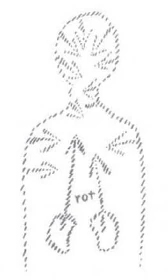
[ 13 ] What is the true nature of diphtheria? One can only understand diphtheria if one knows that human beings actually live through two channels. First, human beings live through their skin. The skin is an immensely important organ. And from the skin—from their surroundings—they actually live inward. It works like this (see diagram): Here you have the skin—I’ve already spoken about it. The skin is constantly in contact with the outside air, with the external world. As a result, the skin continuously becomes horn-like. In humans, it becomes only slightly horn-like and then flakes off. Humans are constantly shedding skin all over their bodies. They are constantly renewing their physical bodies. This is external influence. You can imagine what a tremendous influence what is in the air has on the living body if you consider the following. Imagine there is water, and a being lives entirely within it. When a being lives entirely within water, its skin develops to be very soft. The water itself causes the skin to develop very soft. And particularly under the influence of sunlight, everything that constitutes soft skin is drawn forward, and the creature in the water becomes a fish. You can barely see the fish’s jaws, because they are firmly covered by skin (see drawing, left).

[ 14 ] Now imagine that the creature does not live in water, but in the air. If the creature lives in the air—if this here were the air (drawing on the right)—then the creature that lives in the air cannot develop such soft skin. Now imagine: if the creature that lives in water were unable to develop soft skin, it would have no jaw on the inside; the entire inner jaw would be on the outside, and it would be a bird. The fish is simply adapted to life in water in such a way that it covers its jaw with soft skin. Because the bird lives in the air, it has a keratinized jaw that is positioned entirely on the outside. From this you can see what kind of external influence is exerted on living beings. And in the case of humans, it is true that they can develop soft skin through yet other organs, but this soft skin is constantly shed and renewed.
[ 15 ] Now consider this: in addition to this life—from the outside in—there is also a life that flows from the inside out; specifically, it emanates from the kidneys, from the inside out. Both must be active within a person. The skin must constantly work from the outside in, and the kidneys must work from the inside out. And the heart stands right in the middle. It senses very precisely whether there is too much activity from the outside or the inside. When the kidneys begin to work too hard, the heart senses it. When the skin begins to work too hard or too weakly, the heart senses that as well.
[ 16 ] And what happens in the case of diphtheria? In diphtheria, the skin suddenly begins to function too weakly. It is simply too weak; the person does not exchange enough air through the skin. That is, in fact, the main issue here. The person does not exchange enough air through the skin—or through the skin of the nose, which is also exposed to the outside world. So the skin’s activity becomes insufficient. As a result, the radiations I have recorded here do not function properly. The heart senses this. The heart senses that the kidneys are working their way upward. But what are these kidneys doing? The heart can no longer hold back this kidney activity; it surges upward. Long before kidney inflammation sets in—before the kidneys become inflamed—the kidney activity is already surging upward. And because skin activity is not functioning properly from the outside, an excess layer of skin forms on the inside. This is the skin (see drawing on p. 269) that forms on the inside. So, because skin activity is not functioning properly from the outside, an excess layer of skin forms from the inside. And it fills everything out because kidney activity is too strong.
[ 17 ] Well, you see, when a person develops kidney atrophy—it does happen that a person’s kidney function becomes insufficient and the kidneys then shrink—then you can always apply pressure there (on the head), and you’ll see that the head sinks in here. There is, in fact, a connection between the kidneys and this part of the head. As soon as kidney function is impaired, the head sinks in there. You can see that the head sinks in with anyone who develops kidney disease. But the optic nerve lies right underneath that. When the head sinks in, the optic nerve becomes inactive. In cases of ordinary kidney atrophy, a person begins to see blurrily. But if kidney atrophy does not occur and kidney inflammation is instead setting in, then kidney activity surges upward into the head and exerts an influence on the optic nerves.
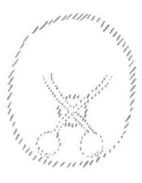
[ 18 ] Well, you see, the optic nerves work like this: Imagine I’m looking at the whole thing from above—so I’m looking down at the head (see drawing)—here’s the head, there’s the face, and there are the eyes. The optic nerve runs backward. But the two optic nerves cross over there. Then they go into the hindbrain. And here is the optic chiasm; that is, the two optic nerves cross over there inside. And the optic nerves have to be working perfectly if we’re to see normally, since we see with two eyes. The moment the optic nerves that cross aren’t quite right, we see double. So if the optic nerves are even slightly paralyzed and don’t cross properly, we see double. — You know how someone who likes to drink can tell, when he comes home, whether he’s still capable of functioning or not: he lies down in bed, puts his hat on the bedspread; if he sees the hat as a single object, he’s still okay; if he sees it double, he’s no longer okay! That’s very easy to do. — Even ordinary alcohol intoxication numbs the optic nerves because the blood flows too rapidly, and the result is that the person in question then sees double when he has had enough alcohol.
[ 19 ] This kidney activity also has a stimulating effect on the two optic nerves, and if they do not interconnect properly at the optic chiasm, the person sees double. This is the case, for example, with diphtheria. You can see, then, that diphtheria results from abnormal skin function. Therefore, the improved treatment of diphtheria in the future will consist, above all, in properly treating patients with diphtheria using baths—specifically, by immediately placing them in baths that strongly stimulate skin function. Then the formation of the membrane—this skin formation—will cease, and the person will once again return to normal skin function.
[ 20 ] Although serum therapy is effective against diphtheria—because it gives the body a strong stimulus to become active—it has adverse side effects. In particular, when a child is treated with serum, the child’s constitution will later become rigid. Therefore, we must gradually strive to replace serum therapy with bath therapy, especially in cases of diphtheria. Diphtheria is, after all, entirely due to improper skin function. And one can then see how skin function must actually be given special consideration.
[ 21 ] It’s certainly true that diphtheria is more common today than it used to be. Of course, one must not look at it in terms of decades, but rather in terms of centuries. But based on everything we know about earlier times—there have, of course, been much worse diseases; people were afflicted by the plague and cholera—diphtheria was less common. This is related to the fact that, in general, the European way of life is gradually moving toward no longer supporting skin function at all. Certainly, people who can afford it bathe frequently and so on, but it depends on what you bathe in. And you can see that civilization is not having a positive effect in this regard from the fact that there are really far more bald people around today than in the past. Hair growth is also an external process. Just as plants grow from the ground, hair growth originates from the outside. And it is certainly true that far too little attention is paid to skin activity today. Do not believe that the cold bathing practiced by the English today is all that effective. It depends on what you bathe in. And if a person induces excessive skin activity through unnecessary bathing, that is not right either. So, especially in the case of diphtheria, one must strive above all to promote proper skin activity.
[ 22 ] This, in turn, is related to what affects the offspring. Just imagine: the father or mother has skin that is too sluggish, and therefore does not shed sufficiently. So let’s say, for example, that the father has skin that does not shed sufficiently. This is very difficult to determine, because you really need a very keen eye for human characteristics. The average layperson can’t really judge very well whether someone has thick skin or not. There are simply people who have much thicker skin than others. You can see how difficult it is to judge this from the fact that the skin is actually translucent. The shedding skin can be seen in various colors. This is because we can see what lies beneath. Our skin is actually transparent. Let’s suppose the father were a “horn-skinned” person—a sort of hippopotamus, right? But that is, of course, only speaking in very radical terms—and because the skin is harder than it should be, this strongly influences bone activity on the other side. But you know from what I said recently that blood production depends on bone activity; thus, because the person is a “keratin-skinned” individual, white blood cells are produced in insufficient quantities. This affects the male seed, and the children are weak from the very beginning. So one can say: if the father is a “hippopotamus,” then under certain circumstances the child will be born with rickets, with the “English disease”; the child will be weak and will be particularly susceptible to tuberculosis. This is how these things are connected.
[ 23 ] If the father has skin that is too soft—which can be noticed, in particular, by the fact that it reddens very easily when he is anxious or under similar circumstances—then his bones, in turn, become too hard. However, this causes little harm.
[ 24 ] But if the mother has skin that is too soft—skin that fluctuates greatly between blushing and turning pale—then the mother’s bones become too hard, and then red blood cells are not produced properly, and as a result, the child will develop a predisposition to all sorts of illnesses, such as rheumatism at an early age, and especially to metabolic diseases like measles, scarlet fever, and so on. So that’s how these things are connected.
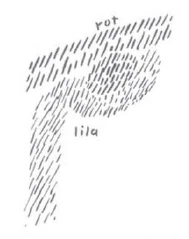
[ 25 ] Now, the flu. You see, the flu actually stems from a genuine brain disease. Specifically, in the case of the flu, the very organ that becomes weakened—if I were to sketch it here from the side, indicating the optic nerves (see drawing)—is the one located beneath the optic nerve; it becomes so diseased that it suffers a kind of paralysis. That is actually the origin of the flu. The flu consists of a paralysis of the part of the brain that lies very close to the optic nerve. The first effect of this is that, because this area of the brain is so important, it actually exerts an influence on the entire body. You see, the common flu proceeds in such a way that, starting from these paralyses in the brain, something in the person becomes diseased. First and foremost—since it goes right into the spinal cord here—the spinal cord begins to be infected. The nerves extend from there to all the limbs. The person experiences limb pain and so on.
[ 26 ] Recently, there was an interesting case of the flu that was very instructive. As I’ve told you, the brain isn’t just made up of solid components—it’s filled with cerebrospinal fluid. Especially near this organ here, which is paralyzed during the flu—there’s a lot of cerebrospinal fluid right there. The recent case of the flu was exceptionally interesting because the person in question developed, one after another, pneumonia, pleurisy, and peritonitis; all sorts of illnesses occurred, and each time—let’s say—pneumonia with a high fever, followed by a drop in fever; pleurisy with a high fever, followed by a drop in fever; peritonitis with a high fever, followed by a drop in fever afterward—in other words, a kind of general paralysis and so on. It was a case of the flu that unfolded quite differently from how ordinary cases of the flu usually do. What was the situation there? You see, it was extremely difficult to determine the actual nature of the case at all when using standard medical treatments. So we asked the person—who is perhaps seventeen years old and has since recovered—to describe how her mental functions had been working during that time. And once she was feeling better, we were able to observe the following rather remarkable phenomenon.
[ 27 ] In the room where she was lying, the people—her parents and the doctor—talked about all sorts of things, and they thought they could say those things because this seventeen-year-old was constantly in the grip of feverish delusions. She didn’t understand a thing during those delusions either. But once she had recovered, she was able to recount everything that had been said in the room. She knew it; she could recount it. This could be verified. So her consciousness was not present while she had this severe flu, which led to all sorts of illnesses; but it remained in her memory. Much remains in the memory that one does not grasp at the moment. But this shows that in her case it was not this solid component of the brain that was paralyzed, but rather the fluid surrounding it. As a result, the entire body was affected even more. For if the solid component is paralyzed, then the further symptoms must be caused by the effects of the solid component on the spinal cord. But the fluid here flows continuously up and down through this canal (see drawing on p. 275), so that when the fluid here is diseased, diseased fluid also develops here. But this spreads from the spinal canal into all the limbs. As a result, it gradually causes inflammation everywhere. But again, because it was the fluid—the cerebrospinal fluid—that was inflamed and not the solid components, there was also more strength available for a counteraction, for healing, and—which was actually almost a miracle in this case—the person was able to recover, even though she had suffered from all kinds of illnesses one after another.
[ 28 ] You see, with a condition like this, the most important thing—though one must also provide some assistance through this or that means— but the most important thing is, above all, to let the body rest properly—that is, to put the body to bed and ensure that the room is always maintained at a consistent temperature, has consistent lighting, and so on—because rest isn’t achieved merely by lying down; I’m also restless if I’m hot one moment and freezing the next. But if you leave the body entirely to its own devices, with consistent warmth and consistent light, then it can endure even the worst episodes—such as pneumonia, pleurisy, and peritonitis—one after another. The human body is capable of this. So, especially with the most severe illnesses—those characterized by the symptoms I just described—proper care is actually more important than the treatment itself. Proper care is of immense value in general.
[ 29 ] You can see the value of proper care from the following: If there is inflammation or an injury somewhere, the very best thing to do is simply to tie off the limb somewhere; but you have to do it correctly. You have to tie it off somewhere. By tying it off, the finer bodily activity—the etheric activity—is immediately set in motion, and healing begins. So if someone has an ulcer on the front of their hand or finger, I tie it off on the back for my own sake, and then it heals very quickly. You have to唤醒 the body’s own healing powers everywhere. If, for example, you have a patient with diphtheria—it varies, of course, one must always take the individual into account; one must know the person well if one wants to heal them—one must have an eye for the person’s nature—but if one has a patient with diphtheria, it may be best, under certain circumstances, to place them, say, in a rosemary bath so that they can smell the rosemary. If they’ve been in that rosemary bath for a good long time—again, this depends on the situation—then their skin function will be strengthened. But there must be enough rosemary in the water that they can smell it constantly while bathing; then skin function is stimulated, and the patient can recover without any serum treatment. The point, then, is that one can properly mobilize the body’s own healing powers through the remedies. Of course, it’s always the case that if something doesn’t work, people immediately consider it a bad remedy. But you must bear in mind that with some people, there is simply nothing that can be done, because often the remedy is applied at a stage where nothing can be done anymore, or the remedy would have to be used so strongly that it becomes a drastic cure; then the person cannot tolerate it! Then they die as a result of the remedy.
[ 30 ] When it comes to the flu, one must definitely bear in mind the fact that, at its root, the flu is actually a disease of the brain. You will also have noticed with the flu that a person with the flu always experiences a kind of drowsiness. They begin to doze off because the brain—specifically its most important parts, the area below the optic nerve—is paralyzed; that is why they become drowsy. And now you can also understand that when the paralysis is located precisely in the upper regions, the optic chiasm becomes paralyzed as well, and the person experiences double vision. So this is what shows you that it is quite natural for a person with the flu to experience double vision.
[ 31 ] You really shouldn't underestimate this at all. I once had a friend who was thirty years old at the time; he was ten years younger than I was. This person had a squint. So here you have the reverse case. With the flu or diphtheria, a person begins to squint temporarily because something is wrong internally. So this person had a squint; he didn’t like the fact that he squinted. Isn’t that right? After all, not everyone is completely free of vanity. So he didn’t like that he had a squint. There was something in his body that caused his left and right sides not to work together properly. That was also the cause of his squint; that’s why he squinted and stuttered. It was actually one and the same thing—that he squinted and stuttered. Sometimes he managed to get past the squinting and stuttering quite well. But there are also people who don’t have much sympathy for people who squint and stutter, and who always hold it against them. For example, someone who wasn’t very tactful—as they say—once asked, “Doctor, what about your stuttering? Do you stutter all the time, or just sometimes?” At that moment, he could barely manage to say: “N-n-not always, o-o-only w-when I’m s-standing in f-front of s-someone I f-f-find t-t-totally unlikable!”
[ 32 ] Well, you see, the same man could recite long poems without stuttering. So when he was in a state of inner, emotional enthusiasm, he didn’t have to stutter. But I don’t want to talk so much about his stuttering now; I only mentioned it because it’s related to his squint. He had a squint, so he was a little vain and wanted to get rid of it. Now, as you know, there are surgeries performed for this, and basically, when the eyes are positioned that way (crossed), a muscle is cut. Then the squint is eliminated by the surgery.
[ 33 ] Now I must say: Since his squint was so deeply ingrained in his body that he also stuttered at the same time, I was absolutely terrified when the man decided he wanted to have surgery to correct his squint. For I told myself: If some kind of brain disease occurs, a person squints temporarily; if someone, like him, squints constantly, then his brain is adapted to that squint. But if you cut a muscle externally, and the condition is so deeply rooted that he also stutters, then the opposite will occur: by attempting to correct the squint through surgery, you will actually induce a brain disorder. If the brain disorder on one side causes the squint temporarily, then—if I correct the squint externally and the problem is so deep-seated that the person stutters—simply by correcting the squint, I will cause the brain disorder; that is, the part where the optic nerves cross will simply be damaged.
[ 34 ] Well, the person in question didn’t let that stop him. He had surgery to correct his squint. If someone had admitted back then that they were afraid of squint surgery, everyone who fancied themselves a real doctor would have been quick to call them an idiot. Because if you somehow weigh in on something that isn’t in their books, people say you’re an idiot. Of course, as you can imagine, I also tried a little to talk him out of it; but I couldn’t tell him directly: “If you have the surgery, you could develop a brain disease.” He wouldn’t have believed it; after all, all the doctors had said it was a very simple operation. And because he knew that I was actually a little less than pleased about his intention to undergo the strabismus surgery, he didn’t say anything to me about it. Then one day he came to me wearing the black eye patch and said, “Look; don’t I see straight now?” But I was absolutely terrified. And lo and behold, not even two weeks had passed before the man developed his brain disease. Of course, the doctor did not recognize the brain disease as such, for what does the average doctor know about these connections! How did the brain disease manifest itself? There was some blood in his feces—that is, the brain disease appeared under the guise of an intestinal disease. The person in question developed an intestinal disease. But this was nothing other than the brain disease, because the intestines and the brain, as I have explained, are interconnected.
[ 35 ] When this happened and I realized it was due to the strabismus surgery, I lost all hope. The most famous doctor in this city was called in; he diagnosed typhus. What else could he say when the intestinal contents showed blood and had that peculiar, pea-soup-like consistency, other than: “Then it’s typhus; he has typhus.” So if there’s blood in the stool—a pea-soup-like consistency and blood—that’s typhus. But it wasn’t typhus; rather, it was the secondary condition—the brain disease—that had set in as a result of the botched surgery for his strabismus.
[ 36 ] So this was the opposite case. The patient died shortly thereafter. The doctor who had been treating him for typhus had admitted him to his own hospital. The patient died. When I arrived, I met his orderly. And as hospital orderlies tend to do, they greeted me right away by saying, “The professor wrote down that it was typhus. He’s supposed to have had typhus! That’s how our bosses do things!” Yes, the orderlies are the very last people to believe what the bosses proclaim!
[ 37 ] It is indeed sometimes the case that one can become quite upset about the one-sided way in which the human organism is treated. For what I am about to tell you—that the person in question developed a typhus-like illness as a masked brain disease as a result of the strabismus surgery—is something every doctor today, when I tell him about it, regards as utter nonsense. He doesn’t believe it because he doesn’t truly understand the interrelationships within the body. He knows only a theoretical connection. And then things happen like the one described in the anecdote—it’s an anecdote, but there’s some truth to it—where someone is brought to the hospital, the professor examines him, places him in a certain ward, gives the resident instructions on how to treat him, and says: “Tomorrow, when I come back, the man will be dead.” - He didn’t even ask about him anymore. After a few days, the professor said: “There’s still someone in Room 15—he’s dead.” — “No,” they said, “he’s doing better—he’s completely healthy!” - “Then you treated him wrong!” replied the professor.
[ 38 ] Well, it’s an anecdote, of course. But that’s what happens when you substitute theory for actual practice. Practice means learning to assess each individual case. And the moment you’re asked what the connection is between double vision—which is always based on a form of strabismus— and the flu, one must point out how, on the one hand, the flu—which is a kind of brain disease—causes a type of double vision, and how, conversely, when a person squints—which has its own causes—and when this is so deeply rooted that the left and right sides do not align at all, then the brain disease is produced.
[ 39 ] All processes in human beings, in fact, proceed from the inside out and from the outside in. This is how it is with human beings. If a person begins to squint from within, then conversely, if one tries to correct the squint from the outside, the person may become ill on the inside, because one is never dealing with a single process within a human being, but rather with two processes that meet in the heart. The heart lies between them. Therefore, the heart is affected when one tries to correct the squint from the outside; but the heart is also affected when something is not right on the inside. The heart is not a pump, but a very delicate mechanism that actually perceives everything that is wrong.
[ 40 ] Suppose I develop fluid in my knee due to an external injury, or due to some other circumstance—perhaps because I drink too much—and I develop rheumatism. Yes, then my internal functions are out of balance, and inflammation develops in that area. Then what comes from within is not right. And you will therefore notice that in such a case the heart is always affected—that the heart is not functioning properly. Thus, cardiac function can be influenced both from the inside out and from the outside in. And in all diseases where this is the case—where something is not right, whether from the inside out or from the outside in—in all these diseases, one will always see this manifested in the heart.
[ 41 ] But one really must understand the connection between what is an external process and what is an internal process when a person squints or stutters, considering what happens if one simply tries to suppress it. That is why strabismus surgeries must always be evaluated to determine whether or not they should be performed. That is the important point. — Next Wednesday, we’ll continue our discussion.