

On Health and Illness
GA 348
27 January 1923, Dornach
Translated by Steiner Online Library
Sixteenth Lecture
[ 1 ] Good morning, gentlemen! Has anything else come to mind that you'd like to ask?
Question: The question is asked about the relationship between human breathing and the heartbeat; surely this must have been quite different in earlier times.
[ 2 ] Dr. Steiner: You mean in humans themselves?
[ 3 ] Well, let’s briefly remind ourselves once again of how things stand today. After all, on the one hand, we have breathing. Through breathing, human beings are connected to the outside world, for they continually inhale air and exhale it again. So one can say: Human beings today inhale healthy air and exhale air that causes illness. The exhaled air contains carbon dioxide. Blood circulation is an internal process. The blood circulates throughout the body. I do not wish to discuss today whether the expression “the blood circulates throughout the body” is entirely accurate—but the force of the blood circulates throughout the body. And if we consider the number of breaths a person takes in a minute, that amounts to approximately—though it varies from person to person—eighteen breaths. And if we consider blood circulation, we can observe it through the pulse; it registers seventy-two beats per minute. So we can say: The relationship between respiration and blood circulation is such that, in today’s adult human, blood circulation occurs four times faster than respiration.
[ 4 ] Now we need to understand exactly how things actually work in humans today when breathing is linked to blood circulation. You see, we must be clear that humans breathe primarily through the lungs: nose, mouth, lungs. But that is only the primary way. It is generally the case with human beings that they perform a certain function primarily with one part of their body, but that what they do primarily with one part of their body is actually also performed to a lesser extent by the entire body. So that air—or rather, the oxygen in the air—is continuously absorbed through the entire skin as well. So we also breathe through the skin, and in addition to ordinary pulmonary respiration, we can quite rightly speak of “skin respiration.” If, for example, the openings in the skin—called pores—are too heavily clogged in a person, then they take in too little air through the skin. Consequently, skin respiration is impaired. In general, the skin must always be healthy enough to allow a person to breathe through it.
[ 5 ] Now, in the case of human beings, whatever they possess externally—as I have already mentioned—they also possess, in a sense, internally. So if I were to sketch a human being for you—I just want to sketch him graphically—we could say: Breathing takes place throughout the entire skin, but primarily this breathing occurs through the lungs and results in eighteen breaths per minute. Everything that happens there, however, requires a counterbalance in human beings. And this is where something very interesting comes to light. A person cannot breathe properly—neither through the lungs nor through the skin, and especially not through the skin—unless there is a counterbalance.
[ 6 ] You know, when you have a magnet, you don’t just have a north pole—positive magnetism—but also a south pole—negative magnetism. And just as humans need lungs and skin to breathe, they also need the opposite, and that opposite is found in the liver. We’ve already explored the liver from various angles. Now we must also come to understand it as the counterpart to the activity of the skin and lungs. In this way, the activity of the liver and that of the skin and lungs balance each other out. One might say: The liver is there to constantly ensure that what a person experiences in their relationship with the outside world through breathing is also brought into balance internally. That is what the liver is for.
[ 7 ] Now imagine that, at some point in a person’s life—this can also happen to older people—the liver isn’t functioning quite right. It’s very difficult to tell when the liver isn’t functioning properly. In fact, people usually don’t know this because the liver is the only organ that doesn’t cause pain when it’s not functioning properly. That’s why a person can suffer from liver disease for a long time without even realizing it. No one notices it because the liver simply doesn’t hurt. You see, this is precisely because the liver is an organ that is connected to the very outer limits of the human body—to the skin and to lung function. Internally, the liver is actually a kind of external world. A person doesn’t feel it when a chair is destroyed, and a person doesn’t feel it when the liver is destroyed. It’s just as if it were a part of the external world. And yet it is incredibly important for humans.
[ 8 ] Now imagine that the liver becomes disrupted. When the liver becomes disrupted, the entire functioning of the lungs and skin also becomes disrupted, and then something very special happens. You see, veins from the heart extend throughout the lungs and skin. So, through very fine veins, blood circulation reaches everywhere in the skin, in the lungs as well, and also in the liver. Now the following can happen: The liver may not be functioning properly. The result is that blood cannot flow in and out of the liver properly. If, because the liver is not functioning properly, too much blood flows into the liver and liver activity becomes excessive as a result, then too much bile is produced, and the person develops jaundice. A person develops jaundice when too much bile is produced—that is, when liver activity becomes excessive or too intense. Thus, a person develops jaundice when excessive liver activity spreads throughout the entire body.
[ 9 ] But just imagine: liver function becomes too weak, the liver isn’t working properly—what happens then? Then the blood is not kept in good condition on the skin and the outer surface. The blood, which flows everywhere, seeks to protect itself, and in a sense, it tests the blood in the liver to see if the liver is functioning properly. If the liver isn’t functioning properly, the blood quickly flows to the outer surface of the body and seeks to sustain itself there. And what happens? Smallpox develops. There you have the connection between smallpox and blood circulation, which is disrupted due to insufficient liver function.
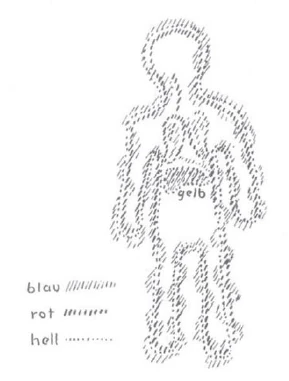
[ 10 ] But wherever the blood goes (see drawing)—wherever I have drawn the bluish line—there is also the reddish line, and that indicates that air, carrying oxygen, reaches those areas as well. This is where blood circulation and respiration properly interact. Whether this occurs in the lungs or in the skin is largely irrelevant, because it balances itself out. But if the air that enters through respiration does not interact with the blood in the proper way, this results in smallpox. So what exactly is smallpox? Smallpox essentially consists of excessive breathing on the body’s outer surface or in the lungs, resulting in excessive activity there. The person becomes highly active on the surface. As a result, everything becomes inflamed due to this activity.
[ 11 ] And what can be done in such circumstances? Well, people are already doing what they can do on their own. Namely, they are now administering cowpox lymph. Yes, what does cowpox lymph actually do? When I inoculate it into the blood, I introduce it into the body, because the blood circulates everywhere. And while the blood would otherwise remain unharmed on the surface, it then has to deal with the inoculated lymph, and this prevents that activity on the surface. So the cowpox vaccination does have a certain significance. The blood, which is not properly utilized by the liver, is utilized by the lymph itself. In general, all vaccination methods are quite significant, and you may have heard that a large portion of our remedies are also based on vaccination, because it allows us to redirect activity that is in the wrong place to another part of the human body.
[ 12 ] The so-called rabies vaccine is particularly interesting in this regard. Although rabies is caused by something entirely different, it is essentially the same thing I just explained to you. Isn’t that right? Just imagine: a person is bitten by a rabid dog or a rabid wolf. Yes, such a wild animal actually has real poison in its saliva. This poison then enters the human body through the bite, and the human is busy trying to neutralize this poison. He may be too weak to do so, and he may perish as a result. But there’s actually something else underlying this death. You know, the person first contracts rabies themselves. They don’t just die from the poison; they contract rabies themselves. What’s the reason for that?
[ 13 ] Suppose I’m bitten by a fierce dog here. Now I have to direct my internal activity to this spot, let it flow there so that the poison is neutralized. This activity is sensed by my spinal cord, and it’s exactly as if I were startled by something. That’s how it is for my spinal cord. Because I suddenly have to generate such intense activity in response to the dog bite, my spinal cord is startled—it goes into shock, as they say—and this shock makes me sick myself.
[ 14 ] What exactly do you have to do now to make this fear go away? You know, when someone freezes in fear, they come to their senses again if you give them a good whack. So you have to give the spinal cord a good whack. But first you have to get to the spinal cord. And you can get to the spinal cord by quickly killing a rabbit, removing the spinal cord from the rabbit, and drying it at about twenty degrees Celsius. But first you have to make the rabbit rabid yourself; you have to give it rabies virus. Then you remove its spinal cord and dry it for about twenty minutes at twenty degrees Celsius. And this dried spinal cord that you have—you then inoculate it into the person with rabies.
[ 15 ] Now, these substances have the curious property that each one goes to a specific location in the body. And this dried rabbit spinal cord, which contains the rabies toxin—it only contains it for a short time, about fifteen minutes, a quarter of an hour—then it’s gone, but during those fifteen minutes, that’s when it’s effective, and that’s when you administer it to a person. Then it goes into the person’s own spinal cord, and that triggers a counter-shock. It’s just like when you shake a person vigorously in a state of shock, and the person then begins to stop being angry—or rather, they can also be protected by healing their spinal cord from the shock through the injected, poisoned, and dried rabbit spinal cord.
[ 16 ] So you see, if a person develops an activity in the wrong place and becomes ill as a result, one must heal them by developing almost the same activity in a different place. These are the complex interrelationships within the human organism.
[ 17 ] Now, however, if you consider breathing and blood circulation, in today’s adult human being the flow of breath and the flow of blood are, so to speak, constantly intertwined at a ratio of one to four. The blood flows faster, and after three have passed, the breath comes in; after another three have passed, the breath comes in again, and this is how it works in our body. The blood flows through the body: one, two, three—on four, the breath comes in; one, two, three—on four, the breath comes in again. This is how it flows through our body,
[ 18 ] Well, but that produces carbon dioxide. Yes, gentlemen, most of this carbon dioxide escapes from our bodies. But if all the carbon dioxide were to leave our bodies, then we humans would truly be the greatest fools. For a portion of the carbon dioxide must constantly enter our nervous system. The nervous system needs this carbon dioxide, because it must constantly be neutralized. The nervous system needs this neutralizing carbon dioxide. So a portion of it simply rises continuously within me as carbon dioxide through my internal air and supplies my nervous system.
[ 19 ] Yes, but what does that mean, gentlemen? It means nothing other than this: Because carbon dioxide is a poison, I must constantly have poison inside me in order to think. That is a very interesting point. Without this constant poisoning taking place inside me—which I must constantly fight off—I wouldn’t be able to use my nervous system at all. I wouldn’t be able to think. Human beings are truly in a situation where they must constantly poison themselves through the air they breathe, and it is through this “breathing poison” that they think. Carbon dioxide—the “breathing poison”—is constantly flowing into my head, and it is with this “breathing poison” that I think.
[ 20 ] Today, people simply breathe in the air. The air contains oxygen and nitrogen. People take in the oxygen and exhale the nitrogen.
[ 21 ] Gentlemen, if one studies human beings today, one arrives at the following conclusion: The modern human head requires carbon dioxide. Carbon dioxide is a compound of carbon—which is, after all, produced in the human body—and oxygen. Humans do not utilize the nitrogen in the air. If one studies the human head today, one comes to the conclusion that it is constituted in such a way that, by taking in carbon dioxide—that is, carbon and oxygen—it is able to think quite well. But you see, this human head is also constantly being ruined by the carbon dioxide, because it is, after all, a poison, and the human head, after all, consists of organs. It’s exactly as if you were constantly breathing in a little carbon dioxide instead of oxygen. You are actually always breathing a little carbon dioxide into your head. This is of immense importance, because we are constantly breathing into our head the very thing that actually destroys our life. And that is also one reason why we need to sleep—why we need a time when the head does not absorb that little bit of carbon dioxide so intensely and can restore its organs.
[ 22 ] But when one studies the human head, one realizes: Just as it is today, it can use this toxin—carbon dioxide—in such a way that it is gradually broken down a little, rebuilt through sleep, broken down a little again, rebuilt through sleep, and so on. But in very ancient times, human beings did not yet have a head. All of this was still in the process of development. If human beings had always breathed only carbon dioxide, they would never have developed a head. The fully formed head can tolerate carbon dioxide. But if human beings had always breathed carbon dioxide, they would never have developed a head. So they must have breathed something else in the past. Now we must ask ourselves what humans might have breathed in the past. And if one really studies the entire course of human evolution in depth, one comes to the conclusion that humans, for example, even during the embryonic stage in the mother’s womb, need something other than just carbon dioxide. And the interesting thing is: in the mother’s womb, the human being is almost entirely head. The fact is that the human embryo, when viewed at a very early stage—I sketched this for you some time ago—is almost entirely head. The rest is terribly small (see drawing on p. 291). And what is still attached here is also almost entirely head; it is then surrounded by the amniotic membranes.
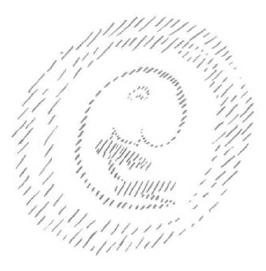
[ 23 ] Yes, you see, the human being is almost entirely head. But he must first come into being. That’s why he needs nitrogen. He needs the nitrogen supplied to him from his mother’s body. If the human being did not have the nitrogen in the womb—the very nitrogen he later spurns in the air and refuses to let near him—then he could not possibly develop. We simply wouldn’t have a proper head if we didn’t get one through nitrogen. So in an earlier stage of Earth’s development, when the human head was just beginning to form, humans must have absorbed nitrogen rather than oxygen. Therefore, instead of carbon and oxygen being essential for them, as they are today, carbon and nitrogen must have been essential.
[ 24 ] So humans must once have breathed in carbon combined with nitrogen—just as they breathe today—meaning they must have absorbed nitrogen. But carbon and nitrogen—what are they, exactly? They are, in fact, cyan. And when it occurs as an acid, it is hydrocyanic acid, or cyanide. In other words: At one time, humans must have taken in nitrogen rather than oxygen from the air, developing cyanide—an even stronger poison—within themselves. And this even stronger poison enabled them to think with carbon dioxide today. Back then, it was through this even stronger poison that they first developed their organs.
[ 25 ] So we now come to an ancient stage of development in which humans, instead of producing carbon dioxide as they do today, produced cyanide. And just as humans exhale carbon dioxide today, they exhaled hydrocyanic acid back then—an even more potent poison. And so we move from humans and their present-day respiration to an ancient state in which the air—just as it contains carbon dioxide today through living organisms—was back then full of hydrocyanic acid, full of cyanide.
[ 26 ] You see, gentlemen, it was in 1906 that I gave lectures in Paris, and there, prompted by various hints from the audience, I came to tell people that even today there are still celestial bodies that, instead of Earth’s atmospheric air, possess the ancient cyan atmosphere—the ancient cyan air. Namely, if one were to look at the Earth today from the Moon or, in particular, from Mars, one would be able to detect traces of carbon dioxide throughout the Earth’s atmosphere using the so-called spectroscope. But if one were to view the ancient Earth—where humankind first developed its intellect—from a distance, one would detect traces of cyanide instead of carbon dioxide. Today there are still celestial bodies that are in the same state as the Earth was back then. These are, namely, the comets. Comets are just as the Earth was back then, when humankind first developed a head. Therefore, comets must contain cyanide. And I said back in 1906: The most essential thing about comets is that they contain cyan; so when you point a spectroscope at them, you must see the cyan line. And immediately afterward, a comet appeared. They do appear rarely. And the curious thing was that when I came to Norway some time later and there was much talk there about the appearing comet, people actually noticed the cyan line.
[ 27 ] You see, people always say that if anthroposophy knows something through the spirit, it should be possible to confirm it afterward. There are, in fact, many such things that have been confirmed later on. But when confirmation comes, people overlook it; they dismiss it. But the fact is that, based precisely on this change in breathing—even before it was observed with a spectroscope—I said that comets contain cyan, the very same cyan that humans once needed, back when the Earth itself was still in a cometary state, in order to develop their heads.
[ 28 ] Now just imagine: if I breathe in nitrogen instead of oxygen, then naturally something different from human blood is produced. Because, as you know, in the lungs, the blood that has turned blue combines with the oxygen and becomes red blood. Now, the fact is that when a person breathes in oxygen, the body absorbs the oxygen into the blood. But when a person breathes in nitrogen, the body absorbs the nitrogen into the blood. Just as our blood—real blood—functions in such a way that there is never any uric acid in the blood of a healthy person, so too, when nitrogen is absorbed into the blood—even if there is just a slight imbalance in the person’s system—uric acid enters the bloodstream.
[ 29 ] Back when humans first developed a head, their blood was actually nothing but uric acid, because nitrogen was constantly binding to it instead of oxygen. His blood was nothing but uric acid. And the human being, who even today still floats as an embryo in what the mother forms around him, floats, so to speak, in a environment where uric acid can easily enter. There is uric acid everywhere in his surroundings. He needs it in his embryonic state. Yes, back when he had developed a head and exhaled hydrocyanic acid—that is, used hydrocyanic acid for himself—and combined nitrogen and carbon, thus having uric acid internally, he was indeed swimming in uric acid. Uric acid was everywhere except within him. The world was once such that uric acid and hydrocyanic acid actually played just as significant a role as water and air do today.
[ 30 ] The fact that living beings cannot survive on oxygen alone is still evident today. For example, there are living beings—though they are tiny, because everything that used to be large has now become small, and today’s smallest, tiniest living beings were once giants— so today they are tiny, small living beings—that can no longer tolerate oxygen at all, cannot tolerate it at all, and they hide from oxygen everywhere, and instead of oxygen, they absorb sulfur. These are the sulfur bacteria; they live on sulfur. So you don’t necessarily need oxygen to live. In the past, life didn’t require oxygen, but rather nitrogen, and that is precisely how human beings first came into being. Human beings were thus formed during a comet-like phase of Earth’s formation. Consequently, the relationship between breath and blood was quite different in earlier times.
[ 31 ] And now let us consider what we learn in this way in relation to the world itself. If we consider this—that we take one breath for every four heartbeats—that is, one, two, three, breathe; one, two, three, breathe; one, two, three, breathe—yes, you see, I can tell you that this same rhythm applies to nature as well: spring, summer, fall, winter. One: spring; two: summer; three: fall; four: winter. Out there in the universe, you find this same relationship that you have within yourself as a human being. So we can say: When we look at the entire Earth, we see that our inner rhythm is also present out there on the Earth. And people don’t even notice what this actually means in relation to the Earth.
[ 32 ] Look, there’s snow outside right now. In the summer, there’s no snow outside. What does that mean? Well, you see, what’s out there as snow right now—you’ll usually encounter it as water. Water is entirely dependent on the earth. People really need to feel that. Isn’t that right? When you live here in the Jura, we have calcareous water in the Jura. Everything that’s inside the earth is inside the water. And people who are particularly sensitive to it develop goiters from what’s in the water in the Jura region. So the water depends on the earth. In the spring, it begins to become dependent. In the summer, it’s at its most dependent. In the fall, this dependence subsides a little. And in the winter—yes, gentlemen, the earth does not create the snow; the snow, which consists entirely of very fine crystals, is formed by the universe, by the cosmos. There, the earth is not, as in summer, surrendered to the world’s warmth, but to the formative forces. The water withdraws from the earth in winter, drawing its cold from outer space. So we can say: Here we have an interesting rhythm in the universe: one: spring, two: summer, three: fall, four: winter; the water aligns itself with the universe, no longer with the Earth. Again, one, two, three—spring, summer, fall; four: the water aligns itself with the universe, no longer with the Earth.
[ 33 ] Now let’s try this with the blood and breathing. One, two, three: blood—the blood aligns with the inside of the body; four: breathing—the blood aligns with what is outside. One, two, three blood pulses: the blood aligns with the inside of the body; four: a breath—the blood aligns with the outside. Here you see the same process in the Earth as in humans. If you take the blood and the water of the Earth, the blood aligns with it. Now let’s take one, two, three heartbeats: internally, a little spring, summer, fall; four: now winter comes—aha—that’s when we breathe. Now comes the breath, just as with the Earth itself. So internally, the human being is completely attuned to the Earth’s breathing. And the fact is that we can say: In humans, this naturally happens extremely quickly—eighteen times in a minute—what takes place on Earth in a year. In one minute, what happens on Earth in a year takes place eighteen times in a human being.
[ 34 ] Actually, human beings are always filled with this rhythm that the Earth also follows. But they go through this rhythm quite quickly. However, when we look at the Earth today and, based on what we’ve discussed, come to the conclusion that it used to be in a completely different state, then the Earth begins to bear a certain resemblance to comets for us. You have just seen this. But comets—as becomes evident when a comet breaks apart—fall as meteorites, as pieces of iron. An entire comet like that, which falls as pieces of iron when it shatters, therefore contains iron.
[ 35 ] That is something we still carry within us. When our bodies decay, the iron particles in our blood are still there and remain. In that way, we have preserved something of our ancient comet-like nature. We actually behave just like a comet in this respect. We have iron in our blood because we are unfolding the old cyan activity. This is the outer body; it must not enter the blood, but it was once allowed to do so. This means nothing other than that today we are separating the outer spring, summer, fall, and winter from our inner spring, summer, fall, and winter. And today we are only slightly dependent on the external spring, summer, fall, and winter.
[ 36 ] But you don't have to go back very far at all. These things take on a completely different character now, but if you grew up in the countryside like I did, then you know that there used to be people—they’re becoming increasingly rare now, because everything in the material world is becoming uniform—who were very dependent on spring, summer, fall, and winter. You could even tell that from their entire inner life. They were in a completely different frame of mind in the summer than in the winter. In winter, they would come up to you and were actually always a little detached from themselves; they were much more like ghosts than people then. And in summer, that’s when they really came into their own. In other words, they were such that they were dependent on the external seasons of spring, summer, fall, and winter.
[ 37 ] But this shows us what humans used to be like. In the past, when humans still breathed nitrogen instead of oxygen, they were completely dependent on their external environment; they synchronized their heartbeat and breathing with that of their cometary body, which I called the “Moon” in my book *Outline of Esoteric Science*. It was a kind of cometary body. They moved in unison with it. They had been part of a vast organism that also breathed. It is as if human beings were to suddenly begin today to have one heartbeat in the spring, one in the summer, one in the fall, then one breath in the winter, and so on. But that is how human beings once were, when they breathed nitrogen: they were a part of the entire Earth organism.
[ 38 ] As you can see, we are now arriving at the same conclusion by a completely different route than the one we took earlier when we were discussing megatheres, dinosaurs, and so on. We are arriving at exactly the same conclusion by a completely different route.
[ 39 ] That is precisely what is remarkable about Spiritual Science. Isn’t it true that other scientific endeavors today begin somewhere, proceed step by step—clack, clack, clack—not knowing where they’re going, yet continuing in a straight line? That is not the case with anthroposophical science. It can start from various points, going here one moment, there the next, and so on, and yet it always returns—just as a hiker who can set out from various points at the base of a mountain always reaches the summit—so it always arrives at the same point. That is precisely what is remarkable. The more one observes the world honestly, the more all the individual observations coalesce into a single whole.
[ 40 ] So today, your question has prompted an example. We started from entirely different premises than we did in the past, and we also arrive at the conclusion that within the entire Earth organism—even when humanity itself was still comet-like—humanity had its own rhythm; it simply withdrew from it. Humanity was once within the Earth just as it is today as a seed within the mother. There, too, it participates in the pulse and respiratory processes.
[ 41 ] Now we must prove that the human being, even today, participates in the mother’s heartbeat and breathing while in the womb. This can be proven by what I told you earlier: smallpox develops from the breathing activity that occurs in connection with blood circulation. Now here is the interesting point: If the human being in the womb truly participates in the mother’s blood and respiratory activity, then a child—as a human embryo—must also contract smallpox while still in the womb if the mother has smallpox. And indeed, the child does contract it. If a mother is pregnant and has smallpox, the child contracts smallpox while still in the womb because the child participates in all of this.
[ 42 ] And so, long ago, when the Earth was still humanity’s mother—though at that time the Earth was a kind of comet—humanity went through everything the Earth went through. Their pulse and breath were the pulse and breath of the Earth. And that is why one can say: It is, again, most remarkable that, when we go back to ancient times, when people knew instinctively—not as intelligently as today, but instinctively—people always called the Earth “Mother,” “Mother Earth,” and so on. They spoke of Uranus—that is, the universe—and of Gaia, the Earth, and regarded Uranus as the father out in the universe and the Earth as the mother.
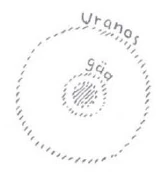
[ 43 ] So one could say: The part of the human organism where the child develops—the uterus—is actually a small earth, only still in its early, comet-like stage.
[ 44 ] And in this ancient comet stage, respiration occurred both in human beings and in the Earth itself; it was a respiration taking place out in the vastness of the cosmos. It was not only human beings who absorbed nitrogen, but the entire comet-Earth absorbed nitrogen from the cosmos. And back then, breathing was also a kind of fertilization. And what remains of that fertilization today is human and animal fertilization. So we can say: During fertilization, something of that nitrogen breathing still takes place, for the most important element in human semen is nitrogen. It is carried into the female organism and, as a nitrogen stimulus, brings about precisely what oxygen could never achieve: the formation of the organs. For later, when the oxygen arrives, they must already be there. So you see that we actually derive our breathing directly from the cosmos.
[ 45 ] Well, gentlemen, let’s try something now. You see, the cycle of the year is already somewhat mirrored in the cycle of the day: we take 18 breaths per minute, so sixty times that in an hour = 1,080; and in 24 hours—a day—we take twenty-four times that = 25,920; so we take 25,920 breaths in a day.
[ 46 ] Now I want to calculate something else for you. I want to calculate how many days we live on average. After all, a year has about 360 days. I estimate the average lifespan to be 71 or 72 years. So let’s say, 72 times 360 = 25,920.
[ 47 ] We take as many breaths in a day as there are days in a human life. But a day is also, in a certain sense, a breath. A day is also a breath. Namely, I exhale my soul when I fall asleep, and inhale it again when I wake up: exhalation, inhalation. I breathe out the spiritual and breathe it in. So this rhythm that I have in my breath—I have it throughout my entire earthly life, whether asleep or awake. That is incredibly interesting: 25,920 breaths a day, an average of 25,920 days in a human life.
[ 48 ] And now let’s look at the sun. If you observe the sun today in the spring, it rises in Pisces. But it doesn’t rise in the same place every spring. On March 21 next spring, it will have shifted a little further. If the sun rises in the constellation Pisces today, it will rise a little further shifted next year, then a little further shifted the year after that, and so on. The sun’s rising position is constantly shifting. And after a certain amount of time, it must inevitably return to that area. So if the sun rises today in the constellation of Pisces—astronomers think it’s in Aries, because they haven’t yet updated their nomenclature; in the past, it rose in Aries—then it must have risen there in ancient times as well. And if you calculate these small annual shifts, you come up with 25,920 years. It is the same thing. So the rhythm of the universe also harmonizes with the rapid rhythm of breathing and blood circulation. Just think how the human being stands there within the universe! The human being is born entirely from the universe. In the universe, there is originally a father and a mother.
[ 49 ] Naturally, this leads one to view human beings in a completely different light in relation to the universe than when someone simply tells you: “God created the world, God created human beings”—all concepts that are impossible to grasp. But anthroposophy seeks to begin by trying to understand everything. People hold that against it. Why? Well, to utter words that require no thought, you don’t have to make an effort. But with anthroposophy, you have to make an effort. That drives people absolutely wild. With modern science, you don’t have to make an effort. Well, suddenly this nuisance called anthroposophy comes along, and you can’t just sit in the movie theater and let the film play out without thinking! They want to bring movies into the schools themselves, so the children don’t have to make an effort. I’m surprised they haven’t introduced math lessons via film yet! And now anthroposophy comes along and demands: You shouldn’t just sit there idly—you have to use your darned brains and participate! — And people don’t want that.