

On Health and Illness
GA 348
10 January 1923, Dornach
Translated by Steiner Online Library
Thirteenth Lecture
[ 1 ] You see, a question like the one you asked last time naturally requires a great deal of information if one is to answer it thoroughly—we already gathered a lot of material last time—because one really needs to thoroughly understand everything related to the reproduction of living beings and everything connected with it. I would like to use today’s session to speak a little more about this question from a completely different angle.
[ 2 ] Something peculiar immediately strikes one today when reading remarks such as the one an American made recently. Namely, an American observed—purely on the basis of statistics—that is, statistics are the darling of our time, and they’re being used more and more in America—that the people who acquire intelligence most easily are always born during the winter months. Statistically speaking, of course, one shouldn’t take this to mean that those born in the summer months must be very stupid; rather, statistics always refer only to the majority. In any case, this American made the observation that, according to the statistics, the smartest people—that is, those who later become intelligent—are born from December through March.
[ 3 ] In any case, this points to something that is difficult to study in humans, because all sorts of factors come into play in humans; however, it shows that living beings in general—and humans are, after all, first and foremost living beings—are, in a certain sense, dependent on the cycle of the year, by which they are influenced.
[ 4 ] Well, things like this American’s remark surprise people today simply because people know far too little about the actual processes of nature. I would say that an American who makes such a remark might well end up in a situation similar to that of a professor who once measured brains. This professor measured brains and compiled statistics, and he found everywhere that women’s brains are smaller than men’s. He concluded from this that, since in his view a smaller brain has less intelligence, all women are less intelligent than men. Now, this was a famous man. He became famous precisely because he discovered that women’s brains are smaller than men’s. Well, with famous men, people sometimes dissect them—specifically, their brains—simply because they are famous. And so this man’s brain was also studied. And lo and behold, it turned out to be much smaller than all the women’s brains he had examined!
[ 5 ] Well, under certain circumstances—if he isn’t too embarrassed to reveal such a thing—it might turn out that the American himself was born in the summer. If he were born in the summer, then one would have to say: he isn’t particularly smart according to his own theory, so his theory can’t be particularly valuable. But you see, there is something behind all these things. And this “something,” if you look at it correctly, sometimes leads you to the most important things.
[ 6 ] Today I’d like to tell you something that is very much related to Mr. R.’s question. You see, the conditions that govern reproduction can really only be studied in animals and plants, because in humans they depend on so many other factors that it’s impossible to study them properly. If you just take what I told you the day before yesterday—that people, both women and men, influence their sperm or egg cells through drinking—you’ll see that so much depends on this that one cannot properly study reproduction. Now, animals very rarely get drunk. So the conditions there are much purer, and one can study the matter much more clearly. And the most important point is actually that one does not need to dissect animals at all if one wants to study this. For dissection actually reveals very little. First, I want to tell you something that is not based on dissection, but on reliable findings from men who did not work according to theories, but according to their practical experience; and what I am presenting to you pertains specifically to beavers found in Canada.
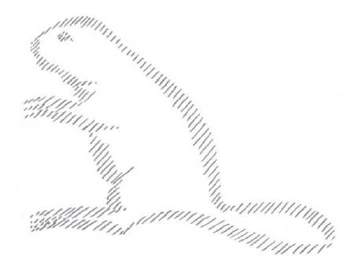
[ 7 ] Beavers—which, after all, we usually only see in zoos or stuffed in natural history cabinets—are actually quite plump. Isn’t that right? A beaver actually looks like this: it has a rather clumsy-looking head from the front, the body is also quite clumsy, the front legs are quite thick toward the back (drawing), and the hind legs are webbed so that it can swim. The strangest thing it has is a tail back there that looks almost like an instrument—it’s quite flat and thus very artificially shaped. That’s actually the most artificial tool it has back there. And people who’ve studied beavers don’t initially know what the beaver needs this particular tail for. That’s why they’ve come up with all sorts of theories, none of which are true.
[ 8 ] This beaver is a very peculiar animal. One might say that when you get to know this beaver in real life—and this is also evident when we have it in our menageries—it is actually an extraordinarily phlegmatic animal. It is truly so phlegmatic that you can’t really do anything with it. You can attack such a beaver, and it won’t defend itself. It never attacks on its own, no matter what you do. It is a completely phlegmatic creature.
[ 9 ] Well, these beavers live specifically in areas where there are either large swamps or short rivers—not very long ones. That’s where they live, and they live in a very peculiar way. Beavers live like this: When spring comes, the beaver chooses a spot somewhere near a lake or a river, on the bank, digs out a burrow, and lives alone in this burrow all summer long like a true hermit—so that this beaver spends the entire summer, I might say, in this hermit-like summer dwelling of his, like a phlegmatic monk, spending the summer there in his summer villa. It is a burrow that he digs into the earth. But he does so in complete seclusion.
[ 10 ] When winter comes—or even when fall comes—but especially when winter comes, these beavers emerge from their burrows, gathering in groups of two to three hundred; they come together in all their “phlegmatic” nature, forming a community of two to three hundred. You can imagine that in such a community there are also those who belong together. Isn’t that right? A female beaver, for example, has made her solitary dwelling in such a way that she can have children; nearby is the male, who makes his own burrow. And they come together there with their entire families.
[ 11 ] Now they first go about their business with great composure and look for a spot. One group prefers—though given the phlegmatic temperament of these beavers, it can sometimes be hard to tell—to choose a lake; while the other group prefers to choose a short river, which they follow to a spot that seems particularly suitable for their purposes. And after they’ve explored that area, the entire group sets off again. There are usually trees near the lake or the river. And now here’s something very remarkable: this clumsy beaver suddenly becomes extraordinarily dexterous. He uses his front feet—not his hind feet, which have webbed toes that allow him to swim—he uses his front feet, but far more skillfully than a human uses any tools. And to do this, he uses his sharp incisors. And with its teeth, supported by its front feet, it bites off twigs and even entire tree trunks. Then, once a group has gathered enough twigs and tree trunks, these beavers haul everything either into the lake they have chosen or into the river.
[ 12 ] Now, those who have thrown their logs into the lake push them to the spot they have chosen. Those who have thrown their logs into the river know full well that the river carries them on its own, and they steer the logs only to keep them from veering off course. And so, everywhere—whether to the lake shore or to the spot on the river they have chosen—the entire load of logs is transported in this manner.
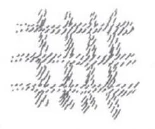
[ 13 ] Once they arrive there, those who have chosen a lake—they have hauled the logs all the way up to the shore—immediately begin building huts. But the others, who have chosen a river, don’t start building huts right away; instead, they first construct a latticework. Some logs are laid this way (see drawing), others that way; but they’re interlaced so that they form a proper latticework. So they weave them together like this, forming a latticework. Once they’ve built one such wall, they attach a second one to it. They keep bringing new tree trunks—all of them together—and attach a second wall to it. And in this way, they build a wall that is sometimes two meters thick, sometimes even thicker. And then, you see, when the river flows like this, they dam the river there; it then has to flow over it, and they have an open space down below. And inside the river—only after they’ve built this weir, this wall—do they build their hut, so that the river flows over the hut.
[ 14 ] Once they have gathered enough tree trunks and their wall seems thick enough to them, they haul in other material—ordinary clay from the ground—and make a kind of mud out of it, which they use to caulk the back, front, and both sides of this wall; like true master builders, they first erect a wall. But those who have set their sights on the lake do not need to do this and refrain from it.
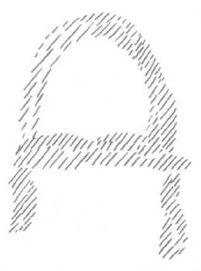
[ 15 ] Once this wall is erected—which happens immediately for those who have chosen the lake—they begin to build small houses out of the same material. They do look like clay barrels, but they are actual little houses. They construct them by weaving the material together. These are then sealed so that even the small amount of water that gets in cannot harm them. Now, a beaver lodge like this—just think how clever that is!—is never built in a part of the river where the water still freezes. You know, the water only freezes at the surface; if you go deep enough, the water isn’t frozen—whether it’s standing or flowing—only at the surface. And that’s exactly where these beavers build their homes, where the water doesn’t freeze all winter long.
[ 16 ] Each of these huts has two stories; there is a raised floor (see drawing), and the entrance is down below. They can run around down there, and they spend their time up there, while their winter supplies are stored downstairs. They haul in whatever they need to consume as winter supplies. And once they’ve brought in all their winter supplies, a beaver family moves into this lodge, but always stays close to the others.
[ 17 ] The beaver family now lives up there until spring comes again and they move back into their solitary homes. They fetch their food supplies from the lower level. And that is how the beaver family gets by. As mentioned, when summer comes, they seek out their secluded burrows. In winter, however, they stay together. There they lead their social lives in beaver villages at the bottom of lakes or at the bottom of rivers, near a dam that they themselves have first constructed with extraordinary artistry.
[ 18 ] Now, gentlemen, as far as we can tell—even from the beavers that have been brought to us in menageries—the beaver does its work solely with its teeth and front feet, never with its tail. It does not use its tail for that at all. Nevertheless, it is extraordinarily skillfully adapted. You will find in many descriptions that the beaver works with its tail; but that has always been a misconception—it is simply not true. Thus, the beaver has particularly finely developed front paws and teeth and can use them much more skillfully than any human can use tools.
[ 19 ] Well, as you know, gentlemen, natural history distinguishes between a wide variety of animal classes, and among mammals there are carnivores, bats, ruminants, and so on. Among mammals are also the so-called rodents. Our rabbit, for example, belongs to the rodents. Actually, based on its entire anatomy, just as it is, the beaver also belongs to the rodents.
[ 20 ] Now, in any natural history text—for example, in Brehm’s *Natural History*—you will find it stated that rodents are the most foolish mammals, so that the beaver, as an individual animal, is counted among the most foolish mammals. In fact, one could say that he also demonstrates—especially when acting on his own—that he is a terribly phlegmatic fellow. His phlegmatism, his phlegmatic temperament, is so pronounced that he can be just as clever as phlegmatic people generally appear to be: they let everything pass them by. So the beaver is indeed terribly stupid. But it does all these things that are extraordinarily clever! So one can say: With beavers, it really isn’t the way Rosegger once put it. Rosegger didn’t say this about the beaver, but about humans:
[ 21 ] A man is a person,
some of his people
and many of his livestock!
[ 22 ] He says that when many people gather together, they tend to act foolishly. That’s what the Austrian poet Rosegger says. There’s certainly a lot of truth to it: When many people are together, they get confused, give the impression of being foolish, and yet there are some very intelligent people among them!
[ 23 ] With beavers, one might say, the opposite is true: one is dumb, and several are a bit smarter. And when two or three hundred of them are together—when they gather in the fall—they become quite clever; they become true architects. Even if we humans aren’t exactly inclined to find any particular beauty in a beaver lodge, that’s just a matter of our human taste. But the beaver’s home really does look as charming as the beaver itself is extraordinarily clumsy.
[ 24 ] Now, there’s a lot to be learned about why beavers are so remarkably clever when they’re together. And one important clue does emerge from this: When fall arrives, these beavers start all this activity. But during the day, you don’t really see much of this activity. The construction of such a dam and the beaver village—because it really is an entire village that they build—happens very quickly; it is sometimes finished in just a few days. If you observe them during the day, you see them working very little indeed. So they work feverishly during the night. Thus, the intelligence of the beaver is confirmed, first, by the winter, and second, by the night. So there are indeed clues as to how one should actually study the whole story.
[ 25 ] But you know, when it comes to human learning, the very first principle is that you really shouldn’t think too much. It may seem strange to you, but you’ll understand what I mean in a moment. Thinking, you see, doesn’t make a person particularly wise. When someone broods over something they’ve observed, it usually doesn’t lead to anything particularly wise. So if you want to understand the ways of the world, you really shouldn’t place too much importance on thinking. Thinking isn’t all that important. One should think when the facts call for it, but one shouldn’t focus primarily on mulling over something after observing it in order to figure out how things actually stand; rather, one should look at other facts and compare them, seeking connections. The more connections one establishes between various facts, the more one learns about nature, for example. So those people who have mulled over nature have, in essence, not really discovered anything significant beyond what they already knew.
[ 26 ] When someone becomes a materialist, they speak of nature in materialistic terms because they were, in fact, already a materialist beforehand. They do not discover anything new. When someone speaks of nature in idealistic terms, they do so because they were already an idealist beforehand. In fact, one can always demonstrate that, through reflection, people only discover what they had already arrived at beforehand. Correct thinking emerges only when one simply allows oneself to be guided by the facts.
[ 27 ] Now I would like to present another set of facts regarding this beaver story, which will immediately put you on the right track—not through reasoning, but simply by comparing the facts. You see, I already mentioned the wasps last time, the day before yesterday; I presented an observation that Darwin made about wasps, and I’d like to draw your attention to it once again today.
[ 28 ] Wasps build very elaborate nests. And these nests they build—while they bear a distant resemblance to honeycombs—first of all, their walls aren’t made of beeswax but of actual paper, and second, the situation is quite different with bees. For example, there are wasp nests where they first dig up the ground; then they build something that looks like a pouch. And this is constructed much like a beaver’s lodge, assembled from all sorts of much smaller, thinner twigs and so on, or from whatever they find there—wood that they process, shaping it in just the right way so that they first create an outer shell, a pouch-shaped shell, which is, however, thick. And it’s inside that they build their little wasp nests. That’s where their levels are constructed. The cells are hexagonal, like bee honeycombs, and have their paper covering. There are levels like that. Sometimes there are many levels stacked one on top of the other.
[ 29 ] Well, you see, everything in there is built out of paper. This outer covering, this pouch—it’s not made of paper, but of materials: all sorts of things they find—thinner twigs or fine wood, which they split open first—form a network like this. They then glue it together. That’s what you see all around—inside the burrow or attached somewhere out in the open, where they glue it to something. Inside are the individual cells, and each of these cells is designed to hold an egg.
[ 30 ] Now, here's how it is with wasps. As you can imagine, they are truly extremely vulnerable to the weather. That’s why, by spring, very few of the wasps from the previous year remain, and it doesn’t really matter if anything else survives besides one or two females from a wasp nest. In winter, they seek out some hiding place where they can barely survive as females and spend the winter there. One such female then emerges from her hiding place in the spring and is just ready to lay eggs at that time. The female wasp lays her eggs in the spring. It’s remarkable: very special wasps hatch from all these eggs in the spring. These wasps that hatch in the spring—since they grow very quickly and don’t yet have cells of their own (they must hatch from eggs without cells)—immediately set about building such cells; they begin flying around in large groups, searching everywhere for the materials needed to properly construct a wasp nest. And this work actually continues throughout the summer. That’s when these wasps build the cells.
[ 31 ] These wasps, which emerge from the eggs laid provisionally in the spring, have a very specific characteristic: they are all asexual and cannot reproduce. These wasps do not reproduce; they have no reproductive organs at all—they are so underdeveloped that it is unthinkable that they could reproduce. So the first thing the wasp does in the spring is to produce an army of workers who are asexual and work terribly hard; they toil all summer long.
[ 32 ] I have known naturalists who regarded it as an ideal that something similar should be done with humans—that it should actually be possible to produce sexless individuals among humans who would not start families and would do nothing but toil, so that reproduction would be entrusted only to a few, as is the case with wasps, for example.
[ 33 ] So here’s the thing: all summer long, sexless wasps work tirelessly. And when summer comes to an end, the female begins to lay eggs, from which males and females emerge. It’s usually even the same female who previously laid the asexual eggs. She now lays eggs from which males and females emerge in the fall.
[ 34 ] The males develop in such a way that they are actually quite stunted creatures. The asexual wasps, on the other hand, are fairly robust workers. But the males—who emerge so stunted—have nothing of substance about them; they barely have enough time to fertilize the females and have virtually nothing else to do. They feed for a while, then they fertilize the females, and then they die. So the males play a rather pitiful role in these wasps: they are born quickly toward the fall, are allowed to eat a little, and afterward they are allowed to fertilize the females, and then they perish as a result of their own way of life and die. That is the last thing they do.
[ 35 ] And with some wasps, where the males have a somewhat tougher life, things get quite curious. It even happens that a custom similar to that found in certain spiders prevails, but that is only an exception. With certain spiders, however, something happens that is actually very strange. You see, with these spiders, the female regards the male as being there solely for the purpose of fertilization. And the males are only allowed to approach the female once they are ready for fertilization. Before that, the females won’t let these males come near them at all—only when they are ready for fertilization. And then it’s sometimes the case with spiders—as I said, this isn’t true of wasps, but of spiders; though as an exception, it sometimes happens with wasps—so with spiders—since they are, after all, lower animals, we can certainly draw attention to this—it’s sometimes quite strange: When the female notices a greedy male approaching, she positions herself in a spot that’s difficult for the male to reach but even harder to leave. She waits there, allows the mating to take place, and then lets the male move a little further away. And if he encounters an obstacle along the way, the female is quickly right behind him and bites the male to death. So the female herself takes care of this business—ensuring that the male spider is killed. This is how it is with some spiders. Just imagine: once the male has done his job, he has to be bitten to death; then he serves no further purpose.
[ 36 ] With wasps, it is generally the case that the males die on their own because they exert themselves so much in their activities that they run out of strength; they perish. At the same time, the asexual wasps also die. After toiling all summer, they all die in the fall. So the asexual wasps die, and the males die, and the females are left behind. Now, many of them perish in the winter cold, and only a few remain—those that have found safe hiding places; they survive until spring, lay eggs, and the cycle begins again. So the situation is that in the summer and toward the end of summer, only asexual wasps are born, and it is not until fall, as winter approaches, that the sexually mature wasps can be born.
[ 37 ] Well, you see, these are facts that must be observed. It is very important to correlate this with other facts, because that shows us how the sexual life of animals is linked to the seasons; the sexual life of animals is incredibly closely linked to the seasons.
[ 38 ] Let’s assume it’s summer. At that time, the Earth is exposed to the sun’s rays with extraordinary intensity. The sun sends its light and heat down onto the Earth. And when you expose yourself directly to sunlight, you simply start to sweat; you can tell just by the way you feel. But neither the beaver nor the wasp—the female wasp, that is—exposes herself directly to the sunlight; after all, they are always inside some kind of burrow. So they enjoy the sunlight and the sun’s warmth only in the way the earth provides it to them while they are inside their burrows. This gives them very specific characteristics for the winter. Just think: wasps acquire characteristics for the winter that give them the capacity to produce sexually mature wasps.
[ 39 ] But what does that mean, gentlemen? The female wasp is exposed to the sun’s heat and sunlight all summer long and produces asexual wasps. So you might say: the sun actually has the effect of essentially destroying sexuality. It is quite obvious from this fact: the sun, with its heat and light—which are reflected back from the Earth—acts in such a way as to destroy the sexual aspect; and that is why, when spring comes and the sun’s heat and light reach them, the wasps produce asexual wasps. But only when winter returns—that is, when the sun’s heat and light no longer have the same power—do the wasps regain the ability to produce sexually mature wasps and to develop reproductive organs in their offspring. So here we can see quite clearly that the cycle of the year has a definite influence.
[ 40 ] And if we now turn our attention from the wasp to the beaver, we have to say to ourselves: Good grief, this beaver is a terribly stupid, phlegmatic animal! He is stupid and phlegmatic to the highest degree. Fine; but where does he spend the entire summer? It stays all alone in a burrow, allowing all the sunlight and solar heat that reaches this burrow to penetrate its body throughout the summer, so that it actually soaks up sunlight and solar heat all summer long. And once it has finished soaking it all up in the fall, it begins to seek out its own kind and become clever along with them. It displays a cleverness that it does not possess as an individual animal. Now the beavers suddenly become clever and gather together. Of course, they could not build all these beaver villages on their own. Even their very first act—choosing a location—is a sign of their cleverness.
[ 41 ] Yes, this clearly illustrates what I told you the day before yesterday: intelligence, when it is present in a being, must first be gathered just as water must be gathered when you collect it in jugs. What does the beaver do while it is in its summer lodge as a solitary animal, as a hermit of sorts? The beaver gathers sunlight and solar heat—that is what we say, because we perceive only sunlight and solar heat. In truth, it is gathering its intellect there. Through sunlight and solar warmth, intellect flows from the world into the Earth. And the beaver gathers it; now that it has it, it begins to build. Thus, in the beaver we can see in reality what I recently presented to you merely as an image.
[ 42 ] Now something becomes clear to us: namely, the beaver’s tail. Compare this to what I told you about the dog’s tail—that it is actually the organ of joy, that is, the dog’s spiritual organ. That is why the dog wags its tail when it is happy to see you. Yes, it is the same with the beaver: In that tail of theirs—which they do not use as a tool, but which is very artfully formed—they hold their collective intellect. They use it to guide themselves. That is to say, they are actually guided by the sun’s warmth and sunlight. These forces are contained within it and have become intellect. This is, in fact, the collective brain of the beaver colony.
[ 43 ] All these tails, then, are the means through which sunlight and solar heat work effectively. He does not, therefore, use them as physical instruments. As physical instruments, he uses the front legs and the teeth. But this is what actually acts—just as when you have a group, and someone in the back drives the entire group forward. That person drives the others. So it is the sun that continues to act through the beaver tails in winter and builds the beaver villages. It is the intellect that comes to Earth with the light and warmth of the sun and builds there.
[ 44 ] Of course, what descends as the soul and spirit of the universe affects all other animals—and thus also affects the wasps. Now, what effect does it have on wasps? In wasps, it causes the following: when the female wasp is exposed to the sun—that is, to the sun’s effect on the earth, since she experiences this while inside a burrow—the power within her offspring that could itself produce further offspring is destroyed. The wasp produces asexual offspring when it must reproduce under the influence of the sun. And only when it is not so strongly exposed to the sun’s heat—in the fall—and yet remains so lively, not frozen as it is in winter, does the power to produce sexual offspring develop within it.
[ 45 ] From this we can clearly see once again: That which comes from the earth generates the sexual forces; that which comes from the universe generates the intellect and suppresses the sexual forces. And thus a balance is brought about. When the wasp is more exposed to the earth, it develops its sexual forces. If the wasp is more exposed to the heavens—if I may use that expression—then it does not develop sexual powers, but instead produces asexual individuals. And these asexual individuals now possess the intelligence to build the entire wasp nest. So who builds the wasp nest? The sun builds it through the asexual individuals!
[ 46 ] This is something very important, gentlemen: In truth, both the wasp nest and the entire beaver lodge on Earth are actually built by the wisdom that flows to the Earth from the Sun. You can see this clearly if you put the facts together. That is why I told you: All the thinking that a person does afterward when observing something is of no use. Only when one compares the facts with one another and holds them together does one arrive at a view that actually makes sense.
[ 47 ] That is why so much of it doesn’t make sense—because people simply look at the individual facts. They think to themselves: Well, when you look at a beaver, you’re just looking at the beaver, and afterward you reflect on what it’s like to be a beaver. What does the wasp have to do with it when you’re looking at the beaver? — But you won’t learn anything from it unless you look at something as far removed as the wasp is from the beaver; for you see that wasp nests are built with that intelligence that comes to us from the sun. You can still notice this in the beaver when it is tamed—that is, you don’t need to tame it because it is phlegmatic—but when it is in a cage: When the sun’s influence somehow weakens and the earth’s influence takes hold, it begins its winter activities. Then it gnaws through the wires of the cages. It has this, as they say, as an instinct within itself. “Instinct” is a word anyone can say; it’s just a word. Such words are containers into which we put everything we know nothing about. If one wants to explain something like instinct, one simply comes to the point where one must say: Well, there’s the sun.” That’s how it is, gentlemen! So that, in this way, through the pure facts alone, one really comes to recognize how the entire environment surrounding the Earth affects living beings.
[ 48 ] And now you will no longer be surprised that an American would say: Yes, with humans, it is the case that those born between December and March are the ones who come to their senses most easily. — Things have become quite complicated for humans. With humans, everything is predisposed so that they become independent of what animals are still dependent on. And so you must consider the following: Those people born between December and March were conceived between March and May. So this goes back to spring. These people are conceived as a result of a fertilization that took place nine months earlier—that is, between March and May—right at the start of the coming summer. Based on everything I’ve explained to you today, the sun’s influence grows ever stronger during this time. So what does it do? It slightly diminishes the sexual powers in human beings—not entirely, for humans are more independent than animals—and these diminished sexual powers are transformed into intellectual powers. That is why such a person has an easier time with this. And those born in the summer must, of course, work a little harder to develop their intellectual faculties. That is, of course, possible. But the fact is that human beings are endowed with quite different predispositions; those conceived in spring and born in winter have a greater predisposition for intellectual faculties than those born at other times.
[ 49 ] You have to know all this in order to use education to restore the balance. In humans, this balance can be restored. You cannot train wasps to produce asexual offspring in the winter and build wasp nests. You cannot train beavers to build their villages in the summer. But you can educate human beings to—as they say—overcome nature to a certain degree. And from this you can already see that this overcoming is different in human beings than it is in animals. In animals, the soul-spiritual aspect is entirely dependent on the development of the world. It simply depends on the sun that wasp nests and beaver villages are built.
[ 50 ] And with beavers, you’ll notice something else. In the fall, these solitary beavers—who have lived in isolation all summer—gather in groups of two to three hundred and can now apply the intellect bestowed by the sun only in that setting; they can apply it as a group, not individually. They could never achieve this on their own as individuals; it must be the work of the group.
[ 51 ] In the case of human beings, it is indeed true that they can accomplish much as individuals, whereas animals can only accomplish this as a group. That is why we say in anthroposophy: Among animals, spiritual life exists only in groups—group souls—while human beings have their own individual souls. And this is very interesting.
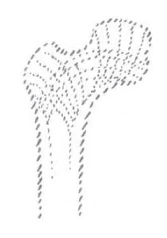
[ 52 ] For example, I once told you what a human thigh looks like. While this is certainly not yet the case with the beaver, a human thigh looks like an extraordinarily delicate, beautiful work of art. There are beams (see drawing); they are constructed in a truly artistic manner. And the entire human being is actually built in such a way that, when you look at it properly, you say: it builds everything within itself that the beaver builds on the outside.
[ 53 ] By nature, he builds within himself everything that the beaver builds on the outside. This leads one to ask: Where, then, does that which is so ingenious and so artfully constructed within the human being actually come from? Well, just as the beaver’s lodge derives from the entire sun and its surroundings, so too does the human constitution derive from the sun. We are not earthly beings; we are solar beings, and we are merely placed on Earth. For what purpose? Well, you can see that if you consider this matter. From the Earth, the wasps derive the power to produce reproductive individuals. Human beings must be on Earth precisely in order to possess their reproductive power. On the other hand, they derive the other aspect—which is more intellectual—from the cosmic environment. And here we can see very clearly: human beings derive their intellect from the cosmic environment, and their reproductive powers from the Earth. One could go on to explain in greater detail how the Moon is connected to the Earth. But there’s no time for that today; we can go into it another time. But you see, by examining the facts in this way—if you look at them correctly—you come to realize how truly the world is a unity, and how we are also dependent on the Earth’s environment, which is not merely a sun that shines and gives warmth, but a wise sun, an intelligent sun. And that is precisely what is so extraordinarily important, because then you’ll also be better able to answer individual questions posed in this way. You see that the reproductive power, as I told you last time, is connected to drinking. Yes, why is it connected in such a way that a little drinking doesn’t really matter, whereas a lot of drinking does make a difference? Well, you can deduce that from the following:
[ 54 ] What exactly is alcohol? You can see from wine what alcohol is, because wine—which, admittedly, only rich people can really afford—is still the most harmful of all; beer has a less harmful effect on the reproductive organs than wine. Beer affects the other organs more—the heart, kidneys, and so on—but the alcohol in wine, and of course the alcohol in hard liquor as well, has a particularly strong effect on the reproductive organs.
[ 55 ] Well, gentlemen, what is the source of the substance found in wine and brandy? It arises precisely through the influence of the sun’s forces! Throughout the entire summer, this substance needs time to mature. And now you can see why it becomes harmful to the reproductive organs. You see, the fact is that when one drinks, the reproductive organs are actually exposed to something that is essentially supplied to them from the outside through food—something that should be absorbed solely through the sun itself, through sunlight. That is where the consequences are felt. People consume what the sun produces outside of them. This turns into poison; whereas, if they absorb it correctly, they first—as I have said—produce the small amount of alcohol they need themselves, while absorbing the sun’s warmth in the proper way. So humans are, in effect, taking in an enemy, because what properly enters the human body becomes poison when it comes from outside. I have shown you this with phosphorus. And so what is produced within alcohol by the sun—for the sun matures the alcohol—is what has this effect. When the sun comes to us, it is exactly the opposite: then we must absorb light and warmth from the outside. And when we take in alcohol internally, it is as if we are heating ourselves from within. The same force that is our friend when we apply it externally becomes our enemy in alcohol when we apply it internally.
[ 56 ] It is the same in nature. In nature, there are forces that, when they act from one direction, have a beneficial effect; but when they act from the other direction, they act as a poison. So we can only truly understand this if we perceive it in the right way.
[ 57 ] I wanted to tell you that so you can better understand the issues related to Mr. Erbsmehl’s question. Take some time to think about that. If you have more questions next Saturday, I hope to be there.