

On Health and Illness
GA 348
16 December 1922, Dornach
Translated by Steiner Online Library
Sixth Lecture
[ 1 ] Gentlemen, do you have any questions about the last lecture? Or is there anything else you would like to know?
[ 2 ] Isn't that right? Last time we talked about the eye, and what particularly struck us—I really want to say—was the sheer wonder of the eye. For even in its external form, the eye truly reflects an entire world. And when you explore the inner workings of the eye, as we did last time, you come to realize that there truly is a small world contained within the eye. Well, I’ve already explained that to you.
[ 3 ] So now we have learned about two of the human senses: the ear and the eye.
[ 4 ] Well, a particularly interesting sense in humans—one that may also interest you in connection with questions you’ve been asking recently—is, as I’ll show you, the sense of smell. The sense of smell seems to be of little importance to humans, but as you know, it is of great importance to dogs, for example; in dogs, one might say that the animal’s entire intelligence is concentrated in the sense of smell. For you need only consider for a moment all that a dog is able to accomplish through smell. A dog can recognize people it has once been with for a long time afterward through smell. Anyone who observes dogs knows that it is not the dog’s sense of sight that allows it to recognize someone it has met before, but rather its sense of smell. And if you’ve heard a lot lately about what excellent detectives dogs become by tracking down criminals and so on—in fact, by tracking down people in general—then you’ll say to yourself: The sense of smell accomplishes remarkable feats here that, of course, actually look very simple, but aren’t that simple at all. You just need to think about how it works, and then you’ll see that it’s not so simple.
[ 5 ] When people talk like this: “Well, the dog is just following the trail”—yes, gentlemen, it’s true that the dog follows the trail. It does follow it. But just imagine for a moment that the dog is supposed to track—police dogs are used for this, after all—the trail of the thief, the burglar Lehmann, and immediately afterward the trail of the burglar Schmidt. The two trails are, of course, completely different from one another. If they were the same, the dog would naturally be unable to track them at all. It is only because they are different that the dog is able to actually track each one. But now just imagine: if you were to point out the differences in the scents left by people—differences that can be distinguished by smell—you wouldn’t find any major differences. The dog finds the differences. It’s not a matter of the dog tracking the trails back and forth, but rather that it can distinguish between the different scent trails. That’s where intelligence comes into play.
[ 6 ] There is another point that is extremely important. You see, Europeans can still make use of their sense of smell when it comes to food and also in relation to certain external things. But this sense of smell does not reveal much to them. In contrast, in Africa, for example, wild tribes can sense—just as a dog does—an enemy that is still very far away. They sense this enemy and make a quick getaway. So the intelligence found to such a high degree in dogs can still be found, in a certain sense, among primitive peoples, so that a primitive person in Africa, among certain tribes, knows long before he sees the enemy: “There is the enemy”—because he distinguishes him from other people with his nose. Now imagine how finely one must distinguish with one’s nose to know: “That is the enemy!” Then there is also a clicking sound—a clicking sound that cannot be produced at all in Europe, a click like the crack of a whip.
[ 7 ] So one could say: The more cultured and civilized a person becomes, the more the importance of their sense of smell recedes. And we can use the sense of smell to study, to some extent, whether we have an uncivilized species among us—such as dogs, for example, which are an uncivilized species—or a more civilized one. If we were to devote a little more attention to pigs in this regard, we would likely make some truly fascinating discoveries, since pigs, of course, have an exceptionally keen sense of smell.
[ 8 ] But now I want to tell you something else that will be of great interest to you in this regard. The elephant is considered one of the most intelligent animals. And it is. Because the elephant is an extraordinarily intelligent animal. Yes, what is particularly well-developed in the elephant? If you imagine everything that lies above the teeth in, say, a dog or a pig—what in humans becomes the nose—and picture all of that as being exceptionally well-developed, you get the elephant’s trunk. So an elephant has what we call a “nose” highly developed, and that’s why it’s actually the most intelligent animal—because it’s very intelligent. This doesn’t depend on the size of its brain; it depends on the fact that its brain is located right in its nose.
[ 9 ] All of this prompts us to stop and think about what the nose actually means to human beings—something that today’s civilized person doesn’t really know much about. Sure, they know how the nose is structured and so on, but they don’t really know much more about it than that it’s in the middle of the face. But the nose, with its extension into the brain, is in fact a tremendously interesting organ. And if you think back to how I described the ear and the eye to you, you’ll say to yourself: that’s extraordinarily complicated. As for the nose, I can’t even say that it’s extraordinarily complicated, but it is extraordinarily ingenious.
[ 10 ] If you look at the nose from the front, there is a wall in the middle—you’ve probably already examined that. It divides the nose into right and left sides, and on the right and left are the nostrils (see drawing). Up there, where the nose is between the eyes, inside the skull bone is the so-called ethmoid bone. It’s a small sieve. So up there, I’d have to draw inside the skull bone—it’s very complicated, but I’ll just draw it simply—a sieve, a bony sieve, that is, a bone full of holes. And this nose—on the outside you also have skin, just like the rest of the skin on your body—is lined on the inside with a mucous membrane. The mucous membrane is everywhere (drawing). You can see for yourself: it’s a membrane that secretes mucus. If you didn’t have the mucous membrane, you wouldn’t need to blow your nose. So when you have to blow your nose, you can see that there’s a layer of skin inside your nose that secretes mucus.
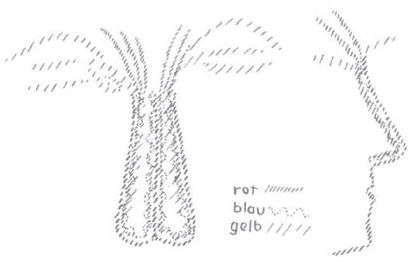
[ 11 ] But the story is even more complicated. You’ve probably noticed that when children cry, they also produce a lot of nasal mucus. At least out in the countryside, where people pay less attention to their noses, you’ll find that when a child cries, they often need to blow their nose; or else it just runs down through the nose, because there’s a canal up there leading to the so-called “lacrimal glands.” Up there (drawing) are the two eyes, and tear fluid continuously flows in from the lacrimal glands, which are located at the outer upper edge of the eye socket. This mixes with the nasal mucus, so that the nose is connected—I would say, in a fluid connection—with the eyes, because the tears flow into the nasal mucosa, since the mucus from the eyes actually mixes with the nasal mucus. So here, too, we see that no organ in the body exists in isolation. The nose is connected to the eyes. And the eyes can not only see, but they can also cry. And what they secrete when they cry mixes with what is simply secreted in the nose, in the nasal mucosa.
[ 12 ] The actual olfactory nerve passes through this ethmoid bone, which is located at the root of the nose, as they say. The olfactory nerve then travels toward the brain; it has two strands, passes through the ethmoid bone (see drawing), and branches out inside the nose. So when we stick our little finger into our nose—which is bad manners—we’re touching the nasal mucosa; but this nasal mucosa is permeated by the olfactory nerve, which leads into the brain. That’s what you can actually see in the nose itself, because it’s actually incredibly simple in structure.
[ 13 ] But here is something that can reveal a great deal if one thinks logically. For example, anyone who carefully examines a person’s eyes will find that no two eyes have exactly the same visual acuity. Anyone who examines both hands will find that they are not equally strong. A person’s organs are never completely equally strong on the left and right sides. And the same is true of the nose. One simply smells less strongly with the left nostril, if I may put it that way, than with the right nostril. But just as it is with the hands, so it is with the nostrils: there are some people who smell more strongly with their left nostril than with their right, just as there are left-handed people. After all, there are such “reversed” people in the world. I don’t just mean the “reverse-minded,” but there are also “reverse-hearted” people!
[ 14 ] In an ordinary person, the heart is shifted—not by much, but just a little—toward the left side, and the entire set of internal organs is formed accordingly. Now there are these “twisted” people whose hearts are shifted a little to the right, their stomachs also a little to the right—they’re completely twisted. You actually notice this much less than when people are “twisted” in the head. When people are “twisted” in the heart or stomach, the issue only comes to light when the person has somehow become ill or when they’re dissected. And it was only through autopsies that people realized there are such peculiar “sideways” people who have shifted their hearts and stomachs to the right. And since not every “sideways” person is autopsied during their lifetime—it doesn’t always happen—one sometimes has no idea that there are far more of these “sideways” people than one might think, who have shifted their hearts too far to the right.
[ 15 ] But look, in proper pedagogy, one must take this into account, because if you have a child whose heart isn’t in the right place—and I mean this only in the anatomical sense—then you really must take that into account; otherwise, it can turn into a very unpleasant situation for the child. But since human beings are not merely physical machines, they should not be raised in such a way that such things become obstacles for them. That is precisely the great art of education: taking such things into account. You see, Professor Benedikt has studied a great many criminal minds. In Austria, they were reluctant to allow him to do this, because in Austria people are Catholic, and they insist that such things not be done. He was a professor in Vienna. There he got in touch with the Hungarians—who, at a certain time, were more Calvinist—and they allowed him to transport the criminals’ skulls to Vienna. Various things happened to him there. There was a hardened murderer—I’ve forgotten how many murders he had to his name—and he happened to be devout. He was a devout Catholic. And once a rumor broke out that Professor Benedikt was having the criminals’ skulls sent to Vienna and examining them there. So this one criminal, who was a hardened murderer, protested: he didn’t want that; he didn’t want his skull sent to Professor Benedikt, because on Judgment Day, when all people rise from the dead, where would he find his head to reunite with the rest of his body!—So he did believe in Judgment Day, even though he was a hardened criminal.
[ 16 ] Yes, what did Professor Benedikt find in the criminals’ skulls? We have the cerebellum back there in the brain—I’ll talk more about that later—and a lobe of the cerebrum is draped over the cerebellum. It looks like this (see drawing). The cerebellum looks like a small tree, and the cerebrum is draped over it like a lobe. Now, Professor Benedikt found that in people who have never committed murder, who have never stolen—there are such people, after all—the cerebral lobe extends very far down, whereas in those who were murderers or other criminals, it does not extend as far down; it does not cover the lower part.
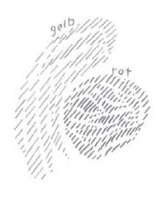
[ 17 ] Of course, a person is born with such a defect. But, gentlemen, there are many people who are born with an occipital lobe that is too small to properly cover the cerebellum! And in such cases, education can help. A person does not have to become a murderer just because he has an occipital lobe that is too small; he only becomes one if he is not properly raised. From this you can see, once again, that if the body is not properly developed, the soul can help make up for it. So it is nonsense to say, as the otherwise witty Professor Benedikt has said: “It’s not a person’s fault if he is a criminal”; yes, it’s not a person’s fault. - Because he was not properly positioned as a germ, as an embryo in the womb, he ended up with an occipital lobe that is too small. He may well be quite well-mannered depending on how he is raised, but he has not been properly raised for such a thing. Of course, he can’t help it. But society can—society is responsible for ensuring that things are done correctly in education.
[ 18 ] I am telling you all this so that you can see just how important the overall organization of the human being actually is.
[ 19 ] And now we must say that in dogs—let’s go back to dogs for a moment—it is precisely this very simple sense of smell that is particularly well and strongly developed. Gentlemen, what do we actually smell? What does a dog actually smell?
[ 20 ] If a piece of material is simply lying somewhere—for example, chalk—then you cannot smell it. Only when you set the material on fire, and the substances evaporate and turn into vapor, so that they are drawn into your nose as air, do you smell them. You don’t even smell liquid substances unless they evaporate first. So we only smell what evaporates first. We can therefore say: There must be air around us, and the vapors of the substances must mix with this air. Then we smell the substances because they have become vapors. We don’t smell anything else. Of course, we smell the apple or the lily. But it is nonsense to believe that we smell the solid lily. We smell the vapors that rise from the lily and enter our nose. Then, when this lily scent—which is thus in vapor form—wafts toward us, the nerve in the nose is capable of perceiving the odor.
[ 21 ] So, of course, when the savage smells his enemy, the odors are part of it. You can infer from this that humans assert themselves far beyond the reach of their hands. For if we were savages, and one of us were to go down to Arlesheim, he would know whether there was an enemy of his here among us. So this enemy of his would have to make his presence felt all the way to Arlesheim! You are therefore still present down in Arlesheim through what you exude. Everywhere, far around him, man is still present through his aura. He is present far more through his aura than through what one sees outwardly.
[ 22 ] Now there is something about dogs that humans cannot do, and which is extraordinarily interesting; you all know it quite well. If you have a dog—or even just see a dog that you know well and that knows you well—and you meet him again, he wags his tail. Yes, gentlemen, why does it wag its tail? Because it is happy! Humans cannot wag their tails when they are happy, because they no longer have tails at all. Humans have atrophied to such an extent in this regard that they cannot even begin to express their joy. So the dog smells the human and wags its tail. The scent, in fact, stirs his entire body into excitement, and this is expressed by the fact that the experience of joy flows into his tail muscles, causing him to wag his tail. In humans, things have come to the point where they no longer possess such an organ with which they could express their joy in this way.
[ 23 ] We see that, although humans are more highly evolved than dogs, they lack the ability to transmit a scent down through their spinal cord; for that is how it works in dogs. A dog takes in a scent through its nose, transmits it down through its spinal cord, and then wags its tail.
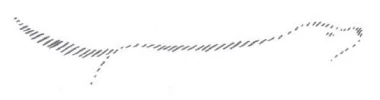
[ 24 ] So what he takes in as a smell through his nose goes into his spinal cord. And the end of the spinal cord is the tail, and that’s where he wags it. Humans can’t do that. Why? I’ll tell you why humans can’t do that. Humans also have this spinal cord, but they are unable to transmit the scent through it.
[ 25 ] Now I want to draw the entire human head as seen from the side. The spinal cord would continue there; it runs down that way. In dogs, it extends into the tail, which is why dogs can wag their tails. In humans, however, the power of the spinal cord is reversed. Humans, after all, have the ability to reverse many things that animals cannot. Animals therefore walk on all fours, or if, like some monkeys, they do not walk on all fours, then that is all the worse for them, because they are actually built to walk on all fours.
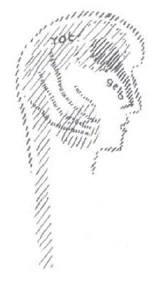
[ 26 ] But humans stand upright during their lives. They also start out on all fours; then they stand up. It is this force that runs through the spinal cord, and this force, I would say, propels the entire brain forward. You can really say, when you look at a dog: that’s incredibly interesting, especially when you see it wagging its tail. If you compare yourself to it as a human, you really have to say: Wow, it can wag its tail; I can’t do that! — But all the force that lies in that wagging tail—humans have redirected it and channeled it up into the brain here. The one here (in the dog) grows downward, not upward. So this force that the dog has directed backward in its tail—we reverse it and now channel it into the brain. And so you can form a mental image of it like this: If you were to picture the end of your own spine—where we have the so-called coccyx, which consists of atrophied bones, whereas in a dog it consists of very well-developed bones—in us, it has already fused together, and this completely atrophied “leg,” which can no longer wag, extends downward and is covered by skin. Well, we reverse all that wagging power, and actually, if it weren’t for the skull, then when we perceive a pleasant smell, we could wag our brains up there. So we would actually—and this is very interesting—when we’re happy, when we see someone, if our skull bones weren’t holding our brain together, we would wag our brains forward.
[ 27 ] You see, this is a peculiar aspect of human organization: we reverse the patterns found in animals. So this wagging ability—it is developed, but it is reversed. In reality, we do wag our tails, too, and some people even have a keen sense of it. Isn’t that right, court officials who surround the dukes—they wag their tails when the dukes are nearby? Well, they don’t wag them like a dog does, but some people have the feeling that they really do wag their tails. They wag them in a spiritual sense. It’s something that looks like wagging. But you see, once you’ve acquired that perception—which is sometimes, though easily misunderstood, called clairvoyance—which consists precisely in seeing certain things better than other people do—well, gentlemen, then you don’t just have the feeling that the court councilor is wagging his tail in front of the duke; you actually see it, so to speak; only he isn’t wagging it back there (like a dog), but he’s wagging it up front. He’s really wagging it! Isn’t it true that the solid matter inside your brain is held together by your bones? But what develops there as a subtle substance, as warmth—that’s what’s wagging when the court councilor stands before the duke. It alternates—a little warm, colder, warmer, colder. And it’s actually like this: When the court councilors surround the duke, and if you have a subtle sense of that wavering warmth, then you can already see something like what happens when you drape a donkey’s ear around someone’s neck: it wags up front—we then say that the etheric body, the more subtle body, is wagging up front, because that is also correct. It’s true: the etheric body wags.
[ 28 ] But now, through this entire process, the spinal cord is formed in the dog or the elephant. In humans, what remains atrophied in the dog or the elephant is pushed forward. How does that work? Now I want to draw the nerve—which I’ve marked in red there (see drawing on p. 115)—in yellow here, and it now enters the brain. Inside the brain, two things now meet: that which has been pushed forward as the wagging organ—which is unique to humans—and the olfactory nerve, which is also present in humans. But in dogs, this olfactory nerve pushes its way into the brain to an enormous size because nothing counteracts it—since whatever could counteract it is wagging out the back. Humans, however, reverse this process. All this wagging force comes toward the nose. That is why, in humans, what enters as the olfactory nerve is made as small as possible, because it is pushed back by what comes toward it. And so humans have an organ inside that, first of all, suppresses their sense of smell, but which actually connects them to other humans in a certain way. These are the forces that have been pushed upward.
[ 29 ] Therefore, one can say that a large portion of the olfactory nerve is located inside the forebrain of both dogs and elephants; a huge olfactory nerve is located there. In humans, the olfactory nerve is somewhat atrophied; instead, the nerves that are pushed up from below are situated there. So that in this very spot—where in dogs the nerve that carries signals from the nose still extends far—in humans, the very noblest part of the brain is located. And the result of this is that in the forebrain of humans, the capacity for compassion and for understanding other people in general is actually present. There is something very noble there. What the dog detects with its nose is transformed in humans into something very noble. And humans actually have an extraordinarily noble organ in the forebrain, precisely at the spot where the much-despised nose would otherwise send its olfactory nerve.
[ 30 ] I told you that we don’t smell with our left and right nostrils with equal intensity. Now think about this: when someone who is accustomed to making rather exaggerated gestures is deep in thought—what does he do? You’ve surely seen this before: he moves his finger or hand up there, just so that his index finger rests on his nasal septum—because that’s where, behind the nose inside the brain, the power of discrimination finds its physical expression.
[ 31 ] The nasal septum allows a dog not only to follow a scent with great precision, but also to distinguish very precisely, using its left and right nostrils, between the scents of one person and another, and—this is very interesting—in its right nostril, it always has the scent of the one it is currently tracking, while in its left nostril, it has the scents of all those it has already tracked. This makes it increasingly skilled at tracking, just as we humans become more skilled the more we learn and the more we store in our memory. Dogs, in fact, have a good memory for scents. That’s what makes them such good trackers.
[ 32 ] And there is another connection to human life here. One can observe the following, in fact. You see, humans have become rather desensitized to smell; but Mozart, for example, sometimes came up with his most beautiful melodies when he smelled a flower in some garden. When he pondered why that was, it was because he had already smelled that flower somewhere else, where he had particularly enjoyed it. Mozart, for example, would never have gone so far as to say: “Well, I was once in that beautiful garden over there, and there was a flower there with a scent that I particularly liked; now there’s that scent again, and it makes me—well, almost want to wiggle.” Mozart would never have said that; but a beautiful melody came to him when he smelled that flower again. From this you can see how the sense of smell is connected to our memory.
[ 33 ] But this doesn’t stem from what we humans send in through our sense of smell, but rather from what we receive in response. That is where our capacity for discernment as human beings is developed. So if someone is particularly capable of logical thinking and makes the right mental connections, then we must say: This person has placed their brain in front of their olfactory nerve and has, in fact, adapted it to what would otherwise be the role of the olfactory nerve. — One could even say that a particularly intelligent person is actually someone who has overcome their “dog-like nature” to the greatest extent possible.
[ 34 ] So if someone were born half-dog—with a particularly keen sense of smell—and were then raised to distinguish between other things that aren’t smells—since he distinguishes them by what he contrasts with his sense of smell—then he would become a particularly intelligent person.
[ 35 ] Intelligence and discernment stem entirely from the fact that humans have transcended the sense of smell. The elephant and the dog derive their intelligence from their noses—that is, largely from outside themselves; humans possess their intelligence within themselves. That is, in fact, the difference. So one must not merely look to see whether humans and animals have the same organs. Certainly, dogs and humans have a nose, but what matters is how the noses are arranged. And from this one can see that something is at work in humans that is not at work in dogs. And so, when one recognizes such things, one gradually works one’s way up from the physical to the spiritual. For neither the nose nor that broom-shaped end of the spinal cord—which the dog uses to wag its tail, and which is covered only by skin and traversed by a few bones—has any urge to grow toward one another. This urge arises only from the soul, which the dog does not possess in the same way as humans do.
[ 36 ] Now you see, I have been able to describe the nose—with all its associated features—in such a way that we find it extending into the brain, and that we actually find human intelligence linked to it.
[ 37 ] It strikes us as strange when we compare the sense of smell to a sense that is very similar to it, yet at the same time vastly different: the sense of taste. It is so closely related that, for example, in the region where I was born, people never say “smell”—the word “smell” doesn’t even exist there. They say, “It tastes good” or “It tastes bad” when they smell something; where I was born, they don’t talk about “smelling” at all. (An interjection: “Here, too!”) So here in Switzerland as well, people don’t speak of smelling, but of tasting, because the concepts of smelling and tasting seem so closely related to them that they don’t distinguish between them at all.
[ 38 ] But when we examine the sense of taste, it’s very peculiar. It’s similar to the sense of smell. If you look at the back of the throat here—I can only hint at this today, but I’ll go into more detail later—back here is the so-called soft palate, up front is the hard palate, and there are the teeth with the gums; if you look at that, you’ll see something very curious. Just as a nerve enters the nose—which I’ve marked in red here—so too do nerves extend from the brain into all these areas. But these nerves, for example, do not extend into the gums; nor do they extend into the front part of the palate, but only into the back part; they do not even extend into the front part of the tongue, but only into the back part of the tongue. So if you look at how the nerves associated with taste are distributed, you’ll find very few at the front—almost none at all. The tip of the tongue is not actually a taste organ; rather, the tip of the tongue is primarily for sensation. Only the back part of the tongue can taste, as can the soft palate. If you reach into your mouth, you’ll find it soft in the back and hard in the front. This soft part is suited for taste. You can’t taste anything on the gums.
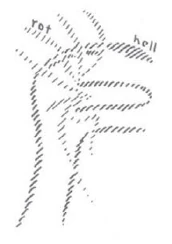
[ 39 ] Now, it is curious that these nerves, which serve the sense of taste, are still particularly connected in humans to everything related to the internal organs. And it is certainly true that it is not merely a matter of chemically analyzing a food—a food must first taste good. And in taste, humans already have a regulator for their nutrition. For example, with small children, we should pay much more attention to what they like or dislike than to studying their chemical composition. If we notice that a child consistently rejects a certain food, we’ll find that something isn’t right with their abdominal organs. That’s when we need to intervene. Yes, but, gentlemen, that is indeed most peculiar. You see, here I have drawn the olfactory nerve right at the front (see Figure 109); now I would have to draw the nerves that go to the tongue and the palate here like this (see Figure on p. 120); and here I have drawn what in humans is, well, the diminished sense of smell, which is actually located at the very back in dogs. If we now move gradually forward, we come to the abdomen in humans—and in dogs as well—and this corresponds to the taste nerves. And it is indeed the case that when a dog gives itself over to its sense of smell, it wags its tail; that is, it drives everything through its entire body. It goes all the way to the very end. The tail is, after all, the very end; the tip of the nose is at the very front, the tip of the tail at the very back. So whatever is connected to the dog’s sense of smell passes through its entire body. What the dog eats, if it tastes good to him, does not pass through its entire body but remains further back in the intestines. That is very interesting.
[ 40 ] So we can see from this: The deeper within the body something related to the nerves is located, the less far it extends its effect within the body. And this will lead us next time to understand even better than we already have that the entire structure of the human being depends on the nerves. The human being is shaped by the nerves. For if we ask about the dog: What does its tail resemble? The nose. —- What do its internal organs resemble? The nerves of the mouth. — The nerves are at one end and determine the form at the other end. This is something I would ask you to take as the basis for further reflection. You will benefit greatly if you come to realize that a dog’s entire tail-wagging is derived from its nose; that, for example, when it feels comfortable in its intestines, this is due to the nerves of its mouth, and so on. We will see more of this later.
[ 41 ] So it is extraordinarily interesting how the nerves are connected to form. That is why I told you the other day: Even a blind person has something from his eyes, because the optic nerves—which, although they do not serve for seeing in a blind person—still shape his body. How he looks is determined by his cranial nerves, and partly by his optic nerves, but also largely by his other nerves. And so, if we want to study why humans differ from dogs in their form, we must think of the nose! (Finger on the bridge of the nose.) In dogs, the nose plays a major role in their form. In humans, this has been overcome; the nose’s functions have been somewhat suppressed. In dogs, the nose simply occupies a higher rung on the ladder of evolution. In dogs, the nose is, so to speak, the very first master; in humans, its activity has been suppressed. Then we’ll see what else comes into play in shaping the human form. The eye and the ear are already more important to human form than the nose.