

On Health and Illness
GA 348
20 December 1922, Dornach
Translated by Steiner Online Library
Seventh Lecture
[ 1 ] Gentlemen, today we would like to finish answering the question from the other day.
[ 2 ] You see, through its skin, the human being is, in fact, a sensory organ in its entirety. Human skin alone is something extraordinarily complex, something truly marvelous. If you examine the skin from the outside in, you first find a transparent layer on the very outside, the so-called stratum corneum of the epidermis. It is transparent only in us white Europeans, whereas the epidermis of Black people, Indonesians, and Malays is interspersed with pigment granules and is thus colored. For us Europeans, however, the stratum corneum of the epidermis is transparent. It is called the stratum corneum because it is actually composed of the same substance—albeit arranged somewhat differently—as the horns of animals and as our nails and hair, since our nails actually grow out of this outer stratum corneum of the skin. Beneath this horny layer lies the so-called dermis, which in turn actually consists of two layers: an upper layer (see diagram, red) and a lower layer, which I’ll perhaps color greenish here. So, as humans, we are actually covered and clothed with a three-layered skin: an outer horny layer, a middle dermis, and an inner lower dermis.
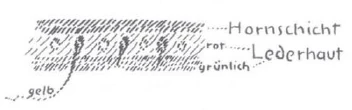
[ 3 ] Well, you see, this lowest layer—the dermis, shown here in green—is actually there to nourish the entire skin. That’s where the skin’s nutrients are stored. But the middle layer, which I’ve marked in red here, is filled with all sorts of things; above all, it’s filled with muscle fibers. But what’s particularly important for us is that there are all these little bulbs inside this skin, one next to the other; so that everywhere you look, there are little bulbs (yellow), one next to the other; so that everywhere you look, there are little bulbs. We have thousands and thousands of these inside our skin—these little ones; I can call them “little bulbs,” because an onion is, after all, particularly distinguished by the fact that it has layers: the outer layer, the second layer, the third layer, and so on—many layers. And these little bodies here, which an Italian, Pacini, discovered—and which are therefore called Pacinian bodies—these little bodies have such onion-like layers; they’re structured exactly like that, with the outer layer facing outward, and the other, thinner part, facing inward, just as I’ve drawn on the outside.

[ 4 ] Well, you see, these tiny little organisms—they’re so tiny, you can only see them under a microscope—have twenty to sixty of these shells! You can imagine just how tiny that is. So, humans actually have all these tiny little bulbs scattered all over their entire body surface. Most of them—not just in snakes, but in humans as well—are at the tip of the tongue. That’s actually quite funny: most of them are at the tip of the tongue! There are also many on the fingertips, on the inside of the palm, and on other parts of the body; but, as I said, the tip of the tongue has the most. If, for example, you compare the many tiny bulbs at the tip of the tongue with those at the fingertips, there are about seven times fewer at the fingertips than at the tip of the tongue.
[ 5 ] You see, a nerve fiber extends from each of these little bulbs. The nerve fiber first travels along some path—it finds its own way—into the spinal cord, and from the spinal cord into the brain. And you can create a mental image of that: From the brain, all these nerve fibers extend in every direction throughout the body, forming such bulbs at the body’s surface—including on the tongue—everywhere. So I can also draw a human being in such a way that all these nerve fibers originate in the brain and go everywhere, eventually forming such bulbs within the skin, in the dermis.
[ 6 ] This is very interesting because you can really form a mental image of it—and if you can really form a mental image of it, you’re imagining something real—: Suppose there is the ground (see the drawing on the left); in there we have a real, actual onion; it grows out of the ground and forms the onion flower up there. Yes, gentlemen, that’s pretty much how it is in the human body.
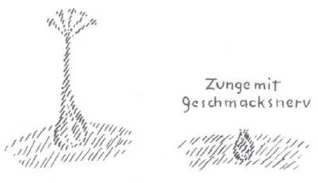
[ 7 ] That’s where (see the drawing on the right) the bulbs are located, and the stem is only inside—in the nerves (of the tongue) it’s short, but in the other nerves it’s sometimes incredibly long; the bulbous nerves that run from the feet through the spinal cord to the brain are incredibly long. And of all the “bulbs” we have in our skin, we actually have the “flower” inside our skull. So you can form a mental image: The whole human being, within his skin, is actually a kind of soil—just curiously shaped, but it is a kind of soil. On the outside, it has the horny layer, in which all sorts of crystals and so on are embedded. These are the solid bodily masses at the bottom, with the “humus” layer above them. In humans, the dermis lies just beneath the hard stratum corneum, from the outside in. That is the soil. And all these bulbs grow out of the soil and have their blossoms in the brain. Their stems extend all the way into the brain, and their blossoms are in the brain.
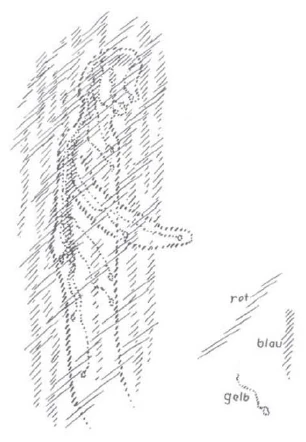
[ 8 ] Yes, gentlemen, for us older folks, it’s the case that we can no longer really follow the whole story—except when we’re asleep; but this is even more true for a child. It’s the case that, as long as a child’s intellect hasn’t awakened—that is, throughout the first year—there is a very lively, bulb-like activity within them, in their nerves. And just as the sun shines down on the blossoms of the bulbs, so too does the light shine into the child—who has not yet transformed the external light it takes in into understanding—and this is indeed as if the sun were spreading throughout the head and unfolding all these bulb blossoms. In fact, an entire plant life grows within us in the nerves. We actually carry within us, in our cutaneous nerves, an entire plant kingdom. But later, when we enter elementary school, this lively growth actually comes to a halt. Then we use the forces that were previously derived from the nerves for thinking—we draw them out and use them for thinking. This is very interesting. For people usually believe that the nerves think. The nerves do not think. One can only use the nerves for thinking by, so to speak, stealing their light. The human soul steals the light from the nerves, and what it steals, it uses for thinking. That is indeed the case. Anyone who truly reflects on this matter will, in every respect, come to simply acknowledge the independently acting soul.
[ 9 ] Well, you see, we actually share these types of bulbous plants that grow from the inside with just about all animals. All animals, even the simplest ones—which are really just, let’s say, masses of mucus that are somewhat shaped, can see, and so on—all these animals actually have sensory nerves that terminate in a kind of bulb on the surface. The closer we get to humans, the more these individual nerve bulbs are specially modified. And such modified skin nerves are, for example, our taste buds.
[ 10 ] So at the front of the tongue—as I mentioned last time—we have these sensory glands. That’s why the front of the tongue is so sensitive. But at the back of the tongue—that’s where we taste—and on the soft palate, and so on; so on the palate and the back of the tongue, there are also these little bulbs scattered about. But they’re actually situated in little pits there. And in these little pits, it’s this bulb that extends into the nerves; it simply pushes its way into the dermis like a bulb. First, a small pit forms in the back of the tongue; this bulb then pushes its way into this pit, all the way up to the surface, so that you can see its roots through it. So there are an incredible number of these small pits at the root of the tongue, and in each pit, a bulb like this grows up from below, and that is how we are able to taste.
[ 11 ] And with our sense—that is, with these “onions” on the surface of our bodies—we can perceive everything everywhere. But you know yourself that we don’t remember much of that. If I have a rough chair, I know through my sense of touch that it’s rough, because I feel that it’s rough through so many sensory receptors that are constantly changing. I can do that, but our memory doesn’t exert much effort through this sensation, nor does it exert much effort with taste—perhaps a little better, but unconsciously. People who are gourmets always know in advance what is good, not only after they taste it; that is why they seek it out.
[ 12 ] Well, these onions travel through the spinal cord, go directly to the brain, and bloom there. But everything we want to taste must first be dissolved by the mucus in our mouths. We cannot taste anything that has not first been transformed into water. But then we might ask: What is it that actually tastes good? We would not be able to taste anything at all if we did not have water within us. Our solid human body—that which is solid within us—does not actually taste anything. It is the case that when the taste buds are here on the tongue, water first surrounds them; the inner water of which the human being is composed mixes with what is dissolved in the food, and we can say: our own water mixes with the water from outside. So it is not the solid human being who tastes at all, but rather—as I have already told you—we consist of about ninety percent water. We make this water particularly fluid here around the taste buds. Just as water gushes forth from a geyser or from such a pit in the earth, so do we truly have such a gushing of water at the root of our tongue.
[ 13 ] When I spit out water—which is the mucus of the mouth—it no longer belongs to me as a human being; it has separated from me. But as long as the water remains in the pits of my tongue, it belongs to me as a human being, just as my muscles belong to me. I am not made up solely of solid muscles; I am also made up of water. And it is this water that actually has a taste, because it mixes with the water that comes from outside.
[ 14 ] What is it like to lick sugar? When you lick sugar, you draw water from inside into the taste buds on your tongue, and the dissolved sugar falls into this water; the liquid within you becomes infused with the sugar, and that’s when you feel good, as the sugar spreads throughout your own fluids, because the sugar first settles finely into these taste buds.
[ 15 ] Well, you see, we humans can only taste. But why can we only taste? If we had fins and were fish—which would also be an interesting way of life—then every time we tasted something, the taste would also be transmitted through our fins. But we would have to swim in the water so that everything would always be properly dissolved, even the fine particles, because fish taste all the fine particles that are in the water, and they act according to what they taste; the sensation goes straight into their fins, and they swim on with their fins. So if something pleasant swims toward it from any direction, it tastes it, and its fins move toward it immediately.
[ 16 ] We humans cannot do what fish can do. We do not have fins; ours have completely atrophied. So we cannot use our sense of taste to move ourselves; and that is why we internalize it. Fish have a keen sense of taste, but no internal taste. We humans internalize taste; we experience it, whereas fish actually live within the water itself, experiencing taste together with the water. That is why it is also the case with fish—and people have wondered about this—that they swim far out into the sea when they want to lay their eggs. They even swim into the Atlantic Ocean, to completely different parts of the world. And the young fish then slowly make their way back to the European rivers. Why is that? Well, the European rivers where they all swim are freshwater. The eggs cannot mature in freshwater. The fish sense when a bit of salt begins to approach the river mouth; they taste this and swim out into the sea. And when, on the other side, the sun shines differently on the earth, they taste that, and guided by that taste, they swim halfway around the world. And the young ones, in turn, taste their way back to where the adults once lived. So they are guided entirely by taste.
[ 17 ] This is an extraordinarily interesting thing: the water that flows in rivers on Earth and is found in the ocean is actually full of flavor. And the way the fish swim around in it is, in fact, the very thing that the water’s flavor does all the time. It is actually the taste of the water that makes the fish swim and gives them their direction. Of course, when the sun shines on a patch of water, the sun’s heat immediately causes everything in the water to be finely dissolved. This transforms into a different taste. And that is why you see the fish wriggling around in there. It’s all about the taste.
[ 18 ] Yes, gentlemen, this story is actually very strange. We humans would actually swim, too, if we were to simply follow our taste buds. When I taste sugar, something inside me—namely, the watery part of me—actually wants to swim toward it. The urge to swim is already there. The human being actually wants to swim continuously in response to taste. Only the solid body holds him back. And from that which wants to swim but cannot—we actually have a fish within us at all times that wants to swim but cannot—from that which cannot swim, we retain what constitutes our inner soul life based on taste. For with taste we actually live entirely within the etheric body, except that the etheric body is held back by the water we possess, and the water, in turn, is held back. And it is only natural to say to oneself: The human being has an etheric body that is actually not at all suited to walking on the earth, that is suited only to swimming, that is actually a fish, except that the human being stands upright, and thereby becomes something else. But human beings have this etheric body within them, which actually exists only within their liquid nature. And it is indeed true that human beings would actually like to swim constantly—to swim in the fine water that is, after all, always present in the air. That is where we would actually like to swim constantly. But we transform this swimming into an inner sensory experience.
[ 19 ] You see, it is things like this that lead one to understand human beings in the first place. You won’t find this in any modern scientific book, because people really only observe the human corpse, not the living human being. Of course, when we have a corpse in front of us, it no longer wants to swim. But it also does not participate in life. We participate in life because we are, in fact, everything that exists in the world. We are fish, and the vapor—the water vapor—that is actually there is similar to us. But we want to swim in it constantly, and the fact that we cannot do so causes us to pour it all into ourselves and taste it. Fish are actually very cold creatures. They could taste wonderfully everything that is dissolved in the water. They do not do so because they immediately move their fins. If the fish’s fins were taken away, then the fish would become higher animals; they would begin to taste.
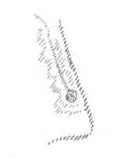
[ 20 ] Well, another type of transformed bulb—the nerve bulb—is what I told you about last time, on Saturday. These penetrate the nasal mucosa. But these bulbs aren’t located in a small cavity where water is constantly bubbling; instead, they extend all the way to the surface. Therefore, these bulbs can perceive only what comes near them; that is to say, we must allow the scent of roses to reach the sensory bulbs in our nose; only then can we smell it. Thus, a part of the human body is dedicated to developing these bulbs—which are spread across our entire skin—specifically to take in what is in the air.
[ 21 ] But, gentlemen, even so, if you take such an onion and place it inside a person’s nose—yes, it is blown upon by the outside air that flows in—but in addition, the breath flows from within. Breath passes through the nose continuously. The air-being lives within this breath. As I have told you before, just as we are water, so too are we air. We truly do not have air within us merely for the sake of it. Just as I have water within me, so do I have breath within me; it is not solid. And just as when I extend my hand and feel that I have extended something solid, so I extend what I have within my air organism into my nose. This is an air-like hand. And there I perceive the scent of roses or the scent of carnations. For I am not merely a solid human being—not even ten percent solid; I am a column of water, and constantly an air-being. For as long as the air is within us, we are the air itself. That is where it lives—the air. And we extend these air-hands through our nose, reaching out toward the scent of roses and carnations—and, of course, the scent of manure as well. We grasp at that; but we do not grasp it with our hands, rather through the bulbs that draw in the breath from within, so that the breath can take hold of the scent of roses.
[ 22 ] So it’s like this—it’s even evident in dogs: The nose sniffs, and right away the tail wags, as I’ve told you. Just as a fish’s fin starts moving, so does a dog’s tail. But what is the tail supposed to do, since it can only wag? It’s actually interesting: a dog’s tail can only wag. But what does it actually want to do? You see, gentlemen, the dog would actually do something completely different; if it weren’t a dog but a bird, it would fly under the influence of the scent! Just as a fish swims, so would the dog fly if it were a bird. Well, the dog has no wings, so it uses this substitute organ and can only wag its tail. It’s not enough for him; but it’s the same exertion of force. And it’s the same with us humans. Because we’re constantly smelling—we don’t even notice it—we actually always want to fly. Just as we constantly want to swim, we constantly want to fly.
[ 23 ] Just think about the swallows for a moment. The swallows live here during the summer. They enjoy the scents rising from the flowers and so on. Their sense of smell finds this pleasant, and so they stay here. But when fall comes here—or even when it’s just approaching, drawing nearer—well, if the swallows could communicate with one another, they would say: “It’s starting to smell bad!” The swallow’s sense of smell is incredibly keen. And just as I told you that people can be detected all the way to Arlesheim, so too is the scent emanating from the south detectable to the swallows as autumn approaches; it spreads all the way north. Down there it smells good; up here it’s starting to smell like manure! — That’s when the swallows start flying toward where the pleasant scent draws them, for it rises from the south toward the north.
[ 24 ] Gentlemen, entire libraries have been written about bird flight. But the truth is that even during these great migrations in the fall and spring, birds navigate by the incredibly subtle distribution of odors throughout the Earth’s atmosphere. Their sense of smell guides the swallows southward, and then back northward again. When spring arrives here, the air down south begins to smell musty to the swallows once more. The delicate scents of spring reach them in the south, and so they fly back up north. It is truly the case that the Earth is, in fact, a single living being, and other beings are part of it.
[ 25 ] You see, our bodies are designed so that blood flows to the head and then flows away again. On Earth, certain birds—migratory birds—are designed to fly toward the equator and then fly back again. The air we breathe drives the blood to the head. We are completely permeated by scent, insofar as we are air-beings. And the person who, for example, walks across a field that has just been manured—that person is actually walking there with their air-being; for the solid human and the liquid human are unaware of the manure. But the air-like human being does notice it, and this gives rise within him—as you will surely understand from what I have said—this naturally gives rise within him to the urge to fly away. In fact, a person would like to fly away continuously up into the air whenever the manure stinks over the field. He cannot do so because he has no wings. And that is why a person internalizes that from which he cannot fly away. He internalizes it. It becomes a matter of the soul. And the consequence of this is that, insofar as a person is a “person of the air,” they become completely filled inwardly with the smell of manure, with the vapors and mists that the manure has turned into. They themselves become completely manure-like. And then they say: it disgusts them. In the soul, that is disgust.
[ 26 ] Just as this more subtle human being lives within the fluid human—one that is, in a sense, stolen from the fluid human, through which we taste— so it lives within this air-like human, which we constantly renew within ourselves because we inhale and exhale, which we expel again, which is actually born at every moment—born eighteen times a minute—and dies again, eighteen times a minute. Otherwise, wouldn’t we be born and, under certain circumstances, become old men? it takes years for the solid human to die. With the ethereal human, it’s like this: it is born eighteen times a minute when we inhale, and dies again when we exhale. It is a continuous process of being born and dying. That’s exactly how it is. And what is now being extracted from within—we call that the astral body, just so we have a word for it. But it is simply there. And as I told you last time, what ought to be down there is pushed upward, shoveled upward, and grows toward the sense of smell—what moves us to think is precisely our astral body, which shovels it upward. No one can truly understand the brain—which grows upward toward the nose through the astral body—unless they view the whole matter as I have just described it. This is precisely what emerges from a proper examination of our senses.
[ 27 ] We humans would actually like to fly all the time, thanks to our sense of smell. But we cannot fly because, at most, we have these solid shoulder blades. But the bird can fly. Why can the bird fly? Gentlemen, the bird has something quite unique that enables it to fly; namely, the bird has hollow bones. There is air inside them. And the air that it takes in through its olfactory organ combines with the air it has inside its bones. So the bird is really, primarily, an air creature. The most essential part of a bird is actually what consists of air. The rest is merely an appendage. And if you look at a bird with a lot of feathers, you’ll see that everything else is actually withered away. But the most important thing about it—even in the case of the ostrich—is that there is still some air inside each of those downy feathers, and the external air itself is in contact with all this air of which the bird itself is composed. The ostrich can still walk, because otherwise it would be too heavy to fly; but the other birds do fly.
[ 28 ] We humans have only these shoulder blades—which, on top of that, are extremely clumsy—firmly attached to our backs. We’d like to fly constantly with them, but we can’t, so we push our entire spinal cord into our brains and start thinking. Birds, on the other hand, don’t think. You only need to observe birds closely to see that everything about them is focused on flight. It looks very clever; but it is actually the air that makes it so. Birds do not think. We think because we cannot fly. Our thoughts are actually the transformed forces of flight. That is what is interesting about human beings: their sense of taste transforms into emotional forces. When I say, “I feel good,” what I actually want is to swim. But I cannot swim, so that desire transforms into an inner sense of well-being. When I say, “I’m disgusted,” what I actually want is to fly. But I can’t fly; so that transforms into the thought: “I’m disgusted; the smell of manure is revolting.”—And so, fundamentally, all our thoughts are actually transformed smells. And the human being is such a perfect thinker precisely because he experiences in his brain—along with the mental images I’m describing here—everything that a dog experiences through its nose. As human beings, we actually owe an extraordinary amount to our noses. You see, when people have no sense of smell—that is, when their nasal mucosa has atrophied—there are indeed such people who have no sense of smell—they actually lack a certain capacity for invention. They can think only through what they have inherited from their parents. It is, after all, always good that we inherit something; otherwise, we could not live at all if we did not have all our senses developed. The person born blind has also inherited the inner aspect that the eye possesses, and possesses it precisely because he is not merely a solid human being, but also a liquid and an air-like human being.
[ 29 ] But we have now seen how strange this is: we perceive solids through our sense of touch via the bulbs that extend everywhere toward the skin; and we perceive liquids—watery substances—through our sense of taste. We perceive airy and gaseous substances through our cilia, which extend into the nasal mucosa. We also sense something else around us, but more so as a whole: that is warmth and cold. Just as we, as human beings, are a little bit of solid matter, a little bit of water, and a little bit of air, so too are we a little bit of warmth. After all, we are warmer than the external world.
[ 30 ] But you see, science doesn’t really understand that what tastes is actually the watery human, and what smells is the airy human. Science is always pondering this: The taste buds extend into the tongue papillae, and it actually seems as if the nerve itself were tasting or smelling. But that is nonsense. In the mouth, we taste the water from the water-being, and in the nose, we taste or smell the air from the air-being. And when we perceive cold or heat, this is perceived by the little bit of warmth that we ourselves are. The warmth within us directly perceives the external warmth. And that is precisely the difference between the sense of warmth and the other senses: it is the warmth itself that is secreted by all the organs. As human beings, we have a small world of warmth within us, and this world of warmth perceives the world around it. However, when we touch something that is hot or cold, we naturally perceive it only at the point where we touch it. But when it is cold in winter, we perceive all the cold around us as human beings—we are a single sensory organ—and likewise, in summer, we perceive the heat.
[ 31 ] So we can already see how wrong science actually is in this area. When you open a scientific book anywhere, it’s as if the whole human being were just some kind of fixed structure. They simply draw in the bones, the muscles, and the nerves. But that’s all nonsense. That’s only one-tenth of the human being. The rest is ninety percent water, and there’s also air inside, and even a bit of heat. So, actually, the diagrams drawn by materialistic science would have to include a second human—the water human—a third human—the air human—and a fourth human—the heat human. Otherwise, the human being cannot be understood at all. And it is only because we are also a bit of the world’s warmth—warmer than our surroundings—that we feel independent in the world. If we were as cold as a fish or a turtle, we would have no “I”; we would not even be able to say “I” to ourselves. Just as we could never think if we had not transformed the sense of smell within us—that is, if we had no astral body—so too would we have no “I” if we did not possess a little warmth within us.
[ 32 ] You might say: But higher animals also have their own body heat. Yes, gentlemen, these higher animals—they, too, bear the burden of this warmth! The higher animals, you see, want to become an “I” but cannot. Just as we cannot swim or fly, so too do the higher animals want to become an “I” but cannot. And that is why these higher animals are formed as they are. You can tell by looking at them that they actually want to become an “I” but cannot. And that is why they have their various forms.
[ 33 ] But we human beings have these four parts within us: the solid human being, who is the actual physical human being, the material human being; the watery human being, who carries within himself the life body, the etheric body, the finer body; the airy human being, who carries within himself the astral body, which continually dies and is renewed in the physical realm, yet remains as the astral human being throughout one’s entire life; and the little bit of warmth we have within us—that is the “I”-human being.
[ 34 ] The sense of warmth is actually distributed throughout the entire human body, but it is subtle. And science is going through something peculiar in this regard. If you examine a person purely from a material perspective, you simply find these “sensory bulbs” that I have described to you. Now people say to themselves: So when I touch this box here, I feel the box—the solid object—through these sensory bulbs. If the box is quite cold, then I should also feel the cold through one of these sensory bulbs. Yes, they’re constantly searching for these “heat bulbs” and these “sensory bulbs”—and they can’t find them! Every moment, someone comes along and examines a small patch of skin. Some of these sensory bulbs look a little different, and so one might think they belong to something else. But that’s nonsense. There are no “heat bulbs” because the whole human being perceives heat in this very way. We only have these bulbs that are there for the solid, for the liquid—that is, for the sense of taste—and for the gaseous—that is, for the sense of smell. Where the sense of warmth begins, we are already extraordinarily light-sensed beings—namely, merely a tiny bit of warmth that simply perceives external warmth. When we are surrounded by just enough warmth that we can rightly say “I” to ourselves, then we feel at ease; but when we are surrounded by cold to the point that we shiver, the external cold takes away that little bit of warmth that we are. Our “I” is in danger of being lost. The anxiety within our “I” makes this bit of coldness perceptible to us. When someone is cold, they are actually always anxious about their “I,” and they have a reason to be anxious, for then they push the “I” out of themselves faster than they actually should.
[ 35 ] These are precisely the things that gradually lead us further and further away from considerations of the physical toward considerations of the non-physical, the non-material. And only in this way can we truly understand human beings.
[ 36 ] Now that we have established this, we will be able to draw some very interesting conclusions from it. We will continue with this next time.