

On Health and Illness
GA 348
23 December 1922, Dornach
Translated by Steiner Online Library
Eighth Lecture
[ 1 ] Gentlemen, as I mentioned last time, there are still a few points left to consider, and I would like to address them today. Perhaps you could then discuss over the Christmas break what should be covered in the next session, so that your needs in this regard are also met.
[ 2 ] A person’s senses are important for learning to perceive the world, and we have already considered the eye and the ear; we have also considered the sense of touch, which extends throughout the entire human body, as well as the senses of taste and smell. All these senses, however, are important only for enabling a person to become acquainted with their surroundings and, as I have also told you, to shape their body. A person cannot live through their senses; rather, they live through the process of breathing. So if you ask why you are an upright being, why the nose is situated in the middle of the face, and so on, then you must answer: because my senses are such and such. But if you ask why you are alive, then you must look to your breath, for the breath is connected to life as a whole. Now, humans breathe in the same way as higher mammals; but there are many animals that breathe differently. For example, fish—which live in water and are capable of doing what I told you last time that humans simply cannot do because the relevant organs have atrophied—breathe in water because they can swim and always live in water. So they can breathe in water.
[ 3 ] If we now turn our attention first to human beings, we see that in humans there is the process of inhalation. I have already described these things to you from a different perspective; today, let’s look at them in such a way that you can gain a great deal of insight from them. The breathing process is, first and foremost, a process of inhalation. We inhale from the air that surrounds us—specifically, what is necessary for our life: oxygen. The oxygen then spreads throughout our entire body, and throughout our entire body there are tiny particles of carbon floating around—or, I might say, swimming around—or even flying around.
[ 4 ] You see, the carbon we carry within us can also be found elsewhere in nature, and it exists in a wide variety of forms. First of all, as you know, carbon is found in coal. But carbon is also present in every plant, because plants consist of carbon, water, and so on—but carbon is the main component of plants. And if you have a pencil that contains graphite, you’re writing with carbon. Finally, diamond—that precious material, that valuable stone—is also carbon. Diamond is transparent carbon, while coal is opaque carbon. It’s quite interesting that in nature, something like coal—which, with its unassuming nature, isn’t exactly a showstopper—is exactly the same substance as, for example, something considered particularly valuable—because it’s as hard as a rock—such as the diamond in the Crown of England; the same substance, just in a different form. So we have this carbon within us in a wide variety of forms.
[ 5 ] So we breathe in oxygen. It spreads throughout our body and combines with carbon. When the oxygen combines with the solid carbon, a gas is formed: carbon dioxide; carbon dioxide is oxygen and carbon combined. We then exhale this carbon dioxide. So our life actually consists of connecting our body to the rest of the world by inhaling oxygen and exhaling carbon dioxide.
[ 6 ] But we could also put it this way: If we were to breathe in nothing but oxygen all the time, then we would have to have an immeasurable amount of carbon, and the carbon dioxide would have to remain inside us. Yes, that would mean we’d keep inflating ourselves with every breath, and eventually become as huge as the Earth itself. Then we could just keep breathing in—take one single, enormous breath. But we don’t have that much carbon. It has to be constantly replenished. We couldn’t live if we just kept breathing in. We have to exhale again and produce carbon anew. And this carbon dioxide that we produce—that is death.
[ 7 ] We can already say this: Oxygen is life for us; carbon dioxide is death. For example, if you were to fill this room with carbon dioxide and step inside, you would die. We are constantly alternating: when we inhale, we breathe in the air of life; when we exhale, we breathe out the air of death. Life and death are constantly at work within us. And look, it’s interesting to consider how this life and death actually enter the human being in the first place. To help you understand this, I’d like to point out that tiny living organisms are found everywhere in nature—you’ve heard of them before—bacteria, bacilli. Every time we walk through the air, countless such living organisms are floating around in it.
[ 8 ] If we take any muscle from an animal, countless tiny organisms live inside it. Yes, these tiny organisms—I’ve already told you about them—have the ability to multiply enormously. No sooner is there even one of them somewhere than—especially the tiniest ones—there can already be millions; they multiply enormously. This is, after all, the basis of so-called infectious diseases. It’s not that these tiniest organisms cause the disease, but rather that when something within us is diseased, these tiny organisms thrive there. Just as a plant thrives in manure, so these tiny organisms thrive in our diseased organs. They like to stay there. Anyone who claims that diseases come from these tiny organisms—who says, for example, that the flu comes from the flu bacillus, and so on—is, of course, just as sensible as someone who says that rain comes from croaking frogs. Of course, when the rain comes, the frogs croak because they sense it—since they are in the water, which is stirred by whatever causes the rain. But the frogs do not bring the rain. Likewise, the germs do not cause the flu; but they are present where the flu is, just as the frogs appear in an inexplicable way when the rain comes.
[ 9 ] So you can't say, on the one hand, that testing for germs is of no use; it's just as useful as knowing that a person is exposed to the disease as it is to know that frogs croak when it rains. So you can’t throw the baby out with the bathwater and say that testing for germs is unnecessary. But on the other hand, one must realize that germs do not cause disease. Otherwise, one will never be able to explain things properly if one always just says: “There are germs for cholera, there are germs for the flu,” and so on. This is, of course, just a cop-out for the fact that people do not want to investigate the real causes of disease.
[ 10 ] But now, if you take such bacteria—that is, such tiny organisms—and remove them from where they are, they can no longer survive. For example, you cannot remove a cholera bacterium from the human intestine and let it live anywhere you choose. You can’t do that. It can only live in the human intestine or in the intestines of rats and the like. So these tiny organisms always need a certain environment in order to live.
[ 11 ] Well, why is that? It’s actually a very important point that these tiniest organisms have a very specific environment. You see, the moment, say, the cholera bacillus is inside the human intestine, gravity doesn’t affect it as strongly as it does when it’s outside, and Earth’s gravity immediately destroys the cholera bacillus once it’s out of its element.
[ 12 ] But a human being is also such a tiny living creature—just like these countless others—when he or she begins to live. For as an egg, as an embryo, a human being is also such a small living creature, such a tiny little living creature. And this brings us to a very important topic, gentlemen.
[ 13 ] Let’s take a cholera bacillus and compare it to a human being. This cholera bacillus must, therefore, live in the human intestine. All these bacteria must live somewhere where they are protected from the Earth. But what does that mean: they are protected from the Earth? It means that something other than the Earth is acting upon them. And in fact, the moon exerts an influence on all these living beings—as strange as it may seem that moonlight, which shines on the Earth in ever-changing ways, should have such effects. It is indeed true: these living beings must be protected from the Earth so that they can surrender themselves to the cosmos, the greater world, and primarily to the influence of the moon.
[ 14 ] You see, the human embryo, in its very earliest state, is also subject to the influence of the moon. It is subject to this influence even before so-called fertilization by the male sperm has taken place. Just as, in my view, the cholera bacillus lives in the intestines, so this tiny human embryo initially lives within the woman’s body, and it is protected at first. But the female human organism is structured in such a way that the human embryo is protected only at the beginning. The moment it emerges too far from the body, it is no longer protected; then the Earth’s forces act upon it. This is a very interesting fact.
[ 15 ] Women shed these human embryos every four weeks. At first, for a very short time, they are under the influence of the moon. There they are protected. However, the female organism is designed in such a way that, through the course of the monthly period, it expels the human embryo outward. There it comes under the influence of the Earth, and the Earth’s influence destroys the human germ.
[ 16 ] You see, the human organism is so wonderfully designed that it acts as a counterbalance to the bacteria—let’s say, the cholera bacteria. They remain in the intestines. They are careful not to venture too far out. When left to their own devices, they stay where they can be protected from the influence of the earth. The human embryo is also initially protected from the influence of the Earth within the mother’s body, but it then advances; it must advance through the woman’s blood circulation, moves further outward, and comes under the influence of Earth’s gravity. It is destroyed every time the woman’s monthly period begins, which is, of course, linked to the lunar cycle. Here we see that this is connected to the influence of the moon. Each time, a human embryo is actually destroyed. It is not yet a true human embryo, for in order to be a true human embryo, it must be preserved from destruction—and this occurs through fertilization.
[ 17 ] So what actually happens during fertilization? Through fertilization, this very germ—which would otherwise perish if left solely to the influence of the earth—is enveloped in a very fine, ethereal substance and protected from the earth, allowing it to mature within the mother’s body; thus, male fertilization provides protection for the human germ against the forces of the earth. Thus, every time fertilization occurs, a human germ is protected from destruction by the forces of the earth.
[ 18 ] But the fact is this: What is destroyed in the unfertilized human embryo spreads out into the entire environment. It does not, of course, simply disappear. It dissolves into the entire earthly environment. So that what actually happens continuously is that such germs, which are of no use to the Earth, spread throughout the entire earthly environment.
[ 19 ] You see, your attention might be drawn to something that people very rarely notice. For example, if we look away from humans, we see only the herring in the sea. Yes, gentlemen, the herring lay millions and millions of eggs. Very few of them are fertilized. Those that are fertilized are protected from the influence of the Earth. Those that are not fertilized—with humans it’s a bit different, because humans aren’t herring; at least not always—so all these herring eggs that are laid in the sea escape the influence of the Earth by, so to speak, evaporating. And now, if you consider the herring and all other fish and animals, along with human beings, you will say to yourselves: Yes, my gaze is drawn to something that is constantly rising from the Earth into outer space. Gentlemen, it is not only water that evaporates upward; such unfertilized seeds are also constantly leaving the Earth and entering outer space. There is simply much more happening in outer space than materialistic science assumes.
[ 20 ] So if, for example, someone were able to perceive something like this while sitting up on Venus, the vapors rising there—which, of course, soon fall back down as rain—would be of little interest to him; but what, as I have just described to you, is constantly rising into outer space—that he would see up there as a greenish-yellowish light; for when viewed from a distance, it is a kind of greenish-yellowish light. And one comes to realize that the light emanates from the life of some celestial body. Then one is led to the realization that even the Sun is not a physical body of the kind that materialistic science has in its mental image, but that up there on the Sun there is an even greater, more powerful life. And it is always the case, as I have told you before: that which radiates light must be fertilized, just as the sun must be fertilized so that it can radiate light through its life.
[ 21 ] But here’s the difference: if a human egg is not fertilized, it actually drifts out into space; if it is fertilized, it remains on Earth for a while.
[ 22 ] You see, what is happening there is similar to inhaling and exhaling. When I simply exhale, I am actually releasing my essence into the cosmos just as the unfertilized human egg is released into the cosmos. And consider how interesting this is: You exhale; the air you exhale contains your own carbon. See how wonderful that actually is. Just imagine: Today, you might have a small amount of carbon in your big toe. You inhale. The oxygen spreads out. The small amount of carbon you have in your big toe today combines with the oxygen, is expelled as carbon dioxide, and tomorrow that tiny bit of carbon will be somewhere miles away out in the world. That’s just how it is. Throughout their lives, human beings continually carry within themselves the same substance that the human embryo actually contains when it is fertilized. And if we were to only exhale and never inhale, we would simply be dying continuously; we would be constantly dissolving into the vastness of space. So we inhale again and protect ourselves from dying. Every time we inhale, we protect ourselves from dying.
[ 23 ] But you see, when the child is still in the mother’s womb, it has already developed from the fertilized human embryo. It is protected from disintegrating. It matures within the mother’s womb. But it doesn’t actually take its first breath of outside air until—as the saying goes—it sees the light of day. As it is about to be born, at the moment of birth, that’s when it takes its first breath. So the child takes its first breath when it steps out into the world. Before that, it must obtain oxygen from the mother’s body. And something very special happens there. What happens is that the human being first receives the opportunity to live from the outside world. After all, it cannot live without oxygen. Yet in the mother’s womb, it lives without receiving oxygen from the outside air. It must obtain oxygen from the mother’s body.
[ 24 ] So one can say: When a human being enters the world from his mother’s womb, he actually changes his entire life process. His entire life process becomes something different. He takes in oxygen from the outside, whereas in his mother’s womb he can obtain oxygen internally. Yes, just think about it: is there a machine anywhere in the world that heats itself one way one moment and another way the next? After all, we live in our mother’s womb for nine months—or ten lunar months—before we emerge into the outside world. During that time, we sustain ourselves with what life provides in a completely different way than we do after we’ve taken our first breath.
[ 25 ] Now let’s consider something else that’s related to this, and then come back to it later. Imagine, for example, that you have, let’s say, somewhat restless sleep. You’ve probably experienced waking up from restless sleep after having a rather frightening dream. You may have experienced, for example, waking up from a dream in which you were somewhere, came back, and found your house locked, unable to get in. But inside the house, people are waiting for you. You want to get in quickly, and you struggle terribly to unlock the gate. You’ve probably experienced this or something similar. After all, one can go through such states of fear in a dream.
[ 26 ] But if you look into what’s actually going on when a person has such anxiety dreams, you’ll always find that something is wrong with their breathing. You can even induce such anxiety dreams experimentally. If you take a handkerchief and stuff it into your mouth or nose, you’ll have the most wonderful anxiety dreams—that is, they aren’t wonderful, but as anxiety dreams they are wonderful—because you simply can’t breathe in properly.
[ 27 ] It is indeed peculiar that whether or not we experience such states of anxiety is simply connected to inhaling and exhaling—that is, to oxygen and carbon dioxide. We live—as can be seen from this—with our soul within the air. We do not actually live with our soul within our muscles or our bones; we live with our soul within the air itself. And our soul itself actually floats with the air within us as we breathe in and out. That is how it is. So we can say: The soul seeks out the air in which it floats after the child has taken its first breath. Before that, it had taken in oxygen in a different way.
[ 28 ] Let us examine where the human being obtained oxygen beforehand. After all, the human being does not yet engage in true respiration at that stage. In the mother’s womb, the human being does not yet engage in true respiration; instead, everything takes place through the body fluids. All kinds of vessels extend from the mother’s body into the embryo, into the human germ, which are then torn away, and along with the humors—the fluid—oxygen also enters. Thus, when a human is born, they carry their actual life principle out of the fluid, out of the aqueous substance, into the air. Thus, the human being carries this life principle out of the aqueous substance—in which it resided before birth—into the air when he is born.
[ 29 ] From this you can conclude that, first of all, before a human being is fertilized, it is a being that is not at all created for the Earth—just as bacteria are not created for the Earth. At first, the human being is a being not at all created for the Earth; afterward, he is protected from the forces of the Earth and can continue to develop within the mother’s womb; but then, when he is actually born and thus emerges from the environment of the mother’s womb—no longer protected by that environment—he is indeed exposed to the forces of the Earth. He becomes viable only by acquiring a way of living that allows him, so to speak, to live in the air. And during his earthly life, he protects himself from the forces of the Earth by living not with the Earth at all, but with the air.
[ 30 ] Just imagine what it would be like if you had to live on Earth! Stand on a scale for a moment—you have a certain weight, don’t you? A thin person weighs less, a heavy person more, right? But now imagine you had to constantly hold onto the tip of your hair and carry that whole person all the time—your entire weight. That would be quite a burden! You don’t even feel what the Earth’s gravity does to you. You really are carrying your Earth’s gravity, but you don’t feel it. Why? Because your breath protects you from the Earth’s gravity. You don’t actually live in your body with your soul—you live in your breath with your soul.
[ 31 ] You see, now you can easily form a mental image of why materialistic science cannot find the soul. Materialistic science searches for the soul within the body, which is heavy, and to do so it also uses a body that no longer breathes—one that is already dead. It dissects that body. Yes, and of course it cannot find the soul there. It is not inside. Materialistic science could only find the soul if we were constantly walking through the world in such a way that we had to carry ourselves and would have to sweat terribly in the process because we’re carrying ourselves. Then it would make sense to search for the soul using materialistic science. But as it is, it makes no sense at all. We have to sweat for reasons other than carrying ourselves. For once we have emerged from our mother’s womb, we do not live in our solid physical components; we are present there only ten percent of the time. Nor do we live in our bodily fluids; rather, we give them life. But in truth, we live through our soul in our breathing.
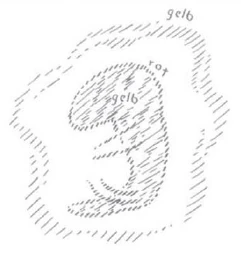
[ 32 ] Well, gentlemen, now follow me on a train of thought that is among the most important for our time. Let’s assume we have this human embryo (see drawing). If these red lines represent its solid parts, I’ll use this yellow to denote its fluid parts. That would be its liquid component. It is then still surrounded by all sorts of things. Now, through birth, it emerges into the outside world and becomes a real human being. And now it inhales air through its lungs and exhales it through its nose. Now you can, so to speak, grasp this tangibly: When a human being is born—that is, when it is here—it actually lives through its breathing process in conjunction with its soul. As long as he is in his mother’s womb, he lives in moisture, in water. What the human being actually is leaps, so to speak, out of the water into the air when he is born. And that which lives within us while we walk around on earth as already born human beings can only live in the air. Yes, try it for yourself—jump into the water and see if you can continue to live there! You’d have to be able to swim to get back out as soon as possible, or someone would have to fish you out. If you simply jump into the water, you certainly can’t live in it; as an earthly human being, you can only live in the air—you can’t live in water. But before birth, you live in water. Until well into the third week, you’re even shaped like a little fish so that you can live in water. You live in water until then. The earth does not allow you to live in water. Before birth, you live in water. What does that mean? It means that your life cannot come from the earth at all—it must come from outside the earth—because the earth does not allow you to live. Even as a born human being, you must rise from the earth into the air in order to live.
[ 33 ] But you have to live in water until you’re born. So your life doesn’t have to come from the Earth. The earth cannot give you your life. The spiritual life you have when you walk around on earth—the earth cannot give you that. You’d have to be a little ghost that can already breathe; but ghosts cannot breathe. So it’s impossible for the earth to give you your life—your spiritual life. Therefore, spiritual life comes from outside the earth. Anyone who understands how life is actually present in the process of breathing, and how life is already there in the child in the mother’s womb—though it is in a watery state—will immediately understand that this life sinks into the maternal germ from a spiritual world.
[ 34 ] You see, people often call a statement like that unscientific. But you can really have studied a great deal of science, and then come to the conclusion that what these people do in their science is far, far less logical than what I have just told you; for what I have just told you is absolutely logical. And unfortunately, the way things are these days, children are trained as early as school not to hear such things at all later on, or if they do hear them somewhere, they’ll say at most: “Anyone who says something like that is a crazy guy, because we learned in school how everything grows from the human germ.”
[ 35 ] But how did they learn that? They learned it in much the same way as if one were to try to teach someone that a human head grows out of a head of cabbage. Just as a human head cannot grow out of a head of cabbage, so too can nothing human—the entirety of human activity throughout life—grow out of a human embryo on its own. Yet children are already taught such things in school, things that are completely nonsensical.
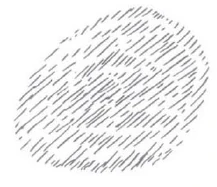
[ 36 ] I have already given you an example of this. Even the youngest children are taught today that the Earth, along with the entire solar system, was once a giant primordial nebula (see illustration). Of course, the nebula doesn’t do anything when it’s still. And that’s why people say: it’s spinning; so it spins quickly. As the nebula spins, it gradually thins out; then individual bodies break away, and the round body remains in the center. And you demonstrate this to the children, saying: You can try this yourself. — Take a small disc of cardstock with a pin stuck through it, put a small drop of oil in a glass of water so that it floats on top. Now spin the disc; the oil drop begins to move and rotate, tiny droplets of oil break off, and the large oil drop remains in the center. And that’s a small planetary system with the Sun. You see, children—as they say—you can always do this on a small scale. So it’s quite easy to understand that there was once a nebula that spun, and celestial bodies gradually broke off from it, while the large celestial body remained in the center.
[ 37 ] Yes, but, gentlemen, we mustn’t forget the most important thing. Why does the drop of oil spin? Because there’s a teacher there who’s spinning it. So there must be a gigantic schoolmaster out there in the vastness of space, sitting on a chair and spinning it, and eventually the planets will break away! Gentlemen, if you teach children this in school from the very beginning, they’ll grow up to be “smart” people; then later, when someone tries to be logical and questions the matter, they’ll say: “Well, he’s a dreamer, a fool, because we already learned in school how the whole world came into being!”
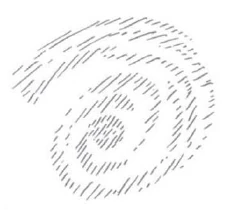
[ 38 ] You see, such ideas are not really reality at all; they are not reality. This cosmic nebula, which Kant and Laplace once conceived, is certainly not reality; it is so foolish to call such rotating cosmic nebulae reality. The only reason for this is that one can look out into the vastness of space with a telescope, and then one supposedly sees such spiral nebulae. Certainly, there are such spiral nebulae out there (see illustration)—that is true. But anyone who, by looking out there with a telescope and seeing these spiral nebulae, says: ‘Well, our entire solar system was once such a spiral nebula’—is about as wise as someone who sees a swarm of mosquitoes in the distance and mistakes it for a cloud of dust. One can, of course, mistake a swarm of mosquitoes for a cloud of dust; but then one simply forgets that the swarm of mosquitoes is alive and the cloud of dust is dead. The spiral nebula is alive out there; it has life within it. In the same way, the entire solar system once had life within it, its entire spiritual essence within it. And this spiritual essence is still at work today. When the human embryo is protected within the mother’s body through fertilization, then this protected human embryo can unite with the human spirit.
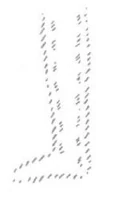
[ 39 ] And then, as we gradually grow older, gravity begins to make itself felt a little, namely because our individual bodily substances are affected by gravity. Just imagine this: it is a human lower leg (see drawing); a person has somewhat impaired internal digestion; as a result, life does not flow properly. Then all sorts of small, solid particles form in the muscles. These muscles become filled with small, solid particles—tiny urinary stones—and we develop gout. That is when we begin to notice the effects of gravity.
[ 40 ] If we are healthy and oxygen flows through our bodies in a truly revitalizing way as we breathe, then such urinary stones do not form, and we do not develop gout. Gout only develops when oxygen does not flow through our bodies in a truly revitalizing way and does not properly absorb carbon. If oxygen does not circulate properly through our bodies, carbon causes all sorts of problems, and tiny little fragments then appear everywhere in our blood vessels. We go about our lives and now feel this as an effect of the earth. We must be protected from it. We actually live only because our breathing constantly protects us from the Earth and its influences. The Earth is actually harmless to us simply because we are constantly protected from it. If we were constantly exposed to the Earth, we would be constantly ill. It’s very interesting.
[ 41 ] You see, around the middle of the 19th century, at a time when the natural sciences were achieving their great materialistic successes, people were completely astounded by this and wanted to explain everything that was happening on Earth through it. There was, in particular, a very enthusiastic “materialist”—a “Stoffhuber,” as they were called back then—and a particularly enthusiastic one was “the fat Vogt” in Geneva, Moleschott, and so on. They were very intelligent people; they freed humanity from many things. Nothing negative should be said about them—one can even praise them—but they were completely fixated on advances in the natural sciences and explained the whole human being as if only earthly influences had an effect on him. They forgot just one thing: namely, that when these earthly influences begin to affect a person, he first becomes nervous, and then falls ill in some way. It is precisely because a person is constantly protected from earthly influences that he remains healthy.
[ 42 ] But little by little, these earthly influences take hold of him. And how do they make themselves felt? Well, these earthly influences make themselves felt in that human beings no longer truly understand the art of breathing. They gradually forget how to breathe properly. And once he has completely forgotten how, he can no longer inhale properly, and he finds himself once again in the same state he was in before he was conceived. He first dissolves into the world ether and returns to the world from which he came. He returns, so to speak, with his last breath to the world from which he came. Whoever truly understands breathing also understands birth and death. But modern science as a whole simply does not understand breathing in the correct way.
[ 43 ] Now I have simply wanted to try to explain to you a little how human beings first learn to live in the world through the female egg, learn through male fertilization to live on Earth for a time, and how they then return to the state where they can once again live alone outside of Earth. One gradually learns to understand birth and death and begins to form a true concept of what one is in a spiritual sense—that which is not born and does not die, but comes from outside, unites with the embryo in the mother, and returns outward into the spiritual world.
[ 44 ] The fact is that today, especially when one is truly engaged in the natural sciences, one must understand the immortal spiritual realm, which is not subject to birth and death at all. And you see, this is something that humanity truly urgently needs today. For many centuries and millennia, humanity has held a belief in immortality that it can no longer possibly maintain today, because people are told all sorts of things that actually crumble in the face of natural science—that are nothing in the face of natural science. Everything one is supposed to believe today must also be something one can know. One must learn to grasp the spiritual correctly from within scientific knowledge itself—as I am doing here in these lectures for you. And that is the task of this Goetheanum and of anthroposophy in general: that the spiritual be correctly understood from within scientific knowledge.
[ 45 ] You see, gentlemen, it is so difficult to get people used to understanding something new in any way. It is Christmas time now. People could say to themselves: Well, we must understand in a new way how the spirit lives within the human race. — If people were to reflect on how the spirit lives within the human race and were to try to gain that understanding through true knowledge, then we would actually have everything anew. We could also celebrate Christmas in a new way, for we would celebrate it as it should be celebrated in modern times. Instead, people persist in always researching only the dead in science and, alongside that, perpetuating the old traditions to which they no longer attach any meaning at all. I would like to know what meaning people who give each other Christmas gifts and celebrate Christmas today still associate with Christmas. None at all! They do it out of old habit. And besides, don’t you think, a natural science is simply taught that is internally contradictory throughout. Nowhere is there any willingness to acknowledge that natural science itself offers something that can lead to an understanding of the spiritual.
[ 46 ] But we can already say today: If Christianity is to have any meaning at all, it must commit itself to regaining a true knowledge of the Spirit. That is the only way forward; it is not enough merely to perpetuate the old. Isn’t it true that reading the Bible aloud to people during festive seasons in the old-fashioned way—what does that actually mean? Or even merely reading the ordinary Bible to children in school—what does that mean when you then casually tell them: “There was a primordial mist that swirled”? That creates a complete contradiction between the head and the heart! You see, and then people completely forget how to truly be human on Earth, because they no longer know themselves at all. A fool is one who believes that we, as human beings on Earth, consist of what is heavy—merely of the physical body we place on a scale and weigh. We have no need for that at all. A fool is one who believes that we consist of these material substances that have weight. In reality, we don’t even notice this “guy” because we protect ourselves from it so as not to become ill. And curing the illness consists in removing the earthly influence that is affecting the sick person. Anyone who has given this some thought knows that all healing actually depends on freeing the person from earthly influences. If you cannot free them from the earth and its influences, then you cannot heal them. Then they lie down in bed, surrender to the weight, and let the bed carry them. You simply cannot support yourself when you are lying down.
[ 47 ] But on the one hand, we have old habits, and on the other, modern science, which does nothing to enlighten people about what it means to be human. Nothing good can come of that. And you see, the fact is that the World War, with all its consequences—which we are still suffering from today—would not have happened if people had somehow known something about their humanity beforehand. But they still don’t want it now. They still want to gather at conferences, without any new ideas, repeating the same old things over and over. They can’t manage it—nowhere can they manage it—to come up with new ideas. For whatever first takes root as convoluted thinking within humanity becomes a way of life, and that is our social order today. And we will not return to anything in the world until we once again truly sense, from within, what a human being actually is.
[ 48 ] That is actually the mental image that those who understand what “anthroposophy” aims for envision as Christmas. Christmas is meant to remind us that a spiritual science is to be born once again. Spiritual science is the finest spiritual being that can be born. Humanity is in dire need of a Christmas. Otherwise, it will have no choice but to retain only the cross from Christ and cast aside the living Christ. For conventional science is, in fact, merely the cross. But we must return to the living. That is what we must strive for.
[ 49 ] Well, gentlemen, that is what I wanted to say today as a follow-up to what I said earlier. I wish you all a very happy holiday season!