

On Health and Illness
GA 348
27 December 1922, Dornach
Translated by Steiner Online Library
Ninth Lecture
Question:
1. Question regarding the transmission of diseases;
2. Regarding hay fever.
The person in question has been suffering from hay fever for years. He has now heard that patients should be treated in advance. It is better to get the shots as early as January or February, rather than waiting until he is already suffering from the condition. A doctor in Basel told him this. The medication is absorbed better into the bloodstream that way. Should he do the same with the hay fever medication?
[ 1 ] Dr. Steiner: That’s correct; there’s just one small catch. Namely, this very remedy that we use is designed—as they say—to act prophylactically, that is, in advance, and should actually be taken for weeks before hay fever symptoms appear; but the only catch is that patients don’t come in until they’re already suffering from hay fever.
[ 2 ] We just received a very interesting letter today in which someone writes about another hay fever remedy. The inventor of the other hay fever remedy writes that his remedy actually only helps to relieve individual hay fever attacks, whereas he himself believes that our hay fever remedy, especially when used twice in a row at longer intervals, provides lasting relief from hay fever.
[ 3 ] Well, the thing is, we would of course much prefer it if patients sought treatment in January or February rather than in May or June. But people usually come in—and this is understandable—only after the illness has already broken out in some way.
[ 4 ] But with our hay fever remedy, the situation is such that even if one treats the patient with it during the external manifestation of the disease—which is, after all, merely the final stage of an internal illness—especially if one applies it again after a year; it is not necessary to use it repeatedly—it nevertheless protects the patient from being struck by the illness again, because it is actually assumed that the disease is always present throughout the entire organism and only manifests itself particularly in a single organ.
[ 5 ] If I am to explain this to you, I would like to talk about the way in which illnesses arise in the first place when they come from within. I have already made a few remarks about this, but I would like to explain to you once and for all how illnesses arise when they originate from within. It is, of course, very easy to understand why one becomes ill when one breaks a leg or cracks one’s skull after falling. In such cases, there is simply an external injury, and it is very easy to understand. After all, the cause of the illness is visible from the outside. But with so-called internal illnesses, people usually don’t stop to think about where they come from or how they suddenly manifest themselves. And this ties in with the question someone asked earlier—the question of how it happens that, when you come into close contact with a certain sick person, you become infected. That, too, seems to be an external cause.
[ 6 ] Conventional science answers this very easily by saying: Well, germs simply fly off from a sick person—who has the flu, for example—and then I breathe them in, and they make me sick. It’s just like if someone hit me with a pickaxe and I got sick from it: the sick person throws a bunch of germs at me, bombards me with them, and that’s how I get sick. — Well, things are by no means that simple; rather, they’re actually quite different. And you can understand this if you start from the premise that, in everyday life, people actually always get a little sick and always heal themselves a little. In fact, our ordinary physical life consists of constantly getting a little sick and healing ourselves a little. But that’s not quite accurate in the strictest sense either. Each of us is a little sick when we’re thirsty or hungry, and we heal ourselves a little when we drink and eat. After all, you understand that one can rightly say: Hunger is the beginning of an illness if it persists for a long time. You die from it. After all, you can die of hunger—and even more easily of thirst. So even in ordinary, everyday life, there is something akin to the beginning of an illness. Every time you drink is a form of healing, and every time you eat is actually a form of healing.
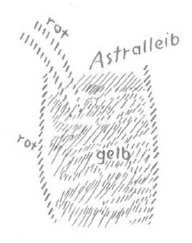
[ 7 ] But now we need to understand what actually happens when we get hungry and when we get thirsty. So let’s take the first one: when we get hungry. You see, our body is never at rest internally; it’s always engaged in internal activity. And I can explain this internal activity—which our body is constantly undergoing—to you in a rough, approximate way through a drawing. Imagine this is a small part of our body (see drawing), and into this part of our body we allow nutrients to enter through our diet—that is, external substances that we take in through food. Now they’re inside. For the sake of explanation, we’ve taken them in from the mouth through the digestive tract to somewhere in the body.
[ 8 ] But you see, when these nutrients enter our bodies, our entire human being immediately rebels against them. The human body does not leave the nutrients as they are, but rather breaks them down. The nutrients must be broken down—in other words, actually fragmented. They are already broken down in the mouth. In fact, one might say they are completely destroyed. They are destroyed. And this is because there is a constant process going on inside our bodies that never stops. One must view this activity in the same way one must view fingers or hands, for the body is constantly engaged in internal activity, and one cannot proceed as conventional science does—simply observing how we eat a piece of bread, how that bread is then broken down in the mouth, and how it is distributed throughout the body—but rather one must take into account that the human body is constantly active. But now consider this: If I put nothing into it—if the human body is there and nothing enters it, if the meal is already far behind us, four or five hours have passed, and nothing is entering it—yes, but the activity within the body does not cease.
[ 9 ] So I will consider what I’ve marked in red as what one usually sees, and I will now mark what constitutes inner activity in yellow. But this yellow is actually in a state of constant inner trembling, in a state of constant activity. You see, right now you are, so to speak, an empty tube—but it is not calm inside; rather, there is a rumbling going on within. You are in a state of inner activity. And as long as you have something for this inner activity—something toward which it can direct itself—then this inner activity is content. This is especially the case after a meal. Then this inner activity can break down and destroy all the substances. It is satisfied with that. You see, that is the difference between this inner activity that we have within us and the human being as a whole, as he exists among us. He can become lazy. But this inner activity never becomes lazy; it never stops at all. And if I put nothing into myself, it is as if I had an empty flour sack, but there is activity inside it, even if I avoid all matter. In Spiritual Science, we call this the astral body, for certain reasons that I will explain to you later; it is never lazy, it is always active. When it can be active—breaking down, fragmenting, and dissolving this food—it is filled with inner contentment; it experiences its inner pleasure. If I do not introduce any food into the body, then it is unsatisfied; this dissatisfaction manifests itself, and the manifestation of this dissatisfaction is hunger. Hunger is not something passive; hunger is an activity within us. So one must say: Hunger is truly a psychic-spiritual activity within us that cannot be satisfied. In fact, one can truly say: This activity within us is in love with food, and when it does not receive food, it is just as unsatisfied as any lover whose beloved has run away and is not there. And this dissatisfaction is hunger. Hunger is definitely something spiritual.
[ 10 ] Well, the activity that takes place inside the body consists in the digestion of food, whereby the useful components are absorbed into the bloodstream, while the rest is excreted through urine or feces. And in this way, the healthy functioning of the human being proceeds regularly, so that his astral body has the opportunity to work properly—to properly break down and dissolve the food, to incorporate what is useful into the body, and to expel what is not useful.
[ 11 ] This human activity cannot be merely a general one; rather, it contains something immensely wise. For suppose the lungs were up here (see illustration on p. 160), and further down we have the spleen; the lungs up here, the spleen down there. Blood vessels lead to both the lungs and the spleen, through which constantly broken-down and transformed nutrients are sent. Indeed, the lungs require entirely different substances than the spleen! It is precisely as if you were to regard this activity—which I have described to you as the astral body—as though the astral body were far more intelligent than the human being. The human being, after all, can’t do anything except shove food into his mouth. But this activity I’ve described—it separates substances, just as if you were busy separating two substances from one another, sending one over there because it’s to be used there, and sending the other over there. That’s what this activity does. It separates certain substances and sends them to the lungs, certain substances it sends to the spleen, other substances it sends to the larynx, and so on. There is a wise distribution taking place there. And what we call our astral body is immensely wise—wiser than we are ourselves. If you were to ask the most learned person today how to ensure that the right substances reach the lungs, the larynx, or the spleen—well, they wouldn’t know what to say. But deep down, the human being knows this; their astral body knows it. That is simply how things are when viewed correctly.
[ 12 ] However, this astral body can also become stupid—still not as stupid as a human being, but it can become stupid relative to its own intelligence. This astral body can also become stupid. Let us suppose that it becomes stupid in the following way.
[ 13 ] By virtue of being born in one way or another, human beings are inherently endowed with certain powers. Their astral body—that which is active within them, that which also feels hunger—actually depends on developing more than just this kind of inner activity. The activity that develops in response to food is also developed when a person sits down and remains seated all day like a pagoda, like an Eastern idol; the astral body would still be active in that case. But that is not enough. We must also do something externally. We must walk around. And even if we have no work to do, we must go for a walk. The astral body also demands that we walk around. And this varies from person to person: some need more movement, others less.
[ 14 ] Let us now assume that, because a person has certain innate tendencies from birth, he becomes a person who sits around a lot. It pleases him—in his foolish mind, or one might even say, in his ego—to sit around a lot. So if he sits around a lot, but his astral body is predisposed to moving around a lot, his astral body becomes dull—just as when someone overexerts himself while walking. In both cases, the astral body becomes dull and no longer functions properly—it fails to properly sort nutrients and send them to the correct organs, but instead does so clumsily. Let’s say, for example, that it can no longer properly coordinate sending the right substances to the heart or the larynx. Well, then something happens! If, say, the wrong substances are sent to the heart, those substances—which are already present in the right form in the food—end up lingering somewhere in the body. And because they are actually useful, they neither end up in the right place nor are they excreted in the urine or feces. They accumulate in the body. But the human body cannot tolerate anything that is not functioning properly accumulating within it; the human body cannot tolerate that.
[ 15 ] What happens to what we, so to speak, excrete as “dirt” within ourselves because the astral body is not functioning properly? What happens as a result? Well, let’s assume we have this dirt inside us. I want to focus on a specific type of dirt—for example, the dirt in the larynx. Because a person is unable to ensure that their astral body functions properly, larynx waste is secreted throughout their body. The first thing that happens is that their larynx becomes weak because it does not receive the proper nourishment, so that the person has a weak larynx. And on top of that, they have this larynx waste in their body. But what does this laryngeal sludge do? Well, first of all, it accumulates. To begin with, we have this sludge inside us. But as I’ve told you: A person isn’t just a solid body; ninety percent of them is water—actually, a column of water. And as a result, this laryngeal sludge now dissolves throughout this watery being. So the human being does not have the pure, vital water inside him that he needs, but rather he now has water in which laryngeal sludge is dissolved. You see, this is what so often happens to us—that we have dissolved laryngeal sludge, or heart sludge, or stomach sludge, or something else entirely, within our water-based being.
[ 16 ] So let’s say we’ve dissolved the mucus in the larynx. It then makes its way to the stomach. There, it doesn’t do much harm, because the stomach doesn’t need it. It has what it needs. Nothing has been taken away from it. But the water, which flows everywhere in the human body, is also in the larynx region. The larynx has already become weak, as I told you. On top of that, it receives this contaminated water—water that has dissolved the laryngeal waste. This is precisely what makes the larynx sick. The other organs do not become sick from the laryngeal waste; but the larynx does become sick from it.
[ 17 ] Well, let’s take a very simple example. Let’s assume there is a person who has a more refined sensibility. When a person has a more refined sensibility and listens to another person speaking—well, you see, it’s quite pleasant when someone speaks beautifully. But if someone crows like a rooster or grunts like a pig, it’s not pleasant to listen to, even if you understand everything. It’s unpleasant to listen to someone who caws like a raven or grunts like a pig. And especially if someone is hoarse, there’s something distressing about listening to them.
[ 18 ] Where does this feeling we have when listening come from? You see, it comes from the fact that we are actually always repeating, in a very subtle way, what the other person is saying. Listening consists not only in hearing, but also in speaking—in a way that is inaudible and very subtle. We don’t just hear what the other person says; we also mimic it with our speech organs. We always mimic everything the other person does.
[ 19 ] And now let’s suppose we aren’t listening to someone else and inwardly imitating what they say, but rather—perhaps even feeling a little compassion, which is a way we can show sensitivity—we are in the presence of someone with the flu. The person with the flu has dissolved a great many substances in his entire watery being. The substances he has dissolved mean that he does not have in his water the pure, living water I spoke to you about in the lecture, but rather he has within him a kind of water that is unhealthy for humans. I can even describe to you what kind of water they have within them.
[ 20 ] Let's say you have some kind of soil here. Well, if you have some soil here, you can plant various things in it. But not everything thrives equally in every type of soil. Now, I want to plant onions and garlic right here on this patch of soil. It’s a strange idea, I know, but let’s assume I want to plant onions and garlic right here. You see, I’m not just going to plant onions and garlic, because if the soil isn’t suitable, that would result in me getting terribly small onions and very small garlic cloves; instead, I’m going to add something to the soil that contains sulfur and phosphorus, and I’ll get the most wonderful onions and garlic! And they’ll smell like it, too.
[ 21 ] Now, if someone happens to have the flu, what happens is that the substances I need to add to this soil—so that I can grow the most wonderful onions and garlic in it—dissolve within them, within their “watery being,” and then the sick person begins to smell just as you described.
[ 22 ] But now I’m going along with it. I might not even notice that I’m sitting in the smell of onions, in the smell of garlic, because it doesn’t have to be particularly strong. This garlic scent he has causes his head to feel dull, because a very specific organ in the head—called the sensorium—isn’t being properly supplied with nutrients. That’s why we have this flu-like stuff inside us: because an organ right in the center of the head isn’t being properly supplied. In this scent—which you can detect with a very sensitive nose—there’s always a hint of onion and garlic. Yes, we take part in that. Just as we mirror a person’s hoarse and grunting voice, so too do we internally mirror what the person is exuding, and as a result, our own astral body and our own activity become disrupted. This, in turn, causes a kind of “soil”—suitable for onions and garlic—to settle within us, and we end up catching the flu. This has nothing to do with bacteria or germs; it simply has to do with the relationship between people.
[ 23 ] Now, if I have a garden like this where I want to plant onions and garlic in particular, and I bring in substances containing phosphorus and sulfur—I can wait and say: Well, I’ve done my duty; I want onions and garlic, so I’m bringing sulfur and phosphorus into my garden in some kind of plant fertilizer—but I’d be a fool to believe that onions are already growing there. I have to plant the onions first. Likewise, I am a fool if I believe that bacteria and germs are already growing inside a person on the ground that is being prepared there. They have to get in first. For just as the onion feels at home in soil rich in phosphorus and sulfur, so do these germs feel at home in there. There’s nothing they like better than being in a little sulfur. And I don’t even need the bacilli for the flu to spread from someone else to me; rather, if I participate in my “water man”—in the way I’ve just described to you—in what is taking place in his “water man,” I myself thereby become fertile ground for the bacilli, and I acquire them—the bacilli—for myself. He doesn’t even need to bombard me with them.
[ 24 ] But the fact is that, when we look at the whole matter, we must answer the question—“What actually causes us to fall ill?”—in a very specific way. We must tell ourselves: If something injures us, we become ill as a result. — But even in the case of internal illnesses, something actually injures us. We are injured by water that is not pure, in which substances have dissolved that should actually have been digested. This injures us internally.
[ 25 ] And now you can also target conditions such as hay fever. Hay fever depends much more on the season itself than on the pollen floating around. What makes a person prone to hay fever is, above all, that their astral body does not secrete properly—it does not properly carry out the activity that is directed more toward the outside. And the consequence of this is that, as spring approaches—when everything begins to thrive in water—the entire “water being” dissolves specific substances into this general body of water, and as a result, the entire “water being” becomes more sensitive.
[ 26 ] You see, here’s how it is, if I sketch it out roughly: If I were to draw the water man—the normal water man—I would have to draw him in such a way that, since he is prone to hay fever when spring comes, his water is actually always slightly diluted as a result of my dissolving substances.

[ 27 ] The “water element” is always a bit too strong in people prone to hay fever. What I dissolve inside pushes the water apart. This makes one sensitive to everything that occurs in the spring, and in particular to those pollens—that is, those grains that come from plants—which are now especially irritating.
[ 28 ] If your nose weren't blocked—even though it is, these plant pollens still get into your nose—but if it weren't blocked, you could also be triggered by many other things to develop hay fever. It’s just that this plant pollen is such that it’s hard to tolerate if you already have hay fever. It doesn’t cause hay fever; it simply triggers it.
[ 29 ] Well, you see, our remedy for hay fever works directly by causing this expansive “water man” within the human body to contract again, so that he becomes somewhat cloudy, and then excretes what he has dissolved. Our remedy is, in fact, terribly simple. It is based solely on bringing the entire “watery being” back to its normal state. As a result, it initially becomes somewhat cloudy, and one must then ensure that afterward the person does not retain within the body what is excreted from the water. Therefore, it is good if, after being inoculated with our hay fever remedy, the person can, for example, sweat a little or move around. If, immediately after being inoculated with the remedy, the person does something that prevents proper sweating from occurring, or if they receive the hay fever remedy while suffering from constipation, the inoculation can be somewhat difficult. For example, when inoculating with the hay fever remedy, one should ask the person whether they are currently suffering from constipation. For if he is constipated, then precisely because the “water person” is being contracted, waste accumulates too heavily and is not immediately excreted. That is not good. If someone says he is constipated when he is being inoculated, one should give him a laxative at the same time.
[ 30 ] Healing does not consist merely—and this is always important, gentlemen—in teaching someone something, but rather in organizing one’s entire life in such a way that the human body responds correctly to what has been taught to it. This is, of course, immensely important; otherwise, you can actually drive someone deeper into illness. If you vaccinate someone with a certain substance—even if it is a very good, an excellent substance—and then fail to ensure that they have proper digestion so that everything produced is eliminated, you will make them sicker than they were before.
[ 31 ] This is especially important when it comes to proper remedies: the doctor must not merely know, “For this illness, I use this or that,” but must also know how to ask questions of each individual patient. The greatest skill of a physician is that, when any patient presents, one asks them the right questions so as to get to know them to a certain degree. This is of immense importance. It is strange, for example, that one encounters doctors who speak of a patient, and if you ask them, “How old is he?”—they haven’t even asked him! But this is so important that a fifty-year-old must be treated quite differently—even if with the same remedies—than a forty-year-old. However, one must not be so formulaic as to say, “This remedy is good for that particular illness.” There is a huge difference between trying to help someone who is constantly suffering from diarrhea with a certain remedy and trying to help someone who is constantly suffering from constipation. Such remedies could certainly be tried.
[ 32 ] For example, animal testing would be much less controversial in this context than in other areas. Suppose that, within the general organism shared by humans and animals, a certain remedy is effective against constipation or diarrhea in humans. Well, it’s easy to verify this: simply administer the remedy to both a dog and a cat at the same time. Dogs usually suffer from constipation, while cats suffer from diarrhea. And if you observe the difference in how the remedy affects the dog versus the cat, you’ll uncover a marvelous science. Science is not actually developed by being trained at the university to perform this or that using certain instruments; rather, it is developed by awakening a little bit of intelligence in the mind and by people knowing how to conduct the investigations.
[ 33 ] So it is particularly important to understand that a disease actually affects the entire human organism. And the individual organ is attacked precisely because this activity—which I have called the astral activity—directs the substances arising from that inner activity toward the individual organ.
[ 34 ] Now I have told you: Certain internal illnesses arise, such as the flu, hay fever, but also many others—it can even go as far as typhoid fever and so on; and all of this can be understood, for example, if one accepts, as I have already told you, that the substances which are deposited unused within us are actually dissolved in the water-man.
[ 35 ] But we are not merely the water being; we are also the material being, which lies at the foundation—I have depicted it here (see drawing on p. 168) in white, while I have depicted the water being in yellow. And now, as I have explained to you, we are also the air being, which I have indicated here in blue. We are constantly the air being, even though it changes from moment to moment—sometimes the air is outside, sometimes inside—but we are an air being.
[ 36 ] But just as the solid particles—which we have within us as impurities—dissolve in water, so too does the water within us constantly evaporate. Take your little finger, for example; there, inside the muscles of the little finger, are vapors of water—subtle vapors. Water is constantly evaporating throughout your entire body. And what evaporates from the “water-being” goes into the oxygen that the person takes in; that, in turn, is vapor or gas. When water evaporates down there on the ground, this water simply enters the air; and when the water inside the water-being constantly evaporates in a fine way, it enters the air that the human being breathes in. The human being can no more tolerate water evaporating into the air-being than he can tolerate solid substances dissolving in water.
[ 37 ] So let’s assume that, because something of the kind I described today has happened—let’s say, because of me—a person’s lungs have become diseased. Now, this lung disease can be cured if it arose because impure substances have settled in the “water-human.” But let’s assume that the lung disease isn’t severe enough to manifest externally. Human organs are, after all, quite delicate things. So it doesn’t come to the point where the lungs become so severely diseased that I find them inflamed or anything like that, but it does happen that they are a little sick. I can tolerate the fact that the lungs are a little diseased, but substances still enter my “water being” that are actually supposed to go into the lungs. And what is then inside them is water that contains dissolved foreign substances; these evaporate along with the water, and they evaporate particularly easily when my lungs are not completely healthy.
[ 38 ] So while in the past the “water person” tended to absorb harmful substances from solid foods in connection with grossly noticeable internal illnesses, harmful substances now evaporate and combine with the oxygen that is absorbed. And this—that water, which evaporates improperly, combines with the oxygen—becomes particularly harmful to the nervous system, because the nerves need healthy oxygen, not the kind that has evaporated from the poor-quality water within the “water person.” Thus, the lungs can cause their own minor ailments by allowing bad water to evaporate within them, causing something that should not evaporate to be carried along with it. This is particularly harmful to the nervous system, and although the person does not become outwardly ill in the conventional sense—what is commonly called a disease—he goes mad.
[ 39 ] So one can say: The so-called physical illnesses, when they originate from within, are based on the fact that, in some way, the human being is caused to dissolve incorrect substances into his “water-man.” But the so-called mental illnesses are, in reality, not mental illnesses at all, for the spirit does not become ill. So-called mental illnesses stem from the fact that water evaporates incorrectly into oxygen, thereby disrupting the nervous system—even if a single organ is only slightly ill, so slightly ill that you cannot perceive it externally. So you see that this is precisely where we come to the realization that human beings are actually constantly dependent on processing substances correctly, so that nothing incorrect dissolves into their water, and so that their water does not evaporate in an incorrect manner.
[ 40 ] But you see, even in everyday life there are things that cause water to evaporate improperly. We notice this when we are thirsty. But we quench our thirst by drinking. In doing so, we repeatedly rid our water of whatever evaporates from it improperly, and we flush out the impurity.
[ 41 ] And so one could say: Hunger actually contains the predisposition to physical illness, and thirst contains the predisposition to so-called mental illness. We could actually say: If a person does not eat properly, they thereby lay the foundation for physical illnesses. If a person does not properly quench their thirst—and this can be much harder to notice under certain circumstances, particularly when it occurs in childhood, when one cannot quite distinguish between quenching thirst and satisfying hunger because both are met by milk— that is, essentially by a liquid, a watery substance—if, therefore, something perishable enters the body through breast milk or wet nurse’s milk, this can, even later in life, cause the “water person” to be unable to transpire properly, and can manifest as some form of mental illness. Or if we, say, vaccinate a person incorrectly, then an incorrect vaccination with this or that cow lymph or even with lymph from a sick person can cause—for example—not the water itself to become diseased, but the organs that process the water—the stomach processes water differently than it processes solid food—to become diseased. And as a result of incorrect vaccination—because the person does not properly metabolize—a predisposition to some form of mental illness may develop later on.
[ 42 ] You will have noticed, gentlemen, that a great many people today are afflicted with what is known as dementia praecox. Dementia praecox is what is commonly called “juvenile insanity”—though it extends well beyond adolescence—a condition in which people begin to lose their mental faculties as early as their youth. Yes, this stems largely from poor nutrition in the very earliest years of childhood, and because people have simply stopped paying attention to this during that time. For a mere chemical analysis of infant formula is not enough; rather, an entirely different approach must be developed. That is why these issues are occurring so vehemently today.
[ 43 ] But this also shows you that it is of no use to simply train doctors who know that this remedy is for this illness and that remedy is for that illness; rather, we must make life as a whole healthier. However, this can only happen once we come to understand everything that is connected with it. That is what we aim to do with anthroposophy. That is why anthroposophy is something that is very much aimed at having a positive effect on hygiene and at truly understanding health.
[ 44 ] This essentially answers the questions posed by the two gentlemen.