

On Health and Illness
GA 348
30 December 1922, Dornach
Translated by Steiner Online Library
Tenth Lecture
A question is asked regarding pregnancy and ways to influence it during pregnancy.
[ 1 ] Dr. Steiner: These matters, gentlemen, are matters of life that must be treated as extraordinarily important. It is generally the case that one cannot exert a particularly strong influence on the child during pregnancy other than indirectly through the mother, for the child—as you will see from some of what I have already said here—is so closely connected to the mother through numerous fine blood vessels that it receives nutrients from the mother, as well as a completely different way of breathing later on, and that it receives the things it needs from the mother.
[ 2 ] Isn't it true that the issues you've just touched on can best be examined if we spend a little more time—especially in light of your two questions—on the topics of human illness and health in general? For in the case of pregnancy, it is actually even harder than with ordinary hunger and thirst to say where the tendency toward illness begins and where it ends.
[ 3 ] Furthermore, certain aspects of pregnancy provide compelling evidence of how the mother’s emotional state has an extraordinary influence on her unborn child. You need only observe what happens when, for example, the mother experiences a great shock, particularly during the first months of pregnancy. As a rule, the child carries this with them throughout their entire life. You couldn’t say that a physical change occurred in the child from the outset; rather, it was the mother who experienced a shock. How can a shock experienced by the mother affect the child?
[ 4 ] You see, modern science essentially offers only a very inadequate answer to this, because it knows absolutely nothing about what is at work in the human soul and spirit—or at least pretends to know nothing. The best way to approach these difficult questions—for these are indeed difficult questions, the ones Mr. Dollinger has just raised—is to take a close look at two phenomena that occur most prominently during the course of the illness. These are, first, fever, and second, collapse. These are two opposing phenomena that a person experiences: fever and collapse.
[ 5 ] What is a fever? Well, you know the answer: it manifests itself externally in that a person’s body temperature, when measured in the usual way, does not exceed 36 to 37 degrees; if the body temperature rises above that, we say the person has a fever. A fever is outwardly visible in that the person becomes hotter.
[ 6 ] What is collapse? Collapse is actually the opposite state. Collapse occurs when a person is unable to generate sufficient internal warmth. For example, if you take a certain amount of a particular toxin—one that is also used as a remedy—if, for instance, you take the toxin known in medicine as hyoscyamine—which comes from henbane—and administer it in an excessive amount, beyond a certain limit, you expose the person to the risk of going into shock.
[ 7 ] The process is, in fact, that precisely in the mother’s lower abdomen—where the child must also develop—the collapse causes all the membranes present there—that is, the membranes of the intestines, but also the membranes of those organs within which the child lies during pregnancy, the membranes of the so-called uterus— —in other words, all the membranes in the lower abdomen—become stretched as a result of, for example, the introduction of such a toxin. It is exactly as if I were to stretch a sack beyond its own tensile strength; it then becomes frayed and can no longer hold things. And so all sorts of substances supplied through food accumulate when henbane poison is introduced in this way, and the person is no longer able to function properly in the lower abdomen, in the manner I just described to you last time. A great many things accumulate in the lower abdomen that the body cannot process.
[ 8 ] Well, gentlemen, to understand how this actually works, one must once again look deeper into the human organism. What actually happens when the lower abdomen isn’t functioning properly? Not only is the lower abdomen not functioning properly, but you will find every time that when the lower abdomen isn’t functioning properly, the brain—particularly its frontal lobe—is also not functioning properly. A very interesting connection!

[ 9 ] Suppose you have the human body: the lower abdomen, the chest, and here, roughly, the diaphragm (see drawing)—that is, the lower abdomen, the chest, and the head. Especially when something is wrong in the lower abdomen, something is also wrong in the front part of the brain. So these belong together. They belong together internally within the human being: the front part of the brain and the abdomen. And again, if, for example, the heart is here with the veins, as I have described to you, then the heart and the middle part of the brain belong together. And when it comes to breathing—the upper part with the lungs—then the lungs belong together with the rearmost part of the brain.
[ 10 ] Whenever there is something wrong with breathing, there is also something wrong in the deepest part of the brain. You can see this from the fact that when someone suffers from shortness of breath—when they’re not getting enough oxygen—there’s always something wrong in the rearmost part of their brain. When someone suffers from a heart disorder—namely, when the heart isn’t beating rhythmically, so that the pulse is irregular—you’ll always find that something is wrong in the midbrain as well. And if something is wrong in the lower abdomen, one always finds something irregular in the forebrain as well. Everything in the human being is so wonderfully interconnected. So one can say: Precisely what is happening in the lower abdomen is connected to the configuration of the forebrain.
[ 11 ] You see, sometimes people don’t want to admit this because they view the forehead as the noblest part of the body and the lower abdomen as the least noble. And when you tell them the truth, they consider it unworthy of a human being. But as you will have seen from my lectures, the digestive system is ultimately so closely connected to the limb system that this is something very important in human beings.
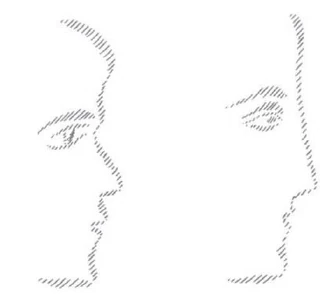
[ 12 ] I once knew a gentleman who had this kind of forehead—a very rare type of forehead (see drawing on p. 179, left). A Greek forehead is different. It looks like this (see drawing, right). In all Greek statues we find this forehead shape, which slopes straight backward. This gentleman, in fact, had a powerful bulge right here, and the frontal lobe of his brain protruded completely at the top. I am convinced that the man whose brain had protruded so far forward had an exceptionally well-developed abdomen and never suffered from diarrhea or constipation, for example; nor did he ever suffer from stomachaches or the like. This man was, in fact, a person with extraordinarily refined sensibilities. But these sensibilities were such that he was actually always dependent on feeling comfortable internally. This suggested that his powerful, forward-leaning forehead never allowed anything to go wrong in his lower abdomen. So you can see from this that, in a remarkable way, the human being is connected to his lower abdomen through his head organs.
[ 13 ] If I give a person too much henbane juice, they will go into shock. What causes this shock? Well, something is wrong in their forebrain because all sorts of things are accumulating in their abdomen. But here’s the strange thing: If I have a person who complains of a certain kind of abdominal pain—which may stem from a slight blockage in the intestines—then I can, with a clear, indeed the very best, conscience, give them henbane juice, very, very strongly diluted, and they will recover. They’ll develop a slight fever and then get well.
[ 14 ] So you see, here is the strange fact: If I give a person—who is even healthy because of me—too much henbane juice, he goes into shock, and his abdomen becomes terribly disordered; his head grows cold, his abdomen swells as shown in Plate 13, his intestines dilate, and his abdomen ceases to function. What do you make of this? You can see from this that I have administered too much henbane juice into the stomach. By doing so, I have forced the stomach—stimulated it—to digest a great deal, for henbane is terribly difficult to digest. To be poisonous means nothing other than: difficult to digest. So the stomach is expected to do an enormous amount of work. The brain—specifically the forebrain—is not strong enough for this. This is how things are interconnected in the human body. The brain is not strong enough to stimulate the stomach to carry out this incredibly intense activity, and the brain grows cold, and the person goes into shock.
[ 15 ] What happens, then, if I give a person a very small dose—that is, a highly diluted solution of henbane juice? The stomach has little to do with it; the brain is strong enough to manage and regulate this minor activity, and by introducing just a little henbane—which can be processed—I actually stimulate the brain to work harder than before. If the brain can handle it, it’s just like when I give a person a task they can handle. If I give them a task they can handle, they do it well; if I give them a mountain of work for one day that actually takes ten days, they’ll be overwhelmed by it. It’s the same with the brain. Inside it is the worker for the lower abdomen. If I don’t challenge the brain enough, it becomes lazy; if it is stimulated by its activity, things go well; but if I overburden the lower abdomen, it stops participating, and the person suffers a breakdown.
[ 16 ] What causes a fever? A fever is caused by the brain becoming highly active and permeating the entire body. Suppose a person develops some kind of disorder in an organ—say, the liver or the kidneys, or specifically the lungs—in the manner I described to you the other day. The brain then begins to revolt against it. If the lungs are no longer functioning properly, the hindbrain begins to revolt and, in turn, stimulates the forebrain to join the revolt against this illness of the lungs, and this is what causes the fever.
[ 17 ] But that means a person is warmed from the top down, starting from the head, and cooled from the bottom up. That is actually very interesting. A person is truly warmed from the top down. We create fever with our head. And when an inflammation occurs in the big toe—the fever we develop is generated by our head. It is even interesting that what lies farthest down is regulated by the very front parts of the brain. Just as in a dog, what lies farthest back is regulated by the nose, so it is with humans as well. When a person develops a fever in the big toe, the activity that generates the fever is located right at the front. A person must accept—in keeping with their dignity—that when they develop an inflammation in the big toe, their fever comes from right at the front, just above the nose; so that a person is always warmed from above and cooled from below.
[ 18 ] This is also why, when we introduce certain substances into the human body in excessive amounts, we cause a collapse; yet we can induce a healing fever if we do not overburden the brain and instead stimulate brain activity with small amounts of the substance. But brain activity is not stimulated throughout the day solely by substances we introduce into the brain; the brain is constantly stimulated whenever you see or hear something. And even when you eat, you’re not just stuffing food into your stomach—you’re tasting it. Your sense of taste is stimulated. Your sense of smell is stimulated. These are all stimuli originating in the brain.
[ 19 ] Now imagine a woman who is pregnant. The child is in the early stages of pregnancy. Yes, this causes a tremendous increase in abdominal activity. What has to take place in the lower abdomen there is something that doesn’t need to happen at all outside of pregnancy—and never happens at all in men. So abdominal activity is increased tremendously. And when abdominal activity increases, the sensory nerves are stimulated above all else, because the lower abdomen and the frontal part of the brain are connected.
[ 20 ] If a person is simply hungry, what does that mean? I have told you that a certain activity—one that is actually supposed to be carried out continuously—cannot be performed. When a person is hungry, he longs for food. But that also means that his taste buds need to be stimulated. He longs for stimulation of his taste buds. Well, he can satisfy that need simply by eating.
[ 21 ] But when a woman is pregnant, if there is something in her abdomen that concerns the developing child, all sorts of sensations are also stimulated in the brain—particularly in the sensory nerves, taste nerves, and olfactory nerves. In that case, it doesn’t do much good for the taste and smell nerves to be given food, because it doesn’t go directly to the child but first only into the stomach, since the digestive system has to work overtime. In a sense, the abdomen has to work overtime. Consequently, a need arises in the head for heightened tastes and smells. And the point is that the best way to care for the child, of course, is to have an understanding of these things.
[ 22 ] It will even happen with a great many pregnant women that they are not at all satisfied when you give them exactly what they happen to want at that moment, because once they have it, their tastes have already changed. They are, in fact, extremely fickle at the same time, and their tastes have already shifted again. But you can satisfy them by being kind to them, by responding to what you believe they are actually imagining. For it is fantasies of taste and smell that pregnant women live in, especially during the first few months. And if you simply say, “Oh, come on, it’s all just a fantasy!”—then that really is like an emotional blow to the pregnant woman. You’re essentially rejecting what forms quite naturally within her through the connection between her lower abdomen and her brain and mind. If you bring her joy in some way by responding to these things, satisfaction comes much more easily than if you—I would say—either brush it off or take it literally, so that if, for example, she asks for vanilla for my sake, you immediately go and get vanilla. Sometimes that’s not the right thing at all; because once you’ve provided it, she’ll say, “Yes, but now I want sauerkraut!” That’s just how it is. One must come to terms with the fact that when something so extraordinary is taking place in the lower abdomen, the child’s development must be particularly supported, and that the pregnant woman must also be addressed in a special way.
[ 23 ] Yes, gentlemen, this shows us much more than that. It shows us that the entire way in which a mother lives—mentally and emotionally—has an immense influence on the child. Anyone who has an eye for certain things that occur in life can, for example, understand the following. There are children who are born with hydrocephalus. In most cases where children are born with hydrocephalus, it can be traced back to the fact that the mother—who may have been predisposed to quite a lot of stimulation in life—was terribly bored during the first months of pregnancy, especially during the first few weeks. The husband went to the tavern and so on. The mother was terribly bored, and as a result, she lacked the necessary strength to influence the cerebral vessels. Boredom empties her head; an empty head also empties the abdomen. It does not develop firmly enough to properly hold the head’s forces together. The head swells up, becoming a hydrocephalic head. And some children, on the other hand, are born with heads that are too small—specifically, with upper heads that are too small, so-called “pointed heads.” One will see that in most cases this is related to the fact that the mother was too exuberant during the first weeks of pregnancy, having too much fun. Thus, one will always be able to notice the connection between how the child turns out and the mother’s emotional state during the first weeks of pregnancy, provided one is predisposed to perceive such things correctly.
[ 24 ] Of course, there is a lot that can be done medically in this regard, but when it comes to such matters, we still do not have true medicine today—rather, it is more like quackery—because the connections are not properly understood in purely materialistic science. However, these connections must usually be viewed in detail, and they can be observed most clearly in the human embryonic life—that is, during the mother’s pregnancy.
[ 25 ] So suppose that abdominal activity increases significantly during pregnancy; the abdomen must be working incredibly hard. This means that the forebrain, in particular, must also be working as hard as possible. It is therefore no surprise that some mothers go a little bit crazy in the early stages of pregnancy. They sometimes go a little crazy precisely because the lower abdomen and the forebrain—which is responsible for thinking—are intimately connected—and it is, in fact, very remarkable when one seeks the connections between the lower abdomen and humanity’s spiritual achievements; one then arrives at interesting results. It is somewhat curious and amusing that it is precisely Spiritual Science that must draw attention to these things, while materialistic science completely fails in this regard.
[ 26 ] For example, it would be extraordinarily interesting to do the following. You see, in England there has been a whole series of philosophers—Hobbes, Bacon, Locke, Hume. These philosophers, right up to John Stuart Mill, are actually the reason why materialism has become so widespread and so dominant. These philosophers all had such heavy thoughts. They were unable to penetrate into the spiritual realm with their thoughts. Their thoughts were fixated on matter. Now, I would find it extraordinarily interesting if someone were to investigate what kind of digestion all these philosophers—this entire line of philosophers—had. For I am convinced that they all suffered from constipation! And this entire philosophy—from Hobbes, from the 17th century on through the 19th century—which brought us materialism, actually stems from the constipation of individual philosophers! And this materialism could have been prevented—I’m not saying what I’m about to say is serious; I’m just joking around—but it could have been prevented if Hobbes, Bacon, Locke, and others had been given as many laxatives as possible in their youth. Then all this materialism probably wouldn’t have come about at all!
[ 27 ] Yes, you see, it is strange that it is precisely in Spiritual Science that one must point out what people very often call materialistic. But that stems from the fact that, precisely when one observes the human being, the spirit reveals itself where others see only matter. In anthroposophy, we do not at all take the view that the abdomen is merely a chemical factory; rather, as I have told you before, the liver is a marvelous organ, and the kidney and so on are also marvelous organs. One can only understand the organs by finding the spirit everywhere. Once one stops finding the spirit anywhere—once one’s view of digestion is too materialistic to study it properly in a spiritual way—one becomes a materialist precisely because of that. Materialism, you see, has arisen solely from spiritual arrogance. It’s remarkable—you see, I’ve told you this before: When the ancient Jews in the Old Testament had bad thoughts at night, they didn’t attribute these bad, unhealthy thoughts to their heads, but to their kidneys: “God afflicted my kidneys that night,” they said, and they were more right than today’s quackery. And the ancient Jews also said: God does not reveal Himself to man through his head, but God reveals Himself to man precisely through the activity of his kidneys—indeed, through the activity of his lower abdomen.
[ 28 ] From this perspective, it is extremely interesting, gentlemen: I don’t know if you’ve ever seen an old Jew praying. When an elderly, devout Jew prays, he does not take his prayer scroll out of a pouch over his heart, or even from something he hangs on his head; rather, he keeps his prayer scroll on his lower abdomen and prays with it there. Today, of course, people no longer understand the context; but those who once gave such commandments to the ancient Jews knew the context.
[ 29 ] Of course, it makes quite an impression when you see elderly Jews praying in the eastern parts of Europe—in the western parts, people don’t really have much opportunity to observe this. When they prepare for prayer, they first take the prayer scroll out of their fly, and it then hangs from them. Yes, and then they pray.
[ 30 ] So this knowledge, which was once possessed—albeit based on all sorts of fantastical, ancient clairvoyant powers—has been lost to humanity, and today humanity is not yet ready to rediscover the spiritual in all of matter. For one cannot truly understand anything by merely applying one’s thoughts, by merely entering the laboratory and mechanically conducting experiments, and so on. One doesn’t give it any thought that way. One must experiment in such a way that the spirit leaps out at one from everywhere. To achieve this, the experiments must be set up accordingly.
[ 31 ] And so one might say: It is indeed somewhat strange that it is precisely the Spiritual Science of anthroposophy that must draw attention to how the human brain—and specifically its so-called noblest part—is connected to the lower abdomen; but that is simply the way it is. And it is only through true science that one arrives at these insights. If, for example, someone has a heart problem, it can stem from all sorts of causes; it could, of course, be due to some kind of internal irregularity, but in most cases, irregular heart activity can be traced precisely to the fact that the person—I’ve highlighted this here in yellow (see drawing on p. 177); there’s yellow again—has a problem in the midbrain. For feelings are also based in the midbrain. Now here’s the interesting part: You see, just as the lower abdomen is connected to the forebrain, so too is this forebrain psychologically connected to the will, and the midbrain is connected to feeling. And it is actually the rearmost part of the brain that is connected to thinking. When we look at the brain, (we see that the rearmost part of the brain is connected) to breathing and to thinking—breathing even has a very strong connection to thinking.
[ 32 ] But now create a mental image of this: A person develops during their youth not through the kind of educational approach we recommend—based on Waldorf pedagogy, where these matters are discussed at length—but rather in such a way that they become a sort of scoundrel. Their emotional life is out of balance, because if one acts maliciously at every opportunity, the emotional life is out of balance. What does that mean? It means that the soul is not functioning properly in the midbrain. If the soul is not properly nourished, the heart’s rhythm becomes irregular, and you can easily cause an irregular heart rhythm—and all kinds of heart diseases—simply by becoming a mischievous little rascal.
[ 33 ] Of course, if a pregnant woman—let’s say—goes into the woods during the first few months of her pregnancy and has the misfortune of finding, at that very moment, a man who has hanged himself from a tree and is already dead—if he’s still twitching, it’s even worse—if she comes across him there, she’ll be terribly startled. This becomes an image imprinted on her mind, and most likely—unless other measures can be taken, measures that are usually taken by life itself and not even by art—she will give birth to a child who is pale, has a pointed chin, has thin limbs, and cannot move properly. For a pregnant woman, a single such sight is enough. Later in life, when one is already eighteen, nineteen, or twenty years old, it is of course not enough to be a scoundrel just once; rather, one must be one by habit, and it must last for a considerable time. But for a pregnant woman, that single sight is enough.
[ 34 ] It can go much further than that. You see, the following can happen: A mother is busy with some kind of work, and nearby—she hasn’t been told—a military exercise is taking place: the cannons start thundering terribly; she flinches at the sound. Hearing is extremely closely linked to what’s in the back of the mind; it’s also linked to breathing, and if, for example, the mother is startled by a military exercise, the child will experience some kind of disturbance in its respiratory system.
[ 35 ] You might say now: What is he telling us? He’s actually telling us things that suggest we really ought to pay attention to every single detail in life! Yes, but gentlemen, if a healthy upbringing is already in place—and healthy living conditions exist in general—then there’s no need to think about many things in the first place; instead, they develop out of habit, just as other things develop out of habit. I don’t think many men give it a great deal of thought when they beat their wives in the second week [of the month]; they do it out of habit. There are men like that, after all. Why do they beat them? Because they’ve run out of money; they can no longer entertain themselves at the tavern; so they entertain themselves at home and beat their wives! These are the kinds of habits that develop. Yes, gentlemen, if we had a truly sound system of public education, there would be different habits. For example, there could be the habit that someone who knows there’s a military exercise tomorrow—and that there will be terrible explosions in the area—would point this out to his pregnant wife, quite out of habit. Something like that can become a habit. Through sound education and healthy social conditions, all sorts of habits could develop—habits that one no longer even needs to think about, but simply follows out of habit. That is precisely what we must strive for: to instill different habits in people. Fundamentally, this can only be achieved through a proper education.
[ 36 ] You see, one could say this: It is precisely the Spiritual Science that will be able to explain the material world in the right way. Materialism, which looks only at the material world, simply does not know what is living within it. It looks at a fever but does not realize that the fever is caused by brain activity that is expanding enormously. Materialism is immensely astonished by the collapse, yet it does not truly understand that this collapse stems from the body getting cold because proper metabolism is no longer taking place. And so we can say: The way the mind is stimulated in pregnant women is incredibly closely connected to how the child develops.
[ 37 ] And if one were to think about these things properly—I’m going to tell you something now that might surprise you, but which must nevertheless be strived for—then something different from what is happening today would emerge. You see, if a pregnant woman were to ask today what she should read—there’s nothing! You can’t really recommend anything at all! The other day I went into a bookstore in Basel, where I found the latest catalog of what’s being published: a “Negro novel”—just as Negroes are now gradually entering European civilization! Black dances are being performed everywhere; people are hopping around to Black dances. But we’ve even got this “Black” novel already. It’s incredibly boring, horribly boring, but people are devouring it. Yes, for my part, I’m convinced that if we get a number more “Negro novels” and give these “Negro novels” to pregnant women to read—especially in the early stages of pregnancy, when they can sometimes develop just such cravings—if we give these “Negro novels” to pregnant women to read, there’s no need to ensure that Negroes come to Europe to produce mulattoes; simply through the mental act of reading “Negro novels,” a whole host of children will be born in Europe who are completely fair-skinned, will have mulatto-like hair, and will look like mulattos!
[ 38 ] So one can say: Today, people simply do not pay any attention to what is contained in spiritual culture. The fact is that a healthy upbringing will gradually permeate everything we read or are told. And so, for example, if we take to heart what anthroposophy teaches, novels for pregnant women might one day be written. When pregnant women read these, they will once again see beautiful people before them, and these beautiful people will also be born as strong and beautiful human beings. For during pregnancy, a woman is simultaneously, through what she does in her mind, the cause of the activity taking place in her womb. She shapes the child’s form from the mental images she creates, the feelings she experiences, and the wishes she has.
[ 39 ] And there, gentlemen, is where Spiritual Science really comes into its own. It reaches a point where one can no longer say: the spiritual has no influence on human beings. For throughout his entire life—unless later education regulates this—he is under the influence of what his mother did, particularly during the first months of pregnancy. Later on, this is no longer of such particular importance, because by then the human being has already been formed and shaped into certain patterns. But the first few months are especially important and significant. It is precisely when one looks at the physical origin of the human being in the womb that what draws one most strongly toward Spiritual Science is revealed.
[ 40 ] Yes, gentlemen, if one really thinks rationally, then one simply says to oneself: In the lower abdomen, the warmth flowing from above and the cold flowing from below must come together in the right way. They must always meet in the right way in the human abdomen. This is something that must be taken into account: that what comes from above must meet in the right way with what comes from below.
[ 41 ] And when we realize that a human being is so strongly influenced by what the mother simply experiences spiritually and emotionally—to the point that the child may have a large or small head, or that the child’s heart or breathing may be damaged—then we see: Just as a person stands before us, he is in fact entirely influenced by the spiritual and soul aspects.
[ 42 ] But, you see, this also happens: If, for example, the mother has never seen a person with a noticeably crooked nose and she encounters someone like that during the first few months of pregnancy, then in most cases—unless a corrective effect occurs—the child will be born with a crooked nose. And you’ll even be able to see that in most cases, if the mother is startled by someone whose nose is crooked to the right, the child will be born with a nose crooked to the left. Just as in humans the right hand is connected to the left speech center—just as everything is reversed in humans—so, too, is the situation reversed here. We can see that if someone has a crooked nose, it is most certainly because the mother was once startled in some way by a person who had a crooked nose on the other side! You see, human beings carry many other such characteristics within them. Materialistic science always speaks of heredity when it comes to anything whose origin it does not understand. If someone has a crooked nose—well, they must have inherited it; if someone has a red complexion—they must have inherited it; but that’s simply not how things are. It actually stems from things like the ones I’ve told you about. The concept of heredity is one of the most obscure concepts modern science has.
[ 43 ] Now, when you look at a person and see a crooked nose or birthmarks, the mother doesn’t necessarily have to have seen a birthmark herself; she may have seen something else that caused the child’s blood to flow in the wrong direction. When you see this, these are always deviations from the normal human form. But there is, of course, such a thing as a normal human form.
[ 44 ] One cannot simply say: The deviations from the normal human form do not stem from the physical, but from spiritual experiences; yet the whole human being comes solely from the mother’s womb, from what is materially present there. If one must explain these deviations in spiritual terms, then one must certainly explain the whole human being in spiritual terms as well! But of course, the mother—just as little as the father—can bring forth a human being spiritually. That would require the existence of the entire art of humanity, and that does not exist at all, because it is infinite. This leads us to the conclusion that the human being already exists as a spiritual being before birth and unites with what is given to him physically as a soul. And it is only in the case of abnormal characteristics that the embryo can be spiritually influenced. But his normal characteristics—that I have a nose in the middle of my face at all, that I have two eyes—that is all so much more! If I am born with just a crooked nose, that is an abnormal characteristic. But consider: the nose is in the middle of the face, has the wonderful normal shape that I sketched for you the other day; the eye is a marvelous thing—it does not grow out of the womb; it is something that is already present in the soul before a human being is formed in the womb.
[ 45 ] And that is precisely where, if one truly understands the natural sciences, one arrives at an understanding of what human life is in the spiritual world before fertilization. Of course, today’s materialists say: Yes, that’s just a fantasy. Why do they say that? Well, gentlemen, all those ancient people who, in the earliest times of humanity, still possessed certain dreamlike insights—insights we can no longer have—knew that the human being exists before coming to Earth. But throughout the entire Middle Ages, it was forbidden—by a decree of the Church—to think about so-called pre-existence, that is, about pre-earthly existence. The Church forbade that. And when today the materialist agitator stands at the lectern, that lectern is for him merely a continuation of the medieval pulpit, for he speaks only what—even if he no longer speaks in the tone of a pulpit sermon but in the tone of an agitator—he speaks only what the medieval pulpit sermons already proclaimed. Materialism, too, has merely adopted the medieval pulpit sermons. And today’s materialists, who actually know nothing but merely parrot what was already taught in the Middle Ages through church precepts, are—in essence—not those who build upon any science, but rather those who build precisely upon what the Church teaches. Materialism essentially stems from the Church in the Middle Ages. For at that time, no soul was permitted to exist prior to its earthly existence, because the intention was to teach people that some arbitrary god would simply create the soul once conception took place. Meanwhile, people have had the whim to allow conception to occur—as we know, in many cases this can be nothing more than a whim—and the Lord God must immediately step in and create a soul for it! —That is, in essence, what was actually the commandment: that one should believe this to be true.
[ 46 ] Yes, gentlemen, but that is not a reasonable view if one merely makes the Lord God a servant to human whims, so that He must quickly create a soul whenever one here on earth has felt the whim to conceive! When one reflects on these things, one begins to realize what the materialistic view actually entails—what an undermining of the entire dignity of the human being. In contrast, a genuine, true understanding of the human being leads us to say: The soul is indeed already there, has always lived, and simply descends to what is offered to it by the human germ and its fertilization.
[ 47 ] In this way, one must say: Anthroposophy has not returned to the spirit because it sought to do so out of some fanciful notion, but simply because it must—because it takes scientific findings seriously, whereas others do not take them seriously at all. On the one hand, they study the natural sciences—which would lead directly to the spirit—but on the other hand, they are too lazy to arrive at the spirit on their own through the natural sciences, because that requires a bit of mental effort. They allow the old teachers to take the spirit away from them, and can still be pious at the same time! But then they are simply being dishonest. That is keeping two different accounts. The one who keeps a single account must ascend from nature to the spirit. Things such as those we have considered today, for example, lead us precisely there.