

Rhythms in the Cosmos and in the Human Being
GA 350
6 June 1923, Dornach
Translate the original German text into any language:
Versions Available:
Rhythms in the Cosmos and in the Human Being, tr. SOL
3. Blutkreislauf und Herzbewegung — Geistiges Wahrnehmen durch die Augenlinse
3. Blood Circulation and Heart Movement — Mental Perception Through the Lens of the Eye
[ 1 ] Guten Morgen, meine Herren! Will jemand noch eine Frage stellen?
[ 1 ] Good morning, gentlemen! Does anyone have any more questions?
[ 2 ] Es wird eine Frage gestellt in bezug auf den grauen Star. Der Fragesteller sagt, daß er im Jahre 1916 in Basel im Spital war wegen einer Irisentzündung, und da habe er Einspritzungen in den Kopf bekommen. Nun möchte er fragen, ob diese Einspritzungen nicht schädlich gewirkt haben könnten.
[ 2 ] A question is asked regarding cataracts. The person asking the question says that in 1916 he was in the hospital in Basel for iritis, and that he received injections in his head there. Now he would like to ask whether these injections might have had harmful effects.
[ 3 ] Dr. Steiner: Haben Sie denn etwas bemerkt an sich? Daran ist natürlich nicht zu denken, daß durch diese Einspritzungen etwa eine Starkrankheit gefördert werden könnte. Diese sogenannten Fliegen, diese Erscheinungen, von denen Sie sprechen, die müssen nicht hindeuten auf irgendeine Starkrankheit, sondern die kommen von etwas anderem. Nicht wahr, die Einspritzungen, die haben die Eigentümlichkeit, daß sie zuweilen die Muskeln, die in der Nähe sind, etwas schwächer machen, und dann kann man nicht mehr so frei die Muskeln entfalten; das Auge wird ein bißchen starr. Wenn man nun das Auge auf etwas einstellt, stellt es sich nicht gleich richtig ein, und dadurch kommen diese «Mücken und Fliegen» heraus. Also es rührt dies oftmals nur her, ich möchte sagen, von einer kleinen Schwäche in der Einstellung. Warum haben Sie denn die Iriseinspritzungen bekommen?
[ 3 ] Dr. Steiner: Have you noticed anything unusual about yourself? Of course, it’s unthinkable that these injections could somehow contribute to a serious illness. These so-called “flies”—these phenomena you’re talking about—don’t necessarily indicate any serious illness; rather, they stem from something else. Isn’t that right? The injections have the peculiarity that they sometimes weaken the nearby muscles somewhat, and then you can no longer move your muscles as freely; the eye becomes a little stiff. When you try to focus your eye on something, it doesn’t focus properly right away, and that’s what causes these “mosquitoes and flies” to appear. So this is often caused simply—I would say—by a slight weakness in focusing. Why did you receive the iris injections, anyway?
[ 4 ] Fragesteller: Man dachte, es sei der Glaskörper.
[ 4 ] Questioner: People thought it was the vitreous humor.
[ 5 ] Dr. Steiner: Es ist ja so, daß man immer besser tut, solche Dinge durch andere Mittel zu bekämpfen, also so lange es geht, durch innere Mittel. Manche Dinge kann man nicht durch innere Mittel bekämpfen; dann versucht man zu impfen. Aber eine Sorge brauchen Sie deshalb doch nicht zu haben. Das ist nicht nötig.
[ 5 ] Dr. Steiner: The fact is, it’s always better to combat such things by other means—that is, through internal remedies for as long as possible. There are some things that cannot be combated by internal remedies; in those cases, one tries vaccination. But you really don’t need to worry about that. It’s not necessary.
[ 6 ] Ist vielleicht noch eine andere Frage aufzuwerfen, die wir beantworten können?
[ 6 ] Is there perhaps another question we can answer?
[ 7 ] Fragesteller: Ich möchte noch einmal zurückkommen auf das Drehen. Mir und auch meinen Kollegen ist aufgefallen, wenn wir auf das Herz zu sprechen kommen, daß da einige Unklarheit ist. Ich habe darüber nachgedacht, wie Herr Doktor uns einmal aufgezeichnet hat, wie die Erde mit dem Mond zusammenhängt und das Fluidum — ich weiß nicht, ob ich mich richtig ausdrücke —, die Sonne drum herum ist. Das Herz ist auf der linken Seite im Körper. Ich möchte nun fragen, ob das Herz eigentlich auch mit diesem ganzen Weltgetriebe zusammenhängt?
[ 7 ] Questioner: I’d like to come back to the topic of rotation. It has struck me—and my colleagues as well—that whenever we discuss the heart, there seems to be some confusion. I’ve been thinking about what the doctor once explained to us—how the Earth is connected to the Moon, and the fluid—I’m not sure if I’m expressing this correctly—with the Sun surrounding it. The heart is on the left side of the body. I’d now like to ask whether the heart is actually connected to this entire cosmic mechanism as well?
[ 8 ] Dr. Steiner: Da müssen wir an verschiedenes erinnern, was wir auch schon besprochen haben. Ich habe einmal gesagt: Über das Herz hat man heute in der Wissenschaft überhaupt falsche Ansichten. Man denkt sich, das Herz sei eine Art von Pumpe, und das Herz pumpe das Blut überall hin in den Körper. Man denkt sich also: Das Herz zieht sich zusammen. Wenn sich das Herz zusammenzieht, wird es kleiner, hält weniger Blut in sich. Dadurch stößt es das Blut durch die Adern aus, es wird in den Körper gestoßen, und weil das Herz elastisch ist, denkt man, dehnt es sich wiederum aus. Dadurch kommt das Blut wiederum zurück. — Also man schreibt heute dem Herzen zu, daß es sich wie eine Pumpe verhält, daß es also das Blut durch den Körper hindurchpumpt.
[ 8 ] Dr. Steiner: We need to recall a few things here that we’ve already discussed. I once said: Today, science holds completely false views about the heart. People think the heart is a kind of pump, and that it pumps blood throughout the body. So people imagine: The heart contracts. When the heart contracts, it becomes smaller and holds less blood. As a result, it forces the blood through the veins; it is propelled into the body, and because the heart is elastic, people think it expands again. This causes the blood to flow back. — So today, the heart is described as behaving like a pump, that is, pumping blood throughout the body.
[ 9 ] Sehen Sie, das ist eine ganz falsche Ansicht. Es ist überhaupt eine Ansicht, die nur aus der materialistischen Zeit stammt, die also alles zurückführt auf das Maschinelle, wenn man meint, das Herz soll eine richtige mechanische Pumpeinrichtung sein, die das Blut durch den ganzen Körper pumpt. Dabei nimmt man gar keine Rücksicht darauf, wie eigentlich das ganze Leben in einem lebendigen Wesen vor sich geht. Ich möchte Sie dabei auf eines aufmerksam machen.
[ 9 ] You see, that is a completely wrong view. It is, in fact, a view that stems entirely from the materialistic era—one that reduces everything to the mechanical—when people believe that the heart is merely a mechanical pumping device that pumps blood throughout the entire body. In doing so, they take no account whatsoever of how life actually unfolds within a living being. I would like to draw your attention to one thing in this regard.
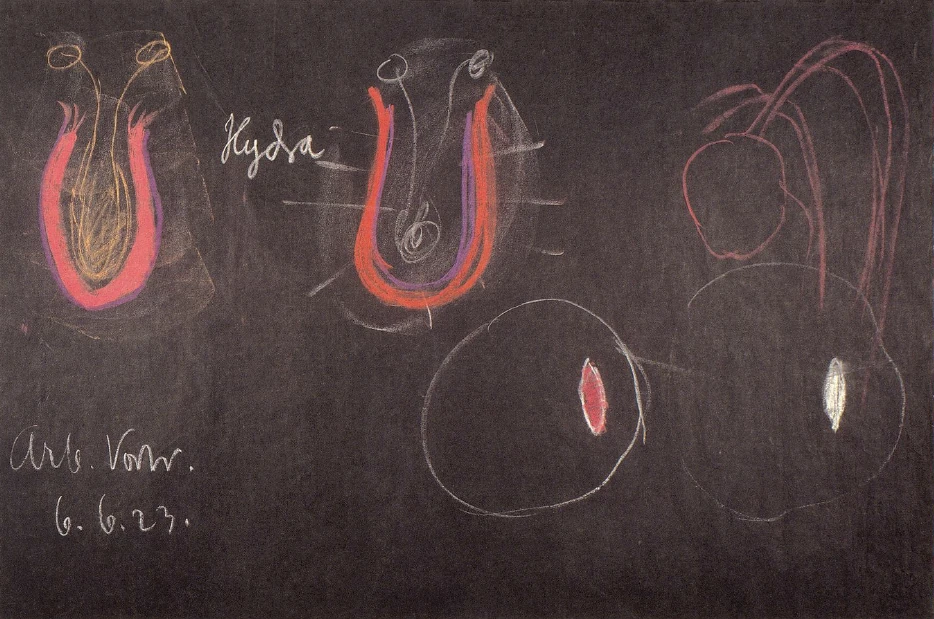
[ 10 ] Es gibt ein ganz kleines, niederes Tierchen, das besteht eigentlich nur aus einer Art von Schlauch. Wenn ich dieses Tierchen aufzeichnen wollte, so müßte ich es etwa so aufzeichnen (siehe Zeichnung): Da wäre eine Haut. Solch ein Schlauch ist das Tier. Da drinnen ist es hohl, und da ist es einfach so wie ein kleiner Hafen, ein kleiner Napf. Da hat es noch kleine Fangwimpern, solche Härchen, mit denen es sich bewegen kann. Es lebt im Wasser, dieses Tierchen. Hydra heißt es, weil es im Wasser lebt. Dieses Tierchen, Hydra, hat die Eigentümlichkeit, daß es eigentlich, wenn man es mit höheren Tieren oder mit dem Menschen vergleicht, nichts anderes als ein bloßer Magen ist. Und dieser Schlauch tut eigentlich nichts anderes, als daß er allerlei Körnchen, also allerlei Nahrungsmittel, die in seine Nähe kommen, aufnimmt und da drinnen verdaut. Das Tierchen lebt also im Wasser; im Wasser schwimmen allerlei Nahrungsstoffe. Das Tierchen schwimmt herum, schwimmt an die Nahrungsstoffe heran, nimmt diese Nahrungsstoffe auf, macht es also geradeso wie unser Magen; der nimmt auch auf. Den Schlund, den Mund, der die Nahrungsstoffe vorbereitet, den hat natürlich dieses kleine Tierchen nicht. Die Hydra nimmt einfach diese Nahrungsmittel auf und verdaut sie. Das Eigentümliche ist allerdings dies, daß es das Abscheidungsorgan, den After, mit dem Mund zugleich hat. Es sondert auch gleich wieder durch den Mund ab. Also, es ist alles beisammen bei diesem Tierchen.
[ 10 ] There is a very small, simple little animal that consists essentially of nothing more than a kind of tube. If I wanted to draw this little creature, I would have to draw it something like this (see drawing): There would be a skin. This tube is the creature. It’s hollow inside, and it’s just like a little harbor, a little bowl. It also has small cilia—little hairs—that it uses to move. This little creature lives in water. It’s called a hydra because it lives in water. This little creature, the hydra, has the peculiarity that, when compared to higher animals or to humans, it is actually nothing more than a mere stomach. And this tube does nothing else, really, than take in all sorts of particles—that is, all sorts of food—that come near it and digest them inside. So the little creature lives in water; all kinds of nutrients float in the water. The little creature swims around, swims up to the nutrients, takes them in—just like our stomach does; it also takes things in. Of course, this little creature does not have a pharynx or a mouth to prepare the nutrients. The hydra simply takes in this food and digests it. What is peculiar, however, is that it has its excretory organ—the anus—right next to its mouth. It also excretes immediately through the mouth. So, everything is all together in this little creature.
[ 11 ] Nun ist es ja natürlich: Wenn etwas überhaupt ein lebendes Wesen, namentlich ein Tierchen sein will, so muß es nicht nur essen — essen muß es —, aber es muß auch atmen. Und dieses Tierchen, das atmet nämlich mit der Außenseite seiner Haut. Da überall sind ganz kleine Löchelchen. Die sind ja überall, wo organischer Stoff ist, lebendiger Stoff ist, diese Löchelchen. Und durch diese Löchelchen saugt es aus dem Wasser die Luft ein, die es braucht. Also man kann sagen: Dieses Tierchen, die Hydra, hat eine Innenseite, einen Hohlraum, mit dem es frißt. Äußerlich, an seiner Außenseite, hat es seine Atmungsorgane. Das Tier zieht also die Luft ein, und die Luft kommt auch da in der Mitte herein in diesen hohlen Raum. — Das Tierchen kann fressen, atmen. Damit beschäftigt es sich überhaupt. Das Tierchen schwimmt überall im Wasser herum, frißt und atmet aus dem Wasser die Luft ein, die ja auch im Wasser enthalten ist.
[ 11 ] Well, it goes without saying: If something is to be a living creature at all—namely, a tiny animal—it must not only eat—it has to eat—but it must also breathe. And this tiny animal breathes through the outer surface of its skin. There are tiny little holes all over it. These tiny holes are found wherever there is organic matter—living matter. And through these tiny holes, it draws the air it needs from the water. So one could say: This little creature, the hydra, has an interior, a hollow cavity, which it uses to feed. Externally, on its outer surface, it has its respiratory organs. So the creature draws in air, and the air enters right there in the center into this hollow space. — The little creature can eat and breathe. That’s all it does. It swims around everywhere in the water, eating and breathing in the air from the water, which is, of course, also contained within the water.
[ 12 ] Was wird nun der materialistische Mensch sagen? Der wird sagen: Nun ja, dieses Tierchen, das besteht einfach aus dieser Haut. Diese Haut, die ist im Inneren so gewachsen, daß sie im Inneren ein Ernährungsapparat ist, und außen ist sie ein Atmungsapparat. — So sagt der Materialist. Aber wir können nicht so sagen, denn wir müssen das als eine höchst oberflächliche Ansicht betrachten und müssen sagen: Nein, dieses Tierchen hat auch einen Ätherleib, in dem es drinnensteckt, und auch einen Astralleib, in dem es eben auch drinnensteckt. Das hat es noch, das sind die unsichtbaren Glieder,
[ 12 ] What, then, will the materialist say? He will say: Well, this little animal simply consists of this skin. This skin has developed internally in such a way that it serves as a digestive system on the inside, and on the outside it serves as a respiratory system. — That is what the materialist says. But we cannot say that, for we must regard this as a highly superficial view and must say: No, this little animal also has an etheric body in which it is enclosed, and also an astral body in which it is likewise enclosed. It still has these; these are the invisible members,
[ 13 ] Nun, meine Herren, kann man durch irgend etwas beweisen, daß das Tier auch noch etwas Unsichtbares ist außer dem Sichtbaren? Der Materialist sagt: Um das Sichtbare kümmere ich mich, um das Unsichtbare kümmere ich mich nicht. Das Sichtbare, das zeigt mir im Inneren eine Art Magen, außen ist das eine Art Lunge, und damit bin ich zufrieden.
[ 13 ] Well, gentlemen, is there any way to prove that an animal is also something invisible in addition to what is visible? The materialist says: I care about what is visible; I do not care about what is invisible. The visible part—on the inside, it looks like a stomach; on the outside, it looks like a lung—and that’s enough for me.
[ 14 ] Nun kann man etwas Besonderes machen mit diesem Tier. Nicht wahr, meine Herren, unsereiner trägt keine Handschuhe, aber man weiß doch noch, wie das ausschaut. Wenn Sie einen Handschuh haben, so können Sie den umdrehen. Denken Sie sich also, der Handschuh ist außen meinetwillen braun und innen hat er ein graues Futter. Wenn Sie ihn nun umdrehen, so daß das Graue außen ist und das Braune innen, so haben Sie ihn ganz richtig umgestülpt; jetzt ist das Innere außen und das Äußere innen. Sie können ja einen Fingerling davon abschneiden und das jetzt mit dem einzelnen Fingerling machen. Dann haben Sie nämlich, wenn Sie den Fingerling abschneiden und umdrehen, so etwas wie diese Hydra. Die Hydra schaut so aus wie ein einzelner Fingerling. Und das Merkwürdige ist: So wie man diesen Fingerling umdrehen kann, so daß das Innere außen und das Äußere innen ist, so kann man auch diese Hydra umdrehen. Man kann das machen, kann sie richtig umdrehen. Und dann ist das, was ich hier (in der Zeichnung, S. 53) rot gezeichnet habe, außen und das, was ich blauviolett gezeichnet habe, das ist jetzt da drinnen. Aber der Hohlraum ist ja jetzt auch da draußen, und was früher draußen war, das ist jetzt drinnen. Und das Merkwürdige dabei ist: Jetzt fängt plötzlich die Hydra an, auch wiederum herumzuschwimmen. Es macht ihr gar nichts aus. Sie schwimmt wiederum im Wasser herum, sie frißt und atmet. Sie frißt jetzt geradeso die Körnchen in diesen Hohlraum hinein, der neu entstanden ist, und atmet durch das, was früher die Magenwand war. Also der Hydra macht das gar nichts aus. Es schadet ihr gar nichts. Sie fängt an, mit dem, womit sie früher geatmet hat, zu fressen, und mit dem, womit sie früher gefressen hat, zu atmen.
[ 14 ] Now you can do something special with this animal. Isn’t that right, gentlemen? People like us don’t wear gloves, but we still know what they look like. If you have a glove, you can turn it inside out. So imagine that, for my sake, the glove is brown on the outside and has a gray lining on the inside. If you now turn it inside out so that the gray is on the outside and the brown is on the inside, you’ve turned it completely the right way; now the inside is on the outside and the outside is on the inside. You can cut off a fingerless glove from it and do this with that single fingerless glove. Then, when you cut off the fingerless glove and turn it inside out, you’ll have something like this Hydra. The Hydra looks just like a single fingerless glove. And the remarkable thing is: just as you can turn this fingerless glove inside out so that the inside is on the outside and the outside is on the inside, you can also turn this Hydra inside out. You can do that—you can turn it inside out. And then what I’ve drawn in red here (in the drawing, p. 53) is on the outside, and what I’ve drawn in blue-violet is now on the inside. But the cavity is now on the outside, too, and what used to be on the outside is now on the inside. And the strange thing about it is: Now, suddenly, the hydra starts swimming around again. It doesn’t bother her at all. She swims around in the water again, she eats and breathes. She now eats the grains right into this cavity that has newly formed, and breathes through what used to be the stomach wall. So it doesn’t bother the hydra at all. It doesn’t harm it at all. It starts to eat using what it used to breathe with, and to breathe using what it used to eat with.
[ 15 ] Ja, meine Herren, wenn das so wäre, daß das nur so gewachsen wäre, und da im Inneren nur ein Magen wäre und außen Atmungsorgane, da könnte ja die Hydra gar nichts anderes machen, als da innen einzuatmen und von außen anfangen zu fressen. Das tut sie aber nicht, sondern im Moment, wo sie umgedreht wird, macht sie ihren Magen zur Lunge und ihre Lunge zum Magen. Ja, nun möchte ich wissen, wenn sonst nichts da wäre als Magen und Lunge, wie das geschehen wäre! Wenn Sie ein Werkzeug haben, einen Handschuh oder was es ist — den können Sie umdrehen, wenn es etwas Äußeres ist. Wenn es etwas Inneres ist, können Sie es natürlich nicht einfach umdrehen. Also dasjenige, was da als Ätherleib und astralischer Leib noch daran ist, das Unsichtbare, das bleibt. Und weil das da ist, kann einfach der Körper der Hydra umgedreht werden. Also Sie schen: Betrachtet man nur mit einem klaren Blick dasjenige, was eigentlich in der Natur vorgeht, dann findet man sogleich heraus, daß die materialistische Ansicht absolut falsch sein muß. So daß man sagen kann: Dasjenige, was da eigentlich frißt und was atmet, das ist etwas Unsichtbares. Und weil der Körper der Hydra nicht so festgemacht ist wie bei uns, nicht Knochen und Muskeln hat, sondern alles ein und derselbe Stoff ist, deshalb kann eben die Hydra diesen einen Stoff zu allem brauchen.
[ 15 ] Yes, gentlemen, if that were the case—if it had simply developed that way, with only a stomach on the inside and respiratory organs on the outside—then the hydra would have no choice but to breathe in from the inside and start eating from the outside. But that’s not what it does; rather, the moment it’s turned inside out, it turns its stomach into lungs and its lungs into a stomach. Well, now I’d like to know—if there were nothing else there but a stomach and lungs, how could that have happened! If you have a tool, a glove, or whatever it is—you can turn it inside out if it’s something external. If it’s something internal, of course you can’t simply turn it inside out. So whatever remains there in the form of the etheric body and the astral body—the invisible part—that stays. And because that is there, the Hydra’s body can simply be turned inside out. So you see: if one simply observes with a clear gaze what is actually happening in nature, one immediately discovers that the materialistic view must be absolutely wrong. So that one can say: what is actually eating and breathing there is something invisible. And because the Hydra’s body is not as rigidly structured as ours—it has no bones or muscles, but is all made of one and the same substance—that is precisely why the Hydra can use this single substance for everything.
[ 16 ] Nicht wahr, wir können nur deshalb nicht unseren Magen nach außen drehen, weil er so besonders ausgestaltet ist, weil wir nicht aus einer solchen gleichen Stofflichkeit bestehen wie die Hydra, sondern unsere Stoffe verschieden sind. Aber im Inneren muß unser Magen auch atmen, und die Luft, die wir in ihm haben, die zieht er ebenso von außen ein. Also unser Magen ist schon eine Art von Hydra.
[ 16 ] Isn’t it true that the only reason we can’t turn our stomach inside out is because it’s structured in such a unique way—because we aren’t made of the same material as the Hydra, but rather our substances are different? But on the inside, our stomach must also breathe, and the air we have inside it is drawn in from the outside as well. So our stomach is already a kind of hydra.
[ 17 ] Aus allen diesen Dingen, zu denen man noch vieles hinzufügen könnte, geht aber hervor, daß man am kleinsten Tier schon nachweisen kann: Da ist etwas Unsichtbares, was diesem Tier zugrunde liegt.
[ 17 ] From all these things—to which much more could be added—it is clear, however, that even in the smallest animal one can demonstrate that there is something invisible that underlies it.
[ 18 ] Nun, meine Herren, daraus sehen Sie aber, daß auch, wenn wir davon sprechen, was eigentlich unseren ganzen Menschen bewegt, wir darauf kommen, daß es etwas Unsichtbares ist. Wenn Sie die äußere Bewegung nehmen, wenn wir gehen, da werden Sie gar nicht darauf kommen, daß etwa Ihre große Zehe es ist, die den Schritt macht, sondern da sagen Sie: Ich gehe, mein Wille ist es, der da verursacht, daß ich gehe. — Wenn im Inneren die Organe sich bewegen — und es bewegt sich ja nicht bloß das Herz, es bewegen sich zum Beispiel die Gedärme fortwährend; die Gedärme bewegen sich in Wellenbewegungen, sonst könnte der Speisebrei nicht verdaut werden; also im Inneren des Menschen bewegt sich ja auch alles, fortwährend geschehen Bewegungen im Inneren —, wenn also im Inneren die Organe sich bewegen, so werden diese Bewegungen nicht hervorgerufen durch dasjenige, was Materielles in uns ist, sondern sie werden hervorgerufen durch dasjenige, was unsichtbar in uns ist. So daß wir sagen müssen: Das Herz ist nicht eine Pumpe, sondern das Herz wird bewegt durch unseren astralischen Leib. — Also wir haben einen astralischen Leib, und der bewegt das Herz, respektive weil im astralischen Leib auch unser eigentliches Ich drinnen ist, bewegen wir auch mit unserem Ich unser Herz, und zwar bewegen wir es jetzt auf eine ganz besondere Weise.
[ 18 ] Well, gentlemen, this shows you that even when we speak of what actually moves our whole being, we come to the conclusion that it is something invisible. If you consider external movement—when we walk, for example—you won’t even think that it is your big toe that takes the step; rather, you say: “I am walking; it is my will that causes me to walk.” — When the internal organs move—and it is not just the heart that moves; the intestines, for example, are constantly in motion; the intestines move in wave-like motions; otherwise, the chyme could not be digested; so everything inside the human being is in motion, with movements constantly taking place within—so when the internal organs move, these movements are not caused by what is material within us, but by what is invisible within us. So we must say: The heart is not a pump, but rather the heart is moved by our astral body. — So we have an astral body, and it moves the heart; or rather, because our true “I” is also within the astral body, we also move our heart with our “I,” and indeed we move it in a very special way.
[ 19 ] Wenn Sie das Herz anschauen, so liegt es, wie der Herr Burle ganz richtig gesagt hat, bei einem normalen Menschen etwas an der linken Seite, nicht stark, nicht so stark als man gewöhnlich meint, aber es liegt etwas an der linken Seite. Und dann gehen vom Herzen hier die großen Adern aus. Die große Schlagader und die anderen Adern gehen eigentlich vom Herzen aus.
[ 19 ] If you look at the heart, as Mr. Burle quite correctly pointed out, in a normal person it is located slightly to the left—not significantly, not as much as people usually think, but it is slightly to the left. And then the large arteries branch out from the heart here. The aorta and the other arteries actually originate from the heart.
[ 20 ] Nun ist das so: Wenn ich zum Beispiel einatme, da ernähre ich mich gewissermaßen mit dem Sauerstoff. Wenn ich ausatme, gebe ich die Kohlensäure von mir. Wenn ich die Kohlensäure von mir gegeben habe, bekomme ich sogleich Sauerstoffhunger. Ich will wieder einatmen. Ja, das hat zunächst mit meinem Herzen gar nichts zu tun, sondern mit meinem ganzen Leib. Mein ganzer Leib bekommt den Sauerstoffhunger. Dadurch, daß er den Sauerstoffhunger bekommt, kommt er in den Trieb hinein, all sein Blut zu bewegen, denn das Blut muß Sauerstoff haben. Der Körper schickt durch seinen astralischen Leib das Blut dahin, wo es den Sauerstoff kriegen kann.
[ 20 ] Here’s how it works: For example, when I inhale, I’m essentially nourishing myself with oxygen. When I exhale, I release carbon dioxide. Once I’ve released the carbon dioxide, I immediately feel a craving for oxygen. I want to inhale again. Yes, at first this has nothing to do with my heart at all, but with my entire body. My entire body feels this hunger for oxygen. Because it feels this hunger for oxygen, it is driven to circulate all its blood, for the blood must have oxygen. Through its astral body, the body sends the blood to where it can obtain oxygen.
[ 21 ] Oder nehmen Sie an, ich gehe oder ich arbeite. Da verbrennt in mir die Nahrung. Das habe ich Ihnen ja schon einmal ausgeführt. Dadurch wird das Blut arm an Nahrung. Wenn man arbeitet, wird immer das Blut arm an Nahrung. Jetzt, was will das Blut? Das Blut will wiederum Nahrung bekommen. Das Blut reißt gewissermaßen die Nahrung, die der Magen und die Gedärme aufgenommen haben, an sich. Das alles, dieser Lufthunger, Nahrungshunger, das bringt das Blut in Bewegung. Das Blut ist es, das zunächst sich bewegt, und das Blut reißt das Herz mit. Also es ist nicht das Herz, das das Blut durch den Leib pumpt, sondern das Blut bewegt sich durch Lufthunger, durch Nahrungshunger, und dadurch wird das Herz bewegt. So daß wir also sagen müssen: Unser unsichtbarer Mensch ist es, der das Herz bewegt.
[ 21 ] Or suppose I’m walking or working. That’s when the food burns inside me. I’ve already explained this to you once before. As a result, the blood becomes depleted of nutrients. When you work, the blood always becomes depleted of nutrients. Now, what does the blood want? The blood, in turn, wants to get nutrients. The blood, so to speak, seizes the nutrients that the stomach and intestines have absorbed. All of this—this hunger for air, this hunger for food—sets the blood in motion. It is the blood that begins to move, and the blood draws the heart along with it. So it is not the heart that pumps the blood through the body, but rather the blood moves due to a hunger for air and a hunger for nourishment, and this is what sets the heart in motion. So we must say: It is our invisible human being who moves the heart.
[ 22 ] Nun, meine Herren, wenn Sie das jetzt hören, so können Sie eine Frage aufwerfen. Sehen Sie, bei unserer Anthroposophie ist es immer so, daß die Gegner meinen, sie machten die Einwände. Die Einwände kennt man aber lange vorher. Die macht man sich vorher selber. Deshalb mache ich Sie immer auch auf die Einwände aufmerksam. Sie können einwenden: Ja, wozu haben wir denn das Herz, wenn es nicht das Blut durch den Körper pumpt? Wenn das Blut sich bewegt, brauchten wir vielleicht gar nicht das Herz, das da mitgerissen werden soll.
[ 22 ] Well, gentlemen, when you hear this now, you may raise a question. You see, with our anthroposophy, it’s always the case that opponents think they’re the ones raising the objections. But we’re already familiar with those objections long before they’re raised. We come up with them ourselves beforehand. That is why I always draw your attention to the objections as well. You might object: “Well, what good is the heart if it doesn’t pump blood through the body? If the blood moves on its own, perhaps we don’t even need the heart, which is supposed to be carried along with it.”
[ 23 ] Ja, sehen Sie, das sagen diejenigen Menschen, die keinen rechten Begriff haben vom ganzen menschlichen Leib. Es ist ein großer Unterschied zwischen dem menschlichen Kopf und dem übrigen Menschen. Ich habe Ihnen schon einmal etwas von diesem Unterschied gesagt. Nehmen Sie einmal an, Sie gehen oder Sie arbeiten. Ja, der Kopf arbeitet da nicht mit. Der Kopf sitzt am übrigen Körper, wie man ungefähr in einer Kutsche sitzt. Da sitzt man ganz ruhig. Die Kutsche muß ihre Räder bewegen, die Rosse müssen ziehen. Aber so müssen unsere Hände, unsere Füße arbeiten, und der Kopf, der sitzt drinnen als derjenige, der nicht mitarbeitet, nicht wahr? Sonst müßten wir an den Ohrwascherln irgendwie Seile haben, und mit denen müßten wir die Räder an den Maschinen in Bewegung setzen. Das tun wir nicht. Der Kopf arbeitet nicht mit. Denken Sie sich einmal, man könnte da sich einmal am Haarschopf — die meisten Menschen in der Gegenwart könnten das nicht mehr, weil sie eine Glatze haben — solche Seile anmachen. Das würde dem Menschen sehr schlecht bekommen. Der Kopf arbeitet eigentlich nicht mit, der sitzt ruhig auf unserem übrigen Organismus. Allein, warum tut er das? Ja, sehen Sie, der Kopf ist eben etwas ganz anderes als der andere Mensch. Der andere Mensch ist ein Bewegungsapparat. Der Kopf ist nur insofern ein Bewegungsapparat, als er die Bewegungen mitmacht und so weiter; da wirken eben die Bewegungen herauf in unseren Kopf. Aber der Kopf ist nicht dasjenige, was selber die Bewegungen macht.
[ 23 ] Yes, you see, that’s what people say who don’t really understand the human body as a whole. There’s a big difference between the human head and the rest of the body. I’ve already told you a little about this difference. Suppose you’re walking or working. Yes, the head isn’t actually doing any work there. The head sits on the rest of the body, much like one sits in a carriage. You sit there quite still. The carriage has to turn its wheels; the horses have to pull it. But that’s how our hands and feet have to work, while the head sits inside as the part that doesn’t participate, doesn’t it? Otherwise, we’d have to have ropes attached to our earlobes somehow, and use them to set the wheels of the machines in motion. We don’t do that. The head doesn’t participate. Just imagine if you could attach such ropes to the top of your head—most people today couldn’t do that anymore, because they’re bald—that would be very bad for a person. The head doesn’t actually participate; it just sits quietly atop the rest of our organism. But why is that? Well, you see, the head is simply something entirely different from the rest of the human being. The rest of the human being is a locomotive apparatus. The head is a locomotive apparatus only insofar as it participates in the movements and so on; that’s simply how the movements affect our head. But the head is not the part that performs the movements itself.
[ 24 ] Der Kopf hat nach außen hin die Sinnesorgane. Da nimmt er das wahr, was draußen ist. Aber der Kopf nimmt auch noch das wahr, nur unbewußt bei den meisten Menschen, was im Inneren vorgeht. Wenn ich nach außen gucken will, damit ich weiß, was draußen vorgeht, brauche ich meine Augen. Wenn ich nach innen gucken will, nach der Blutzirkulation, brauche ich mein Herz. Das Herz ist nicht dazu da, daß es das Blut durch den Körper pumpt, sondern es ist ein Sinnesorgan, das alles wahrnimmt, wie der ganze Kopf. Wir könnten nichts wissen von unserer Blutzirkulation — natürlich, mit unserem Oberstübchen wissen wir auch nichts davon, aber im Kopf drinnen muß ein Wissen sein —, wenn der Kopf nicht durch das Herz unsere ganze Blutzirkulation wahrnehmen würde.
[ 24 ] The head has the sensory organs on the outside. That is where it perceives what is outside. But the head also perceives—though unconsciously in most people—what is happening on the inside. If I want to look outward to know what’s happening outside, I need my eyes. If I want to look inward, at my blood circulation, I need my heart. The heart isn’t just there to pump blood through the body; it’s a sensory organ that perceives everything, just like the whole head. We could know nothing about our blood circulation—of course, with our little brain we know nothing about it either, but there must be knowledge inside the head—if the head did not perceive our entire blood circulation through the heart.
[ 25 ] Ich habe Ihnen gesagt, wie die Leber ein Wahrnehmungsorgan ist. Die unteren Bewegungen nimmt zum Beispiel die Leber wahr. Aber was der ganze Mensch für Bewegungen hat, nimmt schon das Herz wahr. Dadurch wird das Herz in Bewegung gesetzt. Durch die Bewegungen, die hervorgerufen werden durch Atmungshunger und Nahrungshunger, wird das Herz in Bewegung gesetzt. Und an den Bewegungen des Herzens merkt man, ob im Körper eben etwas in Ordnung oder in Unordnung ist.
[ 25 ] I have told you how the liver is an organ of perception. For example, the liver perceives the lower movements. But the heart perceives all the movements of the entire human being. This sets the heart in motion. The movements caused by the body’s need for air and food set the heart in motion. And by observing the movements of the heart, one can tell whether something in the body is in order or out of order.
[ 26 ] Meine Herren, das können Sie ja leicht sehen. Was tut man denn, wenn einer krank wird? Das erste ist, man fühlt den Puls. Derjenige, der sich angewöhnt hat, den Puls zu erkennen, der kann ungeheuer viel am Pulsschlag erkennen. Der Pulsschlag ist wirklich ein Barometer für den ganzen Gesundheits- und Krankheitszustand. Aber der Pulsschlag ist ja nichts anderes als die Bewegungen des Blutes. Dasjenige, was man tut, wenn man beim Kranken den Puls fühlt, das macht der Kopf fortwährend. Er fühlt fortwährend durch das Herz die ganze Blutzirkulation. Überhaupt alles, was im Leibe vorgeht, fühlt der Kopf durch das Herz.
[ 26 ] Gentlemen, you can easily see that. What do you do when someone gets sick? The first thing is to feel their pulse. Anyone who has gotten into the habit of reading a pulse can learn an immense amount from the pulse rate. The pulse is truly a barometer of one’s entire state of health and illness. But the pulse is nothing other than the movement of the blood. What one does when feeling the pulse of a sick person is what the head does constantly. It constantly senses the entire blood circulation through the heart. In fact, the head senses everything that goes on in the body through the heart.
[ 27 ] Nun, denken Sie sich, einer hat an einem gewissen Abend fürchterlich viel Alkohol getrunken, war, wie man sagt, gründlich betrunken. Dadurch kommt diese ganze Blutzirkulation in Unordnung. Am nächsten Tage merkt der Kopf durch das Herz: Die ganze Blutzirkulation ist in Unordnung. Er bekommt dasjenige, was der Katerzustand ist, nicht wahr, den bekannten Brummschädel. Ja, warum brummt es denn da im Kopf? Sehen Sie, wenn ein schöner Tag ist, und ich gehe mit meinen Augen durch die Gegend, da habe ich einen schönen Eindruck. Wenn da draußen ein furchtbares Wetter ist, da habe ich einen schlechten Eindruck. Ja, meine Herren, wenn im Blut alles ordentlich sich bewegt, da hat der Kopf einen guten Eindruck, da ist im Kopf alles geordnet. Wenn es aber so zugeht, daß ein Gewitter ist im Blute — das ist es, wenn einer sich am Abend betrunken hat —, dann hat der Kopf durch das Herz eben einen gewitterigen Eindruck, da schwummelt alles durcheinander.
[ 27 ] Well, just imagine: one evening, someone drank an awful lot of alcohol and was, as they say, thoroughly drunk. This throws the entire blood circulation out of whack. The next day, the head senses through the heart that the entire blood circulation is out of whack. He gets what’s known as a hangover, doesn’t he—that familiar throbbing headache. Yes, why is there a throbbing in the head? You see, when it’s a beautiful day and I look around with my eyes, I get a pleasant impression. When the weather outside is terrible, I get an unpleasant impression. Yes, gentlemen, when everything in the blood is flowing properly, the mind has a clear sense of things; everything is in order. But when there’s a storm raging in the blood—which is what happens when someone gets drunk in the evening—then, through the heart, the mind gets a stormy sensation, and everything gets all jumbled up.
[ 28 ] Also wir verstehen das, was das Herz ist, erst dann, wenn wir wissen: Das Herz ist eigentlich das innere Sinnesorgan, durch das der Kopf alles das wahrnimmt, was im Körper vor sich geht.
[ 28 ] So we can only understand what the heart is when we realize that the heart is actually the inner sensory organ through which the mind perceives everything that is happening in the body.
[ 29 ] Wenn wir uns umsehen in der Welt, dann stellt sich heraus, daß der Mensch durch seinen unsichtbaren Teil, durch dasjenige, was ich seinen astralischen Leib genannt habe, im Verhältnis zu der ganzen Welt steht. Die wichtigsten Sterne, zu denen der Mensch im Verhältnis steht, sind Sonne und Mond. Nun, mit der Sonne, da steht hauptsächlich der menschliche Kopf in Beziehung, aber der übrige Mensch steht tatsächlich mit dem Mond in Beziehung. Und man kann sagen, es ist natürlich ein furchtbarer Aberglaube, wenn man meint, mit den jetzigen Mondesphasen könne man irgend etwas machen. Aber im Menschen ist ein Rhythmus, der sich auch im Blute ausdrückt und der ähnlich ist dem Mondenrhythmus. Der Mensch richtet sich schon nach der ganzen Welt. Und so ist es auch der Fall, daß tatsächlich die innere Bewegung des Blutes nicht allein von der Nahrung abhängt. Wenn der Mensch ganz gesund ist — er ist ja in gewisser Weise ein freies Wesen —, dann macht er sich in gewissem Sinne unabhängig von den äußeren Natureinflüssen, macht sich auch in gewissem Sinne unabhängig von der ganzen Welt. Aber in dem Augenblick, wo der Mensch anfängt ein bißchen krank zu werden, da wird er abhängig von der ganzen Welt.
[ 29 ] When we look around at the world, it becomes clear that human beings are connected to the entire world through their invisible aspect—what I have called their astral body. The most important celestial bodies with which human beings are connected are the Sun and the Moon. Now, the human head is primarily related to the Sun, but the rest of the human being is in fact related to the Moon. And one can say that it is, of course, a terrible superstition to believe that one can do anything based on the current phases of the Moon. But there is a rhythm within the human being that is also expressed in the blood and that is similar to the lunar rhythm. Human beings are already attuned to the whole world. And so it is also the case that the inner movement of the blood does not depend solely on food. When a person is completely healthy—and in a certain sense, a person is a free being—then, in a certain sense, they make themselves independent of external natural influences and, in a certain sense, independent of the whole world. But the moment a person begins to become even slightly ill, they become dependent on the entire world.
[ 30 ] Nehmen Sie an, irgend jemand ist krank und man merkt die Krankheit an seinem Puls. Es ist dann für denjenigen, der das wahrnehmen kann, ein riesengroßer Unterschied zwischen dem Puls am Morgen und dem Puls am Abend. Man kann viel daran sehen, wie sich der Morgenpuls und der Abendpuls unterscheiden. Aber außerdem ist für gewisse Kranke ein großer Unterschied zwischen dem Puls, der bei Vollmond und dem Puls, der bei Neumond ist. Der Mensch ist eben abhängig. Wenn er sich auch in gesundem Zustand unabhängig machen kann, eine gewisse Abhängigkeit bleibt vorhanden, und die zeigt sich besonders bei der Krankheit. So daß wir sagen müssen: Wir sind in dem, was einen Eindruck auf unser Herz macht, schon in einer Beziehung zu der Bewegung der Weltkörper, namentlich des Mondes. Wir sind in Beziehung zu der Bewegung des Mondes. — In dieser Beziehung müßten eigentlich noch recht, recht viel Beobachtungen gemacht werden.
[ 30 ] Suppose someone is sick and you can tell by their pulse. For someone who can perceive this, there is a huge difference between the pulse in the morning and the pulse in the evening. You can tell a lot from how the morning pulse differs from the evening pulse. But in addition, for certain sick people, there is a big difference between the pulse during a full moon and the pulse during a new moon. Human beings are, after all, dependent. Even if they can become independent when healthy, a certain dependence remains, and this becomes particularly evident during illness. So we must say: In what makes an impression on our hearts, we are already in a relationship with the movement of the celestial bodies, namely the Moon. We are in relationship with the movement of the Moon. — In this regard, there is actually still a great deal of observation that needs to be done.
[ 31 ] Ich habe Ihnen vorhin gesagt: Bei einem normalen Menschen ist es so, daß das Herz etwas nach links gerückt ist. Aber geradeso wie es Linkshänder gibt und die meisten Menschen Rechtshänder sind, mit der Rechten alles machen, so gibt es kurioserweise auch Rechtsherzer. Es gibt nämlich Menschen, die haben das Herz nicht links, sondern auf der rechten Seite. Meistens wird das überhaupt nicht bemerkt, weil der Unterschied da natürlich ein innerlicher ist. Wenn einer ein Linkshänder ist, nicht wahr, so merkt man das sehr bald, aber wenn sein Herz etwas nach rechts statt nach links geschoben ist, so merkt man das nicht so bald. Aber es wäre interessant, gerade solche Leute, die das Herz auf der rechten Seite haben, auch einmal zu prüfen, wie sie im Leben etwas anders sind als diejenigen, die das Herz auf der linken Seite haben. Derjenige, der das Herz auf der rechten Seite, also nach rechts hin verschoben hat, der ist nämlich ein Mensch, welcher gewisse Dinge, die er macht, eigentlich immer zu einer gewissen Jahreszeit oder zu einer gewissen Tageszeit machen muß. Der Rechtsherzer, der ist viel mehr abhängig von der äußeren Umgebung als der Linksherzer. Und wenn das Herz nur ein kleines bißchen nach rechts gerückt ist — es sitzt ja nicht überall bei jedem Menschen an derselben Stelle, sondern ein bißchen anders bei jedem Menschen —, wenn es noch immer links ist, aber doch ein klein bißchen nach rechts gerückt ist, so hat er gleich die Sehnsucht, sich mehr nach der äußeren Umgebung zu richten. Er will gleich, sagen wir, im Frühling etwas Besonderes tun und im Herbst etwas Besonderes tun. Man kann das natürlich nicht immer und ruiniert sich dann. Die Menschen wissen ja gar nicht, wodurch sie sich ruinieren können.
[ 31 ] I told you earlier: In a normal person, the heart is positioned slightly to the left. But just as there are left-handed people and most people are right-handed—doing everything with their right hand—curiously enough, there are also people with their hearts on the right. In fact, there are people whose heart is not on the left, but on the right side. Most of the time, this goes completely unnoticed because the difference is, of course, an internal one. If someone is left-handed, right, you notice that very quickly, but if their heart is shifted slightly to the right instead of to the left, you don’t notice that right away. But it would be interesting to examine precisely those people who have their heart on the right side to see how they differ in life from those whose heart is on the left. The person whose heart is on the right—that is, shifted to the right—is someone who must always do certain things at a specific time of year or a specific time of day. The “right-hearted” person is much more dependent on their external environment than the “left-hearted” person. And if the heart has shifted just a little bit to the right—after all, it isn’t in the exact same place for everyone, but varies slightly from person to person—if it’s still on the left but has shifted just a little to the right, then that person immediately feels a longing to orient themselves more toward their external environment. They immediately want, let’s say, to do something special in the spring and something special in the fall. Of course, you can’t do that all the time—it will ruin you. People don’t even realize what can ruin them.
[ 32 ] Man muß zum Beispiel in der Schule bei Kindern, die das Herz etwas nach rechts gerückt haben, gleich etwas anders vorgehen — das braucht ja gar nicht bemerkt zu werden — als bei denjenigen Kindern, die das Herz an der rechten Stelle haben. Der Mensch wird dann, wenn er das Herz nach rechts gerückt hat, dazu veranlaßt, seinen astralischen Leib viel mehr in Anspruch zu nehmen.
[ 32 ] For example, in school, one must take a slightly different approach with children whose hearts have shifted somewhat to the right—which need not even be noticed—than with those children whose hearts are in the right place. When a person has shifted their heart to the right, they are led to make much greater use of their astral body.
[ 33 ] Sehen Sie, meine Herren, das ist die Geschichte: Wenn einer lange Zeit an einer Maschine arbeitet, da werden Sie sich sagen können, es wird im allgemeinen so, daß die Arbeit mechanisch wird. Sie wird ja unangenehmer dadurch, daß man selber zu einem Stück Maschine wird, aber wenn man lange Zeit an einer Maschine arbeitet, so macht man die Handgriffe und so weiter mechanisch. Denken Sie sich, man ist ganz normal ein richtiger linksherziger Mensch. Der Vater war auch ein linksherziger Mensch, der Großvater auch, der Urgroßvater auch. Da hat sich langsam das schon eingeschlichen. Und wenn man da nun als Sohn geboren wird, so macht man natürlich dieselbe Bewegung innerlich, die schon Vater und Großvater und Urgroßvater gemacht haben. Das geht so leicht, wie wenn man an einer Maschine schon lange gearbeitet hat.
[ 33 ] You see, gentlemen, this is how it is: When someone works on a machine for a long time, you’ll find that, generally speaking, the work becomes mechanical. It does become more unpleasant because you yourself become part of the machine, but when you work on a machine for a long time, you perform the manual tasks and so on mechanically. Just imagine: you’re a perfectly normal, genuinely left-handed person. My father was also a left-hearted person, as were my grandfather and great-grandfather. It just slowly crept in. And when you’re born as a son into that, you naturally make the same inner movement that your father, grandfather, and great-grandfather already made. It comes as easily as when you’ve been working on a machine for a long time.
[ 34 ] Wenn man ein rechtsherziger Mensch ist, da ist die Lage des Herzens nicht vom Vater geerbt. Der Vater ist in der Regel nicht auch ein rechtsherziger Mensch. Das vererbt sich nicht. Da muß man erst aus seinem astralischen Leib heraus die Dinge gewissermaßen immer wieder neu anfangen. Da hat man nicht die ganze Vererbung drinnen. Und die Folge davon ist, daß ein solcher Mensch, der ein rechtsherziger Mensch ist, eben viel mehr innere Kraft anwenden muß, um die ganze Blutzirkulation in Ordnung zu haben. Und daher kommt es, daß ein solcher Rechtsherzmensch sich viel mehr nach dem Äußeren richtet.
[ 34 ] If one is a right-hearted person, the state of one’s heart is not inherited from one’s father. As a rule, the father is not also a right-hearted person. This is not something that is inherited. In such cases, one must, so to speak, start over again and again from within one’s astral body. One does not carry the entire genetic inheritance within oneself. And the result of this is that such a person—who is a right-hearted person—must exert much more inner strength to keep the entire blood circulation in order. And that is why such a right-hearted person is much more attuned to the external world.
[ 35 ] Es ist sogar folgendes möglich. Nehmen Sie an, Sie seien gar kein Rechtsherzmensch, sondern ein ganz normaler Linksherzmensch. Aber wenn Sie nun Ballettänzer werden — das passiert ja auch den Männern, aber den Frauen noch mehr —, so wird durch den Ballettanz auch das Herz beeinflußt. Jetzt ist ja der Ballettanz so, daß er eben auch sehr materialistisch ist. Aber in alten Zeiten, wenn die Menschen zum Tanz angehalten wurden, zum Beispiel im alten Griechenland, da wurde dadurch, daß sie sich dann hineinfügten in Bewegungen, die den Sternen nachgemacht sind, das Herz sogar während des Lebens ein Stückchen nach rechts gerückt, wie überhaupt beim Tänzer auch heute noch der Tanz durchaus, wenn er auch materialistisch geworden ist, auf das Herz einen starken Eindruck macht, weil es eben etwas nach rechts rückt. Und wenn man mehr auf diese Dinge achten würde, würde man, wenn man den Menschen dann seziert nach dem Tode, schon sehen, wie das Herz gewisse Gefäße auseinandergedehnt hat. Dadurch, daß der Betreffende ein Tänzer oder eine Tänzerin war, ist das Herz — das kann man ihm nach dem Tode noch ansehen — eben ein Stückchen nach rechts gerückt worden.
[ 35 ] The following is even possible. Suppose you are not a “right-hearted” person at all, but a perfectly normal “left-hearted” person. But if you were to become a ballet dancer—which happens to men as well, though even more so to women—then ballet would also influence your heart. Now, ballet is, after all, a very materialistic art form. But in ancient times, when people were encouraged to dance—for example, in ancient Greece—the fact that they engaged in movements modeled after the stars caused the heart to shift slightly to the right even during their lifetime. Indeed, even today, dance still has a powerful effect on the heart of a dancer—even though it has become materialistic—because the heart does shift slightly to the right. And if one paid more attention to these things, one would, upon dissecting a person after death, already see how the heart has stretched certain vessels apart. Because the person in question was a dancer, the heart—as can still be seen after death—has simply shifted a little to the right.
[ 36 ] Dadurch beantwortet sich die Frage, die Herr Burle gestellt hat. Sie beantwortet sich dadurch, daß man sieht: Der Mensch will eigentlich, wenn er mehr seinem astralischen Leib überlassen ist, nicht seiner gewöhnlichen Blutzirkulation folgen, sondern er will diese noch mehr beherrschen, und dadurch gibt er sich Bewegungen hin, die eben mehr nach den Bewegungen außerhalb der Erde, nach dem Mond geartet sind. Kann man das verstehen? (Antwort: Ja!)
[ 36 ] This answers the question posed by Mr. Burle. It is answered by the fact that we see: When a person is more attuned to their astral body, they do not actually want to follow their usual blood circulation, but rather want to control it even more, and in doing so, they engage in movements that are more akin to those outside the Earth, toward the Moon. Can you understand that? (Answer: Yes!)
[ 37 ] Also das, was Sie heute gefragt haben, daß sehr leicht bemerkt wird, daß der Mensch eine gewisse Sehnsucht hat, das zu machen, hängt eben damit zusammen, daß der Mensch seine ganze Herzbewegung von dem unsichtbaren Teil aus beherrscht, daß er ja dann, ich möchte sagen, ein bißchen hinüberrutscht nach dem Unsichtbaren und daß er dann eigentlich nach dem Äußeren sich richtet und nicht bloß nach der inneren Blutbewegung, die sich nach Atmung und Nahrung richtet. Alle diese Dinge kann man erklären, wenn man den Menschen wirklich versteht.
[ 37 ] So what you asked about today—that it is very easy to notice that a person has a certain longing to do this—is precisely related to the fact that a person’s entire emotional life is governed by the invisible realm, so that, I would say, they slip a little over into the invisible realm, and that they then actually orient themselves toward the external world and not merely toward the inner circulation of blood, which is governed by breathing and nutrition. All these things can be explained if one truly understands human beings.
[ 38 ] Und jetzt möchte ich Ihnen etwas sagen, was noch ein bißchen mit dem zusammenhängt, was wir das letzte Mal besprochen haben. Wir haben das letzte Mal gesehen: Da im Auge drinnen, da ist diese kleine Linse (es wird gezeichnet). Wenn der Mensch ganz normales Sehen hat, dann ist diese kleine Linse durchsichtig. Wenn der Mensch den Star bekommt, dann wird die Linse undurchsichtig. Salze lagern sich ab. So daß wir also sagen können: Bei einem gesunden Menschen ist hier im Auge — wenn das das Vordere des Auges ist — die Linse; die ist durchsichtig. Bei einem Menschen, der starkrank ist, haben wir die Linse, in der sich Salze abgelagert haben, undurchsichtig. Dadurch, daß die Linse durchsichtig ist, kann der astralische Leib des Menschen mit der durchsichtigen Linse die Welt schen. Er sieht alles in der Welt.
[ 38 ] And now I’d like to tell you something that’s still somewhat related to what we discussed last time. Last time we saw that inside the eye there’s this little lens (a drawing is made). When a person has normal vision, this little lens is transparent. When a person develops a cataract, the lens becomes opaque. Salts are deposited there. So we can say: In a healthy person, here in the eye—if this is the front of the eye—is the lens; it is transparent. In a person who is seriously ill, the lens has become opaque due to the deposition of salts. Because the lens is transparent, the human astral body can perceive the world through it. The person sees everything in the world.
[ 39 ] Wenn man sich durch solche Dinge, wie ich sie beschrieben habe in dem Büchelchen: «Wie erlangt man Erkenntnisse der höheren Welten?», an ein ganz, ganz intensives Denken gewöhnt, so kommt einmal ein Moment, wo man etwas ganz Besonderes kann. Aber an ein ganz intensives Denken sich gewöhnen, das wollen ja die Menschen heute nicht leicht. Denn sich ganz zurückziehen auf sein eigenes Denken, das machen eben die Menschen heute nicht, weil sie sagen: Es muß uns alles von außen gegeben werden; die Geheimnisse der Welt müssen wir von außen erforschen. — Natürlich, es ist ja auch unbequem, denn man muß sehr achtgeben bei diesem Denken. Wenn man sehr lebendig denkt, muß man natürlich furchtbar achtgeben. Aber es kommt dann einmal ein Moment im Leben, wo man etwas ganz Besonderes kann.
[ 39 ] If one accustoms oneself to very, very intense thinking through things such as those I have described in the little book How Does One Attain Knowledge of the Higher Worlds?, there comes a moment when one is able to do something quite special. But getting used to very intense thinking—that’s not something people today are easily willing to do. For people today simply do not withdraw completely into their own thinking, because they say: Everything must be given to us from the outside; we must explore the mysteries of the world from the outside. — Of course, it’s also inconvenient, because one has to be very careful with this kind of thinking. When one thinks very vividly, one naturally has to be extremely careful. But there comes a moment in life when one is able to do something truly special.
[ 40 ] Nicht wahr, daß ich mit meiner Hand einen Stuhl hebe, das begreift jeder, weil es fortwährend geschieht. Aber ich kann auch meine Hand in Ruhe lassen, kann sie nicht gebrauchen zu dem, was sie sonst tut. Dasjenige, was die Augenlinse tut, das steht nicht so in der Macht der Menschen. Wenn Sie von außen einen Eindruck haben, nun, dann gukken Sie durch Ihre Augenlinse eben nach diesem Eindruck hin. Wenn Sie keinen Eindruck haben, dann bleibt die Augenlinse in Ruhe.
[ 40 ] Isn’t it true that I lift a chair with my hand? Everyone understands that, because it happens all the time. But I can also leave my hand at rest; I don’t have to use it for what it usually does. What the lens of the eye does, however, is not something within human control. When you perceive an external impression, well, then you simply look through your lens toward that impression. When you don’t perceive an impression, the lens remains at rest.
[ 41 ] Aber, meine Herren, denken Sie sich, jemand hat sich wirklich Mühe gegeben, ein ganz starkes Denken zu haben. Er ist ganz nur im innerlichen Denken. Er guckt nicht nach außen, er läßt seine Augenlinse so in Ruhe, wie man die Hand in Ruhe läßt, wenn man nichts tut mit ihr. Ja, da spiegelt sich dann an der Stelle, wo man sonst die durchsichtige Linse hat, mit der man sonst sieht, der ganze Sternenhimmel. Das ist nämlich, ich möchte sagen, das geradezu Wunderbare, daß man durch diese Methode, die man ausbildet auf die Art, wie ich es beschrieben habe in «Wie erlangt man Erkenntnisse der höheren Welten?», die einzelnen Organe nicht nur für die Erde, sondern eben für die andere Welt gebrauchen lernt. Wenn sich natürlich Salze abgelagert haben, wird die Linse starkrank, da wird sie unwillkürlich undurchsichtig. Wenn einer recht tief nachdenkt, bleibt sie durchsichtig, aber der Mensch sieht nicht durch die Linse, er guckt nicht nach außen. Und da fängt es an, von der Linse aus die ganze Welt zu beleuchten. Aber man sieht dann das Geistige. Und zwar sieht man den ganzen Sternenhimmel nach seiner wahren, inneren Bedeutung. Diese kleine Stelle im Menschen, wo die Linse sitzt, die kann einen unterrichten über all dasjenige, was man sich dann getraut zu sagen über Sterne und so weiter. Sehen Sie, so großartig ist es eigentlich mit dem Menschen, daß ‚an dem kleinsten Punkte der Sitz von Erkenntnissen ist, die ungeheuer sind.
[ 41 ] But, gentlemen, just imagine: someone has really made an effort to cultivate a very powerful inner life. He is completely absorbed in his inner thoughts. He doesn’t look outward; he lets his eye’s lens rest, just as one lets one’s hand rest when one isn’t using it. Yes, then the entire starry sky is reflected right where one would normally have the transparent lens used for seeing. For that, I would say, is the truly marvelous thing: that through this method—which one trains in the way I described in How Does One Attain Knowledge of the Higher Worlds?—one learns to use the individual organs not only for the Earth but also for the other world. Of course, if salts have accumulated, the lens becomes clouded and involuntarily opaque. If one thinks deeply enough, it remains transparent, but the person does not see through the lens; they do not look outward. And that is where it begins—illuminating the entire world from the lens. But then one sees the spiritual realm. In fact, one sees the entire starry sky according to its true, inner meaning. This small spot within a person, where the lens is located, can teach one about everything one then dares to say about stars and so on. You see, what is truly magnificent about human beings is that ‘in the smallest point lies the seat of knowledge that is immense.’
[ 42 ] Derjenige, der starkrank ist — man braucht das natürlich keinem Menschen zu wünschen —, der hat sogar diese ganze Geschichte leichter, der braucht sich nicht so stark mit dem Denken anzustrengen. Er braucht nur ein ganz wenig sich zu konzentrieren, so kann er es dahin bringen, daß er innerlich sieht, wenn er äußerlich das Sehen verlernt hat. Das ist aber dasjenige, was immer betont werden muß, wenn man von solchen höheren Erkenntnissen spricht: Wenn man von solchen höheren Erkenntnissen spricht, dann liegt es immer so nahe, daß man sich natürlich zu stark anstrengen kann, und dann kann statt der höheren Erkenntnis schon etwas eintreten wie, sagen wir, die Störung der Linse. Die Linse kann dann durch dieses starke innere Konzentrieren, wenn man auch nicht starkrank wird, aber etwas undurchsichtiger werden. Daher ist in meinem Buche: «Wie erlangt man Erkenntnisse der höheren Welten?» alles so beschrieben, daß ein Mensch das, was da besprochen ist, erreichen kann, aber eben nicht krank wird dadurch. Es darf eben keine Übung so beschrieben werden, daß man auch krank werden kann dadurch. Aber diese Linse, die ist der Ort im Menschen, der uns tatsächlich im Inneren des Auges die ganze Geisteswelt enthüllen kann. Und so können wir sagen: Man kann äußerlich sehen, wenn alles durchsichtig ist im Auge. Man kann innerlich sehen, wenn etwas willkürlich undurchsichtig gemacht wird.
[ 42 ] Someone who is physically frail—which, of course, one would not wish on anyone—actually finds this whole process easier; they do not need to exert themselves so much in their thinking. They need only concentrate just a little, and they can reach a point where they see inwardly, even if they have forgotten how to see outwardly. But this is precisely what must always be emphasized when speaking of such higher insights: When speaking of such higher insights, it is always so easy to exert oneself too much, and then, instead of higher insight, something like—let’s say—a clouding of the lens may occur. Through this intense inner concentration, the lens can then—even if one does not become seriously ill—become somewhat more opaque. That is why, in my book How Does One Attain Knowledge of the Higher Worlds?, everything is described in such a way that a person can achieve what is discussed there without becoming ill as a result. No exercise should be described in such a way that it could cause illness. But this lens is the place within the human being that can actually reveal the entire spiritual world to us from within the eye. And so we can say: One can see outwardly when everything in the eye is transparent. One can see inwardly when something is deliberately made opaque.
[ 43 ] Ja, meine Herren, das ist schon etwas, was Ihnen deutlich machen kann, wie eigentlich die Erkenntnis von geistigen Welten entsteht. Die Erkenntnis von geistigen Welten entsteht eben dadurch, daß man zuerst in seinem Kopfe die einzelnen Punkte findet, die man also nicht braucht zu der gewöhnlichen Tätigkeit, dadurch, daß sie ruhen. Durch die Linse lernt man zunächst die äußere Welt kennen. Aber man kann den ganzen Körper so weit bringen, daß alles mögliche innerlich für einen Augenblick nicht gebraucht wird. Wenn man zum Beispiel das Herz nicht gebraucht — die Blutzirkulation kann weitergehen, aber man schaltet das Herz aus als Sinnesorgan —, dann fängt man erst an, die ganze Blutzirkulation wahrzunehmen. Aber dann nimmt man nicht bloß die Blutzirkulation wahr. Wenn Sie Ihr Herz so machen, daß Sie gewissermaßen durch Ihren Körper durchschauen auf die Blutzirkulation, wenn Sie also innerlich das Herz nicht empfinden und nicht den Pulsschlag empfinden, sondern durchschauen, wie Sie durch die Linse lernen durchschauen in die Welt hinaus mit dem Kopf, wenn Sie also durch sich selber durchschauen lernen, dann, meine Herren, dann sehen Sie nämlich jetzt nicht die Blutzirkulation allein, sondern Sie sehen die ganze Mondenbewegung, alles, was der Mond tut, und Sie sehen, wie der Mond sich zur Sonne verhält. Und dann sehen Sie die Verwandtschaft des Herzens mit Sonne und Mond.
[ 43 ] Yes, gentlemen, this is something that can make it clear to you how knowledge of spiritual worlds actually arises. Knowledge of spiritual worlds arises precisely because one first finds within one’s mind the individual aspects that are not needed for ordinary activity—precisely because they are at rest. Through the lens, one first comes to know the external world. But one can bring the entire body to a state where everything internal is, for a moment, rendered unnecessary. If, for example, one does not use the heart—the blood circulation can continue, but one switches off the heart as a sensory organ—then one begins to perceive the entire blood circulation. But then one does not merely perceive the blood circulation. If you train your heart so that you, as it were, look right through your body to the blood circulation—that is, if you do not inwardly sense the heart or feel the pulse, but instead look right through it, just as you learn to look through the lens out into the world with your mind—if, in other words, you learn to look right through yourself—then, gentlemen, then you will see not just the blood circulation, but the entire movement of the moon—everything the moon does—and you will see how the moon relates to the sun. And then you will see the connection between the heart and the sun and the moon.
[ 44 ] Sehen Sie, in alten Zeiten ging das alles leichter für die Menschen. Da waren tatsächlich die Menschen noch nicht so eingeschult, nur alle Wissenschaft von der Außenwelt zu erfahren. Sie wollten ja überhaupt nicht alles bloß vor sich sehen. Wenn man einen Griechen, also einen Menschen, der gelebt hätte vor siebenundzwanzig-, achtundzwanzighundert Jahren, ins Kino geführt hätte, ja, der hätte sich das Kino nicht lange angesehen, denn der wäre nämlich in Ohnmacht gefallen, weil in dem Momente, wo der alte Grieche darauf hingeschaut hätte, in seinem Inneren, aber nicht bloß in einem Gliede, sondern im ganzen Menschen das geworden wäre, was Sie bekommen, wenn Ihnen ein Glied einschläft, wenn etwas darauf drückt. Nicht einen richtigen Schlaf hätte der Mensch bekommen, aber dieses Einschlafen des ganzen Menschen wäre entstanden, wenn Sie den alten Griechen in eine Kinovorstellung hingesetzt hätten. Er wäre natürlich davon in Ohnmacht gefallen. Der alte Grieche hätte sich das also überhaupt nicht anschauen können, weil in dem Momente sein Kopf durch das Herz eine solche Störung im ganzen Blutsystem bekommen hätte, daß ihm sein ganzer Körper, nicht bloß einzelne Glieder, eingeschlafen wäre, und der Kopf hätte nichts mehr beherrschen können. Er wäre in Ohnmacht gefallen. Der Mensch ist eben ganz anders geworden, als er in alten Zeiten war. Heute hat der Mensch schon eine so unordentliche Blutzirkulation durch die moderne Kultur, daß er nicht ohnmächtig wird im Kino.
[ 44 ] You see, in the old days, all of this was easier for people. Back then, people really weren’t yet so conditioned to learn about the outside world solely through science. They didn’t want to see everything laid out before them at all. If you had taken a Greek—that is, a person who lived twenty-seven or twenty-eight hundred years ago—to the movies, well, he wouldn’t have watched the movie for long, because he would have fainted—for the moment he looked at the screen, something would have happened inside him—not just in one limb, but throughout his entire being—similar to what happens when a limb goes numb, when something presses down on it. The man wouldn’t have fallen into a proper sleep, but this “falling asleep” of his entire being would have occurred if you had seated the ancient Greek in a movie theater. He would, of course, have fainted from it. So the ancient Greek would not have been able to watch it at all, because at that very moment his head, through the heart, would have experienced such a disruption in his entire circulatory system that his whole body—not just individual limbs—would have gone numb, and his head would no longer have been able to control anything. He would have fainted. People have simply become very different from what they were in ancient times. Today, modern culture has already caused people’s blood circulation to be so disordered that they no longer faint at the movies.
[ 45 ] Wenn man sich mit Geisteswissenschaft wirklich innerlich ein bißchen beschäftigt hat und man kommt dann ins Kino, muß man sich sehr zusammennehmen, sonst kann man heute noch in Ohnmacht fallen. Aber nicht wahr, wir sind eben alle Menschen, und der eine nimmt die Eigenschaften des anderen an. Und es ist so, daß der Mensch nicht mehr das Blutzirkulationssystem hat wie in alten Zeiten, wie der alte Mensch. Daher konnten die alten Menschen leichter durchschauen auf das Blutzirkulationssystem und konnten leichter reden von Sonne und Mond als wir. Wir sind abgeschnitten davon und müssen erst wieder dazu kommen durch Übungen. Wir müssen die Organe erst richtig wieder so machen, daß wir sehen können.
[ 45 ] If you’ve really delved a little into the spiritual sciences and then go to the movies, you have to pull yourself together—otherwise, you might still faint today. But isn’t that true? We’re all human, after all, and one person takes on the characteristics of another. And the fact is that human beings no longer have the same circulatory system as in ancient times, as the people of old did. That is why the people of old could more easily perceive the circulatory system and speak more easily of the sun and moon than we can. We are cut off from it and must first reconnect with it through exercises. We must first restore our organs properly so that we can see.
[ 46 ] Sehen Sie, der alte Grieche konnte daher noch verstehen, wenn ältere Menschen eben ihm etwas erzählt haben von dem, wie es auf der Erde eigentlich zugeht. Man darf nicht glauben, daß dasjenige, was aus dem Altertum überliefert ist, immer Aberglaube ist, nur haben es vielfach die Späteren so umgestaltet, daß es zum Aberglauben geworden ist. Es ist ja merkwürdig, wie Dinge, die zuerst ganz vernünftig sind, eben später einfach zum Aberglauben werden. Wenn man nicht mehr weiß, wie eigentlich die Sachen ausgeführt werden sollen, dann werden die Dinge zum Aberglauben. So zum Beispiel haben die alten Juden kein Schweinefleisch gegessen. Ja, die haben gewußt, daß bei ihrer Rasse und der Gegend, in der sie waren, das Schweinefleisch sie schwach macht. Dann ist es später Aberglaube geworden. Die Dinge, die später zum Aberglauben werden, gehen immer auf frühere vernünftige Dinge zurück. Wir müssen also nicht glauben, daß das, was als altes Wissen früher vorhanden war, immer unsinnig ist, aber man kann sich nicht immer auf das Alte verlassen, weil die alten Dinge vielfach verfälscht sind. Deshalb muß man alles neu erforschen.
[ 46 ] You see, the ancient Greeks could therefore still understand when older people told them about how things actually are on Earth. One must not assume that everything handed down from antiquity is always superstition; it’s just that, in many cases, later generations have distorted it to the point where it has become superstition. It is indeed curious how things that are entirely reasonable at first simply turn into superstition later on. When people no longer know how things are actually supposed to be done, they turn into superstition. For example, the ancient Jews did not eat pork. Yes, they knew that, given their race and the region where they lived, pork made them weak. Later, this became superstition. Things that later become superstitions always trace back to earlier, reasonable practices. So we need not believe that what existed as ancient knowledge in the past is always nonsense, but we cannot always rely on the old ways, because the old traditions have often been distorted. That is why we must investigate everything anew.
[ 47 ] Deshalb ist es so unsinnig, wenn die Leute von der Anthroposophie sagen: Da wird zusammengesammelt, was einmal schon da war. — Es wird nichts zusammengesammelt, sondern alles neu erforscht! Und denjenigen, meine Herren, der Ihnen sagt: Da in der Anthroposophie sammeln sie nur alle möglichen alten Gnostiker zusammen —, den fragen Sie nur einmal, wo er nachweisen kann, daß die Geschichte von der Augenlinse steht, wie ich sie Ihnen das letzte Mal und heute gesagt habe, wo man das in irgendeinem Buche finden kann. Das kann man nämlich nicht finden, weil die Geschichte ganz vergessen worden ist. Sie können deshalb jedem antworten, der sagt, es seien die Dinge zusammengesammelt: Du lügst, denn du weißt gar nicht, was dort gesagt wird —, daß also die ganze Anschauung vom Herzen und so weiter erneuert wird.
[ 47 ] That is why it is so nonsensical when people say of anthroposophy: “They’re just gathering together what was already there once.” — Nothing is simply being gathered together; rather, everything is being explored anew! And to those, gentlemen, who tell you, “In anthroposophy, they’re just gathering together all sorts of old Gnostics”—just ask them where they can prove that the story about the eye lens, as I told you last time and today, can be found in any book. You cannot find it, because the story has been completely forgotten. You can therefore reply to anyone who says these things have been cobbled together: “You’re lying, because you don’t even know what is said there”—that is, that the entire view of the heart and so on is being renewed.
[ 48 ] Es ist so, daß hier alles ursprünglich erforscht wird und dann an den ganzen Menschen herankommt. Und an solchen einfachen Sachen wie, daß der Mensch sich tanzend, drehend bewegt, was ich das letzte Mal und heute berührt habe, hervorgerufen durch die Frage des Herm Burle, kann man vieles einsehen. Das kann man verstehen.
[ 48 ] The fact is that everything here is first explored from the ground up and then applied to the whole person. And from such simple things as the way a person moves while dancing and spinning—which I touched on last time and again today, prompted by Herm Burle’s question—one can gain a great deal of insight. That is something one can understand.
[ 49 ] Aber, meine Herren, dann wird etwas anderes herauskommen, vor dem sich die Menschheit am meisten fürchtet. Denn, sehen Sie, wenn Anthroposophie einmal durchdringt — heute kann man ja gar nichts machen; wenn man praktisch etwas tun will, geht ja gleich der Teufel los; selbst wenn man die Sachen nur sagt, entstehen ja gleich die Gegnerschaften, die Sie ja genügend kennen —, aber wenn Anthroposophie einmal so weit sein wird, daß sie in unsere Schulen eindringt, daß sie überall die Dinge geltend macht, wird etwas anderes noch kommen. Dann wird man nämlich wissen, welche Bewegungen beim Menschen für seine Gesundheit und seine ganze Stoffwechselentwickelung richtig und welche falsch sind. Dann wird die Zeit kommen, wo man die Arbeit nach dem Menschen richten wird. Heute richtet man die Arbeit nach den Maschinen. Heute muß der Mensch so sich bewegen, wie es die Leute, welche die Maschine entdeckt haben, angemessen finden. Später wird man finden: Nicht dasjenige, was von den Maschinen kommt, ist die Hauptsache, sondern der Mensch ist die Hauptsache. Deshalb darf es nur solche Maschinen geben, die hergerichtet sind für den Menschen. Das wird man einmal nur können, wenn die Anthroposophie ganz angenommen sein wird. Dann wird man sagen können: Es muß alles Maschinelle sich nach dem Menschen richten.
[ 49 ] But, gentlemen, then something else will emerge—something humanity fears most of all. For, you see, once anthroposophy takes hold—today, of course, there’s nothing we can do; if we try to take practical action, all hell breaks loose; even if one merely speaks of these things, the opposition you know all too well arises immediately—but once anthroposophy has advanced to the point where it penetrates our schools and asserts itself everywhere, something else will come to pass. Then, in fact, people will know which movements are right for a person’s health and overall metabolic development, and which are wrong. Then the time will come when work will be adapted to the human being. Today, work is adapted to the machines. Today, people must move in the way that those who invented the machines deem appropriate. Later, people will realize: It is not what comes from machines that is the main thing, but rather the human being is the main thing. Therefore, there should only be machines that are designed for human beings. This will only be possible once anthroposophy has been fully accepted. Then we will be able to say: Everything mechanical must be adapted to the human being.
[ 50 ] Aber dazu ist etwas notwendig. Zuerst muß man verstehen, wie das Herz nichts Maschinelles ist, sondern sich nach dem Menschen richtet. Dann wird man auch für die äußere Maschine die Grundlage finden können, die sie so gestaltet, daß sie sich nach dem Menschen richtet. Aber eine Wissenschaft, die es sich so bequem gemacht hat, daß sie das Herz so beschreibt, als wenn der Mensch in seiner Blutzirkulation nur eine Pumpe hätte, die macht sich kein Gewissen daraus, auch die Maschine so zu machen, daß sich der Mensch darnach richten muß. Mit dieser falschen Ansicht in der Wissenschaft hängt nämlich unsere ganze falsche soziale Lage zusammen. Und deshalb muß man schon begreifen, daß erst ein richtiges Denken über den Menschen kommen muß; dann kann erst ein richtiges soziales Leben anfangen. Solange man glaubt, das Herz sei eine Pumpe, solange wird man auch im äußeren Leben nicht richtig sich einstellen können. Erst dann, wenn man weiß, der unsichtbare Mensch ist höher als sein Herz, er ist es, der sein Herz bewegt, dann wird man auch die Maschinen nach dem Menschen richten. Das muß man erst anfangen einzusehen.
[ 50 ] But this requires something. First, one must understand that the heart is not a machine, but is attuned to the human being. Then one will also be able to find the foundation for the external machine that shapes it in such a way that it, too, is attuned to the human being. But a science that has made things so convenient for itself by describing the heart as if the human being had nothing more than a pump in his blood circulation has no qualms about designing the machine in such a way that the human being must adapt to it. Our entire flawed social situation is, in fact, linked to this erroneous view in science. And that is why one must realize that a correct understanding of the human being must come first; only then can a proper social life begin. As long as people believe the heart is a pump, they will not be able to adapt properly in their external lives either. Only when people realize that the invisible human being is higher than his heart—that it is he who moves his heart—will machines also be adapted to the human being. We must first begin to see this.
[ 51 ] Heute machen es sich die Menschen viel zu bequem. Sie machen es sich wirklich viel zu bequem. Was ist heute am meisten international? Das Fußballspiel! Ich habe es Ihnen neulich erklärt. Dasjenige aber, was geistig ist, das wird immer auf kleine Zirkel und so weiter zusammengedrängt. Das zersplittert sich. Nicht wahr, in Norwegen kann man hören: Hoch soll er leben! —, oder man hört ein deutsches Lied singen, wenn Fußballspieler (aus Deutschland) oben sind. Aber sonst sondern sich die Leute ab.
[ 51 ] People today are taking it way too easy. They’re really taking it way too easy. What’s the biggest international event these days? A soccer game! I explained this to you the other day. But anything of an intellectual nature is always confined to small circles and the like. It becomes fragmented. Isn’t that right? In Norway, you might hear people chant, “Long live!”—or you might hear a German song being sung when soccer players (from Germany) are on top. But otherwise, people keep to themselves.
[ 52 ] Das, was ergriffen werden muß, ist der Geist, aber so, daß er im einzelnen ergriffen wird. Nicht daß man im allgemeinen redet von Geist, Geist, sondern er muß im einzelnen ergriffen werden.
[ 52 ] What must be grasped is the spirit, but in such a way that it is grasped in its particularity. It is not a matter of speaking generally about “spirit, spirit,” but rather it must be grasped in its particularity.
[ 53 ] Wir wollen dann am nächsten Samstag davon weiter reden.
[ 53 ] We'll talk more about this next Saturday.