

Rhythms in the Cosmos and in the Human Being
GA 350
6 June 1923, Dornach
Translated by Steiner Online Library
3. Blood Circulation and Heart Movement — Mental Perception Through the Lens of the Eye
[ 1 ] Good morning, gentlemen! Does anyone have any more questions?
[ 2 ] A question is asked regarding cataracts. The person asking the question says that in 1916 he was in the hospital in Basel for iritis, and that he received injections in his head there. Now he would like to ask whether these injections might have had harmful effects.
[ 3 ] Dr. Steiner: Have you noticed anything unusual about yourself? Of course, it’s unthinkable that these injections could somehow contribute to a serious illness. These so-called “flies”—these phenomena you’re talking about—don’t necessarily indicate any serious illness; rather, they stem from something else. Isn’t that right? The injections have the peculiarity that they sometimes weaken the nearby muscles somewhat, and then you can no longer move your muscles as freely; the eye becomes a little stiff. When you try to focus your eye on something, it doesn’t focus properly right away, and that’s what causes these “mosquitoes and flies” to appear. So this is often caused simply—I would say—by a slight weakness in focusing. Why did you receive the iris injections, anyway?
[ 4 ] Questioner: People thought it was the vitreous humor.
[ 5 ] Dr. Steiner: The fact is, it’s always better to combat such things by other means—that is, through internal remedies for as long as possible. There are some things that cannot be combated by internal remedies; in those cases, one tries vaccination. But you really don’t need to worry about that. It’s not necessary.
[ 6 ] Is there perhaps another question we can answer?
[ 7 ] Questioner: I’d like to come back to the topic of rotation. It has struck me—and my colleagues as well—that whenever we discuss the heart, there seems to be some confusion. I’ve been thinking about what the doctor once explained to us—how the Earth is connected to the Moon, and the fluid—I’m not sure if I’m expressing this correctly—with the Sun surrounding it. The heart is on the left side of the body. I’d now like to ask whether the heart is actually connected to this entire cosmic mechanism as well?
[ 8 ] Dr. Steiner: We need to recall a few things here that we’ve already discussed. I once said: Today, science holds completely false views about the heart. People think the heart is a kind of pump, and that it pumps blood throughout the body. So people imagine: The heart contracts. When the heart contracts, it becomes smaller and holds less blood. As a result, it forces the blood through the veins; it is propelled into the body, and because the heart is elastic, people think it expands again. This causes the blood to flow back. — So today, the heart is described as behaving like a pump, that is, pumping blood throughout the body.
[ 9 ] You see, that is a completely wrong view. It is, in fact, a view that stems entirely from the materialistic era—one that reduces everything to the mechanical—when people believe that the heart is merely a mechanical pumping device that pumps blood throughout the entire body. In doing so, they take no account whatsoever of how life actually unfolds within a living being. I would like to draw your attention to one thing in this regard.
[ 10 ] There is a very small, simple little animal that consists essentially of nothing more than a kind of tube. If I wanted to draw this little creature, I would have to draw it something like this (see drawing): There would be a skin. This tube is the creature. It’s hollow inside, and it’s just like a little harbor, a little bowl. It also has small cilia—little hairs—that it uses to move. This little creature lives in water. It’s called a hydra because it lives in water. This little creature, the hydra, has the peculiarity that, when compared to higher animals or to humans, it is actually nothing more than a mere stomach. And this tube does nothing else, really, than take in all sorts of particles—that is, all sorts of food—that come near it and digest them inside. So the little creature lives in water; all kinds of nutrients float in the water. The little creature swims around, swims up to the nutrients, takes them in—just like our stomach does; it also takes things in. Of course, this little creature does not have a pharynx or a mouth to prepare the nutrients. The hydra simply takes in this food and digests it. What is peculiar, however, is that it has its excretory organ—the anus—right next to its mouth. It also excretes immediately through the mouth. So, everything is all together in this little creature.
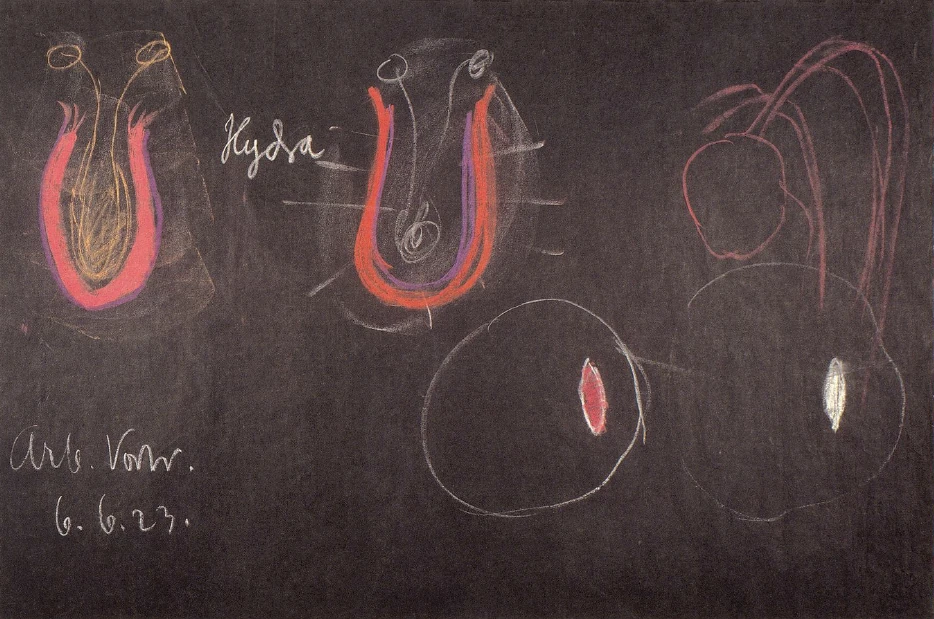
[ 11 ] Well, it goes without saying: If something is to be a living creature at all—namely, a tiny animal—it must not only eat—it has to eat—but it must also breathe. And this tiny animal breathes through the outer surface of its skin. There are tiny little holes all over it. These tiny holes are found wherever there is organic matter—living matter. And through these tiny holes, it draws the air it needs from the water. So one could say: This little creature, the hydra, has an interior, a hollow cavity, which it uses to feed. Externally, on its outer surface, it has its respiratory organs. So the creature draws in air, and the air enters right there in the center into this hollow space. — The little creature can eat and breathe. That’s all it does. It swims around everywhere in the water, eating and breathing in the air from the water, which is, of course, also contained within the water.
[ 12 ] What, then, will the materialist say? He will say: Well, this little animal simply consists of this skin. This skin has developed internally in such a way that it serves as a digestive system on the inside, and on the outside it serves as a respiratory system. — That is what the materialist says. But we cannot say that, for we must regard this as a highly superficial view and must say: No, this little animal also has an etheric body in which it is enclosed, and also an astral body in which it is likewise enclosed. It still has these; these are the invisible members,
[ 13 ] Well, gentlemen, is there any way to prove that an animal is also something invisible in addition to what is visible? The materialist says: I care about what is visible; I do not care about what is invisible. The visible part—on the inside, it looks like a stomach; on the outside, it looks like a lung—and that’s enough for me.
[ 14 ] Now you can do something special with this animal. Isn’t that right, gentlemen? People like us don’t wear gloves, but we still know what they look like. If you have a glove, you can turn it inside out. So imagine that, for my sake, the glove is brown on the outside and has a gray lining on the inside. If you now turn it inside out so that the gray is on the outside and the brown is on the inside, you’ve turned it completely the right way; now the inside is on the outside and the outside is on the inside. You can cut off a fingerless glove from it and do this with that single fingerless glove. Then, when you cut off the fingerless glove and turn it inside out, you’ll have something like this Hydra. The Hydra looks just like a single fingerless glove. And the remarkable thing is: just as you can turn this fingerless glove inside out so that the inside is on the outside and the outside is on the inside, you can also turn this Hydra inside out. You can do that—you can turn it inside out. And then what I’ve drawn in red here (in the drawing, p. 53) is on the outside, and what I’ve drawn in blue-violet is now on the inside. But the cavity is now on the outside, too, and what used to be on the outside is now on the inside. And the strange thing about it is: Now, suddenly, the hydra starts swimming around again. It doesn’t bother her at all. She swims around in the water again, she eats and breathes. She now eats the grains right into this cavity that has newly formed, and breathes through what used to be the stomach wall. So it doesn’t bother the hydra at all. It doesn’t harm it at all. It starts to eat using what it used to breathe with, and to breathe using what it used to eat with.
[ 15 ] Yes, gentlemen, if that were the case—if it had simply developed that way, with only a stomach on the inside and respiratory organs on the outside—then the hydra would have no choice but to breathe in from the inside and start eating from the outside. But that’s not what it does; rather, the moment it’s turned inside out, it turns its stomach into lungs and its lungs into a stomach. Well, now I’d like to know—if there were nothing else there but a stomach and lungs, how could that have happened! If you have a tool, a glove, or whatever it is—you can turn it inside out if it’s something external. If it’s something internal, of course you can’t simply turn it inside out. So whatever remains there in the form of the etheric body and the astral body—the invisible part—that stays. And because that is there, the Hydra’s body can simply be turned inside out. So you see: if one simply observes with a clear gaze what is actually happening in nature, one immediately discovers that the materialistic view must be absolutely wrong. So that one can say: what is actually eating and breathing there is something invisible. And because the Hydra’s body is not as rigidly structured as ours—it has no bones or muscles, but is all made of one and the same substance—that is precisely why the Hydra can use this single substance for everything.
[ 16 ] Isn’t it true that the only reason we can’t turn our stomach inside out is because it’s structured in such a unique way—because we aren’t made of the same material as the Hydra, but rather our substances are different? But on the inside, our stomach must also breathe, and the air we have inside it is drawn in from the outside as well. So our stomach is already a kind of hydra.
[ 17 ] From all these things—to which much more could be added—it is clear, however, that even in the smallest animal one can demonstrate that there is something invisible that underlies it.
[ 18 ] Well, gentlemen, this shows you that even when we speak of what actually moves our whole being, we come to the conclusion that it is something invisible. If you consider external movement—when we walk, for example—you won’t even think that it is your big toe that takes the step; rather, you say: “I am walking; it is my will that causes me to walk.” — When the internal organs move—and it is not just the heart that moves; the intestines, for example, are constantly in motion; the intestines move in wave-like motions; otherwise, the chyme could not be digested; so everything inside the human being is in motion, with movements constantly taking place within—so when the internal organs move, these movements are not caused by what is material within us, but by what is invisible within us. So we must say: The heart is not a pump, but rather the heart is moved by our astral body. — So we have an astral body, and it moves the heart; or rather, because our true “I” is also within the astral body, we also move our heart with our “I,” and indeed we move it in a very special way.
[ 19 ] If you look at the heart, as Mr. Burle quite correctly pointed out, in a normal person it is located slightly to the left—not significantly, not as much as people usually think, but it is slightly to the left. And then the large arteries branch out from the heart here. The aorta and the other arteries actually originate from the heart.
[ 20 ] Here’s how it works: For example, when I inhale, I’m essentially nourishing myself with oxygen. When I exhale, I release carbon dioxide. Once I’ve released the carbon dioxide, I immediately feel a craving for oxygen. I want to inhale again. Yes, at first this has nothing to do with my heart at all, but with my entire body. My entire body feels this hunger for oxygen. Because it feels this hunger for oxygen, it is driven to circulate all its blood, for the blood must have oxygen. Through its astral body, the body sends the blood to where it can obtain oxygen.
[ 21 ] Or suppose I’m walking or working. That’s when the food burns inside me. I’ve already explained this to you once before. As a result, the blood becomes depleted of nutrients. When you work, the blood always becomes depleted of nutrients. Now, what does the blood want? The blood, in turn, wants to get nutrients. The blood, so to speak, seizes the nutrients that the stomach and intestines have absorbed. All of this—this hunger for air, this hunger for food—sets the blood in motion. It is the blood that begins to move, and the blood draws the heart along with it. So it is not the heart that pumps the blood through the body, but rather the blood moves due to a hunger for air and a hunger for nourishment, and this is what sets the heart in motion. So we must say: It is our invisible human being who moves the heart.
[ 22 ] Well, gentlemen, when you hear this now, you may raise a question. You see, with our anthroposophy, it’s always the case that opponents think they’re the ones raising the objections. But we’re already familiar with those objections long before they’re raised. We come up with them ourselves beforehand. That is why I always draw your attention to the objections as well. You might object: “Well, what good is the heart if it doesn’t pump blood through the body? If the blood moves on its own, perhaps we don’t even need the heart, which is supposed to be carried along with it.”
[ 23 ] Yes, you see, that’s what people say who don’t really understand the human body as a whole. There’s a big difference between the human head and the rest of the body. I’ve already told you a little about this difference. Suppose you’re walking or working. Yes, the head isn’t actually doing any work there. The head sits on the rest of the body, much like one sits in a carriage. You sit there quite still. The carriage has to turn its wheels; the horses have to pull it. But that’s how our hands and feet have to work, while the head sits inside as the part that doesn’t participate, doesn’t it? Otherwise, we’d have to have ropes attached to our earlobes somehow, and use them to set the wheels of the machines in motion. We don’t do that. The head doesn’t participate. Just imagine if you could attach such ropes to the top of your head—most people today couldn’t do that anymore, because they’re bald—that would be very bad for a person. The head doesn’t actually participate; it just sits quietly atop the rest of our organism. But why is that? Well, you see, the head is simply something entirely different from the rest of the human being. The rest of the human being is a locomotive apparatus. The head is a locomotive apparatus only insofar as it participates in the movements and so on; that’s simply how the movements affect our head. But the head is not the part that performs the movements itself.
[ 24 ] The head has the sensory organs on the outside. That is where it perceives what is outside. But the head also perceives—though unconsciously in most people—what is happening on the inside. If I want to look outward to know what’s happening outside, I need my eyes. If I want to look inward, at my blood circulation, I need my heart. The heart isn’t just there to pump blood through the body; it’s a sensory organ that perceives everything, just like the whole head. We could know nothing about our blood circulation—of course, with our little brain we know nothing about it either, but there must be knowledge inside the head—if the head did not perceive our entire blood circulation through the heart.
[ 25 ] I have told you how the liver is an organ of perception. For example, the liver perceives the lower movements. But the heart perceives all the movements of the entire human being. This sets the heart in motion. The movements caused by the body’s need for air and food set the heart in motion. And by observing the movements of the heart, one can tell whether something in the body is in order or out of order.
[ 26 ] Gentlemen, you can easily see that. What do you do when someone gets sick? The first thing is to feel their pulse. Anyone who has gotten into the habit of reading a pulse can learn an immense amount from the pulse rate. The pulse is truly a barometer of one’s entire state of health and illness. But the pulse is nothing other than the movement of the blood. What one does when feeling the pulse of a sick person is what the head does constantly. It constantly senses the entire blood circulation through the heart. In fact, the head senses everything that goes on in the body through the heart.
[ 27 ] Well, just imagine: one evening, someone drank an awful lot of alcohol and was, as they say, thoroughly drunk. This throws the entire blood circulation out of whack. The next day, the head senses through the heart that the entire blood circulation is out of whack. He gets what’s known as a hangover, doesn’t he—that familiar throbbing headache. Yes, why is there a throbbing in the head? You see, when it’s a beautiful day and I look around with my eyes, I get a pleasant impression. When the weather outside is terrible, I get an unpleasant impression. Yes, gentlemen, when everything in the blood is flowing properly, the mind has a clear sense of things; everything is in order. But when there’s a storm raging in the blood—which is what happens when someone gets drunk in the evening—then, through the heart, the mind gets a stormy sensation, and everything gets all jumbled up.
[ 28 ] So we can only understand what the heart is when we realize that the heart is actually the inner sensory organ through which the mind perceives everything that is happening in the body.
[ 29 ] When we look around at the world, it becomes clear that human beings are connected to the entire world through their invisible aspect—what I have called their astral body. The most important celestial bodies with which human beings are connected are the Sun and the Moon. Now, the human head is primarily related to the Sun, but the rest of the human being is in fact related to the Moon. And one can say that it is, of course, a terrible superstition to believe that one can do anything based on the current phases of the Moon. But there is a rhythm within the human being that is also expressed in the blood and that is similar to the lunar rhythm. Human beings are already attuned to the whole world. And so it is also the case that the inner movement of the blood does not depend solely on food. When a person is completely healthy—and in a certain sense, a person is a free being—then, in a certain sense, they make themselves independent of external natural influences and, in a certain sense, independent of the whole world. But the moment a person begins to become even slightly ill, they become dependent on the entire world.
[ 30 ] Suppose someone is sick and you can tell by their pulse. For someone who can perceive this, there is a huge difference between the pulse in the morning and the pulse in the evening. You can tell a lot from how the morning pulse differs from the evening pulse. But in addition, for certain sick people, there is a big difference between the pulse during a full moon and the pulse during a new moon. Human beings are, after all, dependent. Even if they can become independent when healthy, a certain dependence remains, and this becomes particularly evident during illness. So we must say: In what makes an impression on our hearts, we are already in a relationship with the movement of the celestial bodies, namely the Moon. We are in relationship with the movement of the Moon. — In this regard, there is actually still a great deal of observation that needs to be done.
[ 31 ] I told you earlier: In a normal person, the heart is positioned slightly to the left. But just as there are left-handed people and most people are right-handed—doing everything with their right hand—curiously enough, there are also people with their hearts on the right. In fact, there are people whose heart is not on the left, but on the right side. Most of the time, this goes completely unnoticed because the difference is, of course, an internal one. If someone is left-handed, right, you notice that very quickly, but if their heart is shifted slightly to the right instead of to the left, you don’t notice that right away. But it would be interesting to examine precisely those people who have their heart on the right side to see how they differ in life from those whose heart is on the left. The person whose heart is on the right—that is, shifted to the right—is someone who must always do certain things at a specific time of year or a specific time of day. The “right-hearted” person is much more dependent on their external environment than the “left-hearted” person. And if the heart has shifted just a little bit to the right—after all, it isn’t in the exact same place for everyone, but varies slightly from person to person—if it’s still on the left but has shifted just a little to the right, then that person immediately feels a longing to orient themselves more toward their external environment. They immediately want, let’s say, to do something special in the spring and something special in the fall. Of course, you can’t do that all the time—it will ruin you. People don’t even realize what can ruin them.
[ 32 ] For example, in school, one must take a slightly different approach with children whose hearts have shifted somewhat to the right—which need not even be noticed—than with those children whose hearts are in the right place. When a person has shifted their heart to the right, they are led to make much greater use of their astral body.
[ 33 ] You see, gentlemen, this is how it is: When someone works on a machine for a long time, you’ll find that, generally speaking, the work becomes mechanical. It does become more unpleasant because you yourself become part of the machine, but when you work on a machine for a long time, you perform the manual tasks and so on mechanically. Just imagine: you’re a perfectly normal, genuinely left-handed person. My father was also a left-hearted person, as were my grandfather and great-grandfather. It just slowly crept in. And when you’re born as a son into that, you naturally make the same inner movement that your father, grandfather, and great-grandfather already made. It comes as easily as when you’ve been working on a machine for a long time.
[ 34 ] If one is a right-hearted person, the state of one’s heart is not inherited from one’s father. As a rule, the father is not also a right-hearted person. This is not something that is inherited. In such cases, one must, so to speak, start over again and again from within one’s astral body. One does not carry the entire genetic inheritance within oneself. And the result of this is that such a person—who is a right-hearted person—must exert much more inner strength to keep the entire blood circulation in order. And that is why such a right-hearted person is much more attuned to the external world.
[ 35 ] The following is even possible. Suppose you are not a “right-hearted” person at all, but a perfectly normal “left-hearted” person. But if you were to become a ballet dancer—which happens to men as well, though even more so to women—then ballet would also influence your heart. Now, ballet is, after all, a very materialistic art form. But in ancient times, when people were encouraged to dance—for example, in ancient Greece—the fact that they engaged in movements modeled after the stars caused the heart to shift slightly to the right even during their lifetime. Indeed, even today, dance still has a powerful effect on the heart of a dancer—even though it has become materialistic—because the heart does shift slightly to the right. And if one paid more attention to these things, one would, upon dissecting a person after death, already see how the heart has stretched certain vessels apart. Because the person in question was a dancer, the heart—as can still be seen after death—has simply shifted a little to the right.
[ 36 ] This answers the question posed by Mr. Burle. It is answered by the fact that we see: When a person is more attuned to their astral body, they do not actually want to follow their usual blood circulation, but rather want to control it even more, and in doing so, they engage in movements that are more akin to those outside the Earth, toward the Moon. Can you understand that? (Answer: Yes!)
[ 37 ] So what you asked about today—that it is very easy to notice that a person has a certain longing to do this—is precisely related to the fact that a person’s entire emotional life is governed by the invisible realm, so that, I would say, they slip a little over into the invisible realm, and that they then actually orient themselves toward the external world and not merely toward the inner circulation of blood, which is governed by breathing and nutrition. All these things can be explained if one truly understands human beings.
[ 38 ] And now I’d like to tell you something that’s still somewhat related to what we discussed last time. Last time we saw that inside the eye there’s this little lens (a drawing is made). When a person has normal vision, this little lens is transparent. When a person develops a cataract, the lens becomes opaque. Salts are deposited there. So we can say: In a healthy person, here in the eye—if this is the front of the eye—is the lens; it is transparent. In a person who is seriously ill, the lens has become opaque due to the deposition of salts. Because the lens is transparent, the human astral body can perceive the world through it. The person sees everything in the world.
[ 39 ] If one accustoms oneself to very, very intense thinking through things such as those I have described in the little book How Does One Attain Knowledge of the Higher Worlds?, there comes a moment when one is able to do something quite special. But getting used to very intense thinking—that’s not something people today are easily willing to do. For people today simply do not withdraw completely into their own thinking, because they say: Everything must be given to us from the outside; we must explore the mysteries of the world from the outside. — Of course, it’s also inconvenient, because one has to be very careful with this kind of thinking. When one thinks very vividly, one naturally has to be extremely careful. But there comes a moment in life when one is able to do something truly special.
[ 40 ] Isn’t it true that I lift a chair with my hand? Everyone understands that, because it happens all the time. But I can also leave my hand at rest; I don’t have to use it for what it usually does. What the lens of the eye does, however, is not something within human control. When you perceive an external impression, well, then you simply look through your lens toward that impression. When you don’t perceive an impression, the lens remains at rest.
[ 41 ] But, gentlemen, just imagine: someone has really made an effort to cultivate a very powerful inner life. He is completely absorbed in his inner thoughts. He doesn’t look outward; he lets his eye’s lens rest, just as one lets one’s hand rest when one isn’t using it. Yes, then the entire starry sky is reflected right where one would normally have the transparent lens used for seeing. For that, I would say, is the truly marvelous thing: that through this method—which one trains in the way I described in How Does One Attain Knowledge of the Higher Worlds?—one learns to use the individual organs not only for the Earth but also for the other world. Of course, if salts have accumulated, the lens becomes clouded and involuntarily opaque. If one thinks deeply enough, it remains transparent, but the person does not see through the lens; they do not look outward. And that is where it begins—illuminating the entire world from the lens. But then one sees the spiritual realm. In fact, one sees the entire starry sky according to its true, inner meaning. This small spot within a person, where the lens is located, can teach one about everything one then dares to say about stars and so on. You see, what is truly magnificent about human beings is that ‘in the smallest point lies the seat of knowledge that is immense.’
[ 42 ] Someone who is physically frail—which, of course, one would not wish on anyone—actually finds this whole process easier; they do not need to exert themselves so much in their thinking. They need only concentrate just a little, and they can reach a point where they see inwardly, even if they have forgotten how to see outwardly. But this is precisely what must always be emphasized when speaking of such higher insights: When speaking of such higher insights, it is always so easy to exert oneself too much, and then, instead of higher insight, something like—let’s say—a clouding of the lens may occur. Through this intense inner concentration, the lens can then—even if one does not become seriously ill—become somewhat more opaque. That is why, in my book How Does One Attain Knowledge of the Higher Worlds?, everything is described in such a way that a person can achieve what is discussed there without becoming ill as a result. No exercise should be described in such a way that it could cause illness. But this lens is the place within the human being that can actually reveal the entire spiritual world to us from within the eye. And so we can say: One can see outwardly when everything in the eye is transparent. One can see inwardly when something is deliberately made opaque.
[ 43 ] Yes, gentlemen, this is something that can make it clear to you how knowledge of spiritual worlds actually arises. Knowledge of spiritual worlds arises precisely because one first finds within one’s mind the individual aspects that are not needed for ordinary activity—precisely because they are at rest. Through the lens, one first comes to know the external world. But one can bring the entire body to a state where everything internal is, for a moment, rendered unnecessary. If, for example, one does not use the heart—the blood circulation can continue, but one switches off the heart as a sensory organ—then one begins to perceive the entire blood circulation. But then one does not merely perceive the blood circulation. If you train your heart so that you, as it were, look right through your body to the blood circulation—that is, if you do not inwardly sense the heart or feel the pulse, but instead look right through it, just as you learn to look through the lens out into the world with your mind—if, in other words, you learn to look right through yourself—then, gentlemen, then you will see not just the blood circulation, but the entire movement of the moon—everything the moon does—and you will see how the moon relates to the sun. And then you will see the connection between the heart and the sun and the moon.
[ 44 ] You see, in the old days, all of this was easier for people. Back then, people really weren’t yet so conditioned to learn about the outside world solely through science. They didn’t want to see everything laid out before them at all. If you had taken a Greek—that is, a person who lived twenty-seven or twenty-eight hundred years ago—to the movies, well, he wouldn’t have watched the movie for long, because he would have fainted—for the moment he looked at the screen, something would have happened inside him—not just in one limb, but throughout his entire being—similar to what happens when a limb goes numb, when something presses down on it. The man wouldn’t have fallen into a proper sleep, but this “falling asleep” of his entire being would have occurred if you had seated the ancient Greek in a movie theater. He would, of course, have fainted from it. So the ancient Greek would not have been able to watch it at all, because at that very moment his head, through the heart, would have experienced such a disruption in his entire circulatory system that his whole body—not just individual limbs—would have gone numb, and his head would no longer have been able to control anything. He would have fainted. People have simply become very different from what they were in ancient times. Today, modern culture has already caused people’s blood circulation to be so disordered that they no longer faint at the movies.
[ 45 ] If you’ve really delved a little into the spiritual sciences and then go to the movies, you have to pull yourself together—otherwise, you might still faint today. But isn’t that true? We’re all human, after all, and one person takes on the characteristics of another. And the fact is that human beings no longer have the same circulatory system as in ancient times, as the people of old did. That is why the people of old could more easily perceive the circulatory system and speak more easily of the sun and moon than we can. We are cut off from it and must first reconnect with it through exercises. We must first restore our organs properly so that we can see.
[ 46 ] You see, the ancient Greeks could therefore still understand when older people told them about how things actually are on Earth. One must not assume that everything handed down from antiquity is always superstition; it’s just that, in many cases, later generations have distorted it to the point where it has become superstition. It is indeed curious how things that are entirely reasonable at first simply turn into superstition later on. When people no longer know how things are actually supposed to be done, they turn into superstition. For example, the ancient Jews did not eat pork. Yes, they knew that, given their race and the region where they lived, pork made them weak. Later, this became superstition. Things that later become superstitions always trace back to earlier, reasonable practices. So we need not believe that what existed as ancient knowledge in the past is always nonsense, but we cannot always rely on the old ways, because the old traditions have often been distorted. That is why we must investigate everything anew.
[ 47 ] That is why it is so nonsensical when people say of anthroposophy: “They’re just gathering together what was already there once.” — Nothing is simply being gathered together; rather, everything is being explored anew! And to those, gentlemen, who tell you, “In anthroposophy, they’re just gathering together all sorts of old Gnostics”—just ask them where they can prove that the story about the eye lens, as I told you last time and today, can be found in any book. You cannot find it, because the story has been completely forgotten. You can therefore reply to anyone who says these things have been cobbled together: “You’re lying, because you don’t even know what is said there”—that is, that the entire view of the heart and so on is being renewed.
[ 48 ] The fact is that everything here is first explored from the ground up and then applied to the whole person. And from such simple things as the way a person moves while dancing and spinning—which I touched on last time and again today, prompted by Herm Burle’s question—one can gain a great deal of insight. That is something one can understand.
[ 49 ] But, gentlemen, then something else will emerge—something humanity fears most of all. For, you see, once anthroposophy takes hold—today, of course, there’s nothing we can do; if we try to take practical action, all hell breaks loose; even if one merely speaks of these things, the opposition you know all too well arises immediately—but once anthroposophy has advanced to the point where it penetrates our schools and asserts itself everywhere, something else will come to pass. Then, in fact, people will know which movements are right for a person’s health and overall metabolic development, and which are wrong. Then the time will come when work will be adapted to the human being. Today, work is adapted to the machines. Today, people must move in the way that those who invented the machines deem appropriate. Later, people will realize: It is not what comes from machines that is the main thing, but rather the human being is the main thing. Therefore, there should only be machines that are designed for human beings. This will only be possible once anthroposophy has been fully accepted. Then we will be able to say: Everything mechanical must be adapted to the human being.
[ 50 ] But this requires something. First, one must understand that the heart is not a machine, but is attuned to the human being. Then one will also be able to find the foundation for the external machine that shapes it in such a way that it, too, is attuned to the human being. But a science that has made things so convenient for itself by describing the heart as if the human being had nothing more than a pump in his blood circulation has no qualms about designing the machine in such a way that the human being must adapt to it. Our entire flawed social situation is, in fact, linked to this erroneous view in science. And that is why one must realize that a correct understanding of the human being must come first; only then can a proper social life begin. As long as people believe the heart is a pump, they will not be able to adapt properly in their external lives either. Only when people realize that the invisible human being is higher than his heart—that it is he who moves his heart—will machines also be adapted to the human being. We must first begin to see this.
[ 51 ] People today are taking it way too easy. They’re really taking it way too easy. What’s the biggest international event these days? A soccer game! I explained this to you the other day. But anything of an intellectual nature is always confined to small circles and the like. It becomes fragmented. Isn’t that right? In Norway, you might hear people chant, “Long live!”—or you might hear a German song being sung when soccer players (from Germany) are on top. But otherwise, people keep to themselves.
[ 52 ] What must be grasped is the spirit, but in such a way that it is grasped in its particularity. It is not a matter of speaking generally about “spirit, spirit,” but rather it must be grasped in its particularity.
[ 53 ] We'll talk more about this next Saturday.