

Rhythms in the Cosmos and in the Human Being
GA 350
2 June 1923, Dornach
Translated by Steiner Online Library
2. The Influence of the Etheric and Astral Realms on Human Beings and the Earth
[ 1 ] Good morning! Actually, I’d like to add something today to what I brought up last time. I believe that we will come to understand better and better what the human being truly is in the context of the universe when we consider precisely such things. So today I’d like to add to what we discussed last time—how things actually are in reality when something like a cataract—whether gray or black—affects the human eye. The eye then becomes useless. At first, the person has the impression that there is something flickering before their eyes. Then everything becomes increasingly blurry, and they can no longer see what they used to see.
[ 2 ] Well, what causes this serious eye disease? It is caused by something in the eye—which must be transparent, just as glass must be transparent—becoming opaque. If, instead of the transparent glass in a window, you have some opaque paper or a piece of cardboard, you can no longer see through it. It is the same with an eye affected by severe cataracts. Something that should be transparent has become opaque.
[ 3 ] Let's be very clear about this. I’ve drawn the eye for you several times. It protrudes from the brain (see drawing) and from the skull; this is a side view. It has a slight protrusion at the front, and inside the eye itself, blood vessels and the optic nerve extend. So that’s where the blood vessels and the optic nerve come together.
[ 4 ] But there’s also something else in the eye—a sort of muscle attachment. This muscle attachment supports what’s called the lens. So, inside the eye, the muscle supports a very small, transparent, lens-shaped structure. If you imagine a small lens—but one that is transparent—it is suspended inside the eye. And you have to look right through this lens. Viewed from the front, this lens looks like this (see drawing), and you have to be able to see through it. From this alone, you can see that the point is that we must have a transparent eye if we are to see. The eye must be transparent. Isn’t it true that, if you really think about it, you’ll say to yourself: It can’t be the eye that sees, because the eye must, in a sense, step aside—make itself transparent—so that it can see. For example, if you smear these window panes so that you can’t see through them, you can no longer see out. Yes, it is you who are seeing through the glass. The glass cannot see; rather, you yourself are seeing. Likewise, it is not the eye that sees, but rather something within the human being that sees through the transparent eye.
[ 5 ] Well, what happens when a person develops severe cataracts? When a person develops severe cataracts, the lens in the eye becomes opaque. This lens is very small, but when you remove it from the eye and look through it, it is transparent. However, a lens from a person with severe cataracts is white, milky, and opaque. So I would have to draw the beautiful, transparent lens of the healthy eye like this, and the opaque lens, I would have to draw it like this. So the lens has become milky and opaque.
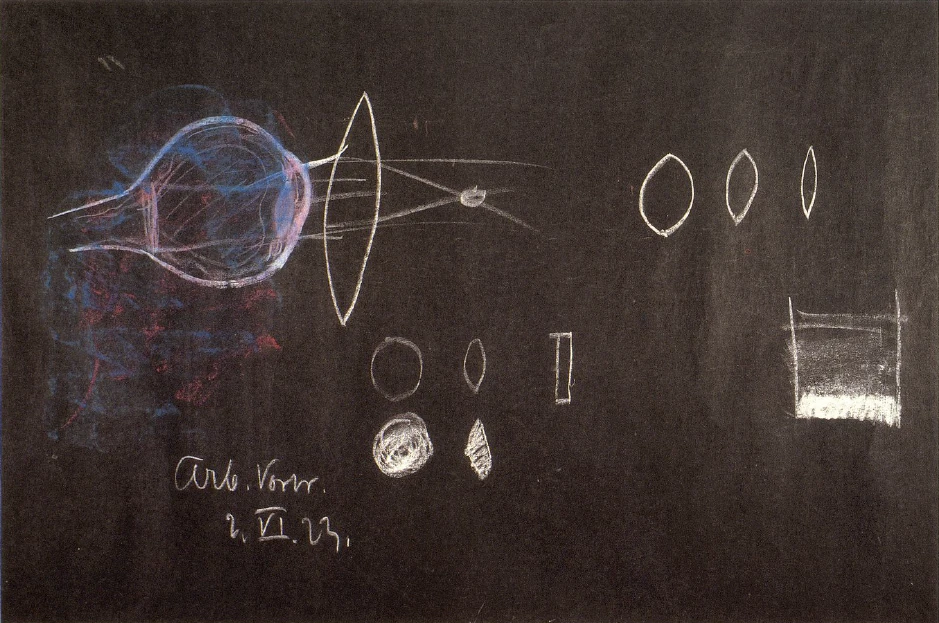
[ 6 ] You see, when it comes to these things, it’s always an advantage that the human body is elastic in its individual parts—elastic in many ways. So if you have a severely distorted eye and you make an incision in a certain direction, this muscle here exerts its elasticity, and the lens—which is normally held in place by the muscle—pops out when you make a hole here. So imagine you have a severely distorted eye. You make an incision in a certain way. The operations are relatively very simple because the body itself assists in every step. The lens pops out. There you have it in your hand; you place it in the dissection dish—the lens that has become opaque. Now, of course, the person certainly cannot see once the lens is out, because they need the lens to see. I’ll show you in a moment why they need the lens to see.
[ 7 ] So when a person has undergone surgery in which the lens has been removed, their vision becomes clear again, whereas before they could not see anything at all. Although they can already look out, once the surgery is complete—that is, once the lens has been removed—they will only be able to see objects that are very far away. But their vision is still insufficient. So we are left with a useless eye. Their vision does not extend far enough for them to still see what they could have seen, for example, with the lens removed. The eye has become useless.
[ 8 ] Now, a person who has undergone this type of surgery is given a pair of glasses. You see, this is actually an artificial lens. He used to have the lens inside his eye, and now he has an artificial lens. Now, through the artificial lens, the rays of light that used to travel in such a way—before the lens was removed—that he could only see very far away are redirected so that he can see up close again. That’s what this lens in front of his eye does. So the lens he used to have inside his eye can be replaced with a transparent lens. Of course, it’s less perfect because it’s not alive. The lens in the eye is alive; you can move it, and that naturally has its advantages. But in any case, in an emergency, you can restore vision simply by removing the lens that has become opaque and replacing it with a glass lens—specifically, cataract glasses. Then the person can see again.
[ 9 ] In this way, one is able to gain a clear understanding of what vision is really all about: that the eye is a mechanism, a tool for seeing, since one can even replace a small part of the eye—using an external tool, namely cataract glasses. That the living lens has an advantage over these cataract glasses—this substitute—may be evident to you from the fact that, as shown in the diagram, when one wants to see something very far away, one must make the lens a little thinner. Then one can see something farther away. So when the hunter takes aim and wants to shoot a little farther, he must make his lens thinner. This is done by the muscle located here (pointing to the diagram, $. 35); it makes the lens thinner. If one wants to see something very close up—to read something small up close—then one must make the lens thicker. That, in turn, is done by the muscle. Of course, you can’t do that with standard glasses, because otherwise you’d always have to switch to a different pair. People do that sometimes, though. Even today, there are certainly people who need two different pairs of glasses—one for near and one for far. But because the lens in the eye is a living structure, you can adjust it internally to see both near and far.
[ 10 ] Now you can also see why, when I have removed the lens completely, only distant objects can be seen, because it is as if I had made the lens completely flat when I removed it. Then I can see things that are very far away again. But then, in turn, my eyesight is not good enough.
[ 11 ] Behind the lens is a gel-like substance called the vitreous humor. It can also become opaque. Once it has become opaque, surgery is not possible because there is no way to replace it.
[ 12 ] When you look into the eye from the outside, it appears black. The lens is right there, behind that black pupil. And it appears black because you are actually looking at the back of the eye. You’re looking through the entire lens and through all of that [the vitreous humor].
[ 13 ] But now we must ask ourselves: What actually happens when the lens becomes opaque? — Just imagine a piece of glass. When the glass is transparent, light passes through it. If you have something opaque, it means that the light does not pass through—that the light is blocked. Now, in the case of the eye, light must be able to enter and exit the lens. You see, light belongs to the ether. It does not belong to matter—to the substance of gravity that is on the outside—but rather, light belongs to the ether.
[ 14 ] Now I have told you: In addition to his physical body, a human being also has an etheric body. And what does it mean that the lens is transparent? The fact that the lens is transparent means that the human etheric body, which passes through everything—I’ll draw it in red now—can simply pass right through the lens. If the lens is perfectly transparent, the etheric body can pass through it. This means that a person then has a small portion of their etheric body at the location of the lens. If the lens becomes opaque, it is because the substance within the lens clumps together. If salt or something similar settles in the lens, it becomes opaque. It’s just like when you dissolve salt in a glass of water. As long as the salt is dissolved, you have an almost transparent salt solution. When the salt settles at the bottom (it is drawn),
[ 15 ] “Then it becomes opaque down there. That means the tissue doesn’t let light through. So when salty deposits build up, the lens becomes opaque. As we age, these salty deposits build up. That’s when the transparent parts of the human body become opaque.
[ 16 ] In the case of severe illness, the transparent lens can become opaque. What is the consequence of this? The consequence is that the human etheric body can no longer enter the opaque lens. Now there is a small hole there. A person’s etheric body is present everywhere, and when they are healthy, this etheric body fills everything. When the lens becomes diseased and opaque, the etheric body cannot enter the space where the lens is located. Now, in the area where the lens is located, you have no etheric body. So we must ask: What does this serious illness consist of? — This serious illness consists of the fact that, in the area of the eye where the lens has become opaque, the person has no etheric body.
[ 17 ] But one cannot yet see with the etheric body alone. If one could see with the etheric body, then one would always be able to see at night, because at night in bed one also has the etheric body; it is only the astral body that is outside. So one does not see with the etheric body. One sees with the soul. But one needs the etheric body to see. The astral body is also still there—it is the third body that a human being possesses—and it, in turn, fills out everything. Now, if this astral body wants to see in this spot here, where there is no etheric body, it cannot, precisely because the etheric body is missing in that spot. And so we can say: How does something like this—our ability to see—happen? It happens because our astral body is inside our etheric body. — But if the etheric body is “switched off” in a certain place—pushed aside because the lens, the eye, is opaque—we cannot see. The astral body cannot see there. Is that understandable?
[ 18 ] It is confirmed: Yes!
[ 19 ] This enables our astral body to see that the etheric body can actually enter the very spot where the lens is located—the place where it is most needed. So if one correctly understands something like Stark’s disease, one can truly see from it how a human being has an etheric body and an astral body.
[ 20 ] When a person is in the very early stages of such a serious illness, one can say: This serious illness arises because the salts deposited in the eye, in the lens, prevent the etheric body from entering the eye. — Now, something must be done to make this lens transparent again. Once the condition has progressed quite far—when the lens is already completely saturated with salts and has thus become opaque—there is nothing left to do but surgically remove it and replace it with cataract glasses. But the fact is that when cataracts are in their very early stages, there is still something else that can be done. And it is precisely through this that I now want to show you how the human being is connected to his or her surroundings.
[ 21 ] Suppose you have this earth here. Plants grow out of this earth. You see, such a plant naturally has a physical body. We can touch it and look at it. But this plant also has an etheric body, because it is alive, and everything that lives has an etheric body. If the plant did not have an etheric body, it would be a stone. It has an etheric body; it is alive. But the plant cannot perceive or feel. It has no astral body. Yet all around the Earth is what is known as astral substance. The astral is everywhere. We have an astral body within us, but the astral is also everywhere in the Earth’s surroundings. I want to tell you how one can come to realize that the astral is everywhere. To do so, we will have to draw upon a rather remote fact that seemingly has nothing to do with this at all.
[ 22 ] As you all know, fire-spewing mountains occasionally—well, as they say—start spewing, with molten masses flying out. Let me describe such a fire-spewing mountain to you a little. First, there is the ground below, filled with ordinary rock. So if we take Vesuvius, for example—which is in Italy, near Naples—the ground there, the bedrock, consists of what is called Apennine rock. So down there we have the ordinary rock that’s also found all around the surrounding area. But then other layers are stacked on top of it. They’re stacked like this (see drawing). At the point where, for example, Vesuvius erupts, there is a fissure in the earth. And when Vesuvius erupts, ash particles mixed with water come out of this fissure first; then bomb-like rocks emerge. All of this is hurled to the surface. Sometimes it’s liquid, sometimes it’s in the form of bombs. Then it flows down, continuing to flow downward. And everywhere, these rocks—which are hurled out like bombs—appear. They flow down again. In between, there’s rain mixed with mud. All of this then piles up to form such a mountain. So, from the Earth’s interior, hot water mixed with ash is first hurled out. As it flows down, this forms a very thick mud. Then, a little later, these bomb-like chunks come rushing up and are hurled all over the place. This is how such fire-spewing mountains are formed.
[ 23 ] Well, gentlemen, I’d like to tell you how science usually responds to a phenomenon such as fire-spewing mountains. Science says: Yes, all sorts of things that lie beneath the earth burst forth there. Fire-spewing mountains are usually found near water. — Certainly, that is also true. There are few fire-spewing mountains in the middle of the country; they are usually near the shore, near water. — So, since there is a fissure in the earth there anyway, water could seep in, and that water would then be brought to a boil by the heat inside the earth. And this boiling water then forces out all the substances that are down there. — So, first, one of the scholars says this, writes a book about it, and in this way has explained, as they say, the origin of the fire-spewing mountains.
[ 24 ] Now someone else comes along and says: Yes, but we have reason to believe that these fissures are not wide enough for water to enter. We cannot assume that, even if the fire-spewing mountains are located near the water, the water can enter through these cracks in the earth. So what the first scholar said cannot be entirely correct. The matter must be explained in a different way.
[ 25 ] Well, here comes this guy and says: Yes, inside the Earth, things aren’t the same as they are out here; rather, inside the Earth, the metals are liquid. Just as iron is liquid in a smelting furnace when it’s being processed, so too are the metals liquid inside the Earth. There are liquid metals in there. — Well — names are easy to come by — these liquid metals are called magma. So there’s magma in there — all right, liquid metals. And now, when this liquid metal—this magma—reaches a spot where it can more easily find a way out—here it’s too difficult for it to escape anywhere, otherwise it would spew out everywhere—when it reaches a spot where it can more easily find a way out, it simply finds a way out there, and that’s where it comes out. — That’s what the other person says. So it happens, says the other person, because of the irregularities in the Earth’s density; the magma radiates out in one direction or another.
[ 26 ] Then a third person—or a fourth—comes along and says: “Yes, but magma can’t possibly have enough power to hurl those bombs out with such force! That can’t be the explanation either.” — Then a few others come along and say something else entirely. And then that gets written into the popular books intended for the general public. So they write: “Actually, we still don’t know the cause of why these fire-spewing mountains form.” — That’s more or less the state of affairs today. Usually you’ll find: One person claimed this, another claimed that—but no one really knows what the cause is. When it comes to the most important things, we don’t know what the cause is!
[ 27 ] But now I want to tell you something. Here’s the thing: When you get to the area where Vesuvius is already very close by, near the fire-spewing mountains, there’s actually a very beautiful phenomenon. If you take a piece of paper and set it on fire, the ground suddenly starts to smoke. So here you have the ground (a drawing is made), you light a small piece of paper here, now it’s burning (red), and now the ground all around the paper flame starts to smoke, all on its own, and little by little, as you burn a large piece of paper, you can find yourself completely surrounded by the rising smoke. That is, of course, a very beautiful sight. For people traveling in Italy, tour guides show them how smoke comes out of the ground when you simply light a small piece of paper.
[ 28 ] Well, what does that actually mean? Yes, you see, gentlemen: At that spot in there, there’s a certain accumulation of water vapor. Down in the ground—at the spot where this vapor then comes out—that’s where it’s accumulated. It can’t escape if the air above it has a certain density. The air keeps that vapor trapped inside. Now, as you all know: When you heat the air, it becomes less dense. When you heat a room, the air also becomes less dense. Warm air is always less dense than cold air. So when you light a fire here, the air becomes less dense. The less dense air can then no longer hold the steam down, and so it flows out. Of course, it has to be down there first. There has to be something down there that can flow out. Yes, but, gentlemen, just think about what you’ve done! You weren’t down there blowing the steam upward. You didn’t do that; instead, you lured the steam out from the outside by setting a piece of paper on fire. So if you set something on fire up here above the ground, you can lure the steam out. Because you’re making the air thinner, you’re luring the steam out.
[ 29 ] You see, the learned gentlemen are constantly searching for the causes of the water vapor coming out of the volcano, and even of the bombs flying out of it; they are searching for these causes—yes, they are searching for them underground. But they aren’t there at all—just as the causes of the water vapor escaping when you set a piece of paper on fire aren’t underground—rather, the causes are out there, outside the earth.
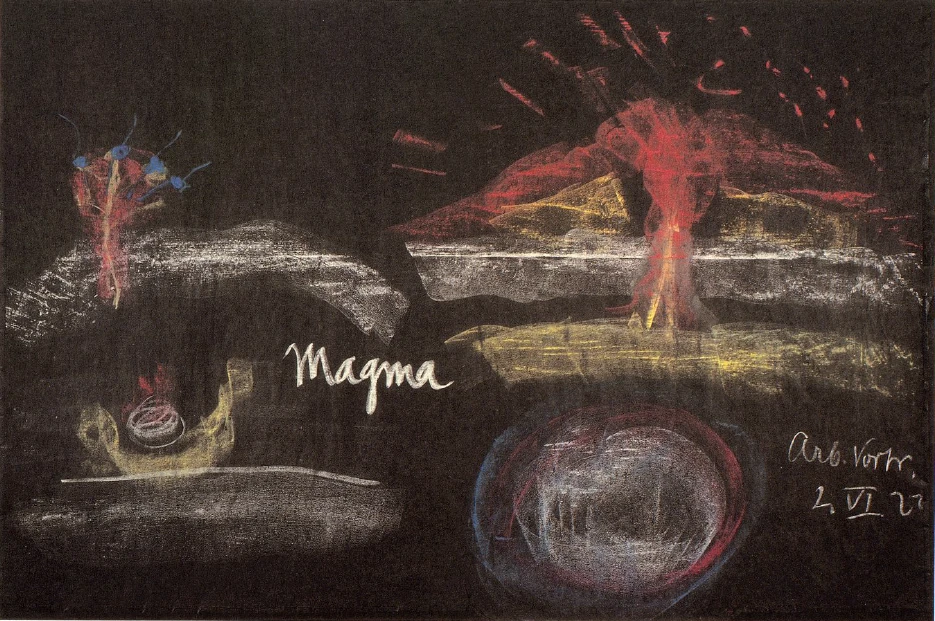
[ 30 ] You simply have to be able to understand the things that are facts in the right way; then you’ll figure things out. Just as you aren’t simply standing here blowing steam up from the ground, but rather coaxing it out through the thin, heated air—in the same way, something down there is coaxing everything that’s down there out. And you see, you can’t get solid rock out of there just by lighting a piece of paper; otherwise, the curious English travelers, if they were to light a piece of paper near Naples, would not only be enveloped in smoke but would also have all sorts of rocks rained down on them! You don’t get that there—instead, the air is simply thinned out and the steam rises. Here, however, above Vesuvius, when it begins to spew and erupt, everything astral that lies above it is thinned out. And this astral substance is thinned out by forces from the stars and planets far away. So when a certain constellation is above Vesuvius—as it often is; it doesn’t usually appear there, but it happens to be in that exact spot—then, just as here through the paper, here through the constellation, because the astral substance above is thinned out, what is below is torn out.
[ 31 ] So you’re seeing a small eruption of Vesuvius when you see the sulfur fumes—it’s not just water vapor, but also sulfur vapor—coming out. This is called a solfatara. So wherever these powerful volcanic eruptions take place, it is not what lies beneath that is active, but rather what is outside—what is coming directly from the constellations.
[ 32 ] Of course, with things like this, there’s sometimes a bit of—how should I put it—nonsense, self-importance. For example, someone once came up with the idea that certain phenomena like this stem from the constellations, from the positions of the Sun and Moon, for instance. That was Falb. Perhaps some of the older ones among you have already heard something about the famous Falb theory. Falb didn’t just say that earthquakes, but also volcanic eruptions, for example, are caused by the constellations. That was actually correct. But he was also a terribly vain man and liked to make a big deal out of the whole thing.
[ 33 ] Now he has come up with something else that is also important. As you know, so-called “explosive gas outbursts” are a terrible scourge in mines. Something happens in the mines because the gases ignite as they rush powerfully through the mine. Now Falb said: Even this particular characteristic of the gases does not come from the Earth’s interior, but rather, for example, from the positions of the sun and moon. — And based on what he had come up with, Falb even compiled predictions of earthquakes and outbursts of gas in mines. Well, these were often incorrect, though sometimes they were correct. Of course, the reality is that unforeseen events sometimes occur during natural phenomena; in such cases, the prediction does not hold true. But Falb then published a calendar covering the entire year. In it, he listed the so-called “critical days.” Whenever specific constellations or particular positions of the sun and moon occurred, he would say: “On that day, there must be outbursts of gas”—or: “An earthquake must occur.”
[ 34 ] I once attended—it was a long time ago, well over thirty years—a lecture by Falb. There, Falb, who was a tall, slender man, presented his theories convincingly, explaining how —he knew nothing about the astral realm, but believed it stemmed solely from this thermal rarefaction—how heat is rarefied and how gases are then drawn up from below, just as with those solfataras, where gases from mines either become explosive fumes or something of that nature. Now, it was a large hall. Falb was standing up there. He explained it—explained it well. There was a lot of truth in his explanation. Suddenly, just as he’s in the middle of his explanation and says: “So, a certain position of the sun and moon causes a change in the air; explosive gases must form; they’re drawn out”—boom, there’s a knock at the door. A newspaper boy from the Neue Freie Presse comes in, brings a telegram, and places it on the lectern. Falb isn’t exactly polite; he says, “It must be something important!”—and opens the telegram right in the middle of his lecture, reading: “Major outbursts of firedamp have just occurred in such-and-such a mine.” — Now Falb had just predicted these gas outbursts in his lecture and had contacted the Neue Freie Presse: “If anything comes up, send it right into the lecture hall!” — Falb often played on such things; he was, after all, a bit vain. But it did happen, gentlemen. Just as Falb had explained that something like a major gas outburst was bound to happen again, the paperboy brought him the telegram. And he added: “You see, ladies and gentlemen, this is how the evidence is delivered right to your table!”
[ 35 ] Well, of course, that was just posturing. But behind such things—especially in Falb’s case—there was, once again, something extraordinarily true. The fact is that one must say: Even these thick, heavy masses are not ejected from below by impacts, as the scholars always claim, but are drawn out from above by the position of the stars. However, I would like to point out that when steam rises from this burning paper and one is completely immersed in that steam, the air is somewhat thinned out. Of course, the air alone cannot become so thin that solid masses can be hurled upward; for that to happen, the ether must be thinned, and then the astral substance as well. This leads us to the conclusion—once we have proper explanations for our fire-spewing mountains—that our Earth is enveloped everywhere not only by earthly substance but also by the astral. Modern science simply lacks the courage to explain such things properly. It lacks the courage!
[ 36 ] So when we imagine the Earth, we must picture it as being surrounded on all sides, first by the ether, but also by the astral. Now, the astral, in turn, permeates everything. But plants generally do not absorb the astral. They have only an etheric body. They absorb only the ether; they do not absorb the astral. But there are certain plants that do absorb the astral. These are the poisonous plants. And that is the difference between non-poisonous plants and poisonous plants: non-poisonous plants contain no astral, while poisonous plants contain astral.
[ 37 ] Well, what does that mean? You see, one of the most poisonous plants is the belladonna. If you have a belladonna here, the reason it is as black as it is is precisely because it absorbs the astral. So the belladonna absorbs the astral. But because of this, gentlemen—because the belladonna absorbs the astral—it does not, in fact, destroy itself entirely—it possesses the power within itself to constantly destroy physical matter. The belladonna is very potent on the inside; it seeks to destroy physical matter. Therefore, when we eat a belladonna, the belladonna juice, as soon as it is inside us, immediately begins to destroy our inner matter. We are bound to perish under the influence of the belladonna. The belladonna possesses within itself the power to destroy physical matter.
[ 38 ] Do you think we are now administering it correctly—by injecting highly diluted, properly diluted belladonna juice into the human bloodstream? Then, when the lens begins to accumulate salts and darken, we can—precisely through the belladonna juice, when it is properly diluted, so diluted that it no longer has any toxic effect—combat this severe disease and disperse what has formed as a deposit. I have drawn the diagram here (on the board). So when we have brought the destructive juice of the belladonna—which disperses everything else everywhere—to the lens through a proper inoculation, it also disperses the salts that have deposited there, and the lens can, under certain circumstances, be healed.
[ 39 ] Of course, if the cataract is already too advanced, one cannot rely too heavily on this approach. But if the condition is detected in time in a person whose cataract is not yet very advanced, then it is possible to treat the cataract without having to surgically remove the lens later.
[ 40 ] That is why the approach taken by homeopathic doctors is usually ineffective. They administer the diluted belladonna. It does have an effect, but not a very strong one; the problem keeps coming back. So, in this way, you usually can’t achieve anything. But you can achieve a great deal if you inject it into the blood. The blood then travels everywhere, including to the eye.
[ 41 ] This also immediately reveals something else to you. Namely, you see this: If we have a poison such as that found in belladonna, if we eat a lot of belladonna—a little is enough, of course, but in this case it is a lot—if we eat a relatively large amount of belladonna, it destroys our physical matter, starting with the stomach and even the throat. We can no longer live. If we dilute this belladonna juice more and more, the physical parts are no longer affected, but the belladonna juice is digested and still strongly affects the head. One can then use the belladonna juice when people have become very nervous, when they have become dizzy, to bring them back to their senses by giving them highly diluted belladonna juice to eat, which removes what has accumulated there. 48
[ 42 ] drives out. But if you dilute it so much that it no longer affects the head, it still acts on the eye. The eye is the organ that is sensitive to even the tiniest amounts of belladonna. Belladonna, “the beautiful woman,” is the name given to the deadly nightshade because it has such beautiful black eyes. Thus, the eye remains receptive to even the smallest amounts of deadly nightshade juice. It is remarkable, then, that our human nature is receptive to the various substances in our environment in such diverse ways. As already mentioned, too much belladonna juice destroys the entire eye, but when diluted, the eye is receptive to the belladonna juice. Other organs, in turn, are receptive to other juices. Thus, for every substance, there is something in our body that is particularly receptive to it and produces different effects.
[ 43 ] Take the human liver, for example. Yes, the fact is that the human liver actually has an enormous amount of work to do. I’ve already told you how it acts as an inner observer. It has an enormous amount of work to do in digestion. In particular, the liver plays a major role in the human body in processing fats. If the liver cannot function properly, then all the fat a person has accumulates and circulates throughout the body in various ways. Fat migrates throughout the body instead of being processed in the liver. The fat that a person consumes, therefore, has a special relationship with the liver. Just as beneficial substances have a relationship with the various parts of the human body, so too do toxins have a specific relationship with all parts of the human body.
[ 44 ] And so we can say: We can, in a sense, restore the clarity of the lens in the eye when it has become clouded, thereby sending the astral body back into this small part of the human being, if we instill in the person something from their surroundings that specifically affects the eye. This, then, is belladonna juice in the appropriate dilution. From this you can see: In belladonna juice we have something that brings the astral back into view specifically in the eye, so that the person can see through the astral; it draws the astral toward it, and the astral in turn draws the etheric toward it.
[ 45 ] That is why I would also like to say: Even though the belladonna grows outdoors, it attracts the astral. The etheric is already present within; it does not need to be attracted. If, therefore, one can properly study this subtle process that occurs during belladonna healing for severe eye ailments, then one also understands what is happening outside in the belladonna plant. The astral substance that has been excluded is drawn in by the belladonna juice. Thus, the belladonna juice also draws the astral substance in from the world. Belladonna juice acts as a force of attraction for the astral. And when we are poisoned by belladonna, too much of the astral is drawn into us; this astral begins to boil, and this boiling destroys our physical body.
[ 46 ] But if too much of the physical has been destroyed—in the severely diseased eye, it is destroyed because too much has been deposited there—then we must remove it again. Away with it! Then one might hope, gentlemen, that Belladonna, or deadly nightshade, could also be used to heal when salts or similar substances are deposited elsewhere in the body. When a person develops gallstones or urinary stones, for example, something solid is deposited that really shouldn’t be there. Then one would hope that if Belladonna can cure this condition in the lens of a severely affected eye, it could also cure gallstones and bladder stones. And indeed it can, provided it is used correctly. It certainly can!
[ 47 ] Thus one can see that everything fits together, and if one understands nature correctly, one can also understand human beings correctly. Now we have returned to the etheric and astral bodies from this perspective, just as we arrived at the etheric and astral bodies last time as we explored the subject. If one simply observes things correctly, one inevitably arrives at these supersensory aspects of the human being. These concepts are truly not mere fabrications, but stem from a science that simply goes further than ordinary science in every respect.
[ 48 ] Next Wednesday, unless you have any questions prepared, we'll continue discussing these matters.