

Rhythms in the Cosmos and in the Human Being
GA 350
30 May 1923, Dornach
Translated by Steiner Online Library
1. The Return of Man—Gymnastics, Dance, and Sports
[ 1 ] Good morning, gentlemen! Since not all of you are here today, I’ll try to speak in such a way that those who aren’t here won’t miss much. Perhaps you have any questions?
[ 2 ] A questioner (Mr. Burle) would like information about reincarnation. After all, there are far more people on Earth today than there used to be!
[ 3 ] Another question: He had often noticed that people love to spin around, whether while dancing or in other situations. Even when a dog runs, it always comes back to the same spot. Even if you get lost in the woods or in the fog, you end up back at the same place.
[ 4 ] Dr. Steiner: That's actually a very interesting question!
[ 5 ] First, the question that was raised regarding incarnations. Isn’t it true that, when we consider anthroposophical spiritual science, we realize that every person living today has had a number of earthly lives behind them and will have many more ahead of them, so that the human soul returns again and again? One must not imagine that what is meant by this has anything to do with what was widely believed in ancient times: that human beings have passed through animal bodies and the like. Our opponents attribute this to us. That is out of the question. But two objections can be raised against the idea of the human being’s constant return. Mr. Burle will now address the first one.
[ 6 ] The common view is that the Earth’s population is constantly growing, so that we have significantly more people in Europe today than, say, about 150 years ago. Isn’t that what you mean? So if all those who are here today—given such a large population—were traced back to their previous earthly lives, wouldn’t that result in far too many people? One would therefore have to say: Far fewer people lived in the past, and far more people live today. So how can it be that people from the past appear in their present bodies? — That is the question. This question is asked very often. There would therefore be too many people here today to say that they have all been here before.
[ 7 ] Well, there are various factors to take into account, First, the statistics that are compiled are always based only on specific regions where the population is currently growing exceptionally rapidly, and this gives the impression that the world’s population has been growing continuously, as if, say, three to four thousand years ago there had been very few people on Earth and today there were an enormous number of people on Earth. People calculate backward in this way. So, for example, they say that in Europe the population has roughly doubled over the past one hundred and fifty years. Now they calculate further back and conclude that two to three thousand years ago there must have been an incredibly small number of people on Earth.
[ 8 ] But, gentlemen, this is also in complete contradiction to the facts we otherwise know. I would simply like to draw your attention to the following. You see, if we go back to a time before the birth of Christ—say, perhaps two thousand years—the most enormous pyramids were built in the Nile region of Africa, in Egypt; the entire Nile was regulated. And if you consider the vast numbers of people required to construct these enormous structures—for example, just the Sphinxes, which are gigantic in size—and to produce them in such great numbers as they were, you will come to the conclusion: It is completely incorrect to say that Egypt had a sparse population back then; rather, there must have been a dense population in Egypt, much denser than, for example, the population is today in Saxony or Belgium. Thus, the notion that as one goes back in the Earth’s development one encounters fewer and fewer people is decisively contradicted by the facts of history.
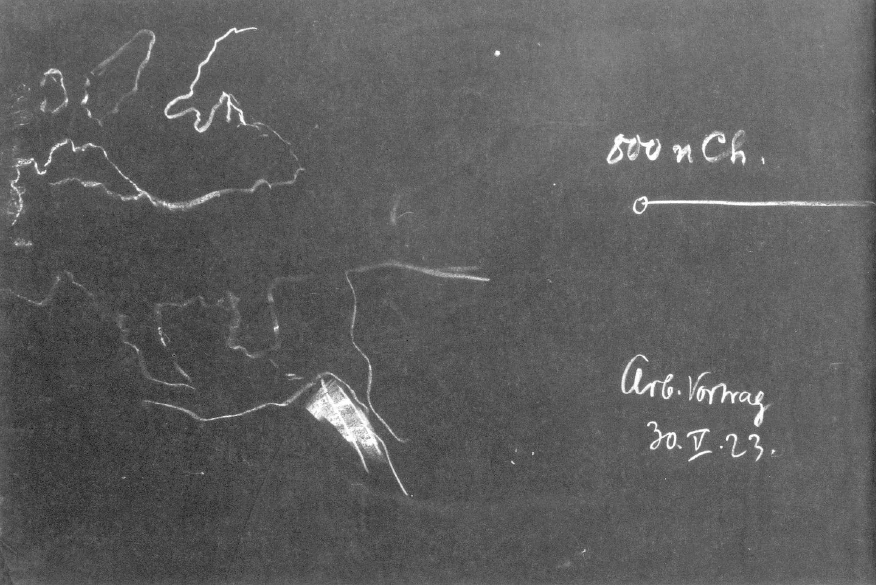
[ 9 ] Furthermore, if we go much further over into Asia, we find huge canal systems that have been built. Isn’t it true that if we have Europe here (it is drawn) — I’ve drawn this for you before — then we have Africa over there. That’s where the Nile and Egypt would have been, and over here we then have Asia. That’s a vast continent that stretches on from there. And here we have this teeming population that built the pyramids and so on. Over there we have the ancient land of Chaldea in Asia. As you know, the Bible says that Abraham came from Ur in Chaldea. This land of Chaldea actually existed back then. And in that land, in ancient times—the remains of which still exist today—huge canal systems were constructed, which in turn required enormous numbers of people. So you must imagine that, as proven simply by the facts, there were enormous populations in Africa and Asia several thousand—and even more—years before the birth of Christ.
[ 10 ] You must also keep in mind: When the Europeans came to America, they settled there. But America was not uninhabited at that time. That ancient Native American population I told you about—the one with copper-colored skin—has, in fact, become completely extinct. When you look at the remains there, some of which are buried, you realize that there was a huge population that the Europeans never encountered.
[ 11 ] So this is simply not true—that there used to be far fewer people on Earth. Just think about it: even regarding the current population, there are no exact figures; one can only provide estimates for a certain region. What does a European statistician today know about the size of the Chinese population today and what it was a thousand years ago! Everything that travelers report on this subject indicates that the population by no means always decreases as one goes back in time, as is commonly assumed, but that there have certainly been periods when the Earth was extraordinarily densely populated. There have, of course, been times when certain regions in particular were less densely populated, but we will see shortly that this is not particularly significant. Thus, even in light of what can be known through external science, the objection that there are too many people today who are reincarnations from earlier times can be completely dispelled.
[ 12 ] But there is something else to consider. You see, when you look at people today, you realize that one person, let’s say, spent a thousand years between death and their current birth, another perhaps only five hundred years, and yet another may have lived in the spiritual world for fifteen hundred years before returning here. So the people living today were by no means all here at the same time, but at different times. When the population on Earth was smaller, the souls simply waited up above until the population grew again.
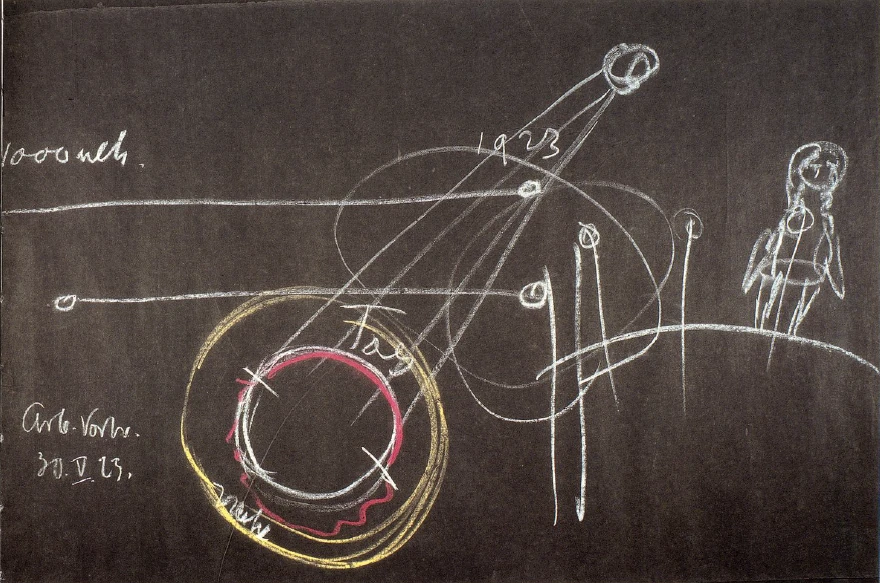
[ 13 ] So what can be said about incarnation and reincarnation—that is, rebirth—is entirely consistent with the facts. I have often said—and this is an objection that has been raised time and again over the many years I have been giving lectures—that this is really just a mathematical example. — Let’s suppose that in the year 800 A.D., there was a person somewhere; now, in the year 1000 A.D., there was another person (this is illustrated). Now we are in 1923. It may very well be that the one from back then meets up with the one who is here now, because the former takes a shorter path. Now you already have two here [1923], and here [800 and 1000 AD] you always have one at these different times. So they don’t all have to be there at the same time or return at the same time. Thus, even for those periods when the Earth is less densely populated, it is certainly true that fewer souls descend to Earth at those times.
[ 14 ] Isn’t it true that, if one thinks rationally rather than fancifully, one must be clear that it wasn’t simply a matter of there once being two people, then four, then six, and so on? Rather, the further back one goes in the history of the Earth’s population, the more one realizes that this process unfolds in a very rhythmic way. There are times when there are many people on Earth, and times when there are fewer people on Earth. And we never go back to a single couple, as the Bible suggests. That is not what is meant. There can be no question of “a single couple” in the way it is stated there. So one would have to say that, if one simply assumes there were once two people, there would always have to be only two, and none at all in between. But that is not the case. Here, real science contradicts what fantastical science believes today.
[ 15 ] But now for something else. You see, one must realize that a certain amount of time simply has to pass before a person returns to Earth. And you might ask: Well, when does he return? — If you really investigate this matter thoroughly, you’ll find that: someone who has spent a great deal of time here on Earth engaging with the spiritual world will find it easier to enter the spiritual world after death. Because they have engaged so much with the spiritual world, they will need a relatively long time between death and a new birth. You might be surprised that I say “long.” They can remain in the spiritual world for a long time because they have already learned a great deal about it here. People who have engaged deeply with the spiritual world here are better able to develop there, stay there longer, and return later. In contrast, those who have concerned themselves only with the material world tend to return relatively soon. And that is how things unfold.
[ 16 ] That is one objection. Then there is another objection entirely. I have already brought that one to your attention. It is this: Why don’t people remember their past incarnations? — Yes, you see, gentlemen, it’s like this: If someone says that people can do math, there’s no doubt about it—people can do math. Now someone says: “But I’ll prove to you that people can’t do math.” — “Well, how will you do that?” — Then he brings a small child who can’t do math. “That’s a person too,” he says.
[ 17 ] This is how it is with past lives on Earth. Human beings can gradually learn this, and they will learn to remember their past lives on Earth as they continue to develop further and further on Earth. This is precisely something about which spiritual science states that human beings today are not yet ready to remember what they experienced in their previous lives. But what we can say in spiritual science is entirely consistent with this. Just consider, gentlemen: you are in the waking state from morning until evening. There you experience everything that is around you. And when you then recall your day, you remember only what you experienced while awake. Just think how quickly one forgets even one’s dreams—which, as I’ve told you, don’t mean anything special! So a person remembers what they’ve experienced here while awake. But there’s something else they don’t remember here on Earth: what they experience while asleep. And in the sleeping state, we actually experience far, far more than we do while awake; it’s just that, with their present level of consciousness, people cannot yet grasp these sleep experiences. Once the ability to do so has been attained—which is indeed something humans can achieve—then one realizes that an immense amount is experienced during sleep. But people generally do not know this yet. Now, when a person dies, what they experienced while awake fades away after two or three days. It seems as though all the thoughts one had while awake simply vanish after two, three, or four days. And then all the things one experienced in sleep come to the surface. As I have told you, these take up a third of one’s entire earthly life. So what a person experiences deep within—he does not yet know that here on Earth. He will come to know it as he delves deeper and deeper into spiritual science.
[ 18 ] That is why we should not be surprised that, in our present earthly life, we are still unaware of things that happened in our previous earthly life. I told you the other day what a difference it makes if I put a shirt button down without being fully aware of it—then I might run around in the morning looking for it, searching and searching—and if I explicitly remember: “You put this little button here”—then I won’t run around, but will go straight to it. It all depends on whether you’re thinking about something.
[ 19 ] In ancient times, people knew that they lived on Earth repeatedly, but over the millennia they never thought of it as something spiritual. That is why they cannot remember it in their present earthly life. But a time will come when they will remember, just as there comes a time when a four-year-old child will be able to count.
[ 20 ] Now here’s the other question: People have this tendency to spin in circles. — That’s an entirely valid observation. I must draw your attention to the following. As we’ve often emphasized, as children we first learn to stand and walk; we first learn to move properly upright, and so on. Now just imagine for a moment: you’re lying in bed asleep, and you wake up from a dream—in that dream, it’s not just that you’re spinning around—in a dream, of course, that’s the first thing—but you can even fly! And dreams in which people fly—at first, of course, only in their minds—aren’t all that rare. The fact that people fly in their dreams usually stems from this: They wake up. They’re accustomed, when they’re awake, to either feeling the floor beneath the soles of their feet or the seat of a chair beneath them—to having something beneath them on which they sit upright; in short, to always feeling something beneath them when they’re awake. When a person is lying down, however, it is very rare for the soles of their feet to touch the bottom of the bed; instead, their feet are suspended in the air. They therefore wake up in a position to which they are unaccustomed. They believe they are in the air and flying. That, then, is their initial belief.
[ 21 ] But now you must consider the following. When we first learn to walk and stand as children—that is, to stand upright—the ability to stand upright is not something we are born with; we have to learn it. In contrast, we now ask ourselves: Where does this ability to stand upright come from? What do we do when we walk upright? — You just need to think very carefully about what you’re doing there. Imagine the surface of the Earth (drawing on p. 24). If you let go of a stone here, it falls toward the Earth. Why? We say it’s because the Earth attracts it. Whether it’s exactly true that the Earth pulls it as if by a string—or not—is something we’d have to understand properly first. We could talk about that sometime, too. But in any case, there is a force pulling it down; otherwise, it wouldn’t fall. And no matter where the stone is, it falls vertically toward the Earth.
[ 22 ] So, we must also learn to align ourselves with this line. As human beings on Earth, we must learn to align ourselves with the vertical line. We therefore fit ourselves into this vertical line. Our entire physical body would serve no purpose at all if we did not fit into the upright position. For look at the animals that do not walk upright but walk on all fours: Yes, their toes are shaped quite differently from our fingers! So if our physical body is to have any purpose, we must fit into the upright position; that is absolutely necessary.
[ 23 ] But does the etheric body need the same things that the physical body needs? You know, I have told you: We do not only have this physical body, which we see with our eyes when we look at a person and which we can touch with our hands, but we also have a subtle etheric body. Yes, this etheric body does not need to adapt in that way. It retains different habits. What habits? Well, gentlemen, you know that the Earth is round, and day and night alternate. How do day and night alternate? The sun is here (he draws a diagram), and when the sun’s rays fall on the Earth like this, it is day on that side. It would always remain day if the Earth did not rotate. When this half—the one here that is red—moves over to this side, then it is night on this half, and on the other half—which then moves over here—it is day.
[ 24 ] Day and night are thus caused by the Earth’s rotation. Now just imagine: The human etheric body—this subtle body that humans also possess—does not readily adapt to an upright position as a child, but instead always wants to go along with the Earth’s rotation. This etheric body always wants to move around the Earth; that is how it always wants to be—it always wants to make this movement. If the etheric body did not want to make this movement, then when you walk in the direction of the Earth—because the Earth is making this movement—you would constantly want to turn around, because everything would always hurt from the jolts you receive. There must be something within you that always goes along with the Earth’s movement; otherwise, everything would always hurt.
[ 25 ] From this you can also see how thoughtless modern science is. It knows full well that the Earth rotates—not just in the way the physical body moves, having adapted to this vertical position. But we no longer have a body that goes along with this movement! That’s the story.
[ 26 ] Now imagine that you are about to faint. When you faint, something leaves your physical body and your etheric body—namely, the “I” and the astral body, that is, the actual spiritual-soul aspect. And as this happens, you sense that the etheric body wants to spin. At first, you spin spiritually and soulfully, just as you do in the morning during a dream when you’ve sensed that the ground isn’t beneath you. So when you faint, you spin spiritually at first. When a person feels dizzy, for example, it is only the soul aspect that wants to spin. But imagine that you are now walking away without thinking. Yes, when you walk away without thinking, you are moving your physical body mechanically. You aren’t thinking about your walking at all, and especially when it’s foggy in the forest, you can’t think about your walking; after all, you don’t know which way to go—where should I go? When you walk with your physical body, you orient yourself toward a specific point. Sometimes you aren’t even aware of it, but the path itself guides you toward a specific point. But when it’s foggy, you can’t see anything; your physical body doesn’t know its way. Then your etheric body takes over; it simply wants to carry out its movement, which is a circular motion. It follows that circular motion, dragging the physical body along with it! When you’re merely dreaming or feeling dizzy, the astral body performs the movement. But when you’re walking, the etheric body draws the physical movement into the physical body, and you go along with it. From this, however, you can see that the etheric body is not at all bound to the earth. The etheric body within a human being, therefore, does not participate in what takes place on earth.
[ 27 ] Now just think about it: As a human being, one is, after all, an earthly being between birth and death. One has to work. But as you know, one can’t work all the time. The physical body would wear out, and so on. So while a person wants to move their physical body, they do not want to move it in the way the physical body has adapted to the Earth; instead, they want to align it with the etheric body. But the etheric body wants to make circular movements, and that is why people dance. And ordinary dance simply consists of the fact that people do not want to follow their physical body, but rather their etheric body. The desire to dance exists precisely so that people can forget their physical body and feel themselves to be beings that belong to the world.
[ 28 ] However, according to his inner feelings, a human being would want to belong far too much to the world and follow his etheric body. In fact, most of the time a human being does not want to move the way the Earth wants him to, but rather wants to follow his etheric body. And they might quite enjoy moving about in a circle, just as the etheric body wants to move. Therefore, human beings must accustom themselves to the kinds of movements that belong to the Earth. And we have also incorporated these ordinary movements into education: we do gymnastics. Why do we do gymnastics? Gymnastics consists of human beings adapting themselves to the Earth even more than they otherwise can. So that a person may detach more from his etheric body—and not always follow his etheric body—that is why he does gymnastics. But of course, so that he does not become completely estranged from the greater world, the external world, a person must also perform movements that do not bind him to the earth.
[ 29 ] Well, you see, we live in an age of materialism today. The people who yearn most for materialism are those who live in the West. The people of the East, who have an ancient culture—the Asians—do not have a great longing to belong to the earth. They regard the earth as a veritable vale of tears, much more so than Christians do, and those who live in the East, in Asia, want to get out of here as quickly as possible.
[ 30 ] But Western people—they love the Earth so much, terribly much. It’s not that they admit it to themselves, but they actually want to stay on Earth forever. That’s why they also want the following. And now I have to tell you something: The etheric body wants to move in a way that is in harmony with the heavens. The planets move in circles—so the Earth moves in a circle. The etheric body wants to move in a circle, while the physical body wants to break out of this circle. When it has a lot of work to do, it does break out of this circle; but let’s take the upper classes in the West, who have nothing to do—how do they feel? It seems a bit strange to them; they feel uncomfortable because the etheric body is constantly pestering them. When such a steak-eating person walks through the world, the etheric body pesters him, torments him constantly, and he wants to make circular movements. And this steak-eating person then wants to follow these circular movements of the etheric body. Good heavens, that’s so unpleasant! The etheric body wants to dance constantly, to make circular, beautifully circular movements, and the steak-eater can’t keep up. Now he wants to train his physical body so that it is strong enough not to let itself be constantly dragged into circles by the etheric body. Now he does sports—not just gymnastics, but sports. And the result of this sport is that the person completely steps out of his etheric body and follows only the physical movements of the earth. Through this, the person becomes increasingly attuned to the earth and turns away from the spiritual world.
[ 31 ] You must not believe that one can detach oneself from the spiritual world simply by not thinking about it, but also through such things as engaging in far too much sports—that is, by completely separating the physical body from the etheric body. This is terrible for human beings, and it is even something that is, I would say, quite alarming. The more sports people engage in, the more they forget the spiritual realm and return from the spiritual world immediately after their death—in a very short time. So that if everything in the West were not to receive any spirit at all, little by little the Earth would come to be inhabited only by people who no longer want to return to the spiritual world at all. But then, little by little, there would only be people on Earth who would gradually bring about its complete ruin. We’re already starting to do that to some extent. That “some extent” is already quite significant for people today. But if people begin to orient themselves no longer at all toward their etheric body, but only toward their physical body, that is something that will bring about terrible conditions on Earth. And that is where spiritual science must intervene once again. This can only be done by countering the forces that are entirely geared toward driving people into their physical bodies—toward making them purely earthly beings—with other forces as well.
[ 32 ] People are already so inclined that becoming earthly human beings is the most important thing to them. Even now, after I have given you so many lectures, you will understand that such matters can break one’s heart—even if one is not a philistine.
[ 33 ] You see, I was in England last summer, too. Just as we were leaving, the whole of England was abuzz with excitement, waiting for the evening papers that were to be published that night about the most important event. Everyone was eagerly awaiting the evening papers. What were they waiting for? The outcome of the soccer game!
[ 34 ] We have just arrived from Norway. When we boarded the train, there were many people there to see us off. The platform was packed with people. And as the train began to move, the crowd erupted: “Hurrah! Hurrah!” — And at the next station, they shouted: “Long live!” — Well, of course that wasn’t because of us; the question is, what was going on there. I just managed to find out: They were soccer players who had come up there from Central Europe and were now heading back.
[ 35 ] Yes, what are people interested in today? Rather than any event that has to do with the welfare or misfortune of millions of people, people today are interested in those things that gradually draw the physical body away from the etheric body, so that human beings become nothing more than earthly creatures.
[ 36 ] That is why the movements being performed all over the world today—and which are spreading farther and farther—must be countered by others: these are the eurythmic movements. These are aligned with the etheric body. When you watch eurythmy, you will see all the movements that the etheric body performs. When you watch sports, you will see all the movements that the physical body performs.
[ 37 ] Yes, gentlemen, this is extremely important, because at the same time there is a longing for sports. I don’t want to speak out against sports in general. Sport is, of course, quite beneficial when practiced by people who also work, because at work one has to get used to more unnatural movements; if one then incorporates natural movements into sport that are better suited to the physical human being, then recreation through sport is beneficial. But this current craze for sports, in which many people participate who don’t even need to relax—what is this? Yes, there are athletes today who, under certain circumstances—not all of them, of course, but there are certainly some—quickly pop into church in the morning, where they pray: “I believe in a God in heaven,” and so on. Then they head to the sports field. Yes, they don’t say it in so many words, but what they’re doing there—if you put it into words—means: “I don’t really believe in a God in heaven. He gave me the etheric body, but I want nothing to do with it.” I believe in flesh and bones; that is my only bliss.” — You see, this is, of course, the inevitable, unconscious consequence of what is being done today. One is not a materialist merely by saying that one wants nothing to do with the spiritual, but through such actions, through which one tears the whole human being away from the spiritual.
[ 38 ] So, with regard to the question you asked earlier, one could say: If someone goes into the forest and it is foggy, and they get lost, it can happen that they end up following their etheric body. That’s not so bad; they’ll just end up back at the same place. If one turns around—that’s not so bad; there’s a lot of back-and-forth oscillation—sometimes oscillating back and forth toward the etheric body, sometimes toward the physical body. That’s because a person has both and is meant to develop both. That’s inherent in the process. But the fact that there is a general tendency in the West today to tear oneself completely away from the etheric body and to cultivate the physical body alone—that is what constitutes the terrible materialism that is actually the most harmful kind of materialism. For intellectual materialism is not even the most harmful of all. The most harmful of all is the materialism in which the whole human being is reduced to the level of an animal. That is precisely what one must bear in mind.
[ 39 ] It’s very easy to end up in a situation where people say to you: “Yeah, he’s a philistine—he rails against sports! Sports are extraordinarily useful.” — But I’m not railing against sports at all. People should certainly engage in sports; they are, after all, free beings. But they will completely ruin themselves as human beings if they devote themselves solely to athletic pursuits.
[ 40 ] In this regard, one must simply be clear that what I said in the first chapter of “Key Points” applies to the greatest extent. Of course, when I wrote these “Key Points,” I thought I would write them in such a way that people would reflect on them. Well, they didn’t care one bit! They didn’t think about it at all, and the “Key Points” were not understood at all. I said: Certainly, we have a great democratic, proletarian movement, but if you look closely, most proletarians today are simply imitating what the bourgeoisie used to show them; they follow everything science dictates and believe what is taught to them at the universities. Sometimes the proletarian parties are the first to approve laws—I’m thinking of freedom of the press—; the socialists are usually the first to say: “Yes, there must be a panel of experts” and the like. — And as for sports: Sports are, of course, a bourgeois invention, and they’re probably being imitated as well! Of course, it won’t work entirely; but still, in terms of mindset, people simply imitate it and regard it as the only thing that is beneficial, whereas in reality the proletarian movement can only become something when it gains its own momentum, when it does not imitate what the earlier classes have done. That is precisely why I wrote this first chapter. Everywhere, one could see how the proletarian movement, unfortunately, falls under the influence of a belief in authority. That is why I wrote this first chapter in Key Points and hoped that people would reflect on it.
[ 41 ] But of course, thinking is something that people who engage in sports do not like at all; for when someone is really engaged in sports, they actually step out of the realm of thinking. For one can think only with the etheric body. No matter how hard you try, you cannot think with the physical body. Therefore, when asked, “Should one eat meat or just plants in order to think better?”—one can only say: You cannot cultivate thinking through eating; you must do that through the etheric body. You must enter into the etheric body.
[ 42 ] So you see, the etheric body practically reveals its presence in the human being through these circular movements that the person feels compelled to make, through the longing to dance, or through this tendency to lose one’s way and walk in circles.
[ 43 ] Yes, gentlemen, if you’ve ever lived in Vienna, for example, then you know: the Viennese are easygoing people. They certainly are; they’re laid-back, but they’re easygoing people. In Vienna, there’s the Prater. It’s a large amusement park—a huge amusement park. The Prater is, you know, the place where you actually go on Sundays—unless you were a good-for-nothing who went to the Prater every day. There are sausages in the Prater, Bajazzi, and so on—all sorts of things. But the paths in the Prater are laid out in a peculiar way. Because the paths are laid out that way, you always end up back at the same spot. You walk down a long street, head into the woods somewhere; sure enough, after a while you’re back where you started! If you were at a sausage stand, you’re back there now. That’s just how the paths are laid out. You see, of course they didn’t say to themselves: “We’ll lure the Viennese out here to amuse themselves”—but they sensed it, felt it, and that’s why they laid out the paths in such a way that people don’t even need the fog to return to the same spot; rather, they created circular paths that the etheric body desires, where a person already feels completely detached from the physical body. For one can also feel detached in such a way that one enters into a true sense of well-being. If one has no sense of direction, then one walks in circles. But if the paths are laid out in such a way that you walk in a circle of your own accord, you also experience that sense of well-being. And that is what the people who designed the Prater wanted to evoke in the Viennese: that their etheric body would experience a genuine sense of well-being whenever they returned again and again to a sausage stand like that. It’s very ingeniously designed. It still exists today. You can see for yourself how the paths wind their way. When you lose yourself in it—you end up back where you started, but you’ve been circling. And this circling is something that leads people—especially when they do it all Sunday afternoon—into a real sense of well-being.
[ 44 ] Now, this is a much more innocent feeling of well-being than many other kinds of well-being. You know that your sense of orientation disappears in other situations as well; I’ve told you this story before: When you come home late at night and aren’t quite sure whether you’re drunk or not, you put your top hat on the bed. If you see it as a single image, you’re not drunk; if you see it double, you’re drunk. That’s because it’s spinning. You see, something is spinning there, too: the astral body. If the person lying in bed is drunk, their astral body spins. But if someone brings in the etheric body in a more spiritual way—by following circular paths—then the etheric body spins. That is the more innocent kind of spinning.
[ 45 ] Drinking affects the astral body; spinning affects the etheric body more. Then one also understands what a difference there is. For when I look at someone who is drunk: Yes, he does not walk in a straight line like someone who walks along straight paths, but rather everything spins around him, as if his astral body itself had now become the globe. He spins just as the Earth spins. It is the astral body that is spinning.
[ 46 ] But when people dance or spin around in Vienna’s “Wurstl-Prater,” the etheric body spins. It carries the physical body along with it; that is the more innocent of the two. One could say: When someone is dancing, the etheric body spins; when someone is drunk, the astral body spins. — One can therefore tell from a person’s actions whether it is the etheric body or the astral body that is doing the acting.
[ 47 ] You see, modern science does not yet address such matters. That is why it cannot answer the great questions of civilization, because people do not know how to organize things so that human beings do not become completely inhuman. Humanity will become increasingly animal-like if today’s obsession with sports remains as it is.
[ 48 ] Something spiritual must indeed find its way into humanity. And I am convinced that those people who, on the one hand, come to know the Earth through their work will, on the other hand, also have a longing to enter into the spiritual realm and will gradually come to understand that one must indeed cultivate the spiritual as well—that this is necessary.
[ 49 ] Well, that’s basically what I wanted to tell you. We’ll talk about these things in much greater detail so that everything is clear to everyone.