

Rhythms in the Cosmos and in the Human Being
GA 350
9 June 1923, Dornach
Translated by Steiner Online Library
4. Light and Color Effects in Earthly Substances in the Celestial Bodies
[ 1 ] Well, gentlemen, what have you decided?
[ 2 ] Question: Various chemical substances have the property of giving off certain colors—for example, in a flame. On the other hand, many stars also have a colored glow, such as Mars. I’d like to know more about this. For example, Mars has a reddish glow. Iron, when it oxidizes—rust—also has a reddish color. Is there a connection between these two?
[ 3 ] Dr. Steiner: That is, of course, a very difficult question. First of all, we need to recall what we have already discussed about colors. We have, after all, already discussed various aspects of colors. You must bear in mind that the color of a body is connected to the entire way in which it exists in the world. So let’s imagine we have some kind of substance. This substance has a very specific color. Now, do you think that this color might manifest quite differently under certain circumstances if we hold this substance up to a flame, so that the flame itself takes on a certain hue? — We must be clear about the fact that when the flame arises on its own, it already has a certain color, and that when we bring a substance into the flame, two colors interact: that of the substance and that of the flame. But the way colors behave in the world is, in general, something highly peculiar. I’d like to tell you a little about that now.
[ 4 ] You’re familiar with the ordinary rainbow. The rainbow has a red band, which then transitions to orange and yellow, then becomes green, then blue, then a slightly darker blue, indigo, and finally violet. This gives us roughly seven colors that the rainbow itself has (see drawing). People have, of course, always observed these seven colors and explained them in all sorts of ways, because these seven colors that you see in the rainbow are actually the most beautiful colors you can see in nature at all. And besides, you must know that these colors appear as if they were floating freely. As you know, they appear when the sun is shining somewhere and there is rain in front of the sun. Then the rainbow appears on the other side of the sky. So when you see a rainbow somewhere, you have to ask: Where is the weather? Yes, the sun must be on the opposite side, the side facing away from the rain. — That’s how it has to be. That’s how these seven colors of the rainbow come about.
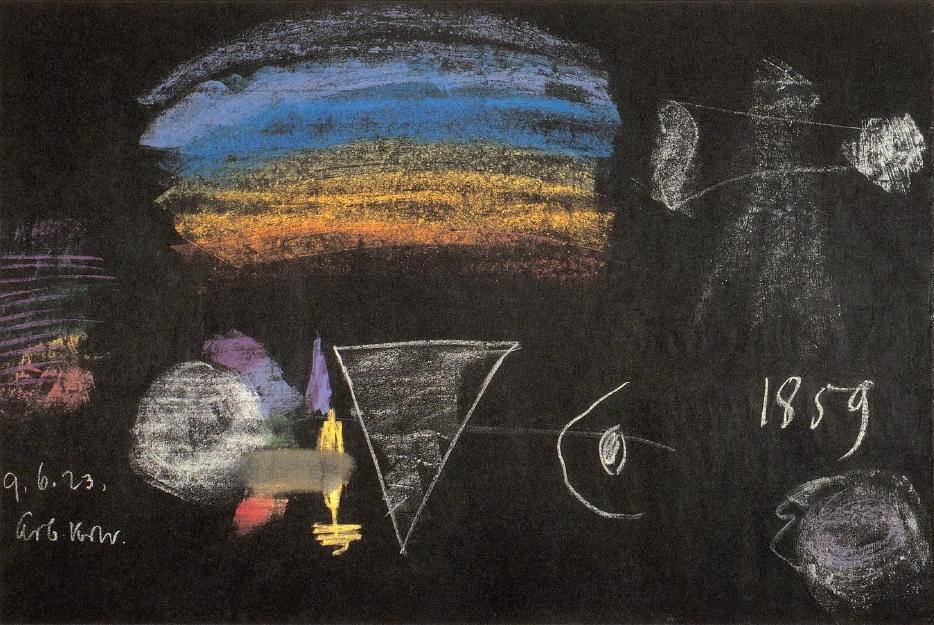
[ 5 ] But these seven colors also appear in other ways. Imagine that we are burning a metallic object, heating it up more and more until it becomes very hot. Then, as you know, this metallic object first turns red-hot and finally white-hot, as they say. So imagine that we have created a kind of flame—I would say we actually have a metallic flame there. But it is not a flame in the strict sense; it is a glowing metal, a metal that is glowing all over. If you now look at such a metal—which is glowing all over—through a so-called prism, you do not see a white-hot mass, but rather you see the same seven colors as in a rainbow.
[ 6 ] I’m going to draw a diagram of this now (diagram on page 72). Imagine that this glowing metal is here, and now I have a prism like this. You know what a prism is. Here it’s drawn from the side—a triangular piece of glass. Here is my eye. Now I look through it. I don’t see a white object, but rather the seven colors of the rainbow—the seven consecutive colors: red, orange, yellow, green, blue, indigo, and violet. So, through the prism, I see what is actually white—what is glowing white—in seven colors. From this, you can see that something that is glowing white can be seen shimmering in the colors of the rainbow.
[ 7 ] Now there’s something else you can do that’s exceptionally interesting. You see, such a white-hot mass can only be produced by heating a metal—or any solid object, for that matter—to incandescence. But if I have a gas and burn it, then when I look through the prism, I don’t see the seven colors, not such a seven-color spectrum, but something entirely different.
[ 8 ] You might ask: How do you get a glowing gas? Well, it’s actually very easy to get a glowing gas. Imagine, for example, that I have ordinary table salt. Common table salt contains two substances: first, a metallic substance called sodium, and second, chlorine. This is a gas that, when released into the air, immediately stings your nose. It’s the same gas used, for example, to bleach laundry. The laundry is bleached by it when chlorine is applied to it.
[ 9 ] So when you have sodium and chlorine together as a single compound, it is our common table salt, which we use to season our food. If you remove the chlorine and place the sodium—which is then whitish—in a flame, the flame turns completely yellow. Why is that? Well, gentlemen, it’s because when the flame is hot enough, the sodium turns into a gas, and then the sodium gas burns with a yellow flame. So now we don’t just have a truly glowing metal, but we also have a gaseous flame. If I now look at this through my prism, it doesn’t break into the seven colors in the same way; instead, it essentially remains yellow. Only on one side does it have—though you have to look very, very closely—a slight bluish tint and a slight reddish tint. But on the whole, you don’t really notice that; you only see the yellow there.
[ 10 ] But that’s not the most interesting part yet. The most interesting part is this: If I set up the whole scenario here, bring in the yellow flame here (drawing on page 72), and now look through my prism on Plate s again, what will you say? You’ll say: When I look at Bee through it, I see red, orange, yellow, green, and so on. “There’s yellow there, too,” you’ll say. “So when I look through it, the yellow here will be particularly strong,” you’ll say; “it will be a particularly bright yellow, a quite vivid yellow.” — Yes, you see, that’s not the case. What happens is that no yellow appears at all; the yellow is completely eliminated, erased, and there’s a black spot there. Just as there can be a yellow gas flame, there is also, for example, a blue one. You can also find substances, such as lithium, that have a red flame. Potassium and similar elements have a blue flame. If you were to place a blue flame here, for example, it’s not as though the blue would appear stronger here; rather, there would again be a black spot. So the peculiar thing is this: When you make something glow—when a solid object glows entirely and is not a gas but is glowing—you get this spectrum of seven colors. But if you have only a burning gas, you get more or less a single color, and that single color then masks whatever part of the entire spectrum corresponds to its own color.
[ 11 ] What I am about to tell you is something that people have known for a relatively short time; it was not discovered until 1859. It was not until 1859 that it was discovered: In a seven-colored spectrum emanating from a glowing solid, individual colors—which originate from glowing gases, or burning gases—cancel out the corresponding colors.
[ 12 ] From this you can already see how extraordinarily complex the interaction between one color and another is. And this is why, when you look at the sun, it appears as if it were a white-hot body. This is true: if you look through a prism superficially, you can see these seven successive colors—red, orange, yellow, green, blue, indigo, and violet—in the sun as well. But if you look more closely, you’ll see that the sun—the solar disk—does not actually contain these seven colors; rather, the seven colors are only approximately present, and in between them are numerous black lines—a whole host of black lines. So when you look closely at the sun, you don’t see a seven-colored band; instead, you see the seven colors, but they are interrupted everywhere by numerous black lines.
[ 13 ] What, then, must one conclude? If one does not see the sun’s true, unbroken spectrum of colors shining back at one, but rather a spectrum interrupted by nothing but black lines—well, then one must conclude: Between us and the sun there are nothing but burning gases that constantly extinguish the corresponding colors along the way. — So when I look at the sun instead of at a glowing metal and see the black lines, wherever I see those black lines, I have to tell myself: There—that is, always at that particular spot—the yellow is being extinguished, for example, by sodium here. If I look at the sun and see a black line within the yellow, I must say: Between me and the sun there is sodium. — And so I see black lines in the sunlight for all metals. Thus, all kinds of metals are spread out in gaseous form in outer space between me and the sun.
[ 14 ] What does this imply? Gentlemen, it implies that outer space—at least the vicinity of Earth, for the time being—is filled entirely with metals that are not only incandescent but also burning. When you consider this, you have to realize that, fundamentally, we cannot really speak of standing here on Earth with the glowing sun up above; rather, what we see actually depends on what lies between us and the sun, And physicists would be very surprised if they could ever actually enter the Sun, because it wouldn’t look the way they expect; rather, what one sees actually stems from what lies between the human being and the Sun. Here you can see from just one example how complicated the relationship between substances and colors actually is.
[ 15 ] So if you have a flame somewhere, and that flame—say, a candle flame—has a certain color, you must first ask: Well, what’s inside the candle? — In the flame, you have those substances in a gaseous state—they are usually converted to a gas by the heat of the flame—which are present in a solid state inside the candle. Let’s then look through a prism, as I’ve done here with the flame: a substance that is in a gaseous state colors the entire flame. Sodium, for example, turns the flame yellow. If you had a flame somewhere—for example, in this room—and then looked through a prism, you’d see the sodium line almost everywhere. You don’t even need to add the sodium in any way. If the apparatus is arranged very precisely so that you can observe it correctly, you’ll find these black lines everywhere—lines that should actually be yellow—and which essentially stem from the fact that there are very small traces of sodium everywhere. There’s actually hardly anything on Earth that doesn’t contain small traces of sodium. But this proves to you that sodium is absolutely essential in nature. Where it is not present, we could not live. We must also always have a certain amount of sodium within ourselves and must process it. And it reveals itself, in fact, only by erasing the yellow lines everywhere and turning them black.
[ 16 ] Well, now you have to remember what I’ve told you before: What causes blue and violet colors? What causes red and yellow? — Well, blue, as I’ve told you, is how the vast expanse of space appears, because out there, where we see the firmament, there is nothing. It is the vast, black expanse of space. So we see the vast, black expanse of space. But we don’t see it simply because it’s right in front of us. Between us and this vast, black expanse of space are the water vapor particles that are constantly rising. Even when the air is clear, there are constantly water vapor particles in the air. If here (a diagram is drawn) is the Earth, here are the water vapor particles, and all around is the black expanse of space, then the sun shines through these particles. When you stand down there and look up, you don’t see black, but blue. Through the illuminated area, you now see the dark space as blue. That is to say, when I see something dark or gloomy through an illuminated area, I see it as blue.
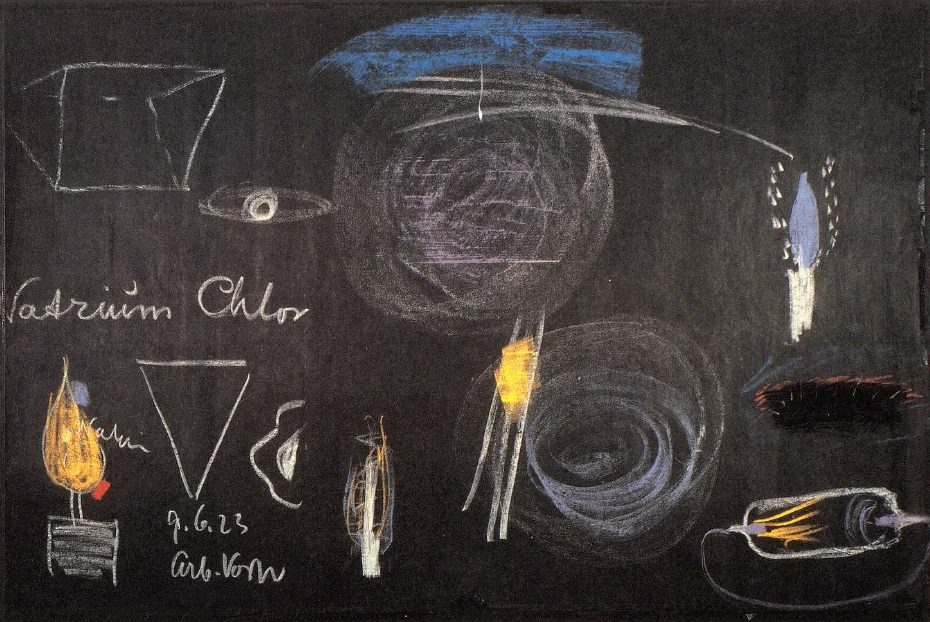
[ 17 ] As you know, the morning and evening glow is yellowish or yellowish-reddish. If this here (he draws it) is the Earth, with the mists all around it, and now the sun is rising here, I see this part illuminated. I see a bright spot here, but at first I see it through the dark mists. That’s what makes it appear yellow to me. When I see something bright through something dark, it appears yellow. When I see something dark through something bright, it appears blue. Blue is the darkness seen through brightness; yellow is the brightness seen through darkness. That’s easy to understand!
[ 18 ] Now, when I observe the yellow color produced by the yellow sodium flame, this yellow sodium flame indicates that sodium is a substance which, when it vaporizes, becomes bright but at the same time produces something dark around itself. So sodium actually burns like this: When the sodium burns here, white light shoots upward from the center (drawing on page 77, left), and darkness shoots upward all around it, which is why I see the whole thing as yellow. So sodium emits light, but because it emits light so intensely, it creates darkness all around it.
[ 19 ] You shouldn’t be surprised that sodium, which emits such a bright light, creates darkness around itself, because if you’re a sprinter and you’re running really fast, and someone else wants to keep up with you, they’ll simply fall behind. What shoots out there is simply a fast runner; it therefore appears luminous against the darkness—it looks yellow to me.
[ 20 ] With an ordinary candle flame, the particles scatter in this way. This makes the area around it bright, while the center remains dark. Therefore, if you have an ordinary candle flame, you see the darkness through the light. Here, the bright specks scatter (see drawing, right). Here in the center, it remains dark—Plate 7 . . a “right ol kel”—so it appears blue. So if you have a yellow flame, as is the case with sodium, that means it is scattering exceptionally strongly. If you have a blue flame, that means it isn’t actually scattering strongly, but rather splitting into fragments.
[ 21 ] That, in essence, is the difference between the effects of substances. Imagine I have a glass tube here; I seal both ends of it. Now I also pump out the air so that I have a glass tube that is completely evacuated. Now I do the following: I pass an electric current in here, which ends there, and another one here [on the other side]; this is a circuit that is then closed here. So now the two poles of electricity are facing each other. Between them is the vacuum. Now something rather strange happens: on one side, the electricity sparks, and on the other side—appearing bluish—such waves form (drawing on page 78), and they then converge.
[ 22 ] There, the light, so to speak, is constantly spurting into the darkness—the bright electricity into the darkness. So there you have the two flames I showed you, separated. You have one at one pole of the electricity and the other at the opposite pole. What the sodium flame does happens here on one side; what the ordinary candle flame does happens on the other side.
[ 23 ] If you proceed in the correct manner, you obtain various types of radiation here, including X-rays, which, as you know, allow you to see the solid components—bones and so on—or foreign objects present within the body.
[ 24 ] So the thing is, there are substances in the world that emit radiation. There are other substances that do not emit radiation, but rather—one might say—glow and are covered on their surface with such waves. The substances that are covered on their surface with such waves are bluish; the substances that emit light are yellowish. When a dark object is placed in front of the yellowish substance, the yellowish substance turns reddish. So if you make the yellowish substance darker, it can turn reddish.
[ 25 ] So you see, gentlemen, the bodies in the world are such that, on one side, they emit light and thereby display the bright colors found on one side of the rainbow, and on the other side, they do not emit light but rather send out such waves. This is how we get the bluish colors found on the other side of the rainbow.
[ 26 ] Once you know this, you’ll say to yourself: There are stars like Mars, for example, which shines with a yellowish-reddish glow, or like Saturn, for example, which shines with a bluish glow. Now, based on the nature of the star, you can see how it behaves. Mars is simply a star that radiates a great deal, which is why it must appear yellowish-reddish. It is a star that radiates a great deal. Saturn is a celestial body that behaves more calmly and is enveloped in waves. You can almost see the waves around it. When you look at Saturn, you can even see the waves around it as rings. It appears blue because it is surrounded by waves.
[ 27 ] Well, what we observe in the terrestrial bodies—if we observe them not mindlessly but correctly—shows us what the bodies are like out there in outer space. But one must be clear about the fact that, as I have told you, the entire universe is filled with all kinds of substances that are actually always in a combustible state.
[ 28 ] Now take a substance, for example iron: it rusts. Is that what you meant by your question? Iron rusts, and as a result, it becomes redder than it normally is. So we have a substance that is relatively dark, that rusts, and that consequently turns reddish. Now that we’ve studied colors, we’ll be able to figure out what that actually means: Iron turns reddish as a result of rusting—that is, when it’s continuously exposed to the air. — Let’s make it perfectly clear what that means. Of course, I don’t have all the colors here, but you can probably imagine what I mean. So let’s assume we have blue iron. Now it is exposed to the air. Now, because it is exposed to the air, it turns reddish due to rusting.
[ 29 ] Now you might say that the reddish hue arises from the fact that you have a bright object that you see through darkness. So a bright object, when viewed through darkness, appears reddish. When I look at iron in its normal state, it is dark at first—that is, it casts wavy lines. But if I expose the iron to the air for a long time—if the iron remains in the air for a long time—then the air comes into contact with the iron; and the iron gradually becomes so affected by the air that it begins to resist the air from within. It resists the air and begins to glow. And whatever glows—such as the sodium flame here, surrounded by darkness—takes on a yellowish or reddish hue. So you can say: The relationship between the iron and the air is such that the iron begins to tingle internally and glows. The iron becomes tingly and glows.
[ 30 ] Now, as you know, iron is also present in the human body, and it is a very important substance. Iron is found in human blood, and it is a very important component of blood. If we have too little iron in our blood, we become people who cannot walk properly, who get tired quickly—in other words, who become weak. If we have too much iron in our blood, we become agitated and start smashing things. So we need to have just the right amount of iron in our blood; otherwise, we simply feel unwell. Well, gentlemen, people don’t concern themselves much with these matters these days, but I have pointed this out to you before: if one investigates how human beings are connected to the whole world, one discovers: In humans, the blood is connected to the influence of Mars. Mars, which is, of course, in motion, actually always stimulates the activity of the blood within us. This is due to its affinity with iron. That is why ancient scholars, who knew this, attributed to Mars the same nature that iron possesses. So, in a certain sense, one can view Mars as something equivalent to our iron. But at the same time, it shimmers reddish-yellow, which means it is constantly radiating from within. In Mars, then, we see a body that is constantly radiating from within.
[ 31 ] One can only understand this whole matter if, based on these studies, one says to oneself: Mars has an iron-like nature; it is an iron-like substance; but it is constantly tingling—it constantly strives to become radiant. Just as iron does under the influence of air, so Mars, under the influence of its surroundings, constantly strives to radiate. It therefore actually has a nature that is constantly tingling inwardly—that is, it wants to become alive. Mars constantly strives to transition into life. — This can be seen in its entire coloration and in the very way it behaves. When dealing with Mars, one must know that it is a celestial body that actually seeks constantly to transition into life.
[ 32 ] With Saturn, it is different. Saturn has a bluish glow; that is to say, it does not radiate, but rather surrounds itself with a wavy aura. It is the exact opposite of Mars. Saturn constantly seeks to pass into death, to constantly become a corpse. One can see that Saturn, in a sense, surrounds itself with brightness, so that we then perceive its darkness as bluish through that brightness.
[ 33 ] Now let me draw your attention to something: You might witness a rather lovely sight if you ever walk through a willow grove—a forest where there are willows—on a night that isn’t completely dark but is very dim. Every now and then you might see something that makes you wonder: “Good heavens, what’s glowing over there? What is that glowing thing?”—Then you walk closer, and the glow turns out to be rotting wood. So the decaying matter begins to glow. If you were to step back very far and look at it, and there were darkness behind it—behind this glowing object—then the glowing object would no longer appear glowing to you, but rather blue. And that is how it is with Saturn. Saturn is, in fact, constantly decaying. Saturn is decaying. As a result, it has a bright glow all around it, but it itself is dark, and that is why it appears blue—because we are looking at its own darkness, so to speak, through the decaying matter surrounding it. With Mars, then, you see how it constantly strives to live; with Saturn, you see how it constantly strives to die.
[ 34 ] What is interesting is that one can view celestial bodies in such a way that one can say of them: The celestial bodies that appear to us in a bluish glow are perishing, and those that appear to us in a reddish, yellowish glow are just coming into being. And that is indeed how it is in the world: in one place there is something coming into being, in another place there is something passing away. Just as on Earth there is a child in one place and an old man in another, so it is in the universe. Mars is still a youth; he wants to live on forever. Saturn is already an old man.
[ 35 ] You see, that is what the ancients studied. We must study it again. But we can only understand what the ancients meant once we rediscover it. That is why, as I said last time, it is so foolish when people say that in anthroposophy we merely compile what we find in ancient writings. Because what we find in ancient writings cannot be understood at all! You see, one can only understand what is written in ancient texts—and what stems from true ancient wisdom—once one has rediscovered it. For example, there was a saying back in the Middle Ages, before America was discovered. It was very interesting; almost everyone used to say it. If you had lived back then, you would have known that saying too. In the Middle Ages, all sorts of people used to say it, because people still learned it the same way we learn, say, a campaign slogan today.
[ 36 ] This saying goes:
[ 37 ] O Sun, a king of this world!
Luna sustains your lineage.
[ 38 ] Luna is the moon.
[ 39 ] Mercury quickly pairs you up.
Without Venus, you’d all be nothing,
The Martians have chosen a husband.
[ 40 ] So, Mars.
[ 41 ] So the saying implies that Venus, who is also a young figure, has chosen Mars as her husband. It thus suggests that Mars is a young man out there in the universe.
[ 42 ] Without Jupiter’s power, you lack everything.
[ 43 ] Jupiter, too, is described as intervening everywhere. And finally, it is said:
[ 44 ] So that Saturn, old and aged,
May reveal himself in many colors.
[ 45 ] Just think how beautifully this medieval proverb contrasts the youth of Mars with the old age of Saturn!
O Sun, a king of this world!
Luna sustains your lineage.
Mercury swiftly unites you.
Without Venus’s favor, you achieve nothing,
For Mars has chosen himself as your husband.
Without Jupiter’s power, you lack everything.
So that Saturn, old and decrepit,
May reveal himself in many colors.
[ 46 ] So you see, people won’t understand this, and that’s exactly what they show. Because when a scholar today reads a saying like that, he says: “Well, that’s just silly superstition!” — He laughs at it. If one rediscovers the truth in such a saying, he’ll say it was simply copied from somewhere. So, isn’t it true—it’s almost unimaginable just how foolishly people actually behave, because they simply can’t understand it. No modern scholar understands what lies within such a saying. But if one is able to engage in spiritual research, then one rediscovers it, and only then does one truly understand it. You have to rediscover these things for yourself first; otherwise, these old sayings—which are folk wisdom—remain truly worthless. But it’s also wonderful when you discover these things through spiritual inquiry, and then you uncover this immense wisdom in simple folk sayings! This simply testifies that the old folk sayings are drawn from what was taught in the ancient schools of wisdom. That is where these sayings come from. Today, the people cannot turn to their scholars in that way, for modern science does not produce proverbs! There isn’t much one can take from it that is applicable to life. But there was a time when people knew such things as I have told you again today. They then wove them into such beautiful sayings. And then, of course, all sorts of things arose from them—sometimes, naturally, misunderstandings as well. Well, this saying I just quoted to you about all the planets—yes, it has been forgotten—but other sayings have been distorted.
[ 47 ] Of course, it’s true that it also means something when, say, animals do this or that. They are connected to the universe. We already know from the tree frog that something is going on with the weather when it climbs up. After all, people use the tree frog as a weather prophet when it scrambles up or down its ladder. That’s because everything that lives is connected to the entire universe. It’s just that this has been distorted over time, and it’s not entirely unjustified, of course, that there are also sayings like that which you can make fun of when you hear them, because stupidity has taken hold of them. For example, if someone says, “If the rooster crows on the manure heap, the weather will change or stay the same”—well, that just goes to show once again that one shouldn’t mix everything together, nor should one mix foolishness with wisdom.
[ 48 ] The saying I quoted to you is, of course, one that points to mysteries in the universe related to light and color. On the other hand, what people often say about what the rooster does and the like—well, of course, one can mock that, just as the saying itself does. But on the other hand, even today there is sometimes—in peasant sayings, which are, of course, gradually being forgotten—something extraordinarily profound, something very wise. And it is not for nothing that the farmer is sad when it still snows in March, for there are indeed certain connections between the grain seed and the March snow.
[ 49 ] This is how we can see, precisely through such things—just as we can through what we observe on Earth—that we can understand the entire world. It would certainly be better to take our cue more from the tree frog, which climbs up and down depending on the weather, rather than—as is the case today—following the example, I might say, of the groundhog, which sleeps, and thus sleeps through all the mysteries of the universe.
[ 50 ] I hope you now understand what I was explaining in response to your question. It’s complicated, of course, and can’t be summed up in just a few words. So I had to go into all of that, but I’m sure you’ll be able to piece it all together. It’s quite interesting, isn’t it, to see the connection this way.
[ 51 ] To be continued next Wednesday.