

Rhythms in the Cosmos and in the Human Being
GA 350
13 June 1923, Dornach
Translated by Steiner Online Library
5. The Work of the Guardian Angel
[ 1 ] Does anyone have a question?
[ 2 ] Questioner (Mr. Burle): I would like to describe an experience from my youth that has to do with fate—the kind of thing that, in religion, for example, is described as if we had a guardian angel. Once, when I was a skittles boy setting up the pins—I was nine or ten years old at the time—and just as I was busy setting them up, a voice called out, “Get out of the way!”—so intensely that I quickly jumped out of the way. And a moment later, the large ball came flying with great force right where I had been standing. I asked, “Who called me?”—but no one claimed to have done so, and the voice couldn’t have come from there either.
[ 3 ] The other incident took place in a blacksmith’s shop where people were sharpening their plowshares. There was a large wheel there. There were five or six of us boys, and we were having fun there. I was maybe eleven years old. I stood on one of the wheel’s spokes to push the wheel down. I enjoyed doing that. Then I said to the other boys, “Pull out the quick-release lever, and I’ll step from one step to the next.” They all pulled hard, but couldn’t manage it. Even though I was the smallest, I went over to take a look. The wheel had whirled around very quickly, and it would obviously have been the end of me if they had raised the quick-release lever.
[ 4 ] I would be grateful if the doctor could comment on whether a higher power can manifest itself in such a case.
[ 5 ] Dr. Steiner: Well, gentlemen, I would like to speak with you about such matters, but here, of course, everything must be discussed in a way that can be scientifically justified. Anthroposophical spiritual science does not simply accept such things as they are very often accepted by people who indulge in all sorts of superstitions; rather, these things must, of course—since they are much more important for life than one might think—be considered from a thoroughly scientific perspective. Now, I would like to tell you one thing first, by way of preparation.
[ 6 ] You see, people actually pay attention to only a very small part of life. They ignore a large part of it, and because they ignore it, they believe that this part of life does not exist. Take this example: If someone is walking past a house somewhere and, at that very moment, a brick falls from above and kills him, people pay very close attention to it, and naturally it causes quite a stir among those who knew the person involved, as well as elsewhere. People talk about it a lot. They’ve just witnessed it and are talking about it a lot.
[ 7 ] But now suppose the following: Someone wants to leave in the morning. At the very last moment, just as he is about to leave, he realizes that he has forgotten something that absolutely must be taken care of, and this delays him by five minutes. Now he leaves. The brick falls five minutes before he passes by, and since he passes by, it doesn’t hurt him. If he had left five minutes earlier, the brick would have smashed his head in. But of course, no one talks about it afterward, because no one can possibly foresee that. No one can know—he himself, of course, forgets it, and no one pays attention to it—what would have happened if he hadn’t been delayed by a few minutes. Well, you see, these things simply aren’t noticed, but they are just as present in life. There are countless such instances where fate spares us from misfortune, yet they go completely unnoticed. We don’t study them precisely because they aren’t so easy to track. We can only track them if the situation is particularly striking in some way, if it demands our attention. Only then do we pay attention to such things.
[ 8 ] Once upon a time, there was a man who spent a great deal of time sitting at his desk, while the rest of his family lived downstairs. He often went up to his room on the upper floor. One day, he had a dream that a great misfortune awaited him on a certain day—that he would be shot. So what did he do? He told the others about it; they told him he should be very careful, because he might be shot in the coming days. So he didn’t go out, but stayed in his room all day. But he still had such an eerie feeling about the dream, for he had already experienced—this goes back to a time when people paid more attention to such things—that such prophetic dreams exist. He had an uneasy feeling. And it was precisely this uneasy feeling that made him become aware of himself. And then it happened that, at a certain moment, he grew restless and, driven by this inner restlessness, had to get up from his seat. At that very moment, a shot rang out, whizzing right past his chair! He owned an old rifle from long ago that was hanging in the entryway—the door was open—and a servant had picked it up. He hadn’t thought to check if it was loaded; he carelessly held the rifle, it went off, and the shot flew past the spot where the man had been sitting.
[ 9 ] So you see, there is a double chain of fate at work here. First, there is a mundane dream. On the other hand, because his fate has not yet been fulfilled—because he is still meant to live—he is driven away at just the right moment by an inner urge. But now the other aspect comes into play. You see, at that very moment he could just as easily have heard: “Go away!”—as you heard it (turning to Mr. Burle). He could just as easily have heard that. How would that have come about? You see, when one speaks of a spiritual world, one must be clear that one must not talk foolishly about the spiritual world. But one would certainly be speaking foolishly about the spiritual world if one believed—which, incidentally, many people, at least those who are spiritualists, do believe—that in the spiritual world there are Germans, French, English, Spaniards, and Chinese. But they would have to be there if one were to hear “Go away!” from the spiritual world, for then some spiritual being would have to speak German. It would speak French to a Frenchman, after all, because if it spoke German, the Frenchman would take it for an inarticulate sound—or might even consider it something very evil today. So it would be a very foolish notion to imagine that the “Go away!” was spoken by a spirit, for a spirit cannot be a German, a Frenchman, or an Englishman. That is precisely the nonsense of the spiritualists—that they believe they can communicate with the dead through a medium, receive answers, and assume that is how spirits speak. Of course, they do not do that. Even though they exist, they do not do it. But the following is the case.
[ 10 ] This kind of connection with the spiritual world—which makes it possible to speak about a spiritual world in scientific terms—requires that one first stop assuming that spirits speak in an earthly language. One must first become acquainted with the supersensible world and only then be able to translate into ordinary language what the spirits speak in a supersensible language. If the person in question, who was sitting at his desk, had heard “Go away!”—that could very well have been the case. But the fact is, gentlemen: You have heard from me that the whole human being is imbued with reason. I have explained this to you before: The liver perceives processes in the human abdomen; the lungs perceive; the whole human being is a sensory organ. The heart perceives; through the heart, one perceives blood circulation. But in ordinary life, one does not need these organs for perception. We need our eyes and our nose, but we do not need these organs for perception. These organs have a very specific characteristic. Take the liver, for example, gentlemen! You see, when the liver is removed from the body, it is this organ that you are familiar with from animals, because you have probably seen a liver of some kind before—at least goose liver. But this organ has an etheric body that is connected to the other etheric body (see diagram, yellow), and it also has an astral body (violet), and on top of that, it is permeated by the “I.” So this organ, the liver, does indeed have a spiritual aspect. In your head, you perceive the spiritual, but in your liver, you do not consciously perceive the spiritual. Given the way you are organized in ordinary life, you cannot perceive anything there—just as I explained to you recently that you do not perceive the spiritual in your small eye lens. Yet you can see the entire sky with that small eye lens. Spiritual beings hardly ever speak through any of the head organs. The whole world speaks—the stars with their movements and so on—they speak through the organs of the head. But spiritual beings also speak through the other organs, for example, through the liver. The stomach speaks to the liver, but so do spiritual beings; the same is true of the lungs. Spiritual beings speak to all the organs that one does not need in ordinary conscious life.
[ 11 ] Well, gentlemen, if the head is essentially limited to perceiving only what it sees out there in the external world, then it is precisely the inner being of the human being—the lower organs—that is designed to perceive the spiritual world. These organs, however, are extraordinarily subtle. They are truly quite subtle. And you can tell just how delicate they are from the conditions that sometimes arise from such organs. These conditions are usually overlooked, and they are overlooked because our medicine is so imperfect. You see, you’ve probably experienced at some point that someone can get diarrhea from intense fear. People don’t pay attention to it because they can’t even imagine that diarrhea could be caused by fear. But it is caused by it. There is an influence from the external world at work here. But this influence can also come from the spiritual world. And from the spiritual world, it happens that these organs do indeed perceive—but they perceive things entirely different from those in the external world.
[ 12 ] As I’ve told you many times before: We humans go through various earthly lives. Yes, if people had been expected to simply go through various earthly lives up to this point, they would not have been able to do so. If a person is to develop here on Earth from an early age, he must have a guide—namely, an educator, a teacher, or someone similar—otherwise he would remain completely ignorant. But in the spiritual world, a person does indeed have such a guide, who leads them from one earthly life to the next and who truly pays attention—not to the things in each individual earthly life over which we have freedom, the things we can reason about on our own, but to the things we cannot think about, yet which are connected to our human constitution. And so it happens that when someone is sitting there feeling a certain anxiety, they become particularly sensitive to what lies ahead. This sensitivity must also be assessed correctly. One must distinguish very carefully: Does this sensitivity pertain to the spiritual, or can it still be explained in physical terms? If one is not critical, one cannot speak correctly about these things at all.
[ 13 ] I’d like to give you another example of this. There was once a sick woman who lived on the fourth floor of a building, and the doctor had to visit her every day—even after she had already begun to recover—because her condition had been quite serious. The doctor didn’t visit this patient at the same time every day, but at all sorts of different times; yet every day, up on the fourth floor, she knew exactly: “The doctor is coming now”—even when he was still all the way downstairs. Even when he was still outside the building, standing at the gate, she already knew: “The doctor is coming now.” — But she knew it especially well when he was still all the way downstairs in the building’s hallway, before he had even climbed a single step. People told the doctor this and said, “Yes, she knows that through clairvoyance.” — Well, at first the doctor was a little uneasy. Doctors don’t believe that right away. But then, as he was repeatedly hounded by the people who told him, “Yes, our daughter is clairvoyant; she knows when you’re down there”—he finally said, “I’ll put this to the test!” And he quietly took off his boots before walking through the gate. And she didn’t know! Well, you see, cases like that do exist, of course, and they have to be properly investigated. Because this patient had simply developed a very sensitive sense of hearing from lying in bed for so long and perceived the footsteps downstairs that one wouldn’t normally hear from below. If you immediately label everything as clairvoyance, then of course you have no right to speak of spiritual worlds. One must be able to distinguish very precisely between what can still be perceived with the senses and what can no longer be perceived with the senses.
[ 14 ] However, the events described there show that the senses can become extraordinarily sensitive. For in everyday life, of course, a person on the fourth floor is not able to hear footsteps below immediately. But just as the senses in the head and elsewhere can become sensitive, so too can the internal organs—which are also senses—become sensitive to the spiritual. And so, for example, if the liver is under the impression that “I might be shot today,” it becomes particularly sensitive, and the result is that the liver can hear—though not in any Italian or German language—the warning from the spiritual being that is indeed present there.
[ 15 ] But just imagine—this is where the miracle happens: The liver must first transmit this to the head; otherwise, a person cannot perceive it. For on its way from the liver to the head, it is translated into the language that the person speaks. That is the marvelous thing about it—that is where the mystery lies. Only then can you say what a remarkable being the human being really is. Not only is the human being capable of having intuitions, but—what is far more marvelous—what comes to them in the spiritual language, they actually translate unconsciously into their own language.
[ 16 ] But you can see from this: Everything that is written down in some spiritualist circles is spoken to the lower abdomen. It’s just that people are reluctant to admit it. They believe the spirits speak Italian or French, but it all comes from the person themselves. And yet, there is a connection to the spiritual world even in these sessions—just a very negative one. This is then expressed in all sorts of ways.
[ 17 ] But from this you can see that when something like this “Go away!” occurs, one must be clear about one thing: the actual connection with the spiritual world still remains a mystery to us. One doesn’t really grasp it if one simply imagines that the guardian spirit whispered in one’s ear—but one must know the indirect path through which this happens. Then one also comes to understand something else. Then one realizes that people can very easily refute such things. For an ordinary person, the story of the man who took off his shoes serves as a refutation. They say: People believe this is clairvoyance or clairaudience, but it wasn’t clairaudience—it was ordinary hearing. So it’s the same in the other case as well.
[ 18 ] Yes, that is precisely what one must examine first, gentlemen! And then, if one exercises the necessary caution, one sees that, in fact, the spiritual world is constantly at work on human destiny through these indirect channels—particularly strongly, of course, during childhood. Why during childhood? Well, during childhood the astral body is much more active; it works much more intensely then. Later on, it no longer works as intensely. When a child’s liver is still soft, the astral body can transmit what it hears in the spiritual world to the liver. Later, when the liver has hardened, it can no longer transmit anything.
[ 19 ] Now you must consider what significance an event such as the one experienced by Mr. Burle has—that is, when death is actually imminent and yet what is quite naturally expected does not occur. After all, at that moment, when you heard the “Go away!”, you could have died, couldn’t you? (This is confirmed.) So you would have died. There are many such cases in human life. It’s just that many go unnoticed. But this is one that you noticed very clearly.
[ 20 ] But before you lived through your present earthly life, you lived through many previous ones. Yes, gentlemen, what one has experienced in past earthly lives is meant to be lived out in the proper way. This means, for example, that in this life one now has a very long life so that everything can play out as determined by one’s previous earthly lives. Now, external circumstances may even contradict this. One day, due to external circumstances, I might be exposed to misfortune, might have to die, and the situation could turn out such that—let’s say—if I die, I would actually be dying at a disproportionately early time relative to my previous earthly life. According to my previous earthly life, it is not right for me to die so early, because I still have something to do on Earth. Now, I could also die. Do not believe that it is absolutely certain that I will not die! I could die; misfortune could strike. I could die, but my entire destiny would be altered. For I would then not have lived out that small portion of earthly life that I was still supposed to experience. My entire destiny would be altered! This is where the spiritual being who guides a person from one earthly life to the next intervenes and can warn him. There is always a reason why it can warn him. But of course, the circumstances are extraordinarily complex, and sometimes it may also be the case that this being, who wants to protect the person—if we may use the term that way—is subject to other beings who hold her back, who keep her at a distance. Such struggles can certainly take place in the spiritual world as well. But if evil beings—if I may put it that way—have no particular interest in the matter, then the warning gets through. And that is how it got through back then. And the fact that very special things can occur—even outwardly—yes, that happens countless times as well.
[ 21 ] You were wondering, weren’t you, regarding the second incident you recounted from your life, why filming didn’t continue there. Because if filming had continued there, you would have perished. The others couldn’t let the water flow; only you were able to do so at that moment. Well, what was the reason for that? You couldn’t see from the outside what the reason was. (Mr. Burle: No!) It was because that spiritual being—who wanted to warn you or protect you—paralyzed the will of the others at that moment. This always works through the person themselves, not in an external way, not through someone else. At that moment, the will of the others was paralyzed; they were unable to move their muscles. That is how things are; that is how they are connected. So whenever one wishes to speak of the spiritual world, one must be certain that the spiritual world acts through human beings. Just as one cannot see a color without eyes, so one cannot perceive the spiritual world without this inner activity of the human being. That is precisely what one must always bear in mind if one wants to pursue true science and avoid falling into superstition. For the fact is that what exists on Earth—the various languages—no longer applies to the spiritual world; rather, only those languages apply there that one must first learn. If one wishes to enter the spiritual world—and I have, after all, described the exercises one must perform to do so—then, above all else, while entering the spiritual world, one must be able to wean oneself from thinking. Not forever—that would be terrible—but for those moments when one wishes to enter the spiritual world. For human thinking is meant only for this earthly world. That is why thinking is so closely related to speech. After all, we actually think in words in the physical world, and it is only by gradually accustoming oneself to thinking without words that one draws near to the spiritual world.
[ 22 ] And now I want to explain to you what it’s like when a person looks directly into the spiritual world. So imagine if Mr. Burle had been a clairvoyant—a true clairvoyant—at the very moment when this happened to him, when he was told, “Go away!” What would have happened then? If Mr. Burle had been a clairvoyant, then he wouldn’t have had to perform that terribly laborious mental work of first translating into German what a spiritual being had told him—something else would have happened instead. For then he would have learned how that same spiritual being can communicate through gestures and signs. Spiritual beings do not speak in words; rather, they use gestures. Of course, not the kind of gestures a deaf-mute makes, but they do make gestures. People are usually not satisfied with these gestures because, like the spiritualists, they want to hear something. But in the real spiritual world it is not like that; there, things are not audible to the physical ear. It’s impossible to comprehend how a rational person could imagine hearing spirits with physical ears, for physical ears cannot listen there. It’s nonsense to believe that physical ears could hear spirits. It must, of course, be some organ of the astral body that hears the spirits. But this is not really external seeing or hearing either; rather, it is a knowledge of how to interpret the signs these beings give. And then, Mr. Burle, if he had been clairvoyant, instead of hearing “Go away!” would have seen a spiritual image—you know, as if someone were pushing him away. And if he had then perceived it correctly on an inner, spiritual level, he wouldn’t have needed to translate it first into “Go away!” But all of this happens quietly and calmly, and people aren’t accustomed to receiving the spiritual world quietly, calmly, and in silence. Nor would one, if danger were looming somewhere, even think of wanting to remain calm. One is agitated then, but it is precisely this agitation that prevents one from perceiving the spiritual world. And when fate does speak, it speaks in such a way that the person must first interpret it within themselves.
[ 23 ] You see, as you know, there are people who can think mathematically very easily and those who cannot think mathematically at all; those who are good at calculating and those who cannot calculate at all. These different abilities do exist. But precisely when one makes a real effort at mathematical thinking, it is easier to enter into true clairvoyance than if one has no concept of mathematical thinking at all. And therein lies the very reason why people today find it so difficult to enter into the perception of the spiritual world. For those undergoing an education today are, for the most part, still the ones who go through Greek and Latin, literature, and all sorts of subjects—all of which allow for sloppy thinking. Indeed, most so-called educated and learned people have actually only learned to think “sloppily,” because they think in the same way the ancient Romans or Greeks did, and others then learn this from them. And so today there is a terribly sloppy way of thinking—not thinking at all that truly possesses inner strength. This is why people today cannot properly understand things that are drawn from the spiritual world. If people had truly sharp thinking, they would be much more likely to come to an understanding of what is happening in the spiritual world. You can see from external events that have taken place over the last few centuries how human beings, on the other hand, are downright determined not to turn toward the spiritual world. I’d like to explain this to you with an example.
[ 24 ] You see, when a certain Stephenson first pointed out that it was possible to build cars with iron wheels that run on rails, the idea was presented to the scholars of his time. This was not so long ago. Now the scholars have begun to calculate; they’ve done a proper calculation. What did they find out? They calculated that if there is a rail here and a wheel there (it is drawn), a car would never move forward where the wheel is supposed to run over the rail. It cannot be. — And they continued their calculations and concluded: The wheel can only move forward if the rail is toothed and the wheel is also toothed, so that a raised tooth always engages with a corresponding tooth. — So the scholars calculated that if the cars had gears and the rails also had teeth into which the car gears engage, then the cars could move forward, and they proved that this was the only way trains could move forward. Well, gentlemen, as you can see, things work just fine today without gears or toothed rails! What did people do? It wasn’t all that long ago. Yes, they did calculations. But they keep those calculations only in their heads; they don’t let other people participate in them. As a result, the calculations become dull. Calculation, in particular, is something that can bring clarity. But in the last century, people even turned against calculation. As a result, however, all other thinking has also fallen into confusion. And in 1835, when the time had come to stop debating “gears” and instead establish Germany’s first railroad from Fürth to Nuremberg, the Bavarian Medical Council was once again convened and asked whether the railroad should be built and whether it was healthy. This document is extraordinarily interesting. It wasn’t as long ago as you might think—it hasn’t even been a century. This assembly of learned gentlemen issued the document stating that it would be better not to build railroads, because the people riding in them would become extremely nervous. But if people were to force us to build railroads after all—if they wanted to move forward so quickly—then we would at least have to erect large, high wooden walls on both sides of the tracks so that, when the trains passed by, the farmers would not suffer concussions from the rapid passage of the trains. That is what is written in the document by those learned gentlemen.
[ 25 ] Yes, that is how people judged it. But don’t think that they judge things differently today—especially those things that are truly breaking new ground in the world. They don’t judge them any differently today either. For the fact that people today laugh at what happened in 1835 is simply a matter of hindsight, and so people will only be able to laugh at what is happening today in hindsight as well, when it will have been nearly a hundred years ago. People have, after all, formed very particular ideas about things that are supposed to be new. It wasn’t at all easy with the railroads, because that went against people’s way of thinking. For example, when the first railroad from Berlin to Potsdam was to be built, the Postmaster General had to be consulted, since he had supervised the four mail coaches that traveled from Berlin to Potsdam and back every week, and he was asked to give his expert opinion on whether a railroad should be built. So he gave his opinion: Yes, he did indeed run a mail coach from Berlin to Potsdam four times a week, and hardly anyone was riding in it. Why on earth should a railroad be built when no one is riding in the mail coach? — Today, ten to twelve trains run daily from Berlin to Potsdam, and they’re all full. Not right now, at this very moment, but they used to be full. You see, for a few centuries now, people have had such a hard time coming to terms with what is actually happening in the world. That’s why people don’t perceive the things that are taking place, and at most they believe someone who, I would say, is an external authority. Sometimes they believe what such a person says. So I’d like to tell you a story.
[ 26 ] There was a very famous engineer in England—this happened not too long ago, about forty years ago—I believe his name was Varley, a very famous engineer whose intelligence no one doubted. The following happened to this very famous man. He drove out of London to the countryside with his wife because his sister-in-law—his wife’s sister—was very ill; she was already on the verge of death. They stayed out there for a few days. Well, on the first night, as this gentleman—who was, as I said, a very famous engineer—lay in bed, he suddenly experienced what is called sleep paralysis and couldn’t move a muscle. You see, if this sleep paralysis passes quickly, it’s not really a big deal, but if it lasts a long time—if you can’t move a muscle and remain awake—you can suffocate. He was lying there, practically numb, so that the only thought he could manage was: I’m going to suffocate. — Well, you see, there’s a person there whom everyone believes will die in a few days. Besides, they want to keep the house quiet. So he tried to pull himself together, but he couldn’t. Suddenly, he saw the sick woman standing upright next to his bed, and she addressed him by his first name, saying, “Get up!”—And that startled him so much that, thanks to the shock, he was able to move his limbs again. Since he was a very clever man, he knew that this had saved him. Well, he was naturally glad that something like this could happen. You can understand that, after all, other things have happened in the world. There have been people who were mute for fifteen or twenty years, who suddenly experienced a great fright and began to speak again. So a great fright can, of course, bring about something terrible in a person, but it can also be beneficial. And in the morning, when the gentleman in question got up, he visited his sister-in-law, who had been in bed all night. But the first thing she told him—without him bringing it up first, since he wanted to spare the sick woman the details and, of course, didn’t want to recount the dream—was that she said: “You know, I had a strange dream last night.” “I dreamed that I had to go to you and startle you so that you wouldn’t suffocate. And then I went and startled you so that you wouldn’t suffocate. That was my dream.”—She had been lying a few rooms away from him.
[ 27 ] You see, this is a story that cannot be doubted. I’m telling you this story for the simple reason that it was recounted by a man who otherwise had a very down-to-earth outlook on life—he was a practical electrician and well-known in his field. I don’t want to share stories picked up off the street, but this is a story that’s just as reliable as if someone had told you something from a laboratory.
[ 28 ] What is going on here? As I have already told you, gentlemen, at night the “I” and the astral body leave every human being. So when the sick woman was asleep, the “I” and the astral body were not present in the body lying in the bed. That which is now called the “protective spirit” could not approach the man directly, because he possessed the clear, sober thinking that people have cultivated over the centuries. Had Mr. Burle possessed that sober thinking back then—which, of course, he certainly did not have as a young boy, for he would have been just as far from being a scholar then as he is today—he would not have heard it, for such sounds are drowned out and blown away by sober thinking. Mr. Varley, on the other hand, possessed this sober way of thinking. His guardian spirit could not have frightened him so easily. In fact, this guardian spirit even took the detour of using his sleeping, sick sister-in-law in her astral body, so that it led the astral body to his bed, through which he was then frightened. The sister-in-law would never have known about this. She could easily have forgotten such a so-called dream and would not have been able to recount it had she been a healthy person. She died a few days later, at which point the astral body would have entered the spiritual world anyway. It had already prepared itself for that. As a result, the sick person was able to retain more easily something she had perceived a few days before her death—something she was destined to learn afterward. And the result of this was that she also knew about the matter.
[ 29 ] So you see, if one observes such things correctly, one comes to speak about them exactly as one would speak about them when, for example, one has a retort somewhere in a laboratory with a flame beneath it; let’s say one puts sulfur into it—at first it is yellow, but then it turns brown, and later red. That can be described. In the same way, one can also describe what happens with spiritual phenomena when one applies truly sound thinking to them. But that, of course, must be the fundamental condition. Now, in our time, everything is made confusing by the very fact that this confused thinking, which I have described to you, is prevalent. And I have described this confused thinking to you not merely for the sake of describing it, but because I wanted to draw your attention to how, even in the case of a person whose destiny was to be intervened in—that is, who still had something to do on the physical earth—the situation was such that, since he could never have had a direct perception, this roundabout route was chosen via the sick woman. But one must understand the matter correctly.
[ 30 ] I think I’ve already told you once what happened to me with Dr. Schleich, who died recently in Berlin—he was a very famous man in Berlin, a famous surgeon, but he also had a certain inclination—he was smarter than the other doctors—to understand such things. Well, the following happened to Schleich once. One evening, a man came to him and said: “I just stabbed a pen into my hand in my office a moment ago, and some ink has seeped in. You must cut off my hand immediately—amputate it—or else I’ll die of blood poisoning.” —“Yes, but, sir,” said Schleich, “I must first examine the wound.”—“No,” said the man, “it must be done right away!”—“That’s not possible; I’m not allowed to do that!” said Dr. Schleich. Then he examined the wound and said, “The wound can very easily be sucked out.” — So he drained the wound for him. The patient insisted that his hand be amputated. — “I can’t amputate your hand,” said the doctor. Then the man said, “Then I’ll have to die!” — He didn’t believe the wound was harmless; he said he would have to die.
[ 31 ] Well, that really spooked Dr. Schleich. Then another doctor called him and reported: “The patient told me he’d been to see you, but that you wouldn’t cut off his hand.” Now he’s with me.” — But that doctor couldn’t amputate his hand either because of the small stab wound. Dr. Schleich couldn’t sleep all night—that’s how unsettling the whole thing was to him.
[ 32 ] The next day, he went to the house where the man lived: he had died during the night! An autopsy was performed, and there was no sign of blood poisoning. But the man had to die. Well, Schleich simply told himself: This is a death caused by suggestion—as we know today, don’t we, that suggestion does occur. Under the influence of suggestion, all sorts of things are done. One can indeed bring about many things through suggestion.
[ 33 ] To give you an idea of what can be achieved through suggestion, I’d like to share the following with you. For example, you can say to someone: “I’m going to put a drawing plaster on you, a Spanish plaster!” — but you simply stick a small piece of scrap paper on them, and they get a huge blister! That’s how the psychological penetrates the physical. You can bring about something like that. Anyone who deals with such matters today knows that this is possible. Schleich said to himself: “Well, the man imagined he was dying.” So this imagination had a suggestive effect on him—death by suggestion.
[ 34 ] He absolutely refused to believe me that this was nonsense. In this particular case, it was indeed nonsense to suggest that the man had died as a result of suggestion, because something entirely different was at play. You see, this man’s nerves were destroyed because, in the stress of modern life as an office worker and a businessman, his nerves were completely shattered; blood had flowed into his nerves. The blood in his veins could be examined quite well—it was fine. And when the nerves were examined, there was so little blood inside them—something that cannot be detected by external means—but the nerves were destroyed by the intrusion of blood. As a result, the man had become jittery; he jabbed the pen into his hand because he was clumsy, and even though it wasn’t very noticeable on the outside, he was already a man marked for death the very next night. He had to die for internal reasons, because his nervous system was permeated with blood. And that’s when he got the premonition and became anxious, so that the psychological effect was exactly the opposite. Schleich believed that the man had suggested death to himself. He did not suggest death to himself; death had come about through his physical constitution, but he had the premonition in his soul that death would come.
[ 35 ] You see, there you have a striking example of how one must think correctly if one wants to gain insight into the spiritual world. You have to know exactly where the crux of the matter lies, so to speak; otherwise, you can be a highly learned gentleman and still interpret the spiritual world completely wrong. That is precisely what happened to Sir Oliver Lodge, who is one of England’s greatest physicists. What happened to Oliver Lodge was precisely that he misinterpreted the spiritual world. For his son had fallen in one of the battles that took place during the World War. He was terribly saddened by the loss of his son, Raymond Lodge, and so he became entangled in a whole web of mediums. A very skilled medium was brought to him, and arrangements were made so that, through this medium, his son Raymond could speak to him after his death. Well, given that his son had died on the German front, this naturally made a great impression on him and was also a great comfort to him.
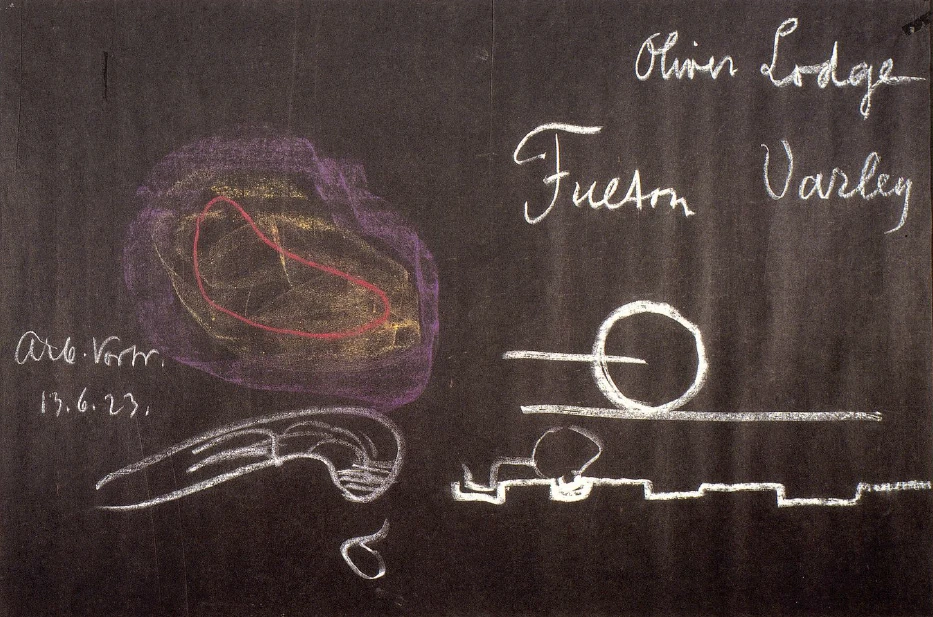
[ 36 ] But Sir Oliver Lodge is also an exceptionally great scholar and does not believe things so readily. But then something happened again that left him with almost no choice but to believe. And behold, what had happened was as follows. The medium, as they say, communicated to him from a trance—that is, from a semi-conscious state—that his son had had his photograph taken in the last few days before he died, and told him that there were, in fact, two photographs.
[ 37 ] It is very common for such photographers to take several pictures in succession, and usually they have the subjects sit in slightly different positions for the second shot. The medium therefore says that the son is sitting differently in the second photograph and describes, quite correctly, how it differs slightly from the first. And Oliver Lodge immediately thought to himself: Good heavens, if what she’s describing to me were true—photographed a few days before his death, in two different poses!—No one in England at the time could have known that this was true, because it had happened only a short time before his death; for the séance took place fourteen days or three weeks after the son’s death. Lo and behold, eight days after the séance took place, the two photographs arrived in London by mail—packages traveled very slowly back then—and they matched, they matched perfectly! So, in his view, he could believe nothing else but that his son had told him this from the afterlife.
[ 38 ] And yet that was not the case here; rather, the medium had already entered a trance, had entered a different state, and had a premonition—as does happen—so she had merely had a premonition of it. The people sitting around the medium only found out about the photographs now, eight days later, when they arrived; but the medium had had a premonition of them and had already seen them eight days earlier. So there was no connection with the afterlife; rather, everything took place on Earth. The medium had merely had a premonition, and Oliver Lodge had allowed himself to be deceived. That’s how careful one must be! So it is all true that a person lives on beyond death, that they can also make themselves known, but one must be certain. When Raymond Lodge communicates this in English—“I had two photographs taken shortly before my death; the poses have changed”—one must ask oneself whether this actually comes from him. For after death, communication in English ceases; otherwise, the spirit would also have to know English. The information must therefore originate from the medium’s subconscious—from that which is not conscious in ordinary life.
[ 39 ] Precisely because Mr. Burle’s question prompted me to discuss such sensitive matters today, I also wanted to tell you how careful one must be, for one is responsible for what one says; I wanted to show that one cannot simply accept any concept at face value, but must investigate everything thoroughly. And only then, after thinking about it at length, can one say: Yes, a protective spirit has indeed spoken. — But the fact that the words were expressed in the German language happened only through human mediation. And if certain people are unable to do something, their muscles must first have been paralyzed by the spiritual world. Everything must pass through human beings.
[ 40 ] Once you've learned that as a foundation, you can move on. We'll talk more about that next Saturday.