

Rhythms in the Cosmos and in the Human Being
GA 350
16 June 1923, Dornach
Translated by Steiner Online Library
6. On the Root Causes of the World War Catastrophe
[ 1 ] Did you perhaps notice something, gentlemen?
[ 2 ] Mr. Dollinger: I wanted to ask about human destiny. Millions of people lost their lives in the Great War. Did they bring that fate with them when they were born? How does this relate to the spiritual world in the context of world development?
[ 3 ] Dr. Steiner: We can also discuss this in connection with other topics, because it is absolutely necessary that, in anthroposophy, we do not simply explain things the way people sometimes do. What is said must be scientific. Now I would like to say something to you specifically in this regard, which will then lead us to understand how the great catastrophe of today—this terrible global misery affecting so many people—could have been possible at all. For today, people generally no longer take into account how one human being is actually connected to another. The fact is that today all human beings actually stand isolated in the world. Even when people today—out of habit or because of some remnant of superstition they still harbor—are aware of and observe the kinds of things I described to you in the last lecture, they generally misinterpret them.
[ 4 ] Now I’d like to tell you a simple story that illustrates how, these days, people no longer even consider the idea that one person might be connected to another in any way. The following incident actually took place—and it is well documented, like a scientific fact. In one family, a younger member—an eighteen- or nineteen-year-old girl—was ill; not so ill that she was bedridden, but she had to lie down from time to time. For a while, her mother stayed with her and cared for her. She was lying on the sofa, being cared for by her mother, and once, when she had more or less fallen asleep, her mother went into another room and read aloud from a book to her husband and other family members. It was in a room quite far away from the one where the sick girl was lying.
[ 5 ] The sick woman now had the following realization. When her mother had walked out the door, she suddenly felt the urge to get up. She stood up and followed her mother through two rooms into the third room, where she found her mother reading aloud. She was extremely surprised that they didn’t seem at all surprised. The sick girl, who could barely walk and had just been left while she was asleep, now appeared in the room where her mother had intended to stay only for a short while, since she also wanted to tend to the others. She was a little taken aback that they remained completely calm. Then the mother, who had been reading, suddenly said, “Now I must go and see how my daughter is doing!”—and walked out of the room. But the daughter followed her. The mother walked through those two rooms again and found the daughter lying on the sofa, looking terribly pale. At first, she didn’t speak to her at all. But then, when she spoke to her, the daughter gave no answer; she was completely pale. The daughter had, in fact, been following her mother the whole time, and now she saw her mother walking away, while she—the daughter—saw herself lying on the sofa. And the daughter was, in turn, very surprised—first, that she saw herself lying on the sofa, and second, that her mother was speaking to her there. At that moment, it was as if the daughter had been struck a terrible blow, and then what was lying there on the sofa took on a slightly better complexion, and everything was back to normal.
[ 6 ] This is a fairly well-documented account; the event actually took place. But now all sorts of people are coming forward who want to explain it. Yes, they explain it, for example, as follows: Well, this daughter has not only a physical body but also an astral body. — People used to talk about the astral body all the way up until the 16th century—that is, four hundred years ago—just as we talk about the nose or the ear. But this isn’t something that has been preserved to this day; it has generally been forgotten. So those people can talk about the astral body and say: Well, the astral body simply went out, walked through the rooms, took part in what the others were reading there and so on, went back again, and slipped back in at the very moment the mother spoke to the girl.
[ 7 ] But, gentlemen, you must realize that if one explains the matter this way, one is explaining it as if a second physical human being were inside you, as if there were a circle around you—a large circle—and as if you were slipping out of it and going for a walk like a physical human being. It is a strong superstition to explain it this way. This superstition is very widespread among learned people today; otherwise, things like what Oliver Lodge experienced—which I have told you about—would not happen. It always comes down to knowing: What really happened there?
[ 8 ] Well, what really happened there is this. The mother is sitting with her daughter and caring for her. Isn’t it true that what takes place there is what we call loving care, and the daughter finds it very, very pleasant to be cared for by her mother? She feels her mother’s love. At such a moment, gentlemen, when one feels the other’s love so strongly and is also very weak, something strange happens: one no longer thinks with one’s own astral body. It becomes dull, and the other person’s astral body gains power over one’s own astral body. Then it even happens that one begins to think with the thoughts of the other person who is beside them. So it was that, while the mother was still caring for her daughter, this feeling that had developed transferred to the daughter to such an extent that the daughter felt and thought exactly as her mother did. Now the mother is leaving. Just like a ball that I push and then rolls away, the daughter is now thinking not with her own thoughts, but with her mother’s thoughts. And as the mother walks through the two rooms, the daughter continues to think with her mother’s thoughts. And while the mother reads aloud, the daughter thinks with her mother’s thoughts.
[ 9 ] So, of course, the daughter remains lying quietly on the sofa, but she is constantly thinking the same thoughts as her mother. And when the mother becomes restless and goes back inside, the daughter thinks that she, too, should go back. And now you shouldn’t be surprised that the daughter has turned pale. Just consider this: If you lie there for a while as if in a deep faint, you’ll turn pale too. Because thinking with another person’s thoughts naturally induces a faint-like state. And when the mother comes back, it has such an effect on the daughter that she is shaken and can once again have her own thoughts. So you see, the correct explanation in this case is that one person exerts an extraordinarily strong influence on another, particularly in the spiritual realm. But this occurs especially when the person being influenced is very weak themselves. So if they cannot develop their own spiritual strength, then the spiritual strength of the other person very easily exerts an influence on them.
[ 10 ] But that’s just how life is. People often don’t even realize what a huge influence others have on one another. Do you really think that when someone tells you something, and you believe it, you always have reasons—reasonable reasons—that convince you? That’s not true at all. When you love someone, you believe them more than you believe someone you hate. That’s the point: one person’s soul exerts an extraordinarily strong influence on another’s. So you have to tell yourself: I need to know how strongly one person influences another. I need to know exactly how things stand with spiritual matters if I want to talk about them at all.
[ 11 ] I’d like to give you another example now, which I’m sharing with you for a specific reason. Because someone might say: “So Dr. Steiner doesn’t believe at all that a person can step outside of themselves; he only believes that one person can influence another.” — No, I was simply giving you an example that clearly illustrates how one person—in this case, the mother influencing her daughter—has influenced another.
[ 12 ] Now, here’s another example where there can be no question of one person having been influenced by the other. Two students are living together in a room. That happens all the time with students. One is a math major; the other is a philology major and knows nothing about math—absolutely nothing about math. But one evening, as they say in student slang, they’re both struggling terribly—one with his Latin grammar, the other with a math problem he wants to solve but just can’t figure out. He’s completely stumped. The one studying languages is doing reasonably well; he goes to bed feeling quite satisfied. But the math student doesn’t go to bed satisfied, because he simply hasn’t been able to solve his problem. With languages, you usually don’t know whether you’ve gotten something right or not. At most, you make mistakes, but you think they’re correct. With math, it’s just the way it is: if you haven’t gotten it right, you get nothing. That’s the difference. Well, so they go to bed; around half past eleven or twelve o’clock, the two of them go to bed.
[ 13 ] As the clock strikes about three, the math student—the language student had glanced at the clock—stands up, sits back down at his little table, and begins to calculate, calculating, calculating. The language student is extremely surprised by this, but he has enough presence of mind to calmly wait and see what happens. The other student calculates, calculates, then gets up from his chair again, lies down in bed, and goes back to sleep.
[ 14 ] At eight o’clock in the morning, both of them get up. The math student says, “Wow, I’ve got a real headache today—it’s as if we’d been out drinking all evening, even though we were at home!” The other one replies, “That doesn’t surprise me! Why did you get up in the middle of the night and work?” — What, me working? That never even crossed my mind! I was in bed the whole night —, says the math student. — But you did get up! — says the other. You picked up the pencil and did calculations, calculations! — Well, says the first one again, that’s not what happened at all! — Well, let’s take a look, said the language student; what you wrote must be there! — The math student looked. There was the entire math problem solved—everything he hadn’t been able to do the night before.
[ 15 ] Now you see, here’s an example where there’s absolutely no question that the other person didn’t cheat, because he wouldn’t have been able to solve the problem. He was just a language student and, besides, he saw how everything unfolded. So the person in question, without even realizing it himself, got up and solved the entire problem. So there’s absolutely no question that anyone else could have influenced him in any way. The person in question actually got up that night.
[ 16 ] But when you explain this, something very strange comes to light. You see, as you know, we first have our physical body, then the etheric body, the astral body, and the ego body. I call them all “bodies”—of course, they are not external bodies—but I refer to these four parts of the human being as “bodies.” Now, gentlemen, when we sleep, only our physical body and etheric body lie in bed; the astral body and the I-body are outside. We see them outside, surrounding the physical body and the etheric body. I’ve already explained all this to you. That’s exactly what happened to this math student. He lies down in bed. He’s able to fall asleep—that is, he brings his astral body and his I-body out—but he’s still troubled by the fact that he hasn’t solved his math problem. If his astral body and ego body had now slipped back into his physical body and etheric body, he would have woken up and still been unable to do anything—he probably wouldn’t have solved the problem again. But that is not at all what the astral body and ego body did; rather, because of the restlessness he had fallen into, they merely nudged him. The astral body can give a nudge; it can even nudge the skin a little. But this can only happen through the air, not physically, since the astral body is not physical. However, it can set the air in motion. And this affects the eyes in particular, the ears to some extent, and especially the nose and mouth. Wherever there are sense organs, this puffing of the astral body has a very strong effect. So the math student lies down in bed; the astral body puffs continuously from the outside but does not enter. But because it is puffing, the physical body, together with the etheric body, feels compelled—quite automatically, like a machine—to get up. The astral body, however, remains outside, for if it had been inside, the student would have become conscious. So he sits down. It does not even occur to his astral body or his “I” to go inside. Yes, who is doing the calculating now? Now it is the physical body and the etheric body that are calculating, and the etheric body is capable of performing the entire calculation—which it cannot do when the astral body and the “I” are inside.
[ 17 ] From this you can see, gentlemen, that you are all far more intelligent in your etheric body than in your astral body or in your “I.” If you could do everything you’re capable of doing in your etheric body—good grief, you’d be some smart guys! For the whole point of learning is actually to bring up into the astral body what we already possess in our etheric body.
[ 18 ] Yes, what actually happened to that math student? You know, in the old days there were almost no teetotalers or anti-alcoholists among the students; in fact, they usually drank quite a lot. And so those two guys didn’t just study every evening; they also spent a lot of time in bars, and as a result—due to the alcohol’s effect on the blood—their astral bodies were ruined. The etheric body was less severely damaged. And the result of this was that the math student, had he gone to the pub less often, would have been able to solve the problem quite well; but because he had allowed his astral body to be so strongly influenced, he was unable to solve the problem while awake. He first had to rid himself of the corrupted astral body; only then could he sit down at the table, and his etheric body—which had remained more lucid—solved the math problem. So we can do exactly what the intellect does with the etheric body. We cannot love with the etheric body—that is the task of the astral body—but everything the intellect does can be accomplished with the etheric body; the etheric body must serve this purpose. Thus, we can say: From this example, we see quite clearly that there is no influence from another source, but rather that the student of arithmetic is dealing solely with himself.
[ 19 ] Now imagine this very clearly: Here we have (drawing) the physical body, and here the etheric body (yellow); it passes right through the physical body. And now, to help us visualize the whole human being more easily, I’ll draw the astral body for you—which is present at night, right here on the outside (red). It’s very small at the top and huge and bulbous at the bottom. Then there’s the “I,” the “I”-body (violet). So that’s what we’re like at night. So we are actually two distinct beings at night. Of course, you must not imagine this as a second, physical human being; rather, what is out there is entirely spiritual. Otherwise, you would once again fall too deeply into materialism if you did not conceive of the matter in spiritual terms. From this, however, you can certainly hold the view that human beings are, in themselves, this dual-natured being—a spiritual-soul part and a physical part together with the etheric body. The waking human being is only as he is because, every morning, the astral body and the “I”-body are properly integrated into the physical and etheric bodies (arrows).
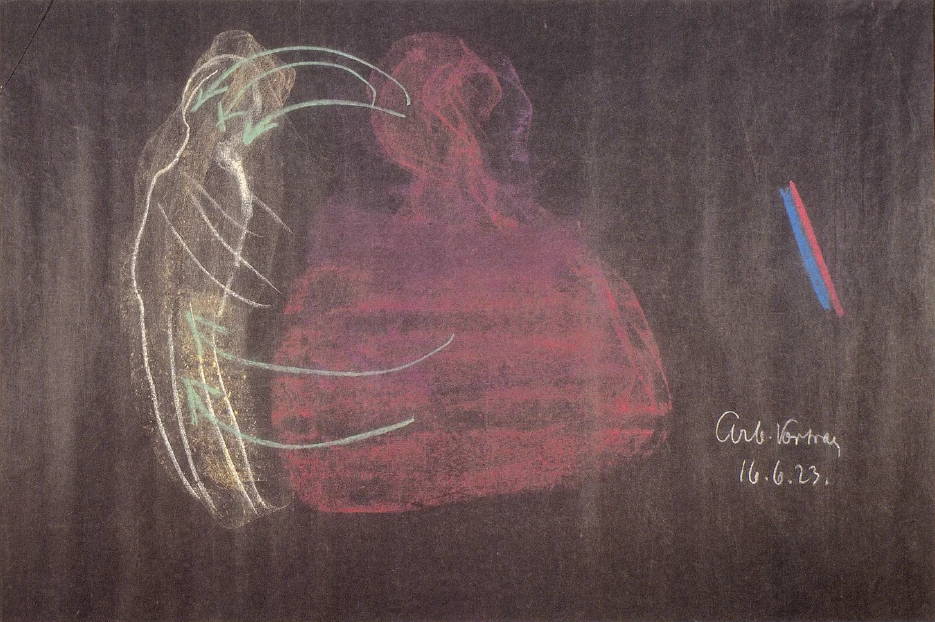
[ 20 ] But now you might think that this couldn’t always happen properly. Yet there are, in fact, some very strange cases. There was once a girl—such things always happen when they occur spontaneously, that is, when they don’t result from practice, but rather when a person becomes somewhat vulnerable, as is the case with young girls, for example, when they’ve just reached maturity, in the early stages of womanhood—so there was a girl, nineteen or twenty years old, who experienced the following. She had days when she spoke, but her family members couldn’t understand a word of what she was saying—not a single word. She spoke of completely unfamiliar things. It was quite strange. For example, she might say: “Ah, hello, I’m very pleased that you’ve come to visit me.” We saw each other two days ago in...—ah yes, we went for a walk in that beautiful forest. There was a spring there.—Then she would wait. It was just like on the phone: you couldn’t hear the other person, but then you’d hear the reply. It was as if she were responding to something: “Well, yes, of course, you took the glass and drank from it.” — And so it was that one always heard what the person in question said in response to something someone else was supposed to have said. Those around her simply couldn’t see the other person. But the girl was there in a completely different world, speaking within it. For example, this happened: Well, she couldn’t move, could she? She’d remain completely still on days like that. But when she was sitting there like that and someone nudged her, she wouldn’t say, “Why are you nudging me?”—instead, she’d say, “It’s a terrible wind! Close the window—there’s such a draft!”—She had completely different ideas about what was happening when, for example, someone nudged her. Well, she’d stay that way for a day or two. Then there’d be a few days—or a longer period—when she was completely lucid, knew everything, spoke properly with people, and knew absolutely nothing about what had happened during those other days. She didn’t remember a thing. When people told her about it, she’d say she knew nothing about it. It was just as if she had been asleep. But then something else would take over. When she was in that other state, she remembered everything that had happened while she was in that other state and nothing at all of what had gone on during her normal state. She could look back on her entire life, which she had lived, as others said, in a dreamlike world.
[ 21 ] What was it about this girl? What I’ve just told you, of course, happens countless times, and sometimes it happens in a truly chilling way. You see, I had an acquaintance with whom I’d worked for a while. He went on to become a professor at a German university, and one day he simply disappeared. No one knew where he had gone. All the investigations ultimately led nowhere. The only thing they were able to find out was that he had gone from where he lived to the train station and bought a ticket. But since a large number of people had boarded the train, no one knew where his ticket was for. He left. He just didn’t come back for a very long time. Then it happened that a stranger walked into a homeless shelter in Berlin, wanting to be admitted, and when he was asked for his papers, it turned out: that was Professor XY from such-and-such a place. He had ended up in a homeless shelter in Berlin. He came back and was able to resume his professorship quite well. Isn’t that right? Things just carry on automatically; it doesn’t hurt to have a little interruption like that. So he carried on with his work. But his relatives—he was even married, after all—continued to investigate what had happened in the meantime. And it turned out that the man in question had bought a ticket to a certain station, not very far away. He’d arranged it all very cleverly. He then got off the train, bought another ticket—this was before the time when passports were required— traveled to a completely different country, then to yet another country, then took a completely different route—he was stationed in a city in southern Germany—to Berlin, lived in a homeless shelter, was taken in there, knew absolutely nothing about the whole thing, and was in a completely different state of consciousness.
[ 22 ] What happens to such a person? You see, with such a person it is just the same as with such a girl. When such a person is about to wake up, the astral body and the “I” body do not fully enter; they merely push from the outside, and so the physical body and the etheric body go through the entire process on their own. Such people behave in an incredibly sensible manner. This, too, is a well-documented story, similar to one I myself experienced with an acquaintance.
[ 23 ] Another story: A person first buys a train ticket, does just that, and travels to a nearby station. Then he has to come up with all sorts of tricks; his etheric body does all of this. He travels all the way to India and stays there for a few years. And then, after he has forgotten everything, he goes on living just as before.
[ 24 ] Yes, you see, these things are truly such that one must say: Here one sees deep into the very essence of the human being. — For what had now become of the man I knew so well, who had traveled through two countries and ended up in a homeless shelter? He had since returned to his university; he had even been appointed to another university to replace a famous professor. One day I happened to be in that very city. He no longer associated with me—as, in fact, had become the case: during the time I was giving anthroposophical lectures, many people who had previously associated with me no longer wished to do so. One day, word got around: “Yes, Professor XY has left again.”—But this time he didn’t reappear; instead, he was found dead. He had drowned himself. Yes, what had happened there? You see, what had happened was that he had once again fallen into the same state where his astral body had simply pushed him aside. There, in his etheric body, he once again recalled the earlier events and was so terrified by them that he took his own life. So here one gains a thorough insight into the nature of the human being when one understands how the various members of the human being interact.
[ 25 ] But here’s the thing: There was once a man who also found himself in such a state, and when he spoke, it was as if he were a completely different person than he was at that moment, so that the other people couldn’t understand a thing. He described—the story took place in the 19th century—how he had been active during the French Revolution. He described entire scenes. What had happened to him? It was similar to what happened to those people I told you about. But what had happened to him?
[ 26 ] In ordinary consciousness, a person doesn’t know all that much about what goes on in the astral body and the I-body, but he nevertheless experiences a great deal there. Well, just imagine the following happening. You see, I want to describe to you what happens when a person wakes up. When a person wakes up, the astral body first splits apart. Here (see drawing on p. 112), it breaks away, and one part enters the head, while the other, the lower part, enters the rest of the body. This is how it sometimes happens. Now imagine this: If the head absorbs the astral body and the “I” more easily than the lower part, then the astral body may already be inside the head earlier on, but not yet in the lower part. In this case, the person begins to speak in such a way that they seem like a completely different person. What is happening here? You see, for a moment, the ability to look back on a past life arises. One learns to look back into a past life. But one cannot quite interpret it, one does not understand it, and so one invents something one has learned from history. The person who was in a different state—because his astral body and his “I” entered his head earlier—said he was a Frenchman and had experienced the French Revolution. He had learned that; it is merely a reinterpretation. But he experienced himself in a previous incarnation, in a past life, and he could not understand it right away; that is why he reinterpreted it in this way.
[ 27 ] You just have to realize this: Right up until the 16th century—so only four centuries ago—people talked about such things, even if rather foolishly and rather vaguely. That was something extraordinarily important to them. Wherever people gathered—not that they were telling ghost stories, but rather that they took these matters just as seriously as other events in life—they told each other such stories and knew that such things existed. It’s simply not true that people didn’t know this. Today—well, gentlemen, just try it once and tell stories like the ones I’ve just told you at your party meetings, and you’ll see right away how you’ll be thrown out—today, it’s no longer possible to talk about these things in a natural, reasonable way. People don’t even talk about it anymore. And scholars, of all people, talk about it the least. I’ll prove to you that they know the least about it.
[ 28 ] Now think for a moment about one of the most important scientific developments that took place in the 19th century. A resident of Heilbronn became a doctor. And since the people at the University of Tübingen considered him to be a rather incompetent individual, he couldn’t go very far in his career, so in 1839 he signed on as a ship’s doctor and sailed to the East Indies on a very crowded ship. The ship ran into quite a bit of trouble. The seas were quite rough, and the passengers became seasick. By the time they arrived in the East Indies, nearly the entire crew was ill. The ship’s doctor was constantly kept busy. Now, back then, it was still customary that if someone had this or that ailment, they would be bled. That was the first thing.
[ 29 ] Now, humans have two types of veins. One type of vein contains blood such that, when it spurts out during bloodletting, it is reddish. Right next to it runs another vein. When blood spurts out of that vein, it is bluish; bluish blood then spurts out. When an ordinary child is bled, of course one does not let the red blood out. The body needs that. One lets the bluish blood out. The doctor knows this very well. He also knows where the blue veins run and does not pierce the red ones. So good old Julius Robert Mayer, who was the ship’s doctor there, has to perform a lot of bloodletting. But everywhere he pricks people, the blood that comes out isn’t really bluish, but rather bright red. “Good grief,” he thinks to himself, “I’ve pricked the wrong vein again!”—But when he does it to the next person and pays closer attention, bright red blood comes out again. Finally, he has no choice but to conclude: “Well, when you come to the tropics, to the hot zone, it’s not like usual—the blue blood turns reddish from the heat.” — This was, of course, something that Julius Robert Mayer regarded as a very important discovery, and rightly so. He had observed something extraordinarily significant.
[ 30 ] But now we have to make a hypothesis, an assumption. Imagine if this had happened to someone—not in the 19th century, but in the 12th century. He would have traveled somewhere with a group of people. People didn’t undertake such long journeys back then, but it could still have happened that an entire crew nearly perished. So let’s assume that an entire crew had fallen ill back then; the doctor would have performed a bloodletting and discovered: The blood, which is supposed to be blue, is actually reddish. So there must be a high fever. — What would he have said? Yes, in the 12th century, he would have said: “What is it that makes the blood blue?” — And since he would have known all the things I’ve told you—even if only vaguely—because anthroposophy didn’t exist back then and things were vague—he would have said, because he would at least have sensed it: “Good heavens, the astral body doesn’t sink as deeply into the physical body as it does in those whose blood is completely blue!” — For he would have known: The astral body is what makes the blood blue. But the heat keeps the astral body outside. That is why the blood becomes less blue and remains similar to red blood. — He would have said: “This is an important discovery, for now I understand why the ancient Orientals possessed such great wisdom. In their case, the astral body has not yet penetrated so deeply into the physical body and the etheric body.” — He would have developed an immense, profound respect for the wisdom of the ancient Orientals and would have said to himself: “Now the Orientals have simply been influenced by people who have a lot of bluish blood, and so it is no longer possible for them to bring their ancient wisdom to light.” — That is what a 12th-century ship’s doctor would have said.
[ 31 ] A 19th-century ship’s doctor knew absolutely nothing about everything I have just told you. What did he tell himself? He said to himself: Well, there’s heat. That causes combustion. Greater heat causes greater combustion. So the blood burns more intensely when you’re in the hot zone.” — And he found the law of heat conversion—which plays such a major role in modern physics—to be in effect; a completely abstract law. He wasn’t interested in any of the rest at all. He discovered the law that plays a major role in the steam engine, for example, where heat is converted into work. And he said: “I can see from the fact that red blood is coming out that the organism simply works harder in the hot zone, and therefore generates more heat.” — So Julius Robert Mayer has now discovered something entirely mechanical.
[ 32 ] You see, that is the big difference. In the 12th century, people would have said: The blood is redder there because the astral body does not sink in as deeply. — In the 19th century, people knew nothing of all these spiritual matters anymore and simply said: “There, the human being functions like a machine, and the fact is that heat produces more work, which in turn generates more heat within the human organism.” — Yes, gentlemen, what Julius Robert Mayer, that great scholar, did—that is roughly the way of thinking of all people today. That is how it is. But because human beings can think and feel in this way only about what is no longer spiritual, they have lost their connection with other people. And at most, when they become ill and weak—like the girl I told you about—they empathize so deeply with others that their thoughts even follow them into another room. That, of course, is a huge difference! Certainly, we have made tremendous strides and achieved great progress, but our humanity has not progressed; it has regressed. We now speak of the human physical organism only as if it were a machine. And even the greatest scholars, such as Julius Robert Mayer, speak of it only as if it were a machine.
[ 33 ] Yes, gentlemen, if things were to continue this way on Earth, then all thought would descend into chaos. All manner of horrors and catastrophes would occur. Even now, people no longer know what they are actually supposed to do. That is why they throw themselves into something with all their might and say: “Yes, our reason no longer holds us together; our nationality must hold us together.” — These nation-states arise only because people no longer know how to hold themselves together. And that, gentlemen—the fact that people no longer know anything about the spiritual world—is what has actually caused this immense misery—the rest is merely superficial—that is what has caused this immense misery. And to say: “People deserve this because they did wrong in their past lives”—that is, of course, nonsense, for this is not the fate of each individual, but rather the shared fate of every individual. Yet each person experiences it in this life. Just think how much misery a person experiences in this present life. It does not stem from a past life. But in the next life, they will face the consequences of the misery they are experiencing now. The result will be that they will be wiser and that the spiritual world will be able to enter them more readily. So the present misery is already a form of education for the future.
[ 34 ] But one can draw a different conclusion from this. Just imagine that anthroposophy had already begun in 1900 and had actually become very well known. But people resisted it and didn’t want to hear anything about the spiritual world. Well, gentlemen, in the old days, if you had a schoolboy who didn’t want to learn anything at all—now we’ve moved away from that; I won’t say anything about whether it’s right or wrong—then you’d give him a good thrashing! Some of them did eventually start learning. It helped some of them. Yes, people didn’t want to learn anything spiritual until 1914. Now they’ve been punished for it by the fate of the world, by our shared destiny. Now we’ll see if that helps.
[ 35 ] Yes, that’s certainly true, gentlemen; one must view this as a shared human fate! For what has happened? You see, the girl I told you about—she was thinking with her mother’s thoughts. People have gradually lost the ability to think for themselves entirely and now think only with the thoughts of those they regard as authorities. People must once again begin—each and every one of them—to think for themselves; otherwise, precisely because they know nothing of the spiritual world, they will be constantly influenced by it—but in a negative sense. And then one can say: What has befallen humanity as misery can indeed be rightly regarded as a blow of fate, I would say, and we can still learn from it. — No matter how many conferences are held, it won’t help a bit. The people who want to prop up the mark with today’s kind of intellect will end up causing it to plummet by half, because this intellect, which is entirely of the earth, is of no use whatsoever. If a body lacks sufficient fluid, it becomes sclerotic; it calcifies. And if the soul knows nothing of the spiritual world, it eventually develops a mind that is no longer of any use. And humanity is heading toward this fate if it does not continually receive nourishment from the spiritual world.
[ 36 ] So the only real solution is for people to start taking an interest in the spiritual world. You see, that is how one must answer the question Mr. Dollinger posed. One has to put it rather bluntly, but that is how the connections work.
[ 37 ] I have to go to Stuttgart next week, but I'll be back very soon. I'll have my next appointment announced to you.