Human History and the
World Views of Civilized Nations
GA 353
1 March 1924, Dornach
Translated by Steiner Online Library
1. The Effect of the Cemetery Atmosphere on People — The Worldviews of the Ancient Indians, Egyptians, Babylonians, and Jews
[ 1 ] Good morning, gentlemen! Has anything come up for today?
[ 2 ] Mr. Dollinger: I would like to ask why it is that people who live near a cemetery often seem less lively and look pale? — He cites an example that seems to confirm this. - I would like to know what the rhythm is like in their bodies—couldn’t it also have a positive effect?
[ 3 ] Dr. Steiner: Well, I do believe I can provide quite a good answer to this question, because I lived right next to the cemetery from the time I was eight until I was eighteen—so I must have looked terribly pale back then. That was sort of true. Based on the various details you’ve provided, that must have been especially true in my case.
[ 4 ] Well, the cemetery was the cemetery of a small town—the town had perhaps six hundred residents—so it was a fairly large cemetery. But at least it was right next to the house and the train station where we lived. And people lived quite close by all around it, as was customary in such places. There was the church, the cemetery all around it, and then the houses: you could always tell what kind of health the people living around the cemetery were in. Well, one could say that there were already considerable differences among the residents, and that, for example, the pastor—who lived not very far from the cemetery—was neither pale nor frail, but rather quite corpulent and also quite handsome. That’s my impression from back then.
[ 5 ] But the view one forms in this regard is that, if sanitary conditions are otherwise established—and this was often the case in places where cemeteries surrounded the churches—one cannot assume that it causes such terrible harm. At the same time, chestnut and walnut trees were widespread throughout these towns. These walnut trees have the effect of being exceptionally beneficial to health through the fragrance they emit. Now you need only assume that there were sound instincts in those places where this was originally a common custom; these instincts led people—because the churchyard is within the village and people live all around it—to plant chestnut or walnut trees, and especially linden trees, nearby. Linden and walnut trees then have a balancing effect, counteracting the harmful effects of the cemetery.
[ 6 ] Now, this must also be taken into account: You see, if we examine more closely what Mr. Dollinger actually wants to know—namely, the effect on the higher bodies—we must be clear that, of the bodies I have mentioned, only the physical body and the etheric body have a vitalizing effect, whereas the astral body and the ego do not have a vitalizing effect but rather, in essence, a paralyzing one; they act as soul and spirit. And from much of what I have told you, you will see that the physical body and the etheric body are like a plant; they grow, and organs form within them. If we had only these—the physical body and the etheric body—we would be constantly unconscious. Otherwise, we would lead a life of slumber like plants, were it not for the constant process of breakdown taking place within us; it is only because this breakdown is constantly occurring within us that we do not lead a life of slumber like plants. The astral body and the “I” break things down; they, in turn, disperse them. There is a constant process of building up and breaking down within the human being. And the astral body is the one that actually breaks things down most intensely within our human being. And all these waste products I have spoken of are actually broken down by the astral body and the ego. The etheric body plays only a minor role. I have already explained this to you.
[ 7 ] Now you see, gentlemen, the cemetery-like atmosphere that arises there is related to the forces that break down the astral body within a person, and it actually supports that breakdown. And a person is broken down more if they live near a cemetery than if they live somewhere out in the woods. When they live out in the woods, their constructive forces are stronger; when they live near a cemetery, their destructive forces are stronger. But if we had no destructive forces, then, as I have already told you, we would remain stupid for the rest of our lives. We need precisely these destructive forces. There is one more thing to consider. I told you: I can speak about this because I have experienced it myself—and experienced it precisely during my youth, when so many things are taking shape. I have always had a tendency to think precisely. Well, I’m convinced that I owe this tendency to think precisely to the very fact that fate allowed me to grow up near a cemetery. So that, in turn, is a good thing, gentlemen. You must take that into account as well.
[ 8 ] Isn't it true that what is harmful about a cemetery are the corpses inside it? After all, the corpses merely continue the process of decay. When we die, the cycle of constant building up and breaking down comes to an end. The process of building up ceases. Thus, the astral body is prompted, when near a cemetery, to think positively. This, too, cannot be denied.
[ 9 ] In what is now known as Burgenland, where I grew up, the villages were all laid out so that the cemeteries were in the center. Burgenland is, of course, the region that has been the subject of so much controversy. There are a few larger cities—Eisenstadt and so on—but they’re far apart, so the villages are scattered everywhere, and everywhere the cemetery was in the center. And it’s certainly true that one could say the people there possessed a certain kind of peasant shrewdness. And it’s also undeniable that this peasant shrewdness actually developed under the influence of the cemetery’s atmosphere. They kept away evil spirits by planting walnut and linden trees everywhere.
[ 10 ] The area there was also a wine-growing region. The atmosphere of the grapevine also has a balancing effect in a certain way. The scent of linden blossoms, as you know, is very strong, and the walnut tree also has a very strong scent; these have a more invigorating effect on the astral body. And the atmosphere of the grapevine, in turn, has a more invigorating effect on the “I.” So that you already have a very strong influence on the higher bodies of the human being.
[ 11 ] Of course, one cannot deny that things change as civilization advances. Of course, the moment towns grow larger, when many houses are built around them—and as a result, the effectiveness of the trees is compromised—the cemetery begins to have a harmful effect; then, naturally, there are these pale-faced people around the cemetery. This can no longer be balanced out, and the result is that the cemetery causes people to suffer from its atmosphere. This, in turn, has led to a natural instinct: once villages had grown into cities, people began to locate the cemetery outside the city.
[ 12 ] Now, of course, there is another factor to consider. This is the case when the effect goes even further, when it affects the etheric body. You see, everything that rises into the atmosphere as a fine mist affects the astral body and the “I.” So the faint smell of death that is always present around a cemetery, as well as the scent of walnuts, linden blossoms, and horse chestnuts—which has a particularly invigorating effect—can actually only affect the higher bodies; these scents do not penetrate the etheric body as strongly.
[ 13 ] Now, the thing about the etheric body is that water in any given area has a particularly strong effect on it. Water has a very strong effect. And in the vicinity of a cemetery, the water is very easily permeated by whatever is coming out of the corpses. The water is drunk; it is used for cooking. And so if, somewhere in a village where the cemetery is near the houses, the water becomes contaminated, no trees can help! Then nature is of very little help. And the result of this is that people do indeed very easily develop consumption, and that they then suffer from it extraordinarily severely.
[ 14 ] You see, I could see that very clearly, too. There was a town—it was several hours away from where I lived—a small town. Almost everyone lived around the cemetery. The people were very sluggish by nature; they just couldn’t get going. Their muscles were limp, their nerves were limp—everything about them was limp; they were pale. And that’s when the thought occurred to me: Where does that come from?—And you see, this is very interesting: Back home in Neudörfl, the people who also lived around the cemetery were relatively healthy! Well, that’s a big question for anyone who truly observes the countryside in terms of the conditions that matter to people. There was a village where people lived around the churchyard, and where they did nothing but plant walnut trees; they did plant them, that was a very healthy instinct—but otherwise, they even very often drew water for cooking from the little village stream! There was a row of houses (it’s drawn here), with the village stream running between them; there was the churchyard, there was the church; there we lived, there was the pastor’s house, there was the schoolhouse; then there was a row of houses here, with a little stream running between them, and there were walnut trees everywhere. People simply drew water from the little stream; naturally, the stream contained the remains and bacteria—the germs—from what seeped through from the cemetery. It was everywhere. The people, especially those who lived there, weren’t known for being particularly clean: there were houses with thatched roofs, and everywhere the manure pile right at the entrance, the pigsty right next to it—the pigsty and the manure pile made for a lovely combination—and then the path leading down to the village stream, so that when you walked in, you were wading through a brownish sludge. Well, you see, it certainly wasn’t, as we say today, hygienically arranged! And yet the people were healthy! One could not help but say that they were healthy.
[ 15 ] Well, first of all, when people are healthy, the corpses aren’t as bad at first as they would be if the people in the town were infected. But that’s of little consequence. The real question, however, was a big one: How was it that some people were healthy, while others were sick or weak and unable to live?—This is explained by what follows. Near this town was another, very small town—a spa town: there was a carbonated spring, carbonated water. The entire village got its drinking water from this place. And the drinking water from this place—the carbonated water—in turn had a balancing effect on the contaminated water from the cemetery. The others, who lived far away from this carbonated spring, simply did not have that. So there one could directly observe how the carbonated water—which, as I have once described to you, has a particularly strong effect on the ego and on thinking—in turn acts back upon the ego and the etheric body, and within the etheric body counteracts the destructive influence of what seeped from the cemetery into the village stream.
[ 16 ] Of course, if a city still has a cemetery within its boundaries, it is essentially impossible—at least as long as spring water is not brought in from a distance—to do much to transform the cemetery’s atmosphere. So if a city is situated in such a way that the cemetery is still in the center of town and water is still drawn from wells, then these are naturally the worst conditions for health, because the etheric body is then attacked; and the etheric body is that which cannot be further subdued by the astral body or the “I.”
[ 17 ] You see, the sanitary and hygienic conditions are, from this perspective alone, extraordinarily interesting. But of course, we must not overlook the fact that for the people living around the cemetery—if they are still believers, that is, if they have not already become unbelievers—the constant sight of funeral ceremonies has a consistently uplifting effect! It has a balancing effect. It affects the self. It is truly strengthening. One must also be able to view this from a health perspective. It, too, has a balancing effect.
[ 18 ] I guess that's pretty much what you wanted to know? Maybe someone else has thought of something else?
[ 19 ] Well, gentlemen, let me continue with this very question, but from a completely different angle. You see, we have already considered many things; today, let us look at the following from the perspective of the insights we have gained.
[ 20 ] When you look at a map, you might be interested in it in such a way that you say: Well, this people lives here, and that people lives there. We’re interested in the various peoples living side by side. — But you could also say: I want to look at the map from the perspective of how humanity has developed. — And that’s when the map really becomes quite interesting.
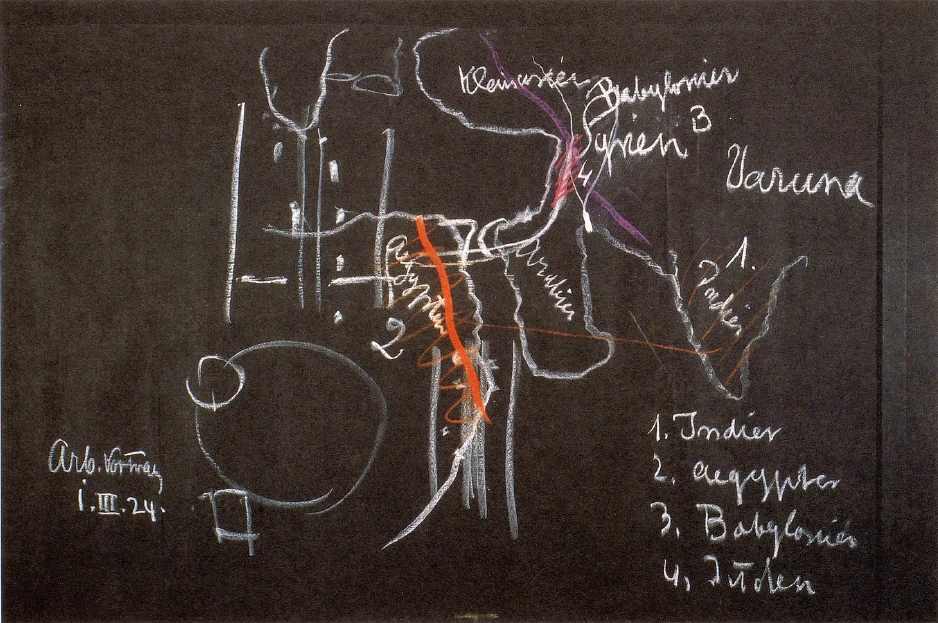
[ 21 ] Let’s take a look at a small section of a map. I’ll just sketch this out very roughly. For example, if we move over toward Asia—I’ve sketched this out for you once in relation to the human races—we have India, the Indian subcontinent; there’s Arabia; and then we have Asia Minor here. That’s where Asia begins to cross over into Europe; we’re already crossing over into Europe, that is, to the islands that face Europe. There’s Greece. Then we come here to Africa. And there we have a river: that’s the Nile; there’s Egypt—today, as you know, completely dominated by the British—; it was once a free country. Now you see, today people live everywhere. In India live the Indians, who are really pulling themselves together these days. They were ruled by the British for a long time—and of course still are today—but they’re pulling themselves together now, and anyone in England with any insight is absolutely terrified that the Indians might somehow become independent one day. There is a major Indian movement today: the so-called Mahatma Gandhi sparked such a movement in India and was subsequently imprisoned, but has now been released on health grounds. Likewise, there are people living here in Arabia who are more or less under British control; Arabia is still a rather inhospitable region. As you know, one of the main causes of the Great War was the desire to build a railway through Turkey, over here, seeking a route to India on one side and to Arabia on the other. Germany wanted to do that, and in doing so, Germany aroused the envy and jealousy of other nations on so many occasions because it wanted to build the so-called Baghdad Railway through Turkey, all the way into Asia. — And there was once Syria.
[ 22 ] You see, from a wide variety of perspectives, it is interesting to ask oneself: People have lived everywhere since time immemorial; their ways of life were quite diverse. One need only mention a few things to realize just how different these people’s lives were. In India, for example, there was a strict caste system—a system against which the European class system is, in fact, merely a pale shadow. In India, one was born into a caste. The highest caste was that of the Brahmins. These were the ones who performed priestly duties and were permitted to study. So in ancient times, virtually all the children of the Brahmins attended school. They were the ones who could write; that was the highest caste. Although priests were drawn from this caste, kings were not. Kings were drawn from the second caste, the warrior caste. But no one could ever rise from the warrior caste to the Brahmin caste; the two were strictly separated. The third caste consisted of farmers and rural people, and the fourth caste comprised those who were considered manual laborers. Now, there were strict divisions between these castes. In ancient India, it was viewed as if a person were to move from one caste into another—just as if a lion were to become a lamb! The castes were regarded as distinct from one another, just as the different species of animals were kept separate. And that is why people did not take any offense at it. It would have seemed just as crazy to them if someone from the third caste were to join the first as if a lion were to try to become an ox. So this was quite evident; it was something people took for granted. Well, that was the case in India.
[ 23 ] Let us now turn our attention to Egypt: there, too, there were castes. What I am about to tell you, gentlemen, takes place approximately three thousand or three thousand five hundred years—perhaps even four thousand years—before the emergence of Christianity. So we must go back five to six millennia if we want to look back to the time I am now describing to you. In Egypt, then, there were also castes, but they were not observed so strictly; it was possible for one person or another to move from one caste to another. So it was not observed that strictly, but there were still castes in Egypt. In contrast, in Egypt the entire structure of the state was based on the priesthood. The priesthood organized everything. This was also the case in India, but there everything was predetermined by the caste system, whereas in Egypt the caste system was not as strict. However, it was firmly held that everything that was to become law originated from the priesthood.
[ 24 ] And in a similar way, the other peoples who lived in Syria and in Asia Minor also had their own distinctive characteristics; they were different.
[ 25 ] Now, so that you can see what role the things we have learned play in human history, I would like to tell you something else today specifically about these peoples. Let’s single out four of these peoples: first, the Indians; then the Egyptians; then the peoples who lived here. The Euphrates and Tigris rivers flow into this gulf, and there was a people who later came to be known as the Babylonians. Let’s consider them as the third group.
[ 26 ] And then, as you know, a people distinguished themselves here who later played a major role in history: the Semites, the Hebrews, the Jews. They migrated to Egypt, later returned, and then settled here in Palestine—a relatively small people in terms of population, but a people that has played a major role in history. So we can consider them in succession: first, the Indians; second, the Egyptians; third, the Babylonians; fourth, the Jews. Let’s take a look at these four peoples today.
[ 27 ] You see, what is particularly characteristic of the Indians is that they actually view the people around them as separate from one another, much like the classes of animals, and divide them into four castes. Added to this is the peculiar religion that the Indians had in ancient times. The Indians did not distinguish between the spiritual and physical worlds; at the time when this Indian population first developed in India, no distinction was made between spirit and body. A tree was not viewed, as it is by many other peoples, as a physical tree with a spirit living inside it—no, that distinction was not made. The tree was itself a spirit, just a somewhat coarser spirit than that of humans and animals. For the Indians, too, the animal was not distinguished into body and soul; rather, it was soul—and so was the human being. There was no distinction between body and soul. And when the oldest Indian asked about the soul—and he knew that one breathes in, breathes in the air—the air one breathed in was, for him, the spirit. And then he knew: The air is out there; that is the spirit that surrounds the entire earth. And when this spirit, which surrounds the entire earth, began to flow, to blow, then he called the spirit that moves, that blows across the entire earth: Varuna. But what he had within himself—that, too, was Varuna. When there was a storm outside, it was Varuna; inside—it was also Varuna. Today one often hears it said that these Indians practiced a “worship of nature” because they revered wind and weather and so on. But one might just as well say they practiced a “worship of the spirit,” because they, in turn, regarded everything as spirit. The Indians had no concept of the body at all. And because that was the case, for the Indians every part of the human being was at the same time a spirit: the liver was spirit, the kidney was spirit—everything was spirit. They made no distinction between body and spirit. That is precisely the secret of ancient Indian wisdom—that no distinction is made at all between body and spirit. The liver was the spirit of the liver, the stomach was the spirit of the stomach.
[ 28 ] Yes, you see, when we look at the stomach today, we find that there must be something in the stomach for it to digest properly; we call this substance pepsin. If it is missing, digestion does not occur properly; then we have to add some hydrochloric acid. The Indian told himself—he didn’t have a name for it yet, but he knew there was a spirit there—that the stomach is structured this way: that is the “stomach spirit.” And that’s how the name for the remedy came to be: “stomach spirit.” Of course, today you can take drops for the stomach—no longer “Stomach Spirit,” but named “Hoffmann’s Spirit” or something similar after the inventor—but you will still find places where, in simple speech, the concept of the spirit is still embedded in the words.
[ 29 ] So the Indians saw spirit everywhere. And that is why they took no offense at the caste system, because they regarded it as something spiritual, just as they regarded the structure of animals as something spiritual.
[ 30 ] When we examine these Indian views, it is interesting to note that the Indians had a very precise understanding of all human organs. They regarded them solely as spirits. The human being was composed entirely of spirits: the spirit of the lungs, the spirit of the stomach, the spirit of the kidneys, and so on; in doing so, they focused solely on the physical body. So when we look at the Indians, we can say: The Indians were imbued with a view that focused on the physical body. They regarded the physical body as spirit.
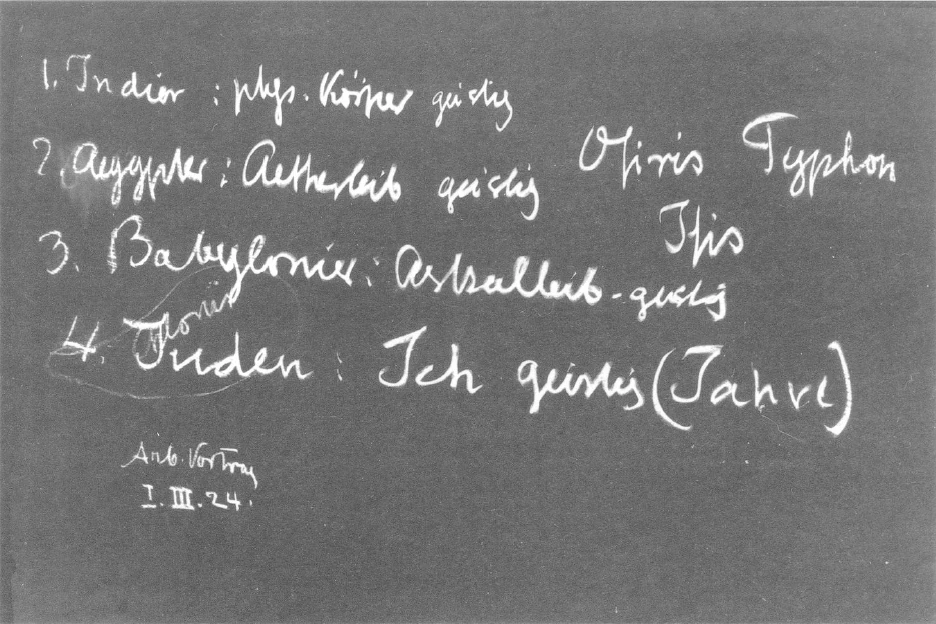
[ 31 ] 1. Indian: The physical body is spiritual
[ 32 ] This is very interesting, because we have now discovered a people who, to begin with, have a precise understanding of the physical body.
[ 33 ] Now let’s turn to the Egyptians. The story of the Egyptians is a remarkable one. The Egyptians, of course, had the Nile. The Nile is, in a sense, the lifeblood of the land. Every year, when July comes, the Nile overflows its banks, and in October it recedes again. So the ancient Egyptians knew nothing other than this: The Nile holds the water; the water recedes during the cold season; the water comes back out, floods the land, and becomes a benefactor to the people. But when the water recedes in October, what remains—and they don’t even need to fertilize!—is a very fertile silt. Grains and other crops were sown into this silt; they then sprouted and were harvested before the Nile flooded again. And so the Nile essentially prepared the farmland for them every year. As a result, the Egyptians were deeply imbued with a sense of the water’s benevolence. They devoted much attention to the nature of water itself. You see, today we admire our engineering for its ability to channel water. Yes, the Egyptians were already very skilled at channeling water thousands of years before us! Of course, when the Nile burst its banks and flooded everywhere, it sometimes ended up where it shouldn’t have been. So even in the earliest times, the Egyptians created Lake Moeris—an entire lake! It wasn’t there naturally; rather, it was created to channel the floodwaters into the right course. Excess water collected in this Lake Möris. So, in a sense, the Egyptians artificially controlled nature. But as a result, their attention was focused intensely on water.
[ 34 ] Now, as I already told you in my answer to Mr. Dollinger’s question: Water has an immense influence on the human etheric body. And based on the intuition that the Egyptians still possessed, they developed the teaching that human beings do not consist merely of a physical body, but also have an etheric body. - It’s interesting, you see: Back in India there were the most ancient peoples; many of these ancient peoples migrated to Egypt via Arabia. In Egypt there was a kind of ancient culture: everything came from India. As the Indians migrated to Egypt, they experienced the benefits of water. But they said to themselves: This does not affect the physical body we came to know in India, but rather it affects an even higher body of the human being. - And so the Egyptians—and the Indians as well—actually discovered the etheric body primarily through what they experienced with water.
[ 35 ] It was through their discovery of the etheric body that the Egyptians developed their entire religion, for it is a religion of the etheric body. If one were to single out the most important aspect of the Egyptian religion, it would be the following legend. These Egyptians said—and this was something the Egyptians told everywhere, just as the Gospel stories were told in Europe at a certain time—that there is a supreme God; they called this supreme God Osiris. This supreme God is the benefactor of humankind. He is, in fact, the source of everything that comes to humankind through the element of water. But he has an enemy. He works for the benefit of humankind; yet he has an enemy. And this enemy dwells in the hot wind that comes from the desert. There was, after all, the desert (pointing to the drawing). Thus they had two deities: Osiris and Typhon—Osiris and his enemy, Typhon. - Everything they saw in nature, they also saw reflected in human life. But unlike the Indians, they attributed it not to the physical body but to the etheric body. - Then they continued the legend: One day, Typhon killed Osiris and carried him off. And Osiris’s wife, Isis, retrieved the body and buried the various limbs in different places. Monuments were then erected to mark these sites. And ever since then, Osiris has been the ruler of the dead. He was once the ruler of the living, and then he became the ruler of the dead. The Egyptians had, after all, already contemplated death.
[ 36 ] Now you know—as I have already told you—that a few days after death, the human etheric body departs; only then does the person gradually regain consciousness. This is expressed in the legend as Osiris departing and then being brought back by Isis. A person regains consciousness after death.
[ 37 ] So one could say: The Egyptians came to the conclusion that human beings have an etheric body. — That’s very interesting! The Indians still regarded the physical body as spiritual. The Egyptians, on the other hand, recognized the etheric body and regarded it as spiritual:
[ 38 ] 2. Egyptians: Etheric body, spirit, Osiris, Typhon, Isis
[ 39 ] And everything the Egyptians believed in, everything they worked toward, was actually for the etheric body. That completely dominated their outlook.
[ 40 ] You see, gentlemen, there is one thing you have certainly observed about the Egyptians: their mummies. I mentioned them to you the other day; I said: When medieval physicians spoke of mummies, they were referring to something spiritual; I explained that to you. But today, when people hear the word “mummy,” they think only of these Egyptian mummies. The corpses were embalmed—carefully embalmed—and preserved. Yes, but why was that done? The Egyptians knew only of the etheric body and preserved the physical body so that, when the human being lives again, he might find his physical body once more. Had they already known of the astral body and the “I,” they would not have believed that the physical body had to be preserved. They knew only the etheric body—albeit in a very spiritual sense. Had they known about the “I” and the astral body, they would have said: “People build their own physical bodies.”—But they knew only the fine etheric body; so they believed that the physical body had to be preserved so that the person could find it again when they returned. Thus, the Egyptians discovered the etheric body.
[ 41 ] Now we come to the third group, the Babylonians. They developed something to a very high degree—namely, they developed their thinking so well that much of Babylonian thought has been preserved to this day; but what they developed most notably was astronomy. They built their great observatories, from which they observed the stars. And there they saw that human beings do not depend solely on what is on Earth, but also on what is in the stars. They sought out the influences of the stars on human beings with particular interest and, above all, made their observations regarding how the year was divided. The year, in turn, exerts a great influence on human beings through the stars. The Babylonians thus first turned their attention away from the Earth and developed astronomy—the knowledge of the stars’ influence on human beings—into a distinct science. And through this, they also came to the realization that they had to divide everything into sixty, twelve, and so on.
[ 42 ] For example, they divided money into units of sixty and twelve. It was only later that the division into tens—the decimal system—was introduced. But even today, you can still find this ancient Babylonian division into twelves in the English shilling. So this system of numerical division was first brought down from the heavens by the Babylonians. Now, what aspect of the human being is particularly influenced by the world of the stars? The astral body, gentlemen. The astral body is entirely under the influence of the world of the stars. But because modern astronomy wants nothing to do with the astral body, it does not set out to observe the stars’ influence on human beings. What is calculated in modern astronomy really has no particularly strong influence on human beings. But the Babylonians had a sophisticated astronomy. And through it, they discovered the human astral body. That is the marvelous thing. So we can say that the Babylonians discovered the astral body spiritually.
[ 43 ] 3. Babylonians: Astral body, spiritual
[ 44 ] That is, in fact, where the astral body gets its name. The Babylonians were the first to discover it. And because they discovered it through the stars—through the astral realm—astrology, astronomy, the science of the stars, the study of the stars—it came to be called the astral body. So you see, successive peoples discovered these things one after another through their spiritual insight: the Indians discovered the physical body, the Egyptians the etheric body, and the Babylonians the astral body.
[ 45 ] If one examines what underlies all the Babylonian legends, it is the stars. Just don’t let yourself be misled by modern science and its books. There is a scholar who says: Originally, all religions stemmed from the worship of the stars. Therefore, one must regard the worship of the stars as the origin of all religions. — Another comes along and says: Oh, come on, all religions stemmed from the worship of nature. The wind and the weather were worshipped. - A third says: “All religions originated from the elements—from water and its effects.” - Yes, gentlemen, where does this come from—that people say such things? The one who tells you that religion stems from the worship of the stars has studied nothing but the Babylonian era. Now he believes that what was true for the Babylonians must have been true everywhere. The one who tells you that religion stems from the elements has studied nothing but the Egyptians. Now, in turn, he applies an Egyptian perspective to everything. — And he says: All religions arose from the worship of wind and weather. — This stems from the fact that people are limited, that they study only individual things. Religions arise from the most diverse sources.
[ 46 ] Now there is something else, I told you, a small people there in Palestine: the Hebrews, the Jews. You see, they lived among these other peoples, and they were not satisfied with anything among those other peoples. You can read in the Bible, in the Old Testament, how the Jews are dissatisfied everywhere and how they come to believe in a completely invisible, spiritual being. The physical body is, of course, completely visible. The etheric body expresses itself in the floods, in the waters of the Nile; they are there. The astral body of the Babylonians is no longer visible on Earth, but if one studies the stars, one finds the astral body. The Jews no longer wanted any of that; they wanted only an invisible God. What is this invisible God? He is that which acts upon the human “I.” So:
[ 47 ] 4. Jews: I am the Spirit (Yahweh)
[ 48 ] The Jews came to understand the “I” as a spiritual entity and called it Yahweh.
[ 49 ] And now you have history! You can read as much as you want in history books: you will not understand how the peoples of antiquity made progress. There, you are told all sorts of things about everything—all kinds of wars and kings—which creates a motley chaos in the human mind; you don’t know what any of it actually is. Then, at most, you hear about religions; but you don’t know where they come from. But if you now know that human beings consist of a physical body, an etheric body, an astral body, and the “I,” and that these were discovered by humans one after another—and that their worldviews depended on them—then you’ll come to realize in this regard: The Indians discovered the physical body, the Egyptians the etheric body, the Babylonians the astral body, and the Jews the “I.” Little by little, it becomes clear that human beings have these different bodies. This knowledge did not simply fall from the sky; rather, people discovered it in accordance with their living conditions.
| Indian | Physical Body | spiritual | |
| Egyptians | Etheric body | spiritual | Osiris, Typhon, Isis |
| Babylonians | Astral body | spiritual | |
| Jews | I | spiritual | (Yahweh) |
[ 50 ] The Indians, through whose lands many peoples have passed, making them racially diverse, focus on the physical body. The Egyptians, who had much to do with water, focus on the ether and, through it, on the etheric body. The Babylonians, who adopted everything they needed for the astral body from other peoples, had priests who came up with the idea of building tall towers: they turned to astronomy. And the Jews, who were always on the move—you can trace this in the stories of Abraham, Moses, and so on—were averse to worshiping anything visible in the realms above or below; they turned to the invisible Yahweh, who is the Creator and the agent of the human “I.”
[ 51 ] That’s where you begin to make sense of it all! That’s where you see how, little by little, a person discovers themselves. Then it continues. We’ll look at that as well. So, gentlemen, today is Saturday—we’ll see each other again next Wednesday.