

Human History and the
World Views of Civilized Nations
GA 353
5 March 1924, Dornach
Translated by Steiner Online Library
2. Transcendental Connections in Human Life — Greek Culture and Christianity
[ 1 ] Well, gentlemen, has anyone else thought of anything else today?
[ 2 ] Questioner: The question is about the purpose of Carnival—whether we could hear something from Dr. Steiner on this topic? Where does the Carnival celebration come from, and what does it mean?
[ 3 ] Dr. Steiner: So you’re asking what the purpose of Carnival is? Well, you see, Carnival isn’t really something to be understood by asking about its purpose, because—at least the way it’s celebrated today—you’ll have to admit that, ultimately, humanity could get by just fine without Carnival over the years. So one could certainly say that, from today’s perspective, Carnival is essentially pointless. But it no longer has its original meaning either. Things like Carnival celebrations have gone the same way as orders of knighthood, ceremonial robes, and so on. They used to have a good purpose; little by little, they’ve lost that purpose. Well, haven’t the other festivals of the year also been gradually disappearing? Little by little, if their meaning isn’t revitalized, they lose their significance. Not much has been done yet to help Carnival regain its significance. For in fact, Carnival would have a profound impact on social life as a whole if it were to regain the original meaning it had, for example, in ancient Rome, where it was celebrated somewhat earlier.
[ 4 ] If we go back to ancient Rome, we find the following. People back then were also—if I may put it that way—divided into classes just as they are here today: one was a government official, another was a soldier, a third was a laborer, and so on; and that division was, at least in a social sense, even more rigid back then than it is today. After all, a slave could even be bought as a human being! So one could say: The distinction between people in ancient Rome was still a very, very significant one. But the awareness of holding this or that position was supposed to be set aside, at least for a few days of the year. Don’t you agree? Today we speak of democracy and mean—admittedly, initially more in a theoretical sense—that all people are equal. Well, the Romans certainly did not believe that at all; rather, for them, only someone born into a higher class was a real human being. As you know, even down to our own times, the saying has held true for certain people: “Humanity begins with the baron.”—So those below the baron are not human beings.
[ 5 ] In ancient Rome, this was, of course, extremely pronounced. Even though the nobility at that time was not organized in the way it later came to be—for that is a medieval institution from the so-called feudal era—there was nonetheless a great distinction between the social classes in ancient Rome. But for a few days each year, people were supposed to be equal; democracy was supposed to reign. Of course, this couldn’t be done with people showing their usual faces—otherwise they would have been recognized—so they had to wear masks. And there they were, wearing their masks. There was also a man who served as the Carnival King. During those days, he could do whatever he wanted. He could issue orders, whereas normally he only received them. And all of Rome went a little crazy for a few days during this time, losing its usual composure; and people could also behave differently toward their superiors, didn’t have to be polite to them—at least for a few days, to make everyone equal! And this tradition naturally meant that people didn’t exactly cry or mourn during those days; for they were delighted that they could live like that for a few days. Out of this joy arose the revelry of Carnival: People played all sorts of wild pranks once they were set free for a few days. And that is how the whole spirit of Carnival came to be.
[ 6 ] The result was that, because people liked it so much, the tradition stuck. But traditions persist even when the original meaning is forgotten. So Carnival remains simply the time when people play wild pranks—because back then, they were allowed to play wild pranks. Then the Church decided that it was necessary for Ash Wednesday to follow immediately afterward, so that people would feel like sinners, realize they couldn’t do whatever they wanted, and so on; and since Christianity—at least in earlier times—had developed the custom that people should practice self-denial, Lent was established. And of course it made sense to schedule Lent right after Carnival, because that’s when people had gone without the least; they simply did whatever pleased them, as best they could. And afterward, it’s much harder to go without the foods you’d been eating before. It was then as if time had stood still. And that is how these festivals came to be.
[ 7 ] However, in Rome, Carnival used to be celebrated much earlier—around the time of what is now our Christmas season—because everything has been shifted slightly to a later time of year. That is how we came to have the Carnival we celebrate today. As far as I know, the date of Fasching in all other regions is based on the Easter season; only in Basel is it celebrated a week later, as far as I’m aware. But as I’ve heard, that just means they celebrate it twice!
[ 8 ] Well, that, then, is what needs to be said about this question. It can be said of many things in human life that they originally had a purpose, but later lost that purpose. Then one asks oneself: What is the point of it all?
[ 9 ] Well, maybe someone has another question for today?
[ 10 ] Questioner: I would like to ask the doctor if he might continue with the story from last time?
[ 11 ] Questioner: I would like to ask the doctor whether it is possible for people to insult others or cause them pain—in other words, to influence others? Mrs. A had a three-year-old child who always saw entities coming in through the door and the windows. The child often had restless nights, and especially when the woman had washed her underwear—she borrowed items from the house—the child would always become restless. Eventually, the incidents stopped; the woman died later. I would like to ask the doctor whether something like this is possible?
[ 12 ] Dr. Steiner: These are, of course, matters that cut across all sorts of fields, in which—because people are gullible—superstition can play just as significant a role as facts. You just have to realize that there are connections in the world that cannot be readily traced through physical means. I want to start with some very simple connections.
[ 13 ] Think of it this way: take a grape harvest. You harvest the grapes, press them, process them, put them in barrels, and store them in the cellar. Now, you’ll notice that by the time the next vintage comes around—when the time comes for the wine to ferment again—it becomes restless. It remains connected, even though there is no physical link. This is a simple fact that shows you that there are such connections in nature itself that cannot be readily observed with the naked eye or otherwise.
[ 14 ] But as you know, there is already a way today to transcend ordinary visibility. You need only consider that even in inanimate nature there are devices today that allow us to transcend the ordinary visible—not the more subtle visible, but the ordinary visible; You need only think of wireless telegraphy! On what, then, is wireless telegraphy based? It is based on the fact that you have an electrical generator somewhere; at first, no wire is connected to it at all—it simply stands there on its own. Somewhere else, without any connection to it, there is a device containing certain delicate discs that can be set in motion. Such a device is called a coherer. At first, it seems they have no physical connection at all; but when you generate electricity here, the signals move there; and when you connect it to a device there, you can receive the messages, just as you can receive electricity via wires. Certainly, this is based on the fact that electricity propagates, but it is simply invisible; it propagates without any gross physical connection. So even in inanimate nature, you have a connection that is such that one can say: The visible has been overcome, at least to a certain degree.
[ 15 ] Now we can take this further. Let’s consider a pair of twins. Even when they reach adulthood, twins are no longer physically connected. One might be here, the other there. Yet, especially with twins, one can observe how, for example, one of them falls ill at a certain time—and the other, who is farther away, does too! Or one becomes sad about something at a certain time—and the other does as well. All such things show you that there are already effects in the world where one cannot immediately speak of a physical influence.
[ 16 ] But when you turn your attention to the animal kingdom, you very soon realize that animals, for example, have perceptions that humans do not have. Suppose, for instance, that an earthquake or a volcanic eruption were to occur in a certain area, one that would be very harmful to humans. People remain calmly seated; but you can sometimes see animals moving away and leaving the area days in advance! From this, too, you can see that animals may have a sense of something that cannot be physically perceived. If it could be physically perceived, then humans would also be able to perceive it.
[ 17 ] From all this you can see that there are indeed connections in the world that go beyond the physical. Now, when we consider such more subtle connections, we come to the conclusion that people sometimes sense something within themselves that they certainly could not have perceived physically. Let me give an example: There is a person somewhere—and this has happened in hundreds and thousands of cases—who suddenly flinches and sees something before him like a vision—it is, of course, only a dream—and he cries out, “My friend!”—but the friend may be far away; he may be experiencing this in Europe while the friend is perhaps in America—“My friend!” Something has happened to him now!”—It turns out: He has died. So such things definitely exist. Here, too, one can observe how such effects can occur without any physical connection being present.
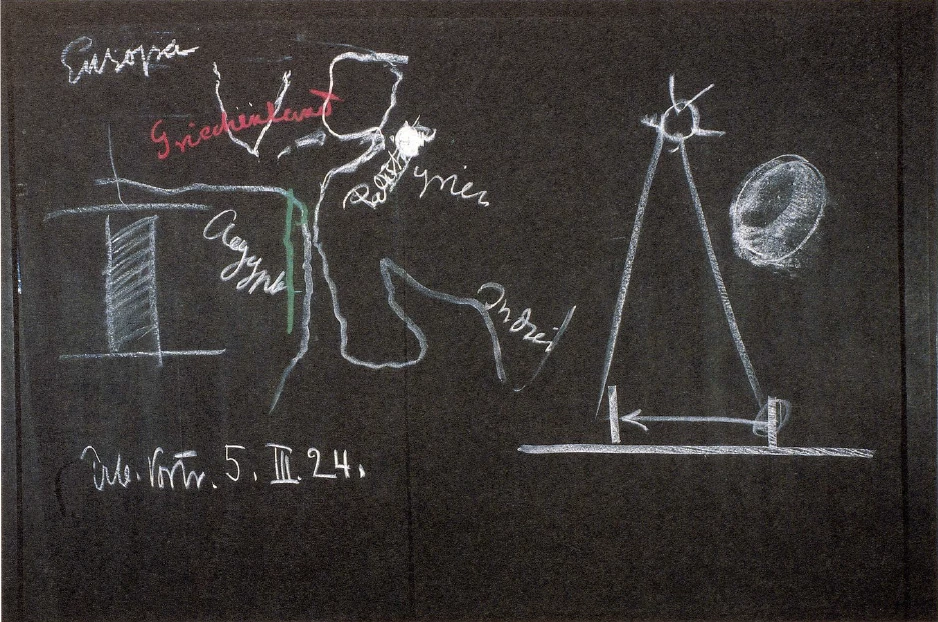
[ 18 ] Yes, but one really has to say: It’s a good thing for humanity that these things aren’t all too widespread; just think, if your mind were capable of perceiving everything that one person or another thinks or says—especially bad things—about you, for example, that would be a terrible situation! Isn’t that right? You know, when you have a telegraph machine, the setup has to be in place first—the wire has to be connected—before the transmission can take place. Similarly, with wireless telegraphy, this part here has to be in order—it mustn’t be disconnected (pointing to the diagram)—then the transmission takes place. Well, generally speaking, a fully healthy person isn’t connected to all the currents that are flowing there; they are disconnected; but in specific cases, it can certainly happen that one is connected to something.
[ 19 ] So let’s take an example—I can’t really go into detail about your specific case for good reason, because you probably don’t know how well-documented it is; but I’ll discuss something similar, and then you’ll be able to understand this as well. I always want to talk only about things that are absolutely well-documented, because otherwise it’s very easy to slip into mere idle talk. You probably didn’t experience the case yourself, but read about it or heard it recounted? So I want to address only what is well-documented. Suppose: A woman, let’s call her A, had an argument during her pregnancy with a woman, let’s call her B, who lives in the neighborhood. It does happen, doesn’t it, that people argue with one another. Now, perhaps this woman B, who lives in the neighborhood, cursed woman A particularly vehemently, and woman A was terribly frightened while woman B was ranting and raving. As a result, the child who is then born may develop a certain dependence on Woman B, but Woman B may also develop a certain dependence on the child, and it can indeed happen that the child becomes receptive to whatever Woman B gives him—such as undergarments or the like—when she washes him. On the other hand, however, it may also be important for Woman B to receive underwear; because she feels a little remorse for what she did to Woman A, she needs something from that household to constantly reassure herself; and the moment that is taken away from her, she tries every possible means to obtain it. People may, by wanting to obtain such things—even though they are not thieves by nature—end up stealing all sorts of items. They become thieves only for these things; they do not steal otherwise, but will go to great lengths to obtain them. Then it can indeed even happen that, when it is taken away from them—because mental and emotional influences are already affecting the person’s health—they waste away from a kind of inner emaciation, a wasting fever, and die, or, let’s say, die from a heart attack or a nervous breakdown. That is certainly possible.
[ 20 ] So one can say: These things happen in the world, and they can also be explained, because—even without a physical connection—one person can certainly exert an influence on another under certain circumstances. But one must always be able to identify the cause. In the case you mentioned, there may have been an entirely different cause. But if, for example, there had been a quarrel between the two women during the pregnancy, that could be the reason why an intervention between this woman and the child took place later on. Well, gentlemen, it was requested that I speak a little further about what I explained the other day. I have shown you how, in ancient India—at a time that may have been four to five thousand years ago—people lived under entirely different circumstances. And it was precisely through this particular Indian character and the way the peoples lived together that these ancient Indians developed their view of the physical human body.
[ 21 ] The Egyptians, on the other hand, whose land was entirely under the influence of the Nile—who, so to speak, owed everything they were to the Nile—developed the concept of the human etheric body because this led people to become aware of the ether as well.
[ 22 ] The people living in Assyria and the Babylonians developed a visual conception of the astral body because, due to the particularly pure air and the high altitude, the stars were easily observable at certain times of the year.
[ 23 ] And the Jews, who in earlier times were actually forced to wander, who were not initially settled anywhere but only became settled later, who thought and felt more from within human nature itself—they developed the concept of the human “I.”
[ 24 ] Thus, the concept of the physical body, the etheric body, the astral body, and the “I” gradually took shape. You see, the word Yahweh means nothing other than: “I am the I-am.” That is the literal meaning of the word. Since Yahweh is regarded as the supreme God, this confession of faith in the supreme God clearly points to the human “I.”
[ 25 ] If we trace the course of history, we find that all these peoples have, in fact, expressed in their thoughts and feelings what they have experienced. The Indian experienced a fertile, rich natural world—where everything is in a state of constant blossoming and growth: a rich, luxuriant nature. He therefore perceived the richness of the physical world particularly keenly, and accordingly, based on his observations, he developed a distinct view of the physical body. The Egyptian, on the other hand, saw that only the Nile, which is visible, helps him; he therefore developed the doctrine of the ether, and so on. But all these people have, in fact, developed everything based on what they have experienced.
[ 26 ] Opposite this lay another people. We can say (a sketch is drawn): Here is ancient India, here is Arabia; here, then, is Egypt, where the Nile flows. Now we move over here, and here we have a land facing Africa that then adjoins Europe. Here, as I told you last time, would be Assyria; here, Egypt; here, India; here would lie Palestine, where the Jews were settled; and here we have Greece. In this Greece, peoples settled who had immigrated from the most diverse regions of Asia and Europe and who thus intermingled there. They had already encountered indigenous inhabitants when they immigrated, but the Greek people gradually took shape on this peninsula of Europe. This Greek people was, in fact, the first to—one might say—open its eyes and actually see something of the world that was not merely experienced from within. The Indians experienced nature from within; the Egyptians experienced the effects of the ether; the Assyrians experienced the astral body through the stars; the Jews experienced their “I.” The Greeks, as I have already said, were actually the first to turn their eyes outward and look at the world. The others, in fact, did not really look at the world. So one can say: A view of nature was not particularly developed among the Indians and the Egyptians, nor among the Babylonians and the Jews; they did not know much about nature because they did not open their eyes and look out. It was only among the Greeks that a view of nature emerged, precisely because the Greeks opened their eyes and looked outward. And so it was in Greece that human beings first became aware of the external world.
[ 27 ] You see, the Indians understood this quite well: This physical world here is a part of the whole world, and at birth I emerged from the spiritual realm; after death, I return to it. The Egyptians did believe that mummies had to be preserved so that the person could return; but they also focused particularly on the spiritual realm. The Babylonians saw the will of the spirits in the starry sky they observed, in the astral realm. So they, too, believed in spirits. And as for the Jews, you know that they held the view that Jehovah, Yahweh, would lead them back to those ancient times when the forefathers lived. So, essentially, they, too, focused on that which connects human beings to the spiritual world.
[ 28 ] Things turned out differently for the Greeks. The Greeks were actually the first to grow fond of the external world. Earlier peoples did not care much about the external world. The Greeks cared deeply about the external world; and there is a Greek saying that goes: “It is better to be a beggar in the upper world”—that is, in Greece, on Earth—“than a king in the realm of shadows,” that is, among the dead. So the Greeks, above all else, came to love the world and, as a result, were the first to develop a view of nature.
[ 29 ] Other peoples, for example, have developed a view of humanity. The Indians, in particular, already had a certain view of humanity in the earliest times. But they did not arrive at this view of humanity by bringing dead people into the dissection room and cutting them up! If the Indians had had to do that, they would never have developed their view of the human being. Rather, they sensed—in the individual parts of the human body (which was still possible in those days)—how the liver and the lungs function. They knew this through inner insight. This is precisely what led the Indians to their great wisdom: that through inner perception and feeling they knew how the liver functions and so on. Today, people only know how a piece of meat tastes in their mouths. The Indians knew how a piece of meat behaves in the intestines, what the liver and the gallbladder do, through inner experience—just as people today sense the pieces of meat they eat in their mouths.
[ 30 ] The Egyptians developed geometry because they needed it. They had to determine the location of their fields time and again; after all, the Nile flooded everything every year. That’s also something you come up with off the top of your head. The Babylonians developed astrology, the study of the stars—again, something unrelated to the earthly realm; they had no strong interest in earthly matters. And the fact that the Jews have no strong interest in the earthly is evident in how the Jew has everything except an actual interest in what is in the sensory world around him; he can think well, but he has no real interest in what is in the sensory world around him.
[ 31 ] The people who take the greatest interest in what surrounds them in the sensory world are the Greeks. If one investigates, it is interesting to discover that they viewed the entire world differently than we do today. That is very interesting. Today we see the sky as blue. The Greeks did not have the same impression of the color blue as we do; rather, they saw the sky as much darker, almost blackish, with a slightly greenish tinge. They perceived the color red with particular intensity. With our muted perception of red, we can no longer even form a mental image of the powerful impression the color red made on the Greeks! Precisely because the sense of blue has gradually developed in humanity, humanity has in turn moved away from the sensory impression. So the Greeks first grew particularly fond of what existed outside of themselves. And through this, the Greeks developed in a very special way what we today call mythology. The Greeks worshipped an entire pantheon of gods: Zeus, Apollo, Pallas Athena, Ares, Aphrodite; they saw gods everywhere. They worshipped an entire world of gods because what they loved as external nature still appeared to them everywhere as animated and imbued with spirit. It did not seem as lifeless as it does to us, but rather, everywhere, it still appeared to them as animated and imbued with spirit. Thus, in nature itself—which they had come to love—they worshipped the gods everywhere.
[ 32 ] As a result, however, during the Greek era, precisely those people who had become dependent on Greek civilization, Greek culture, and Greek spiritual life forgot what the Indians, the Egyptians, and the Babylonians had actually experienced in the spiritual realm.
[ 33 ] Now, gentlemen, you surely know just how great an influence Greece has actually had on the entire development of humanity. That influence continues to this day! Anyone who can send their son to high school today still has him learn Greek. But that used to be much more widespread. In the past, you were, so to speak, a fool if you didn’t know Greek, or at least couldn’t read the Greek writers and poets. Greece has had an immensely strong influence on the world because it was the first to take an interest in this external world.
[ 34 ] Now, while this interest in the outside world was developing in Greece, something significant was taking place over in Asia: the Mystery of Golgotha developed from there—that is, at a time when Greece had already been conquered and everything was, in fact, already under Roman rule. But what does this Roman rule mean? It was, after all, completely imbued with the Greek spirit. The educated Romans had all learned Greek, and anyone who was educated in Rome could speak Greek. Greek had gained the greatest influence everywhere. So while Greek culture was spreading in this way, over in Asia, in a Roman province that was actually little known—that was Palestine at the time; the Jews had been subdued, and Palestine had become a Roman province—a man had appeared, Jesus of Nazareth, who said something entirely different from anything people had ever said before. And you can imagine that, because he said something so extraordinary, he was not immediately understood by others either. That is why, at first, he was understood by only a few.
[ 35 ] What, in fact, did this figure of Jesus say when he appeared in Palestine? Well, this figure of Jesus said, in the way he was able to express it at that time: Yes, people today—that was the “today” of that time—believe everywhere that human beings are earthly beings. But that is not the case. Human beings are beings who originate from the spiritual world and who, when they die, return to the spiritual world. — Today, when Christianity has been active for nearly two thousand years, it is surprising that such a thing was said back then. But that was simply not the case at the time. Asian and African mental images of the spirit were little known and not widely held in Greece. There, people were more oriented toward the material world. And that is why what Jesus of Nazareth initially taught was of such immense significance, particularly in contrast to the secularized Greek culture as it existed in Rome.
[ 36 ] But in doing so, he would have done nothing more than revive what earlier peoples—the Indians, the Egyptians, and so on—had already said. It would have been nothing more than a revival of what I have just told you; it would have been nothing more than a return of what was already there. But that Jesus of Nazareth did not merely rehash what was already there; he also said the following. He said: “Yes, if today I had listened only to what people could tell me, I would never have come to the teaching about the Spirit, for people in reality no longer know anything about the Spirit. This came to me from beyond the Earth.” - And so he became aware that he was not merely Jesus, but that a being had dawned within his soul—that being was the Christ. Jesus, for him, was the one who was born on Earth from his mother’s womb. The Christ was the one who flowed into his soul only at a later time. Through this, the truth dawned in his soul that human beings are of a spiritual nature.
[ 37 ] Now we must ask ourselves: How were the various ancient teachings preserved in India, Egypt, Babylonia, and also among the Jews? If you look around at intellectual life today, you will find the Church on one side and the schools on the other. At most, the leaders of the Church argue with the rulers of the schools over how great the influence of one on the other should be; but the two are separate from one another. This was not the case among those ancient peoples—neither among the Indians, nor the Egyptians, nor the Babylonians, nor even among the Jews. Everything that was connected with religion in those days was at the same time connected with the schools; church service and school service were one and the same. Much of this has, of course, carried over into our own time; but it is no longer as it was in ancient times, when the priest was also the teacher. The priest was the teacher in India as well as in Egypt, Babylonia, and so on. The priest was the teacher. And where did he teach? Well, he taught where worship was performed, where the religious rites took place. The cult was, in fact, completely intertwined with teaching. These were the mystery temples. There were no separate churches and schools; rather, there were such places—such institutions—that served both purposes at once, and which we today call mysteries. But everywhere there was the view that one must be cautious with everything that could be learned there.
[ 38 ] You see, gentlemen, that was an old way of thinking: that a person is only ready for it once they have acquired a certain kind of knowledge. That has been completely lost today. And so, everywhere, those who held the highest office in the mysteries were called the “Fathers.” A remnant of this remains, for example, in the Catholic Church, where certain priests are called “Patres,” or “Fathers.” In ancient times—among the Indians, the Egyptians, the Babylonians, and so on—everywhere those who were actually initiated into the knowledge, who possessed insight, were called the “Fathers.” And when these Fathers had taught those who had been admitted—those whom they believed they could bring to maturity—they would then, just as they themselves had been called “Fathers,” call them “Sons.” And all the other people who were not admitted to the mysteries, who were not accepted, were called the “children” of the Fathers; or they were also referred to as sons and daughters. Now, you can understand that a certain view developed here. This view consisted in the fact that people—who were much more devout back then than they are today—truly regarded those who were part of the Mysteries as their fathers in a spiritual sense; they gladly regarded them as their fathers, as their spiritual fathers. And above all, they believed that these spiritual fathers were in closer communion with the gods than they were on the outside; those on the outside first had to receive the message, the revelation, from the fathers. And so, gradually, people became heavily dependent on the fathers. The state of affairs that the Catholic Church today, I believe, would very much like to reestablish was, in ancient times, simply a matter of course. It was like this everywhere. No one rebelled against it. People simply said: If one wants to be truly human, then one must either be a father oneself—in which case one communicates directly with the gods—or one must learn something about the gods from the fathers. —One is thus human insofar as those who are in the schools, in the mysteries, tell one something. This gave rise to the distinction between children of the gods and children of men, sons of the gods and sons of men. Those who were part of the mysteries were called the sons of the gods, because they, in turn, looked up to the gods as to fathers. But those who lived outside—to whom only what was taught in the mysteries was proclaimed—were called the children of men or sons of men. And so people were distinguished into sons of God and sons of man or children of man. Today this even seems ridiculous to people, but back then it was quite natural. Today, people do make such distinctions—though not exactly in Switzerland, but I don’t know if something similar still has a little foothold there; but certainly in neighboring countries—it has largely ceased now, but not so long ago, people distinguished between Their Excellencies and ordinary people, between barons and ordinary people; this was taken for granted. But in ancient times, it was simply a matter of course that a distinction was made between sons of the gods, children of the gods, and children of men.
[ 39 ] The one who then called himself Christ Jesus—the one who was so called—said: One does not become a Son of God, a child of the Spirit, through another human being, but each person becomes so through God Himself. The only thing that matters is becoming aware of this. The old man said: “The Father of the Mysteries must bring this to one’s consciousness.” — Christ Jesus said: “One already carries the seed of the divine within oneself, and if one makes the right effort, one can bring it forth from within oneself.”
[ 40 ] Damit aber hat der Christus Jesus dasjenige gelehrt, was die Menschen über die ganze Erde in der Seele gleich macht. Und der größte Unterschied, der durch den Christus Jesus überwunden worden ist, das ist der zwischen Göttersöhnen und Menschensöhnen.
[ 41 ] People then misunderstood this in all sorts of ways—the ancients because they did not want the distinction between the sons of the gods and the children of men to be lost, and later generations because they no longer knew at all what was meant by it. Just as later generations no longer understood the meaning of “Fasching,” they also no longer knew what was meant by “sons of God” and “sons of man.” Consequently, the notion that Jesus Christ is sometimes called the Son of God and sometimes the Son of Man has continually crept into the Bible, into the New Testament, whereas all the passages that speak of the Son of God and the Son of Man actually mean that both terms can be used interchangeably; that is why they are used alternately. But if one does not know that this is what led to it, one cannot truly understand the Gospels. And today they are actually misunderstood in a very negative sense, precisely by those who profess to believe in them.
[ 42 ] With this, you have emotionally depicted what actually came into the world through Christ Jesus. And if I first address the external aspects today, I must say: You see, there were also other great differences among people everywhere. One need only think of ancient India. There, distinctions were made, much like those among animals or animal classes: the Brahmins, the priests, the peasants, the laborers. The Egyptians, in turn, had a whole host of slaves. The castes were not so strictly demarcated from one another, but they did exist in a certain sense. Indeed, even in Greece and Rome there was a distinction between freeborn people and slaves. These external distinctions have been erased from history in more recent times only because the distinction between the children of the gods and the children of humans has been erased. Thus, what happened through Christ Jesus in Palestine has exerted an immense influence on the entire social life of humanity.
[ 43 ] But now one can indeed ask about everything: Is it really the case that we can determine where exactly the spiritual enters human beings from outside the Earth?—You see, it is actually very difficult to speak about this today, because nowadays everything is viewed solely from a materialistic perspective. Take language, for example. As you know, different languages are spoken in different regions and countries around the world; yet all languages share a hidden similarity. This similarity need not be as striking as, say, between German and English, or German and Dutch. Nevertheless, it is true that languages, despite their differences, do share a certain similarity. One may find, for example, that the language spoken in India—even if one does not understand it right away—when one looks into it, the individual word forms are similar to those of the German language, for instance.
[ 44 ] Now, what do the people who want to explain such things today have to say? They say: Well, such a language originated in one place on Earth—since everything is supposed to come from the Earth—then the peoples migrated, carried the language somewhere else, and there it changed somewhat. But it all derives from a single language.
[ 45 ] This is the greatest scientific superstition to have emerged in modern times. For you see, gentlemen, this scientific superstition is exactly like the following scenario: Imagine a person living in India who feels warm when the sun shines. Well, this gives rise to the view: People can get warm. — Later, people in Europe discover that they, too, get warm in the summer. They, too, get warm. Now they do not rely on their reason, but on their senses. They say: The fact that one gets warm cannot be explained by the present; but in ancient India, people got warm; they emigrated to Europe and transplanted the ability to get warm to Europe. - Yes, gentlemen, if someone says that, he is of course crazy. But the linguists say the very same thing! They do not say, when a language in Europe resembles a language in India, that the same influence from outside the Earth was at work in India as in Europe; rather, they say: the language migrated here! If a person in two different regions becomes warm, one would not say that he brought the property of becoming warm here through migration, but rather one looks to the common sun, which warms both the person in India and the one in Europe. If one finds two languages that are similar to one another in distant places, this does not stem from the language having migrated there, but rather from the fact that the common influence—just as the influence of the sun is present throughout the entire Earth—the common influence from beyond Earth acts upon the peoples of the most diverse regions of the Earth. But because people absolutely refuse to admit that an extraterrestrial influence exists in the spiritual realm, they concoct all sorts of things—things that one does not realize are crazy simply because they are presented as scholarly. If people were not afraid of being considered crazy, they would deny everywhere that the sun provides warmth; instead, they would say: In primeval times, the property of becoming warm arose once, and that has spread across the entire Earth. - They would deny the sun’s influence if that weren’t considered crazy! - This is something one must take into account if one wants to understand the origins of Christianity.
[ 46 ] It’s already too late today to continue this discussion; we can talk about it next Saturday.