

Human History and the
World Views of Civilized Nations
GA 353
8 March 1924, Dornach
Translated by Steiner Online Library
3. The Arrival of Christianity in the Ancient World and the Mysteries
[ 1 ] Good morning, gentlemen! So today I will continue with the discussion we began. You surely understand the situation quite clearly: over there to the east is Asia. In ancient times, people came from Asia to Europe, to Greece, traveling directly along a whole chain of islands. So here’s how it was (drawing follows): Asia ended here; here it crossed over to Africa; there was the Nile, which I’ve told you a lot about. Here is Greece, here is the Adriatic Sea, and here is Italy, and here is the island of Sicily. So here there would be a number of islands—Samos, Rhodes, Cyprus, and so on—and people traveled from Asia to Greece via these islands. Here would be Greece, here the Roman Empire, which is present-day Italy.
[ 2 ] Now, gentlemen, you must really take the following to heart. You see, in Greece—starting, one might say, around 1000 or 1200 B.C.—everything I have told you about developed, and through this, people learned to view the world. But as early as the 4th and 3rd centuries B.C., so to speak, Greece gradually lost its dominance, and power shifted to Rome. That was, after all, the capital. — What had happened was that, in the earliest times, more and more Greeks—those who were more or less dissatisfied in Greece—emigrated and settled here, both in Sicily and here in Southern Italy. As a result, over the course of half a millennium—four to five hundred years—Greek culture spread all the way over, so that Southern Italy and Sicily were called at that time: Magna Graecia. In fact, the ancient Greek homeland was referred to simply as “Greece,” while the other region was called “Greater Greece.” It wasn’t just the discontented who went there; people like the great philosopher Plato, who wanted to establish an ideal state there, also went. And, in fact, the most important figures who shaped that culture lived in Southern Italy. And it must be said: Here in Southern Italy, in the south, there was a refined, cultured way of life, while from above, the brutal rule—later known as Roman rule—spread.
[ 3 ] As you know, Rome’s original population came into being in a very peculiar way: chieftains—among whom the name Romulus has become particularly well-known—gathered together all the scoundrels in the surrounding area. All the ruffians from the surrounding area were summoned to Rome, and it was with them that the first Roman state of bandits was originally formed. This bandit mentality then continued under the first Roman kings. But very soon—already under the fourth and fifth kings—the settlement and immigration of a northern tribe, the Etruscans, began to make itself felt. These were, in turn, people—one might say—who then intermingled with the descendants of the bandits, and through this, a more humane trait found its way into Roman culture. But everything that later actually laid the foundation for Rome’s world domination—everything that has carried over into our own time in humanity’s lust for power—actually stems—and we must not delude ourselves about this—from this original colony of scoundrels, which was founded on the seven hills of Rome. It’s just that all sorts of things have been layered on top of it; the whole thing has, of course, been terribly refined, but one simply cannot understand how it all unfolded later on unless one knows that an original colony of bandits had been gathered there from the forests. From this, too, sprang all the lust for power and the like that spread throughout Europe and still play such a major role today. What also took shape in Rome was the process that increasingly intertwined the Church with secular rule. And that gave rise to the Middle Ages and so on.
[ 4 ] Well, you see, at the beginning of our era, the Mystery of Golgotha took place. As I have just described to you, Roman rule was established in the 8th century B.C. At that time, then—seven centuries after the establishment of Roman rule—that rule had spread far and wide, encompassing entire regions all the way to Asia. Even in the place where the Mystery of Golgotha took place, Roman rule was widespread. The Jews living in Palestine, among whom Jesus of Nazareth appeared, were also under Roman rule. After all we have said about the Mystery of Golgotha, it would be good to also give some consideration to what has actually been taking place on the Italian Peninsula since the earliest times.
[ 5 ] It is indeed the case that one must say: Europe really only understands what dates back to Roman times. Our so-called educated people have, to be sure, always studied Greek, but very little of Greek culture has actually been understood in Europe. You see, it is very interesting that a hundred years after the Mystery of Golgotha took place, one of the most significant Roman writers, namely Tacitus, wrote a single sentence about Jesus Christ in his extensive historical works! This Tacitus, in a style that later writers were simply unable to emulate, described, for example, the ancient Germanic tribes—the ancestors of the Germans—one hundred years after the Mystery of Golgotha. In his writings, there is only a single sentence about Christ Jesus, which reads: “The so-called Christ founded a sect among the Jews and was then executed following a court verdict.” - That is all the educated Roman Tacitus said, one hundred years after Christianity was founded in Palestine! So you can imagine: Ships were constantly sailing back and forth; all manner of commercial relations—and indeed, spiritual connections as well—had developed; and yet, a hundred years later in Rome, the only mention made of Christianity was this brief note stating that a sect had been founded there and that its founder had been executed following a proper judicial verdict!
[ 6 ] Well, what must be added, however, is that among the Romans—even though the Roman Empire cannot yet be called a state (the proper concept of the state did not actually emerge in Europe until the 16th century)—there was, I would say, already a sense of statehood. In fact, what later became a sense of statehood grew out of Roman culture. So one can say: Tacitus was already so imbued with this sense of statehood that what struck him as most important about Jesus Christ was that he had been executed following a proper judicial verdict. That is one thing.
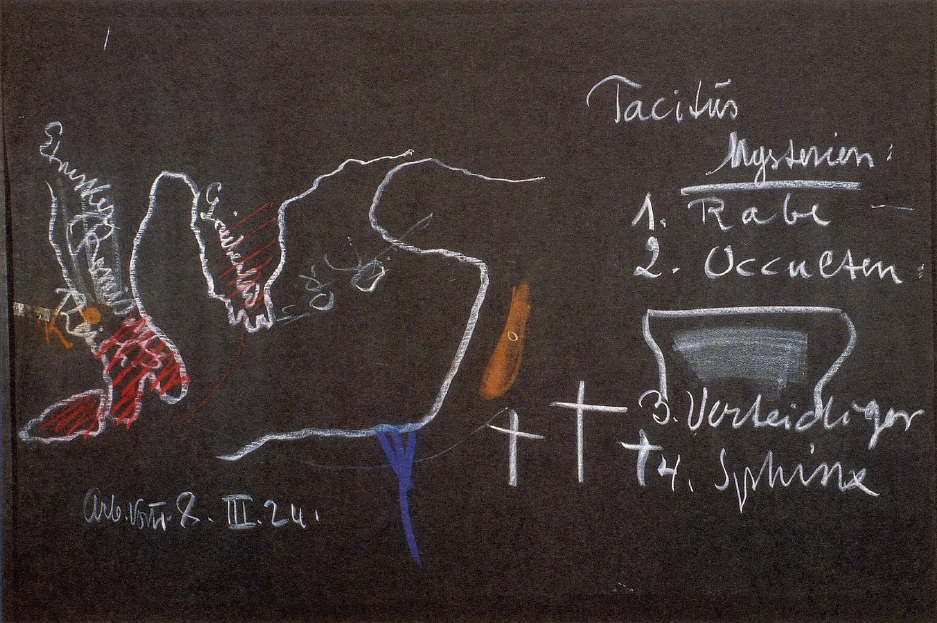
[ 7 ] But then you must consider this: Christianity was by no means, in the beginning, what it later became. Christianity originally had a truly free spirit. And one can certainly say: There were a wide variety of views, all of which agreed only in that they saw something special in Christ Jesus; but otherwise, they held the most diverse views.
[ 8 ] Well, gentlemen, you will only understand what it actually means that Christ Jesus came into the world, and why it was ultimately necessary for me to point out to you how the Earth’s environment influences the Earth, even in language, you will only understand it if I now try to show you how Christianity actually took shape as a doctrine, a perspective, a worldview, and a way of life—and how Christ Jesus intervened in the formation of Christianity. It is, after all, quite remarkable to observe: Christianity is founded there in Jerusalem; a hundred years later, even the most educated Roman knows no more about it than what I have told you! But people are now constantly migrating from Asia through Africa to Italy. And beneath the surface, so to speak, of what is regarded as humanity in Rome, this Christian sect is spreading. And when Tacitus wrote what I told you, the Christians—the “Christianers,” as they were called—had long since been present among the common people in Rome, a group that a distinguished Roman paid no attention to.
[ 9 ] But what did they do with the Christians? Well, you see, the descendants of Romulus, the bandit, had eventually reached a point where they had become “well-educated.” Namely, their “civilization” consisted, among other things, in building large arenas where fights with wild animals took place. People took great pleasure in throwing those who were not considered human in the Roman sense to the wild animals and in reveling in watching them get devoured after first having to fight them. That was a “refined” pleasure, for example. Well, the despised sect of Christians was particularly well-suited to being devoured by wild animals, given that people in Rome thought the way I have indicated to you; they were also particularly well-suited to being coated with pitch so that they could be set on fire and then viewed as torches in the circus. But the Christians found ways to survive nonetheless. And they were able to do so by holding their ceremonies and the like in secret. Whatever they considered right to spread, they spread underground, in the catacombs. Catacombs are vast underground chambers. In these vast underground chambers, the Christians buried the dead whom they loved. There were the graves, and on top of the graves, the religious services—the liturgical rites—were held. - It was a common custom at the time to hold liturgical services above the graves. That is why, even today, when you look at an altar in a Catholic church, you can see that it is, in fact, a burial site (it is depicted), and inside it there are, for example, so-called relics—the bones of saints and so on. In the earliest times, the altar was actually a real gravestone, and liturgical rites were performed on it. But underground, in these catacombs, Christians in the first centuries were able to conceal what they had to do.
[ 10 ] And if you look a few centuries later, the picture changes quite significantly. Here’s what happened. You see, in the first few centuries after the founding of Christianity, the Romans were up above, revelling as I’ve told you, while down in the catacombs were the Christians. After a few centuries, the Romans had disappeared, and the Christians assumed world domination. Whether they did better or worse, we’ll discuss that on another occasion; but they assumed world domination. And that is precisely what has done the greatest harm to Christianity—that it became linked to world domination; for religious life, in the course of world history, is increasingly unable to tolerate this entanglement with external state and world domination.
[ 11 ] The matter is this: The formation of Christianity—and the role of Christ Jesus in that formation—can only be understood if one knows what religious life, which permeated absolutely everything, was like in ancient times. As I have already told you, in ancient times there were the so-called Mysteries. Well, you see, the Mysteries—if I were to use a modern term, one might call them “institutions”—the Mysteries were the institutions where people learned everything a human being could possibly learn. But they were at the same time religious institutions and artistic institutions. All spiritual life sprang from the Mysteries. And learning in the earliest times was not like it is today. What, after all, is learning like today? Learning today is such that—isn’t it true—one is drilled in high school or middle school; afterward, one goes through years at the university, and yet one has not become a different person as a result. But in the Mysteries, there one became a different person. There, one had to develop a different relationship to the whole world. In the Mysteries, one had to become wise. Today, through the institutions that exist in the world, no one becomes wise at all; at most, one becomes learned. But two things are compatible with one another, and two things are not compatible: wisdom and stupidity are not very compatible, but learning is very compatible with great stupidity. So that is one thing: In the ancient Mysteries, people were indeed made wise; one became a person imbued with the spiritual. One became a person who could take the spiritual seriously. And one had to pass through seven stages. Very few people reached the highest stage. These seven stages had names that one must first understand in order to know what the people on these stages were supposed to do.
[ 12 ] If one translates what the person who was first initiated into the Mysteries was supposed to do, one arrives at the term “raven.” So the first level consisted of the so-called ravens. So whoever was initiated into the Mysteries became a raven. What was the raven’s role? Well, the raven’s task was, above all, to facilitate communication between the outside world and the Mysteries. After all, there were no newspapers back then. The first newspapers didn’t appear until millennia later, when the art of printing was invented. Those who taught in the Mysteries had to rely on trusted individuals whom they could send out to observe the world. So one could also say that the Ravens were simply the trusted representatives of those within the Mysteries. And the first thing one had to learn was how to truly be a trusted representative. Today, many people—especially in political parties and the like—are hired as trusted representatives, but one wonders whether these representatives are always trustworthy! Those who were appointed here—in the mysteries—as ravens were only regarded as trusted representatives once they had been tested. Above all, they had to learn to take what they saw very seriously and to report it truthfully within the mysteries. So in those days, one also had to first learn what the truth actually means in a human being. One can certainly say: People in antiquity were no less dishonest than people are today. But today, dishonesty permeates everything; back then, however, one first had to learn to be a true human being. And one had to master this by spending years as a raven, a trusted representative of the Mysteries.
[ 13 ] The second stage, now, is something that is quite unappealing to people today: the second stage is that of the so-called “occultists.” “Occult” means hidden, secret. They were no longer sent out; instead, for a certain period of time, they had to learn something that modern people do not like to learn—namely, silence. And learning silence was a stage of instruction in these ancient mysteries. Yes, it will seem quite grotesque to you, quite ridiculous, that one had to simply remain silent for at least a year—or even longer! But it is true. Through silence one learns an immense amount; one learns an incredible amount through silence. Today, of course, that is no longer feasible. Just imagine, if it were mandated in our schools—which would actually be quite useful for attaining wisdom—that young people between the ages of eighteen and twenty spend a year in silence instead of joining the military, then they would indeed become incredibly wise through this silence! Yet that can no longer be done today. But something else is indeed feasible. Certainly, you can’t break people of this habit; they don’t want to be silent today, but rather to chatter, and everyone knows everything very well, and when you meet a person today, the first thing they have is what is called a point of view. Everyone has a point of view. Of course, everyone has a point of view; but from every point of view, the world also looks different, and that is nothing new to those who know life—it’s perfectly natural: If you stand here, this mountain looks different than if you were standing over there. It’s the same in spiritual life. Everyone has their own point of view, and everyone can see something different. And when a dozen people are together—well, today they naturally have thirteen opinions! That’s not necessary. But the fact that they have twelve points of view shouldn’t surprise anyone; you just shouldn’t take it so seriously. But everyone usually takes their own point of view very seriously—terribly seriously! In the past, however, people in the Mysteries were simply required to remain silent about what they were to learn; they were allowed to be nothing more than listeners. In the occult, they could only be called “listeners” because they had to listen. Today, in fact, those who come to our universities—with the “Zu” omitted—are called “listeners,” no longer “students.” But they are often no longer listeners; rather, they are chatterers. And some even consider chatting with their peers to be far more important than listening in the lecture halls. Sometimes, even listening no longer inspires a sense of particular seriousness. - Well, that was the second stage. There, people could learn silence. And in silence, it becomes particularly clear—as cause and effect are interconnected—that a person’s inner self begins to speak to them. That’s when a person realizes it. Imagine you have a basin of water; if you now attach a hose and drain the water from the basin, then the water simply flows away—if it is not a spring but only a basin—and there is nothing left inside. And so it is when a person chatters incessantly: everything flows out along with the words, and nothing remains inside. The ancients understood this, and that is why their listeners were initially required to remain silent. So, after people had become accustomed to valuing the truth, they learned silence; only then did they learn silence.
[ 14 ] And the third stage was the one that, if translated, could be called the “Defenders.” Now the people were allowed to begin speaking. Now they were allowed to defend the truth they had learned in the Mysteries through silence. Specifically, they were charged with defending the Spirit. “Defense” is indeed a word that can already be used for this third stage. Those who belonged to this third stage had to know enough that what they said about the spiritual realm carried weight—real weight. Thus, one was not simply allowed to speak about the spirit in these mysteries; one first had to have learned it and become a true defender. Then one ascended to the fourth stage.
[ 15 ] The fourth stage can be translated as “Lion.” That is how it is usually translated. It would be even better to translate it as “Sphinx.” Sphinx is a word that roughly means to have become a spirit in one’s own right. Of course, one still walks around in a human body, but among humans, one behaves as gods behave. The people of antiquity did not make a great distinction between humans and gods; rather, in the mysteries, one gradually became a god. That is the immensely freer perspective of the ancients. Modern people, however, see the gods as standing above humanity everywhere. But that was not the view of the ancients. Today people say: Well, humans are descended from apes. — The famous naturalist Du Bois-Reymond even went so far as to say that there was once a huge leap in natural evolution between the great ape and humans—a huge leap even in the enlargement of the brain. The brain suddenly became larger than that of the great ape. - You see, that’s a strange statement from a modern scholar! For one would actually have to assume that, if he says the brain of modern humans is much larger than that of the great ape, he must have dissected a great ape and known how large its brain was. But if you look it up again, you’ll find that these scholars had to say: The great ape hasn’t actually been discovered yet! —So the famous naturalist Du Bois-Reymond spoke about something that hadn’t even been discovered yet, something no one had ever seen: the great ape, which still has a much smaller brain than humans. With such “conscientiousness” is science conducted today. And people don’t even stop to think that the famous naturalist Du Bois-Reymond is talking about something he has never seen, but instead they think: “Oh, that’s the famous naturalist—he knows everything!”—for humanity today is far more gullible than the ancients were.
[ 16 ] Well then, the ancients certainly believed that human beings can develop to the point of divine consciousness.
[ 17 ] The one who was on the fourth level—who was a sphinx—no longer spoke like a defender of the third level, but spoke in a language in which he expressed himself in such a way that it was actually difficult to understand him; one first had to think about how to interpret him. It is difficult for people today to form a mental image of this language spoken by the sphinxes, because they no longer view the matter in the same way it was viewed back then. But even in the Middle Ages—for example, as late as the 17th century, which was only two hundred years ago—there was still something remaining in the form of a tradition of that language. For example, back then—two centuries ago—there were so-called Rosicrucian schools. There, certain initiates also spoke in a language that was somewhat veiled and had to be studied first; specifically, they spoke in a figurative language. And so, for example, even two centuries ago, you’ll find an image—which might interest you—that was meant to explain something to people everywhere. This image was (it is drawn): a human figure with a lion’s head, and next to it a human figure with an ox’s head. Among the people they sought to instruct—by expressing the relationship between these two beings—they would say, “the being with the ox’s head, the being with the lion’s head”—meaning man and woman. But they did not use the two words “man” and “woman”; instead, they said, “the being with the ox’s head”—meaning the man—and they said, “the being with the lion’s head”—meaning the woman—because they saw in the relationship between the ox and the lion something that mirrored the relationship between man and woman. Today, of course, this seems quite paradoxical and amusing to people; yet this tradition has been preserved. And the sphinxes used animal names everywhere to express more clearly and characteristically what lives within human beings. And the sphinxes spoke in such a language—you see, one in which they spoke more from the spiritual realm. So they were already such that they spoke more from the spirit.
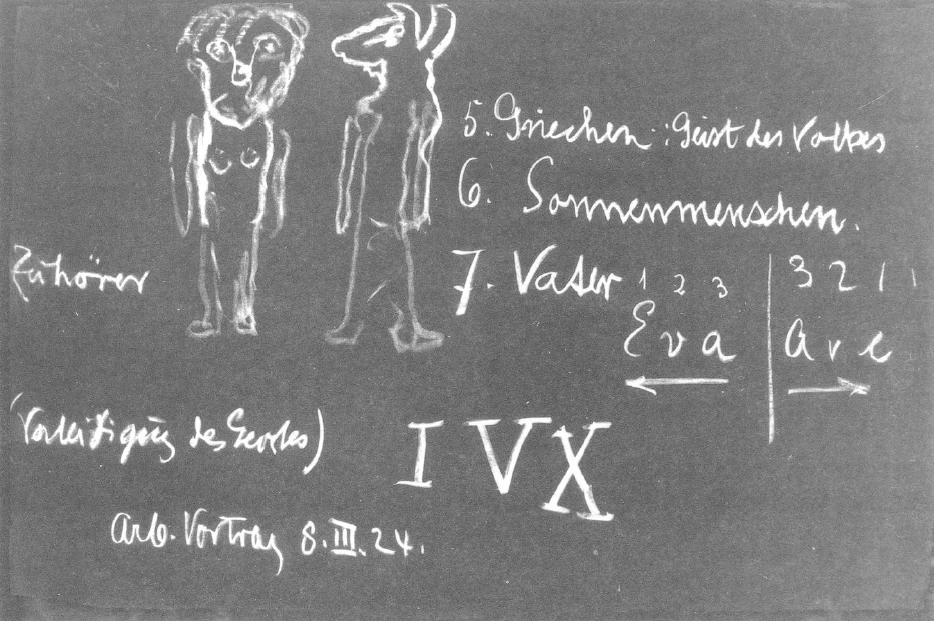
[ 18 ] But then came the fifth stage. In the fifth stage were those people who were bound to speak solely from the spirit. Well, depending on which people they belonged to, they were called “Persians,” “Indians,” or “Greeks.” In Greece, these were the first true Greeks. For people reasoned as follows: Yes, if someone belongs to a particular people, he has his own private interests; he wants this or that; he wants something different from someone who belongs to another people! Only when he has reached the point where he has ascended to the fifth stage does he no longer actually want anything specific, but rather wants what the entire people want; that is also his interest. He has become like the spirit of the people. Thus, he has become a spirit of the people. These spirits of the people—who were, in fact, in the ancient mysteries, and even in Greece, very, very wise people—did not think: “When something comes up, I’ll stand my ground and state my position; I know everything.” Rather, even though they had already ascended to the fifth stage, they prepared themselves for a long time through exercises in order to reach a judgment on any given matter. You see, if someone is a statesman today, well, then perhaps an interpellation is brought before the Reichstag, and he must respond. Just imagine if things were done the way they were back then! If the person who has to answer were to say: “I must first withdraw from the world for eight days, gather my thoughts completely, in order to form a judgment on this”—well, I’d like to know what the Reichstag parties, let’s say, would say to Mr. Stresemann or to other bodies if an interpellant were to receive the following response: “In order to form a well-considered judgment on what you have asked me, I must first withdraw for eight days!”—But that’s how it was back then. For in those days people believed in the spiritual world, and they knew: when one is caught up in the hustle and bustle of life, the spiritual world does not speak; the spiritual world speaks only when one can withdraw. - Admittedly, one can eventually develop the ability to withdraw even while standing in the midst of the world’s turmoil; but that is something one must first learn. And once one had learned it, in ancient times one ascended to the sixth level.
[ 19 ] The sixth stage was such that the person in question no longer had any earthly perspective at all—not even that of the people—but instead said to himself: “I am a ‘Greek’; my brother, the initiate over there in the fifth stage in Assyria, is an ‘Assyrian’; the one who lives further away is a ‘Persian.’ But that is all a one-sided point of view. The sun comes over from Persia to Greece; it shines upon us all. — And so those who were initiates at the sixth stage no longer wanted to learn from what a people says, but rather from what the sun says. They became “people of the sun”—no longer people of the earth, but people of the sun. You see, such “people of the sun” sought to explore everything from the sun’s perspective. People today have absolutely no concept of what was accomplished back then, because they know nothing at all about the mysteries of the world.
[ 20 ] If you want to gain insight into such matters, you need to consider the following, for example. Some time ago, a man came to me and said: “A strange book has been published; it proves that the Gospels were written according to a numerical code. Namely, whenever a certain word appears in the Gospel—let’s take the ‘beginning’ in the Gospel of John as an example: ‘In the beginning was the Word. And the Word was with God, and the Word was God”—then, if you divide the text into sections and find that one section is twice as long as the other, and each word has a numerical value: a word appears at a position where the numerical value is 50, followed by 25, then another word, 50, then another word, 25. And you can calculate what word must appear at a specific position.
[ 21 ] Now, gentlemen, it is interesting to see how such things hold true. So let’s take any word as an example—let’s say—I’ll explain it to you using a word that’s still in common use in German—let’s take the word “Eva.” Now let’s assume that the “E” has the same value as one, the “v” as two, and the “a” as three. Let’s assume that were the case. In ancient times, every letter had its own numerical value; it wasn’t just a letter—people knew, for example, that if you had an “L,” that “L” stood for this or that number. You can still see this in the Roman letters, how the numerical values are embedded within them:
[ 22 ] I = one, V = five, X = ten
[ 23 ] They are also letters, but the letters have numerical values.
[ 24 ] Let's take an example—it doesn't add up to 1, 2, 3 for Eva, but to make the point clear, we can assume it's like this
[ 25 ] 1 2 3 = Eva
[ 26 ] is the mother of all living things. Now let's turn it around:
[ 27 ] 3 2 1
[ 28 ] Yes, then we get the word “Ave,” which means the end of life. Broken down, read backward, or in reverse:
[ 29 ] Going in opposite directions, read in reverse from the back:
[ 30 ] 1 2 3 = Eva; 3 2 1 = ave
[ 31 ] So, if you change the numbers, you can find examples everywhere of how numbers and letters correspond.
[ 32 ] And so there is a numerical code. And one might say: Now let’s take a look at the first line of the Gospel of John. These are the numbers. Let’s look at the second one: there, the numbers are simply rearranged, and the fact that they are rearranged means something. - You see, people today are very puzzled by such things. But, gentlemen, I knew a man—his name was Louvier—who threw himself into the “Sphinx”: “The riddle is solved”; he analyzed Goethe’s “Faust” according to this numerical ratio, and it turned out to be correct. - Goethe never even thought of writing his *Faust* according to any numerical law. Yet it still holds true, because there is something numerical inherent in all poetry. But if you try to say something to someone and I make an effort to use a numerical code, I can apply it to what you say as well; that is already inherent in the speech itself. There is already a spiritual element at work in your speech. And that, gentlemen, is the extraterrestrial aspect: it comes from the influence of the sun. That is why these “sun people” explored the mysteries of the sun. The pyramids, for example, were certainly not built merely to serve as royal tombs; rather, the pyramids had very specific openings through which a ray of sunlight could enter only at a very specific time of year. The ray of sunlight traced a figure on the earth. These people observed this figure and drew inspiration from it. Through this, they explored the mysteries of the sun’s life. So such a person, who had become a “sun person,” could say that he no longer oriented himself at all toward earthly matters, but rather toward the sun. And then, after he had been a “sun person” for some time and had taught people what is of a transcendent nature, he was elevated to the dignity of “Father.” This was the highest dignity, attained by only a few. These were the ones who had reached full maturity, those whom people obeyed and followed. People obeyed them, first of all, because they had grown old in years—for by the time one had passed through these seven stages, one had indeed grown old in years—and they obeyed them because they possessed wisdom of life, and because they also possessed worldly wisdom.
Mysteries:
1. Raven
2. Occultist: Listener
3. Defender - Defense of the Spirit
4. Sphinx
5. Greeks: Spirit of the People
6. Sun People
7. Father
[ 33 ] Well, gentlemen, just imagine for a moment that Christ Jesus—Jesus of Nazareth—lived at a time when, over in Asia, people still knew something about these mysteries everywhere. And people still knew, for example, that there were people who proclaimed solar wisdom. And what Jesus of Nazareth wanted was for people to be enlightened not merely within the Mysteries, but outside of them as well—for it to be made clear to people: What the sun does for human beings is already present within the human being; it lies within every human being. And this is the most important thing about Christ Jesus: that he is the truth of the sun and that he teaches the “Word of the Sun,” as it was called, as something common to all human beings.
[ 34 ] Now you need only consider the great difference between Christ Jesus and the other Sun-Beings. If you do not grasp this, you will never come to an understanding of the Mystery of Golgotha. For you see, the matter is this: What did one have to do in ancient times to become a Sun-Being? One first had to become a raven, then an occultist, a defender, a sphinx, and a folk-soul—only then could one ascend to become a Sun Being. There was no other way. One had to be initiated into the mysteries. What did Jesus of Nazareth do? He was baptized in the Jordan, according to the custom of the Jews of that time; and on that occasion—that is, without having first been through the mysteries—the same wisdom dawned upon him that the Sun Beings otherwise possessed. So what could he say? He could say: “This wisdom has come to me from the Sun itself.” - He was thus the first to enter into a relationship with heaven without having gone through the Mysteries. What, then, did the one who had been a Sun-being in the Mysteries say when he looked up at the one who stood on the seventh level? He said: “Behold, this is the Father.” - He stood on the altar in a white robe, in priestly vestments. That was the Father. That was the “Father” among those who had passed through these various stages in the Mysteries. Christ Jesus had not passed through this in the Mysteries, but had received it from the Sun itself. Therefore, he said: “My Father is not on earth”—he meant, not in the Mysteries—“but my Father is above in the spiritual world.” ” He thus first pointed to the Father in the spiritual world in the most exalted sense. Christ Jesus therefore wanted to direct people—who had previously received everything spiritual from the Earth—toward the very sources of the spiritual in the extraterrestrial realm itself. That is why people have always misunderstood what Christ Jesus actually meant. For, you see, it was said, for example, that Christ Jesus taught that the Earth would now come to an end, as it was said, and that a spiritual millennial kingdom would come very soon. Today’s intelligent people, who in their cleverness sometimes want to be sympathetic toward the ancients—and toward Jesus as well—say: Well, Jesus adopted that view from his own time; he was, after all, a child of his time and simply adopted it.
[ 35 ] But everything people are saying about this is nonsense; for the Thousand-Year Kingdom has indeed come—only it did not look the way people in the world had created a mental image of it, but rather it was like this: In ancient times, people had gained insights into the spiritual world—and even had spiritual experiences—through the methods I have described to you. That was the custom in ancient times, when people were different. This came to an end during the time when Jesus Christ lived, and people had to find their way to the spirit in a different way. The spirit had to be found directly. That is what Jesus Christ did. And if Jesus Christ had not done what he did, then humanity would have completely degenerated. Life would have become meaningless. This does not contradict the fact that in later times, precisely through many Christian institutions, a great deal of meaninglessness emerged; but that was, of course, not part of it originally. And people would have become dull-witted. The mysteries would have perished just as they did; but people would have known nothing of what was taught in the Mysteries. For take, for example, the ancient Sun-Man. What was said about the Sun-Man? It was known, after all: He knows what exists from the perspective of the Sun; he has died to earthly life. When speaking of the Sun-Man, one spoke of one who had died to earthly life. And that is why, before anyone became a Sun-Man, a ceremony was always performed in the Mysteries that reenacted death and burial. And Christ Jesus presented death and burial outwardly before the whole world; and what happened with the death of Christ was, in the eyes of all the people of the world, merely a repetition of what had always taken place in the worship of the Mysteries. Only, back then it was a mystery, and then on Golgotha it stood there before the whole world. You see, it was truly the case with the Sun-Man that he had died for the Earth. But through this, he was also in between—between the passing world of death and the world of resurrection, the world of the Eternal.
[ 36 ] Sometimes things remind us of old matters whose meaning we can no longer recall. Imagine, for example, that a canonization is taking place in Rome. Someone is being canonized in Rome. It is a grand ceremony when someone is canonized centuries after their death. How does this ceremony take place? It begins with the appearance of the Advocatus Dei, the divine defender. He highlights all the good qualities of the person who is to be canonized. Then the so-called Advocatus diaboli, the devil’s advocate, appears; he points out all the bad qualities that the saint possessed. And a decision is then made between these two—I won’t say that the decision is always just, but a decision is made. The ceremony is still performed today. Whenever someone, such as the Virgin of Orléans for example, is canonized, the Advocatus Dei and the Advocatus diaboli appear. Between the one who cites all that is good and the one who cites all that is evil stands the saint himself, in spirit. You know that the image always depicted at Golgotha is this: Jesus Christ on the cross in the center, flanked by the two so-called thieves, whom people call robbers. But the remarkable thing is that Christ says to one of them: “Today you will be with me in Paradise.” So one goes up, and the other goes down. These are Lucifer and Ahriman—Advocatus Dei and Advocatus diaboli.
[ 37 ] And so it was with the ancient Sun-Man. He became acquainted with Lucifer and Ahriman—with the one who seeks to draw humanity upward into the spiritual world so that it may become entirely spiritual—which is not suitable for humanity—and with the one who seeks to draw humanity downward into the earthly realm, which is likewise not suitable for humanity, for humanity belongs to the intermediate stage.
[ 38 ] And so, through the Mystery of Golgotha, what was once confined to the innermost depths of the Mysteries—and was performed only symbolically, for one did not actually die—now stands before the whole world. There, one became a father. Christ truly dies. But he says: My spirit does not die; it goes to the Father, because the Father is not now active here below as the Primordial Father, but is active in the spiritual world. — This view has emerged entirely from the mysteries. And if one wants to understand the concept of the Father, one must seek it in the ancient mysteries. Only then can one truly understand how Christianity actually came into being.
[ 39 ] Well, you see, gentlemen, everything I have just described to you was quite common over there in Asia. That also played a role in the founding of Christianity. The Greeks knew remarkably little about it, because they had built up an external civilization. And the people of Romulus, descended from a colony of scoundrels, knew absolutely nothing about it; they knew only external world domination. They knew external world domination so well that the Roman Caesars, the emperors, even behaved outwardly as if they were initiates; but this was at a time when the mysteries had already fallen into decay. For example, there is a Roman Caesar from the very earliest imperial period named Caligula. Well, you see, a German historian once wanted to describe the German Emperor Wilhelm in the 1890s; but that was impossible—it simply couldn’t be done; one would have been imprisoned if one had written it down! So the good man wrote a little book called *Caligula*. He described the Roman Caligula, but every trait fit Wilhelm II! Anyone who understood the matter knew: Caligula—that’s our Wilhelm II; that was the only way to do it. This Caligula was, at the same time, an initiate, because everything had already become merely external. Of course, if one didn’t take it too seriously, one could understand what the ravens were supposed to do by observing what the princes themselves did. Thus Caligula had become a “sun-man,” but of course only outwardly, just as someone—well, let’s say—a “general” is, who puts on a soldier’s uniform at the age of five or six. That is how Caligula had become an initiate. He had taken only the outward form. But he was even supposed to initiate others! Then, during a ceremony in which the symbolic blow is struck with a sword against one of the sphinxes, he actually killed the person in question with the sword! But of course, that had no effect on Caesar. Among the Romans, things had come to such a point that everything had become merely external; they no longer understood any of it inwardly. No wonder they were all the more unable to understand Christianity.
[ 40 ] And so Christianity in Rome came to be under secular rule. In Rome, when Christianity first arrived, there was a secular ruler who regarded himself as a god—which was only natural, since one became a god upon being initiated. Augustus was regarded as a god, as were his successors. But there was also the Pontifex maximus, the “great bridge-builder.” He was the spiritual ruler. But he had gradually become a mere shadow in Rome; he held no significance, and the sole significance lay with the secular ruler. This, of course, was more in keeping with a people whose ancestor was Romulus, who had gathered together all the scoundrels from the surrounding area. And now, you see, it was precisely through Rome that Christianity became secularized.
[ 41 ] And that is what I had to say to you today, to begin with, about the outward aspects of Christianity. As for the inner aspects—specifically, the actual influence the sun had on Jesus—I will explain that to you next time, next Wednesday.