

Human History and the
World Views of Civilized Nations
GA 353
12 March 1924, Dornach
Translated by Steiner Online Library
4. Wisdom of the Stars, Moon, and Sun
[ 1 ] Well, gentlemen, let us continue our reflection on the Mystery of Golgotha. I told you: our further discussion must now proceed from the premise that what happens on Earth does not depend solely on Earth, but on the entire world. This dependence of earthly events on the entire world is, after all, a mental image that is particularly difficult for people today to grasp. But one cannot even comprehend the simplest human event unless one knows that influences are constantly acting upon the Earth from outer space. Well, I have already illustrated this to you in connection with a wide variety of things. Today I must present it to you in the context of the Mystery of Golgotha.
[ 2 ] I have pointed out to you that the Jews, whom I have cited as the fourth of the peoples in the course of development, actually discovered the fourth essential element of the human being—the human ego. They understood this fourth element as the divine inner essence of the human being and called it Yahweh. And they also placed this Yahweh in a certain relationship to the universe and the starry heavens.
[ 3 ] As you know, Christianity has its origins in Palestine. Jesus of Nazareth lived in Palestine, and the environment in which Jesus of Nazareth lived was a Jewish one. The Jewish religion was the dominant religion there in Palestine; political rule was already in Roman hands, but the Romans were not in a position to, for example, abolish the religion there in these distant lands. So the Jewish religion prevailed in the community surrounding Jesus of Nazareth.
[ 4 ] What, exactly, was the Jewish religion? You will understand it even better if I tell you a little more about the people I mentioned before the Jews—the ones who lived in Mesopotamia, that is, a little further inland in Asia: the Babylonians and Assyrians. These peoples, who lived further over in Asia—though they were neighbors of the Jews—had a distinct star-based religion. Now people say: Yes, the people over in Assyria worshipped the stars. - But they didn’t worship the stars at all; rather, guided by the instinctive wisdom of their time, they knew even more about the stars than people today do. The fact is that people today believe they know everything about the stars.
[ 5 ] You may have read recently that even this certain knowledge derived from the stars is in danger of being lost. It has recently come to light that a discovery has been made indicating that the Earth is in fact not surrounded by empty space, but rather—if one ascends to an altitude of four hundred kilometers—the Earth is surrounded by solid nitrogen crystals! So one must assume that the ancient crystal sky, spoken of in Greek antiquity, is now gradually being vindicated by science once again. But I’ll just mention that in passing. From such things, the very intelligent people of our time can see how little is actually known about the world of the stars.
[ 6 ] But you just need to consider the following. Imagine a Martian—after all, it is assumed in astronomy that Mars is inhabited. Well, when he looks down, he doesn’t see the people on Earth; unless the Martian has highly advanced telescopes, he doesn’t see the people, but rather sees Earth glowing with a greenish hue out into space. But Earth is teeming with people, and these people are connected to spiritual beings. The same is true of the other stars. And just as the physical forces of the stars exert an influence on Earth, so too, of course, do the spiritual forces of the stars exert an influence on Earth—namely, on human beings. For the ancient wisdom—the instinctive wisdom of the peoples of the East—knew well that the stars also contain spiritual beings, and it was these spiritual beings that they worshiped in their own way, not the outward, physical stars. In this sense, the religion over there in the Near East was a star religion. That is to say, people believed that Saturn, for example, has spiritual entities that exert a certain influence on human beings. Jupiter has spiritual entities, and so on, and all these entities have a certain influence on human life on Earth.
[ 7 ] Well, the Jews paid little attention to the other stars; but what they did take from the ancient religions was the influence of the moon. And they associated their Yahweh, their Jehovah, with the spiritual aspect of the moon. So this is actually the original Jewish religion: that Yahweh, who lives in the human “I,” is dependent on the moon.
[ 8 ] Well, gentlemen, this is not merely a legend, nor is it merely a religious superstition; rather, it is something that can be scientifically proven. The fact is that human beings are, in fact, entirely dependent on the Moon during a period that is also crucial for their earthly existence—namely, during the mother’s pregnancy, that is, while they are still a human germ, an embryo. This dependence of the human being on the moon during its embryonic stage—its formative period—has long been known, and the duration of pregnancy was even calculated accordingly as ten lunar months. Only very recently has the practice emerged of converting lunar months into solar months—that is, nine months. But these ten lunar months—which have rightly been assumed to be the duration of pregnancy—also imply that the human being, during its embryonic stage—that is, as a human germ in the mother’s womb—is dependent on the Moon. Now, to what extent is it dependent on the Moon? I have already drawn attention to this as well.
[ 9 ] You see, the fact is that what constitutes the first fertilized embryonic germ actually contains destroyed earth matter—pulverized earth matter—and nothing would ever come of it if only earth forces were acting upon it—never! This human germ only becomes something through the influence exerted on Earth by the Moon. And one can say: The human being enters earthly life through the forces of the Moon. — So the Jews, who regarded Yahweh as a lunar deity, actually intended to point out this dependence of the human being on lunar forces when he enters the Earth.
[ 10 ] Now, certainly, the people further over in Asia—the Babylonians, the Assyrians—also accepted influences other than just those of the moon. For example, they said: Jupiter has a certain influence on whether a person, in the course of their further development, will become intelligent or remain stupid, or something of that sort. But the Jews did not engage with such secondary influences. They worshiped only one God, and that was precisely a lunar deity. It is generally regarded as a great religious advancement that the Jews progressed from many gods to one God.
[ 11 ] This one God whom the Jews worshiped—the God Yahweh—is the same God that Jesus of Nazareth encountered in the surrounding Jewish religion. And in a sense, that is where he was taught about Him.
[ 12 ] Well, you can imagine that if one worships only the moon god—on whom human beings depend during the time they are carried in the womb—then one actually attributes everything to the fact that human beings bring their entire being, just as they are and so on, with them to Earth. And this is also expressed in the ancient Jewish religion, the religion of Yahweh. If you had asked any old Jew who, let’s say, had fallen ill: “Why did you fall ill?”—he would have said: “Yahweh willed it so.”—If his house had been set on fire and you asked him: “Why was your house set on fire?”—he would have said: ‘Yahweh willed it’—and so on. They recognized only this one God, through whom human beings enter the earthly world, and they attributed everything to this Yahweh. As a result, the Jewish religion has something of a rigid nature. Throughout their entire lives, people felt, so to speak, dependent on what they had brought with them to Earth.
[ 13 ] Jesus of Nazareth came to learn about other religions besides the Jewish faith, which taught that humans are influenced not only by the moon, but also by the other stars. You see, the Gospels also hint at this: that there was already a connection between the star-based religions of the East—of Asia—and the Jewish lands where Jesus of Nazareth was born. It is said that the Magi from the East saw a star that led them to the birthplace of Jesus of Nazareth.
[ 14 ] Now, of course, the way it is written in the Gospels today is, in fact, a misunderstanding. The fact is rather that the Magi from the East drew upon their knowledge of the stars and, based on the constellations and the positions of the stars, had foreseen that a very important event was about to take place. And so the astrological wisdom of the East, the astrological wisdom of Asia, came into contact with Jesus of Nazareth himself at the time of his birth. This connection has, in fact, always been maintained.
[ 15 ] And now the main goal of Jesus of Nazareth was to give human beings an inner essence even while they are still walking the earth. The Jew said: Everything comes from Yahweh. — But Yahweh’s decisive influence extends only up to birth, and once a human being is born, as a person walking the earth, he does not simply continue the impulse of Yahweh. And Christ Jesus brought into the world, above all else, the realization that during his life, a human being is not merely a rolling ball that simply continues the momentum Yahweh imparted in the womb, but that a human being also possesses an inner will throughout his life, through which he can improve or worsen his own nature and personality. That was a truly great idea for that time. For, you see, the wisdom of the stars had actually been kept entirely secret, and no one in Palestine itself knew anything about it; certainly not in Rome. The wisdom of the stars had been kept entirely secret. And it was a very significant act when Jesus of Nazareth, pointing first to the sun and not to the other stars, said: “It is not only from the moon that an influence comes upon human beings, but an influence also comes from the sun.”
[ 16 ] That was an extraordinary amount of work at the time. But one must remember that such things cannot be regarded merely as theories; rather, they must be viewed in light of reality. What actually happens, under the influence of the Moon, while the human being is in the mother’s womb? Yes, gentlemen, it is the soul, the spiritual-soul aspect, that enters the physical human being from the moon. The human being descends as a soul from the heavenly world, coming from the moon. And what did it mean when the Jews said: “Yahweh has an influence on the human being during the mother’s pregnancy”?—It meant that the Jews believed: Everything in the human being that is soul-spiritual originates from the Moon; in the Moon resides the Creator of the human soul. — So when human beings walk about on Earth, the Jew says: Well, what is physical in the human being, what is material, comes from the Earth; that which is spiritual-soul-related comes through the Moon from the outer world. - So the human spirit truly enters into the person through the moon. And this actually means: When I meet a person, I must think: Your soul has entered into you through the moon, and what lives within that soul, you have received on your journey through the moon gods.
[ 17 ] Jesus of Nazareth taught: Yes, that is correct, human beings have this soul; but in their later life, this soul can still be transformed. Human beings possess a measure of free will. The human soul can be transformed in later life.
[ 18 ] How did Jesus of Nazareth come to make such a claim? That is the big question. And if one wants to answer this question, one arrives at the following conclusion.
[ 19 ] You know, of course, that Jews are distinguished from the rest of the world’s population. And this distinction stems from the fact that, for centuries, Jews have been raised in the lunar religion and have rejected every other influence in their souls. You see, one must take into account certain peculiarities of Judaism if one wishes to understand these things. You can investigate this anywhere: the Jews have a great talent for music, but very little talent for sculpture, painting, and the like. The Jews have a great talent for materialism, but little talent for recognizing the spiritual world, because of the entire extraterrestrial world they have actually worshiped only the Moon—and they were scarcely even aware of that. The Jewish character and the Greek character are complete opposites. The Greeks were primarily focused on sculpture and painting, and on architecture—at least in its sculptural aspect. The Jews are the musical people, the priestly people, who primarily cultivate the inner self, which stems from their original endowment from the womb.
[ 20 ] Well, during the time when Jesus of Nazareth lived, this trait was exceptionally pronounced. After all, the Jews one encounters in Europe today have already lived among other peoples, and in doing so, they have adopted certain customs. But anyone with discernment can still distinguish the unique mindset of the Jews from that of other people. This is not to say that it is inferior, but it is distinctive. Now, how was this the case with the Jews? It was like this: They directed their entire mind, their entire soul, toward the moon. As a result, everything related to the moon developed within them, but not at all that which relates to the sun. The sun had been completely forgotten. And if Jesus of Nazareth had remained a Jew, he would not have been able to teach anything other than the religion of the moon. But he did not remain merely a Jew; rather, in the course of his life, he received a different impulse: a direct spiritual influence was bestowed upon him from the sun.
[ 21 ] You see, in a sense, he was born twice through this. This concept of being born twice was still present in all the earlier Eastern religions. But it has been forgotten; today it exists only as a legend. People no longer understand it. - So at a certain moment, Jesus of Nazareth felt: Now I have, in a sense, been born again; just as I received my soul in the womb through the moon, I have now received a renewal of my soul from the sun. - And from that moment on, in initiatic circles, the one who was Jesus of Nazareth was called Christ Jesus. And it was said: Well, Jesus of Nazareth became a human being, a Jew, through the forces of the Moon, just like the other Jews; but because he received the influence of the Sun at a specific point in his life, he was born a second time as Christ.
[ 22 ] Of course, people today, who cannot take such things spiritually, cannot make any sense of all this at all. They don’t even give it a second thought that, before birth in the womb, a human being is united with the moon through their soul—which thus receives it from the outside world. And they certainly don’t give it a second thought that Jesus of Nazareth received a solar influence—that, so to speak, a second personality was drawn into him. Just as the first personality enters the womb, so too does the solar being enter Jesus of Nazareth as a second personality.
[ 23 ] You see, the Roman Catholic Church has, in its teachings, completely forgotten what I have just told you. But go to Mass sometime; there, if it is a solemn Mass, you will see standing on the altar—and thereby also bestowing the blessing—the so-called Santissimum, the monstrance (see illustration on p. 80); inside it is the Host, and around it are rays. Yes, what is that? It is the sun, and within it the moon. And the entire monstrance, the entire Sanctissimum, expresses through its form that Christianity stems from a worldview that—unlike that of the Jews—recognized not only the moon but also the sun. And just as human beings are influenced by the moon at birth, so too is Christ influenced by the sun.
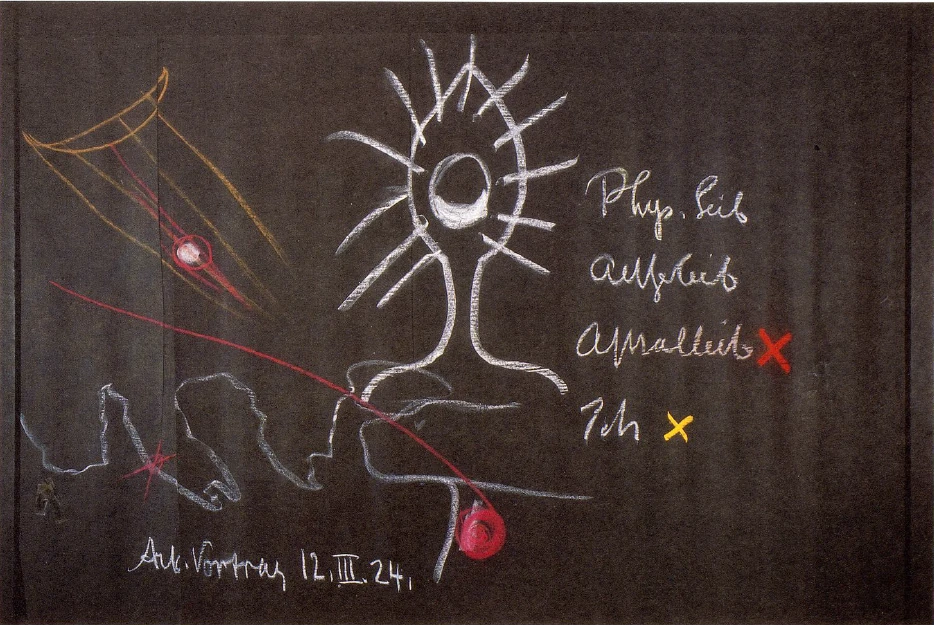
[ 24 ] Now one might say: Well, then every person could be born twice and also receive the influence of the Sun in the course of their life. — But that is not the case; the matter is actually somewhat different. The fact is this: Jesus Christ received an influence that acted directly upon the human “I.” What, then, is the nature of the influence from the Moon that is present in the womb? Well, gentlemen, I have told you: The human being consists of the physical body, the etheric body, the astral body, and the “I.” The influence of the Moon acts upon the astral body, and the astral body—which is unconscious within the human being—is influenced by the Moon. In contrast, the solar influence of Christ acted upon the “I.” But the “I” is independent!
[ 25 ] If the Sun’s influence on human beings were the same as the Moon’s, what would happen? Well, gentlemen, as individual human beings, we don’t exactly have a very strong influence over our birth; we are simply sent into the world through our birth. If the influence of the sun were exactly like that of the moon, then—let’s say—at the age of thirty we would experience this solar influence, and we wouldn’t be able to do anything about it, just as we can’t do anything about our birth. At the age of thirty, we would suddenly be different people; we would even forget what we had done before. Imagine if, as young people, you all went about your lives until the age of twenty-nine, and then—for the sake of argument—your thirtieth year arrived, and you were all reborn. Now, once you’ve been reborn, you meet someone who hasn’t yet reached the age of thirty, and he says to you: “Good morning, Erbsmehl!”—“What? I don’t know anything about that! I’ve only been here since today! What business is it of yours?”—That’s how it would be if the influence of the sun were indeed to affect every human being, let’s say, at the age of thirty. Yes, gentlemen, it will seem quite unbelievable to you, and yet it is true. It has simply been forgotten because historical falsification is constantly taking place; that is why one learns nothing about it. Something quite similar did exist in earlier times, though not as drastically intense as I have just described to you. But in very ancient times—let’s say, seven to eight thousand years ago—if we look, for example, at India, it was indeed the case that people, upon reaching the age of thirty, knew nothing more of their former lives and became entirely new people. And then those around them would take them in and say: “Now you must go to the ‘office’”—I’m using modern terms—and only then would the person in question be told again what his name was and who he was. Of course, this transformation has become weaker and weaker over time, but it did indeed exist. And even among the Egyptians, for example, it was the case that when people reached the age of fifty, they simply did not remember their childhood, but only remembered events up to the age of thirty; they learned the rest from those around them, just as we today learn from those around us what we were doing when we were babies or two years old. - History does not recount that humanity on Earth has changed in this way, but it is nevertheless true. Now, Jesus of Nazareth, through special events, was the last human being who—while all the others had already ceased to receive the influence of the Sun—still received that influence. This is also mentioned in the Gospels regarding the influence of the Sun, but people always misinterpret it. You see, the Gospels recount that Jesus was baptized by John in the Jordan River. At that moment, a dove descended. This dove symbolizes the influence of the Sun. And then this solar being entered Jesus. —And that was the end of it; he was the last to receive this solar being within himself. The others, even in his time, were no longer ready for this due to their physical constitution. He was the last.
[ 26 ] Let us return to the people of the ancient Orient; there, anyone could say: Over the course of a person’s life, the sun has an influence on the human being; a new being enters into the human being. - By the time that Jesus Christ lived, this could generally no longer be said, and the priests knew it only through external science, not through inner intuition.
[ 27 ] Well, what was to take the place of sun worship now? In ancient times, before the Jewish era, people worshipped the sun because they knew that this great, powerful influence during the course of life comes from the sun. - Now they could no longer worship the sun, since they no longer received any influence from it. Who, then, took the place of the sun? Christ Jesus himself! And so Christianity was founded in such a way that, along with the religion of the stars, there was also a religion of the sun that pointed directly to the sun; since Christ Jesus was the last to have attained this solar influence, one could only point to Christ and say: “The spirit of the sun dwells within him.”
[ 28 ] And that, in fact, is the great turning point. It is the most tremendous revolution in thought: that Jesus Christ brought down to Earth what people used to see in the sun. And in ancient times, or in the early days of Christianity, that is why Christ was always called the Sun. You can still find the expression “the Sun, the Christ” everywhere in the Gospels, because people knew exactly what it meant. This was later forgotten entirely. At every solemn Mass, you can see it in the Blessed Sacrament, in the monstrance. But if anyone were to actually say that this is the case—which is, after all, visible—then he would be considered a great heretic and persecuted as a misbeliever. For the Christian Church has always regarded it as dangerous to proclaim the truths about the stars, and thus also about the sun.
[ 29 ] Yes, gentlemen, why is that? To answer that, we must go back to the ancient mysteries and compare them with Christianity. You see, not everyone was admitted to the ancient mysteries. I have told you what the degrees were; the initiates were Ravens, Occultists, Defenders, Sphinxes, and so on. They knew that influence came from the stars; they knew that. And that is why the initiated priesthood strictly ensured that not everyone became wise, that wisdom was present only among them in the mysteries. For knowledge is indeed a power, even if it is often suppressed. But as long as the priesthood remains powerful, knowledge is precisely that: a power.
[ 30 ] But this star-based wisdom had perished. And then Christ Jesus came. He revived it, albeit in a transformed form, saying: “One must bring the Sun God down to Earth.” - He revived the sun religion. And if it had come to pass that Christ had fully permeated the world with his teaching, then the entire ancient star religion would have reappeared as a solar influence! This was indeed often the case in the early days of Christianity. The ancient mysteries flourished once more. But then came the moment when Christ Jesus carried out the immense revolution: He brought what had previously been confined to the mysteries out into the open for the whole world to see. It would thus have been available to all people. Yet no effort could succeed in bringing what I am now telling you to the people.
[ 31 ] In the 4th century, there was a Roman emperor named Julian, known as the Apostate; he wanted to reintroduce his old star-worshiping religion. He was assassinated during a campaign against Persia! What happened in Rome can only be recounted in the following way.
[ 32 ] In Rome, the study of the stars—which had actually been restored once again through Christ Jesus—was slandered as superstition; indeed, it was slandered not only as superstition but as a belief in the devil. So precisely that which leads to true recognition, to the knowledge of the spiritual in the world—that was slandered; it was, in a sense, even abolished. Instead, one was to believe only in the external historical event involving Christ Jesus in Palestine, just as the Church proclaims it. As a result, the Church became the highest authority on what one should think for all those who became believers. You see, Christianity as such did not actually come to Europe via Rome, but rather a distorted form of Christianity that took only this external event from Palestine, not the entire global context. And how did this come about?
[ 33 ] Well, you see, Rome actually traces its origins to a band of robbers who originally gathered there. And some of that spirit had long since seeped in back then. And so Rome has always strived to seize religious dominion along with secular dominion. It is a defining trait of Rome to claim spiritual dominion alongside secular dominion. And the Pope has taken the place of the old, still pagan high priest, the Pontifex Maximus, from whom he has adopted only the name. In the course of the Middle Ages, the Pope effectively took the place of the Roman Caesars, the Roman emperors, assuming world domination along with dominion over people’s thoughts. There was only one occasion, at the beginning of the 11th century, when a very significant German emperor in Central Europe sought to do something similar to what Julian—who was called the Apostata, the Apostate—had done; that was Henry II. It is very interesting! Henry II was initially regarded as a kind of saint because he represented the Christian worldview so well. He reigned from 1002 to 1024. He reigned like a saint. He is also known in history by the epithet “the Saint.” Yes, you see, if you look today at the breviary used by Catholic priests—the book listing all the saints—you’ll find Henry II, “the Saint,” listed there as well. But this Henry II was also someone who sought to point toward something like the ancient truth. He wanted to preserve for Christianity the belief that the Spirit of the Sun lived within Jesus Christ. And so he strove for an *Ecclesia catholica non romana*—that is, a Catholic Church that is not Roman. Consider the date: the beginning of the 11th century! Lutheranism did not come until later. If what Henry II had strove for—a Catholic Church that was not Roman—had succeeded back then, Christianity would have emerged in Europe with global significance, and through the religious life of that time, people would have already attained a true Spiritual Science. But Rome prevailed at that time—that is, religious-Caesarist Rome. There was no “Ecclesia catholica non romana”; instead, the “Ecclesia catholica romana” continued to exist. Emperor Henry II wanted to completely separate the Catholic Church from secular rule.
[ 34 ] Now you will all have to admit: It would have been an immensely great deed, for all the persecutions of heretics and those of false faith that followed could not have taken place. For all these persecutions stem solely from control over the mind. But in reality, one cannot control thoughts. Just think about it for a moment! Can one really control your thoughts? No, one cannot control them! You can control them only if you control people from a worldly perspective—if you force people to attend certain schools, drill certain ideas into them there, and assign them to a particular class. Through that class, they then acquire their worldview and so on. Thoughts cannot be controlled! A church could never have become harmful if secular authority hadn’t aided it by exercising dominion over human beings as physical beings. For the church can only teach, and people must accept what it teaches on their own. And that is what Henry II sought to establish. But, as I said, the old Caesar, the old emperor, prevailed in the pope at that time. And as you know: at that time, secular rule was very strong. One may find that regrettable, but in any case, secular rule was very strong during the time when Henry I was active. And if it had been possible back then to establish a Catholic Church that was not Roman, then the Church’s doctrine would have existed outside of secular rule.
[ 35 ] You see, essentially, the Crusades were pursuing the same goal. It is always said that the Crusades were waged in the service of Rome. The Crusades are usually described this way: Because those dreadful Turks had conquered Jerusalem, pilgrims could no longer pray in peace when they made their pilgrimage there. So Rome stepped in, sending Peter of Amiens everywhere; he preached the Crusade throughout Europe. That is to say, many people were supposed to flock to the Crusade and make the journey to Asia, to Jerusalem. Now, it is true that a large crusader army did come into being as a result of Peter of Amiens’s sermons, and it was under the command of Peter of Amiens and Walter of Have-Noth. You can perhaps guess why he was called “Have-Noth.” Well, he was just as much a “Have-Noth” as the rest of us. We, too, could not afford all that a crusade to Asia would cost. — But this entire crusader army perished along the way. It achieved absolutely nothing.
[ 36 ] In response, other people set out under the leadership of Godfrey of Bouillon. They were not in the service of Rome; rather, they sought something similar to what Henry II had done. They wanted to eliminate secular rule. - Here is Italy (it is drawn), here is Greece, the Black Sea, Asia, here is Palestine, here is Jerusalem: and that is where the Cross was supposed to go, and Jerusalem was to become the seat of the Christian religion. Rome was to be overthrown from the very first Crusade onward. The Crusades were actually waged against Rome. And once again, the aim was to make the Ecclesia—the Church—independent of secular rule.
[ 37 ] Well, none of these things actually worked out. The Roman princes once again interfered in the later Crusades. This can also be read about in the history of the Crusades.
[ 38 ] That is actually how it came to be that this entire foundation of Christianity—which embodies the magnificent idea that the power of the sun was brought down to Earth by Christ Jesus, and that every person who recognizes this can thereby become free— “You will know the truth, and the truth will set you free”—but the truth was not recognized—this whole matter has, in essence, remained unknown throughout human evolution, and only today must we rediscover true Christianity through Spiritual Science. It is hardly surprising that those who represent Christianity as it exists today turn against the Christianity that truly connects to Jesus Christ and teaches the very same things that Jesus Christ taught. But this is happening in anthroposophy. Therefore, it is also not surprising that among those who today know Christianity only from what currently exists, there is a great aversion to Christianity. But this aversion does not pertain to Christianity itself. Christianity has, after all, brought about tremendous progress in the social sphere—namely, the gradual abolition of slavery. If there were no Christianity, yes, gentlemen, then all of today’s science would not exist either. For consider this: most of the truly great discoveries were actually made by monks. Only the air pump was invented by the good Mayor Guericke of Magdeburg; but most of the great discoveries were made by monks. And the man who developed the Copernican system, Copernicus, was, after all, a canon—a Catholic canon. And the schools were, in fact, all dependent on the monks.
[ 39 ] But there’s something else to consider here. You see, the thing is that monasteries were actually not very welcome in the early Church, because the monks had preserved so much of the ancient knowledge. And among the monks—who were simply not allowed to speak out—one can indeed find knowledge of the ancient wisdom of the stars. It is certainly there to be found, if one is only willing to look for it. The things I’ve told you—I wrote down for you last time how men and women were still distinguished in the 17th century—well, these traditions were passed down in ancient times through monasticism, not through the external secular government, but through monasticism, and essentially it wasn’t until the 17th and 18th centuries that they were completely eradicated. The Middle Ages are not nearly as dark as is commonly believed. Only what people usually see is dark. But in secret, people possessed a great deal of wisdom; it’s just that we don’t understand it today, even when we read ancient writings. I showed you, after all, with the term “mummy,” that no one today gives any thought to what a mummy is. I explained it to you.
[ 40 ] And so it is indeed that the greatest idea of Christianity is that of the descent of the sun's power to Earth.
[ 41 ] You see, gentlemen, it was actually this that gave rise to what we call history. For in the Orient, they possessed a great wisdom of the stars, but they paid no heed to history. Those in the East who were the scholars, the wise ones, always pointed out: Creation lies in the vastness of the heavens. But they did not concern themselves much with what people on Earth were doing. Among the Jews, something resembling history emerges, but it is a history that also begins with astrological wisdom, for the “seven days of creation” are astrological wisdom. And then it becomes chaotic; things get mixed up. A true history, which divided the entire development on Earth into the pre-Christian and post-Christian eras, only emerged with the advent of Christianity.
[ 42 ] That is all I could tell you today. I will provide some additional information next Saturday.