

Human History and the
World Views of Civilized Nations
GA 353
25 June 1924, Dornach
Translated by Steiner Online Library
17. Humanity and Hierarchies — The Loss of Ancient Knowledge — On the “Philosophy of Freedom”
[ 1 ] Good morning, gentlemen! Perhaps something has come to mind during this somewhat longer period—a specific question?
[ 2 ] Question regarding the nature of the various hierarchies and their influence on humanity.
[ 3 ] Dr. Steiner: Of course, I believe this is a topic that will be somewhat difficult and perhaps a bit hard to understand for those gentlemen who are here for the first time today, because one needs to know something about what has already been discussed in the lectures that have been given. But I would still like to address the matter and explain it as clearly as possible.
[ 4 ] You see, when you observe human beings as they stand and walk here on Earth, they actually contain all the kingdoms of nature within themselves. First of all, human beings contain the animal kingdom; in a certain sense, they are also organized in an animal-like way. You can already see this from the fact that human beings have, let’s say, for example, thigh bones and upper arm bones, which are also found in a similar form in higher animals; but if you look closely, you’ll find them in a related or at least similar form even in lower animals. And even in fish, you can roughly see what corresponds to a human bone. The same thing that can be said about the skeletal system can also be said about the muscular system and the internal organs. We find a stomach in humans—and in a corresponding way, we also find a stomach in animals. In short, what exists in the animal kingdom is also found in the human body.
[ 5 ] This has led to the materialistic view that humans are, in essence, nothing more than highly evolved animals. But that is not the case; rather, humans develop three things that animals cannot develop from within their own organism. The first is that humans learn to walk upright. Just look at those animals that learn to walk more or less upright, and you will already see the considerable difference between them and human beings. In animals that walk somewhat upright—for example, the kangaroo—you will see how the front limbs, which it does not use for walking, remain atrophied. The front limbs of the kangaroo are simply not adapted for free use. And in the case of the monkey, we certainly cannot say that it is human-like in this respect; for when it climbs up into the trees, it does not walk, but rather climbs. It actually has four hands—it does not have two feet and two hands. Its feet are shaped like hands; it climbs. Thus, upright gait is the first thing that distinguishes humans from animals.
[ 6 ] The second thing that distinguishes humans from animals is the ability to speak. And this ability is linked to walking upright. Therefore, you will find that wherever an animal acquires something similar to the ability to speak—the dog, which is a relatively intelligent animal, does not acquire it, but the parrot, for example, which sits somewhat upright, does—you will find that the animal is then upright. Language is entirely connected to this upright posture.
[ 7 ] And the third is free will, which an animal cannot attain; rather, an animal is dependent on its internal processes. These are, therefore, the things that constitute the entire inner organization of human beings and give them their humanity.
[ 8 ] But human beings nevertheless carry animal nature within them. So they have this animal realm within themselves.
[ 9 ] The second thing that human beings carry within themselves is the plant kingdom. What can human beings do because they carry the animal kingdom within themselves? You see, animals have feelings—as do human beings; plants do not. Admittedly, a certain peculiar branch of modern science—I’ve mentioned this here before—holds the view that a plant can also feel, because there is, in fact, a plant—the so-called Venus flytrap, for example: When an insect comes near, and once the insect has flown close, this Venus flytrap snaps its leaves shut and devours the insect. That is a very interesting phenomenon. But if someone says: “This plant, the Venus flytrap, must sense the insect—that is, perceive it—when it comes near”—that is just as much nonsense as if someone were to say: ‘Such a tiny thing that I’ve set up to snap shut when a mouse comes near—a mousetrap—would also have a sense that the mouse is coming in!’ So there’s not much to such scientific opinions; they’re simply nonsense. Plants do not perceive. Nor do plants move freely.
[ 10 ] Thus, whatever a human being possesses in terms of sensation and movement, he shares with animals; in this respect, he carries animal nature within himself. Only when he is capable of rational thought—which animals cannot do—does he thereby become human. Furthermore, the human being carries the plant kingdom—the entire plant kingdom—within himself. Plants do not move, but they grow. Plants do not feel, but they nourish themselves. Human beings also grow and nourish themselves. This is what constitutes the plant kingdom within them. Human beings also carry this plant power within themselves. He carries this within himself even when he sleeps. He sheds his animal nature when he sleeps, for he neither feels nor moves—unless he is a sleepwalker, which is due to abnormal development; in that case, he does not completely cease moving, and he is ill. But in a normal state, a human being does not walk around while sleeping, nor does he feel anything. If they are to feel, they wake up. They cannot feel while asleep. Even in sleep, human beings carry within themselves only the plant essence.
[ 11 ] And the mineral essence, gentlemen, we also carry within us; it is contained, for example, in our bones. Although they are somewhat alive, they contain the inanimate component of calcium carbonate. We carry the mineral kingdom within us. We even have “brain sand” in our brains. It is mineral in nature. We also carry the mineral kingdom within us. — So we carry the animal kingdom, we carry the plant kingdom, and we carry the mineral kingdom within us.
[ 12 ] But that is not the end of the matter when it comes to human beings. If human beings merely contained minerals, plants, and animals within themselves, they would be like animals and would move about like animals, for animals, too, contain minerals, plants, and animals within themselves. Of course, human beings are not only related to these three visible kingdoms of nature, but they are also related to other kingdoms.
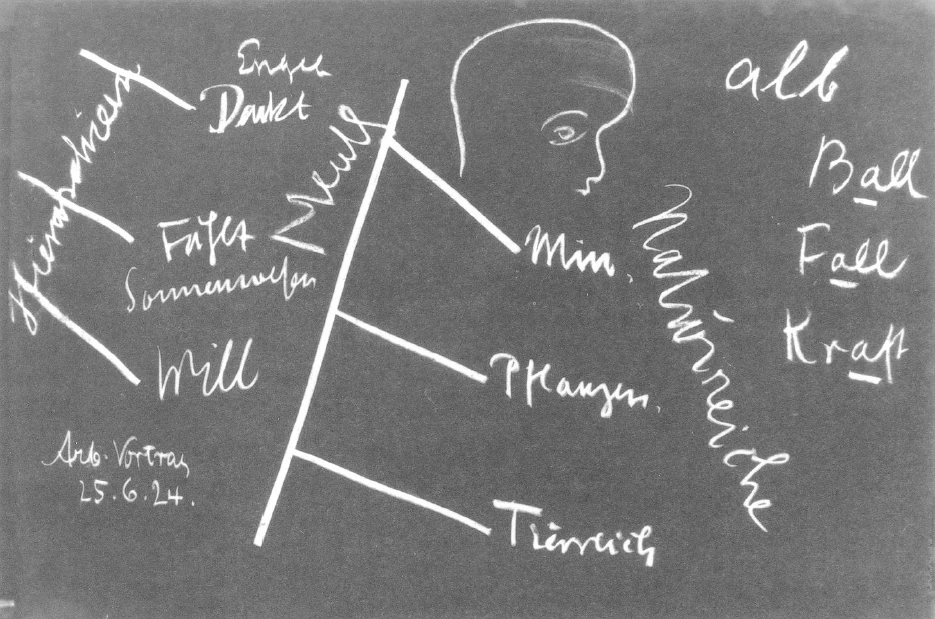
[ 13 ] Now I would like to illustrate this for you schematically. Imagine, for a moment, that this is a human being (see drawing); he is now in relation to the mineral kingdom, the plant kingdom, and the animal kingdom. But he is a human being. You might say: Well, yes, animals can be tamed. That is certainly true; but have you ever seen an ox being tamed by another ox? Or a horse by another horse? Animals, even when they are tamed—and thereby acquire certain abilities that can be loosely compared to human abilities—must still be tamed by humans! After all, there’s no such thing as a dog school where dogs teach themselves and turn wild dogs into tame ones; humans must intervene. And even if one were to concede everything the materialists want—if one were to simply follow their own line of reasoning—one can concede everything to them; for my sake, one might say: “Man, as he is now, was originally an animal and has been tamed”—yet the animal that he originally was could not have tamed himself! That’s simply not possible, because otherwise a dog could tame another dog. So there must have been beings in the beginning—who may now be elsewhere—but nevertheless, there must have been beings in the beginning who raised humankind to its present level. And these beings cannot belong to the three kingdoms of nature. For if you now have a mental image of yourself being tamed by a giraffe, made into a human being, while you are still like a small animal in childhood: just as little as this would be possible, just as little could you be tamed by an oak tree. At most, only the German Nationalists believe this, assuming that the oak—the sacred oak—tamed humankind. And, you see, certainly not the minerals; rock crystal is beautiful, but it certainly cannot tame human beings. There must have been other beings, other realms as well.
[ 14 ] Well, in human beings, everything is truly elevated to a higher level. Animals have the capacity to form mental images, but they do not think. Mental images form in animals. But animals do not possess this activity of thinking. Human beings possess this faculty of thought. And so, while a human being may, for example, have a circulatory system derived from the animal kingdom, he cannot have his organ of thought derived from the animal kingdom. Thus, one can say: Human beings think, feel, and will. All of this occurs freely. And all of this is made possible by the fact that human beings are upright, speaking beings.
[ 15 ] Think about how differently you would have to will, how all willing would be different, if you were always crawling around on all fours, just as you did in your first year of life; truly, all human willing would be different. And you would not be able to think at all. And just as the things we carry in our physical bodies connect us to the three kingdoms of nature, so too do thinking, feeling, and willing connect us to three other kingdoms—to supersensory, invisible kingdoms. Everything must have a name. Just as we call minerals, plants, and animals the natural realms, so we call those realms—which in human beings bring about thinking, feeling, and willing in such a way that they are free—hierarchies. So here we have: the natural realms, through which human beings reach into nature; and here we have: hierarchies. You see, just as human beings reach into three natural realms, so they reach into three spiritual realms. Through their thinking, they reach into the hierarchy—well, you see, there is still no name for it today. Because materialism takes no account of this matter, there is still no name for it; so we must name it using the old terms: Angeloi, angels. You’re immediately branded as superstitious. Certainly, we no longer really have the ability in our language today to find names, because people have lost the capacity to feel something in the sounds; but languages could only be formed as long as people still felt something in the sounds. Today everyone talks about a ball, a fall, a force; there’s an “A” in all of them—every one of these words contains an “A.” But what exactly is an “A”? An “A” is, after all, the expression of a feeling! Imagine if you suddenly saw someone here opening the window from the outside and peering in—consider what effect that would have: since that’s not supposed to happen, you’d be astonished; probably a large number of you would express your astonishment with “Ah!” if you weren’t too embarrassed to do so. “A” is always the expression of astonishment. So with every letter, there is some expression of something. And when I say: “Ball,” I need the “A” because I’m surprised when I throw the ball at how strangely it behaves; or if it means a dance ball, I’m also surprised at how it whirls everything around! It’s just that, over time, people have become so used to it that they’re no longer surprised at all; so you could just as well call it “Bull” or “Bill,” but certainly not “Ball” anymore. - Take “Fall.” When someone plops down somewhere, you can also say: “Ah!”—And the other thing that’s significant is right there in the “F.” “Kraft” (force): when someone applies a force that propels them forward; “Ah”: wherever astonishment arises, there’s the “A.”
[ 16 ] And consider this: You believe that thinking takes place inside your head. But if you were to suddenly realize that spiritual beings are just as much a part of your thinking as animals must be a part of your sensations and feelings on Earth—so that you can possess animal nature within yourself—then you, too, would be astonished; and so, when expressing this astonishment, you would need a word containing the letter A. So you could also name these thinking beings—which were once called “Angeloi”—with an “A,” and the fact that you possess the power of thought, you would denote with the letter that expresses power in a certain way: “L”; and the power that acts, you might perhaps denote with a “B.” The word “Alb,” which has already been used to refer to something spiritual, could just as well become a symbol for these beings associated with thought, were it not for the fact that it is currently used exclusively to describe nightmares, where it has a pathological connotation. So the hierarchies are simply realms into which human beings reach, which they carry within themselves, just as they carry the realms of nature within themselves; and these beings, who have been called “Alb” or “angels,” are those who are connected with thinking.
[ 17 ] On the other hand, when it comes to human feelings, animal beings are involved. What, animal beings? Well, you see, if one pays a little attention—if one doesn’t immediately become agitated when the spiritual is mentioned, but instead is open to the possibility that the spiritual might be a topic of discussion—then one can discover quite a lot, even if one is not yet able to engage in spiritual research as is the case with anthroposophy. Just imagine that if you want to feel, you must have a certain warmth within you! The frog feels much less vividly than a human being because it does not have such warm blood; one really must have warmth within oneself in order to feel. But the warmth one has within oneself comes from the sun! And so one can say: Feeling, too, is connected to the sun—only in a spiritual sense. Physical warmth is connected to the physical sun; feeling, which is related to physical warmth, is connected to the spiritual sun. This second hierarchy, which has to do with feeling, therefore dwells in the sun. One can certainly come to this realization if one has not become too fixated on the brain—as so many are today, especially scientists—and then one realizes: The second hierarchy consists of the solar beings. And because the sun reveals itself outwardly only as light and heat—no one knows the inner workings of the sun, for if physicists were to truly investigate the sun, they would be greatly astonished to find that the sun does not look at all as they usually imagine!—they imagine the sun to be a glowing ball of gas. It is not that at all; it actually consists entirely of absorbing forces; it is hollow—not even empty, but absorbing. We can say that outwardly it reveals itself as light and heat; the beings inside were called “beings of revelation” in Greek. In times when people still knew something about these things—for the ancient instinctive science was far wiser than today’s—these beings that manifest themselves from the sun were called Exusiai; we might just as well say: solar beings. We need only know that when we speak of feeling, we enter the realm of the solar beings. Just as when I say: “Human beings possess within themselves the forces of growth and nutrition—that is, the plant kingdom within them”—so I must say: “Human beings possess within themselves the forces of feeling—that is, the forces of the spiritual solar kingdom, the second hierarchy.” And the third is the first hierarchy, which has to do with the human will—where human beings become most powerful, where they do not merely move, but express their actions. This is connected to those beings who are spiritually present throughout the entire outer world and who are, in fact, the highest spiritual beings we can come to know. We refer to them by Greek or Hebrew names, since we do not yet have German equivalents—or indeed, the linguistic terms themselves: Thrones, Cherubim, Seraphim. This is the highest realm.
[ 18 ] Just as there are three kingdoms in the natural world, so there are three kingdoms in the spiritual world. Just as human beings are concerned with the three kingdoms of the natural world, so they are also concerned with the three kingdoms of the spiritual world.
[ 19 ] Now you will say: Yes, but I can choose to believe that or not, because these three realms are not visible or perceptible. Yes, but, gentlemen, I have met people who had to be made to understand that air exists! He didn’t believe that there was air there. When I tell him: “There’s a board”—he believes that, because when he walks up to it, he bumps into the board, or when he looks at it with his eyes, he sees the board, but he doesn’t bump into the air. He looks and says, “There’s nothing there.” Yet today, everyone acknowledges the existence of air. It’s simply there. In the same way, people will come to acknowledge the spiritual realm. Even today, people say: “Well, the spiritual simply isn’t there”—just as the farmers used to say: “The air isn’t there.”—In my homeland, the farmers still used to say: “The air isn’t there at all—that’s just what the big shots in the city say, the ones who want to seem so clever; you can walk right through it, there’s nothing there to walk through!”—But that was a long time ago. Today, even the farmers know that air exists. But today, even the smartest people still don’t know that spiritual beings are everywhere! They will admit this in due time, however, because otherwise they simply cannot explain certain things that simply must be explained.
[ 20 ] If someone were to say today: “In all that exists as nature, there is no spirit; for it contains everything that natural science knows about nature, and nothing else exists in nature”—well, gentlemen, whoever says that is just like someone standing over a dead person, a corpse, and saying: “You lazy fellow, why don’t you get up and walk!” —I try my best to make him understand that he shouldn’t be so lazy and should get up. Yes, I’m being unreasonable here, because I believe the living human being is in there. And that’s how it is: everything the naturalist can find in there, he doesn’t find in the living—he finds it in the dead. He also finds the dead everywhere out in nature, but he doesn’t find what is alive. He doesn’t find what is spiritual in this way, but that doesn’t mean it isn’t there.
[ 21 ] So that is what I wanted to say in response to this question, which was asked in connection with hierarchies.
[ 22 ] Mr. Burle: In previous lectures, the Doctor has spoken about the knowledge of Spiritual Science of the ancient peoples. That knowledge has been lost to humanity today. Could the Doctor explain to us why this happened? Was materialism solely to blame?
[ 23 ] Dr. Steiner: Why did the ancient knowledge disappear? Well, you see, gentlemen, that is indeed a very curious fact. Not in the way we possess knowledge today, but in an artistic, poetic form—in a lyrical form—the ancient people, our ancestors, possessed great knowledge in primeval times, and this knowledge, as Mr. Burle quite rightly says, has been lost to humanity. Now we may ask how this knowledge was lost. Of course, we cannot say that materialism alone is to blame for this; for if all people still possessed the ancient knowledge, materialism would never have arisen. It is precisely because the ancient knowledge has been lost and people have become spiritually crippled that they invented materialism. So materialism stems from the decline of the ancient knowledge—not that one can say the decline of the ancient knowledge is due to the spread of materialism. So what, in reality, is the cause of the decline of the ancient knowledge?
[ 24 ] Yes, gentlemen, this is because humanity is in the process of evolution. Of course, you can dissect a person who is alive right now; when he dies, you can dissect him. That way, you can gain knowledge about the way human beings are composed in the present. From ancient times, the only things that remain, well, are the mummies in Egypt, which we spoke about recently; but since they are thoroughly embalmed, it is no longer possible to dissect them properly. So as for what human beings looked like in earlier times—particularly in the era when they had a more delicate build—people today cannot form any scientific conception of this through mere external research alone; one must also delve into spiritual research. And there one comes to realize that human beings in ancient times were not at all like they are today.
[ 25 ] There was a time on Earth when people did not have bones as strong as the ones we have today; back then, people had bones like those found today only in children with rickets—bones that are so soft that they develop bowlegs or knock-knees and are generally weak. You can see that such soft bones can exist, for they are still found today in cartilaginous fish. Their bones are as soft as cartilage. Humans once had such bones, for the human skeleton was once soft. Now you might say: But then everyone must have walked around with bowlegs or knock-knees, and everything must have been crooked if the bones were soft!
[ 26 ] That would, of course, have been the case if the air on our Earth had always been the same as it is today. But that wasn’t the case; the air was actually much denser in ancient times. It has become much thinner. And the air contained much more water in ancient times than it does today. The air also contained much more carbon dioxide. The air as a whole was denser. - Now you’re beginning to realize that people back then were able to live with their soft bones; for we have our present-day bones only because the air no longer supports us at all. Thicker air supports people. Walking in those ancient times was much more like swimming than it is today. Walking today is, after all, something terribly mechanical: we put one foot down—which has to stand straight as a column—then we put the other foot down. That’s not how people walked in prehistoric times; rather, just as someone is supported by water, they felt the water-rich air; that’s why they could have soft bones. But when the air became thinner—and we already know from scientific research that the air did indeed become thinner—that’s when hard bones first became necessary; that’s when hard bones first developed. Of course, in the past, carbon dioxide was outside; the air contained it; today we carry carbonated calcium within us; that is why the bones have become hard. That is how these things are connected.
[ 27 ] But when the bones harden, other aspects of a person also harden, so that a person who had softer bones also had a significantly softer brain mass. In general, the skull—the human head—was shaped quite differently in ancient times. You see, it was shaped more like the heads of people with hydrocephalus are today; that was considered beautiful back then, but it is no longer considered beautiful today. And just as a very small child still has it in the womb, so did he retain his head, because he had soft brain matter, and the soft brain shifts forward into the front of the skull. Everything was softer in humans.
[ 28 ] Well, gentlemen, if people used to be more malleable, their mental faculties were also different. With a malleable brain, one can think much more intellectually than with a rigid one. The ancients still sensed this; they called a person who could only ever think the same thing, was slow to accept new ideas, and therefore stubbornly clung to that one idea a “stubborn person.” This sentiment already implies that one can actually think better and have better mental images if one has a soft brain. Early humans had such a soft brain.
[ 29 ] But these early humans had something else, too. We can truly say: When a child is born, its skull, with its soft brain, and even its soft bones are similar—the bones are no longer as strong, but the brain is very much like that of early humans. But try sitting or laying a small child down: it cannot move from the spot, cannot feed itself, or do anything of the sort—it can do nothing! Higher beings had to take care of this while humans still had this soft brain. And the consequence of this was that people back then had no freedom, no free will. These people possessed great wisdom, but no free will at all. But in human evolution, free will gradually emerges. For this to happen, the bones and the brain must harden. Yet with this hardening, the old knowledge begins to fade away. We would not have become free human beings if we had not become thick-skulled, hard-skulled—if we had not acquired skulls with hard brains. But we owe our freedom to that. And so, in fact, the decline of the old knowledge comes with freedom. That is it. Is that understandable? (Answer: Yes) It comes with freedom!
[ 30 ] But now, while people have gained freedom on the one hand, they have lost the ancient knowledge and have fallen prey to materialism. But materialism is not the truth. Therefore, we must return to spiritual knowledge, even though we have a denser brain today than early humans did. We can do this only through anthroposophical Spiritual Science, which arrives at insights that are independent of the body—insights that are perceived solely through the soul. Ancient people possessed their knowledge because their brains were softer—that is, more soul-like; and we have our materialism because our brains have become hardened and no longer absorb the soul. Now we must gain spiritual insights solely through the soul, which is not absorbed by the brain. This is what Spiritual Science does. We are returning once again to spiritual insights. But we now live in an age in which humanity has bought its freedom through materialism. Therefore, one cannot say that materialism—even if it is untrue—is something bad. Materialism, when not taken to extremes, is simply not a bad thing; rather, through materialism, humanity has come to know a great deal that it did not know before. That is it.
[ 31 ] Now, another question had already been submitted in writing:
[ 32 ] I read the following sentence in your *Philosophy of Freedom*: “Only when we have made the content of the world the content of our thoughts—only then do we rediscover the connection from which we have detached ourselves.”
[ 33 ] So that is what the professor read in *The Philosophy of Freedom*. He now asks the question: What belongs to this content of the world, since everything we see exists only insofar as it is thought? And then it is stated: Kan explains that the intellect is incapable of comprehending that which the appearing world of causes is prior to the world of experience.
[ 34 ] Well, you see, gentlemen, here’s the thing: When we’re born, when we’re little children, we have eyes and ears; we see and hear—that is, we perceive things that exist outside of us. The child doesn’t yet think about the chair standing there, but perceives it. To the child, it looks exactly the same as it does to an adult; it’s just that the child doesn’t yet think about the chair. Let’s suppose that, through some artificial means, a very young child—who has no thoughts yet—could already speak; then—as we’re accustomed to today, since even thoughtless people are the ones who criticize the most—the child would already be inclined to criticize everything, to find fault with everything. I am even convinced that if very young children, who cannot yet think, were already able to babble a great deal, they would become the fiercest critics. Isn’t that right? Even in ancient India, only those who were already sixty years old were allowed to criticize or pass judgment at all; the others were not yet granted the right to judge, because it was said: they have no experience of the world. Well, I neither want to defend this nor criticize it myself; I just want to tell you that this is how it was. Today, of course, anyone who has reached the age of twenty would laugh at you if you told them they had to wait to pass judgment until they were sixty! Young people today don’t do that; they don’t wait at all—as soon as they can hold a pen, they start writing for newspapers and passing judgment on everything. In this respect, we’ve come a long way today. But I’m convinced that if very young children could speak—oh, they’d be harsh critics! A six-month-old, for goodness’ sake—just imagine what he’d criticize about our actions if he could be made to speak!
[ 35 ] Gentlemen, you see, we only start thinking later on! — How did language development actually take place? Well, imagine a six-month-old child who cannot yet conceive of the idea of a chair, but who sees the chair just as we do—that child would discuss the chair. Now you said: I also have the concept of a chair; there is gravity in the chair, which is why it stands on the floor; something has been carved into the chair, which is why it has a shape. The chair has a certain internal consistency, which is why I can sit on it, won’t fall off when I sit on it, and so on. I have the concept of a chair. I think of certain things when I look at the chair. - A six-month-old child doesn’t think any of that. So I come along and say: “The chair has fixed shapes; it has weight.” - The six-month-old child, who doesn’t yet have that concept, says: “You’re a silly fellow; you’ve become stupid because you’ve gotten so old.” We already know what the chair is when we’re six months old; later on, you come up with all sorts of fantastical ideas about it. - Yes, that’s how it would be if the six-month-old child could speak; that’s exactly what it would say! And what we only become capable of as we grow older—that we can think about what we’re saying as we say it—in all of this, the fact remains that these thoughts do indeed belong to the chair; I just don’t know them yet. I don’t know the thoughts until I’ve matured enough for them. But I don’t have the chair’s solidity within me. I don’t sit on my own solidity when I sit on the chair; otherwise, I could sit on myself again. The chair doesn’t become heavy because of me when I sit on it—it’s heavy in and of itself. Everything I grasp as a thought is already contained within the chair. So that I grasp the reality of the chair when, in the course of my life, I reconnect with it through thought. At first, I only see the colors and so on; I hear the chair when it’s tapped, and I also feel whether it’s cold or warm—I can perceive these things with my senses. But what’s inside the chair—you only come to know that after you’ve grown older and begun to think. That’s when you reconnect with it and establish the reciprocal relationship.
[ 36 ] Kant—I spoke about him recently—made the biggest mistake by believing that what a child does not yet perceive, and what one only perceives later—namely, the content of thought—is something that humans first project onto things. So Kant is actually saying: When the chair is standing there—the chair has colors, the chair rattles. But when I say the chair is heavy, that is not a property of the chair; rather, I give it that property by thinking of it as heavy. The chair has solidity, but it does not possess that in itself; I bestow it upon the chair by thinking of it as solid. — Yes, gentlemen, this Kantian doctrine is indeed regarded as a great science, as I told you some time ago; but in reality, it is simply utter nonsense. It is precisely there that, due to the peculiar development of humanity, utter nonsense is regarded as a great science, as the highest philosophy, and Kant is, after all, always called the “crusher of everything,” the “smasher of everything.” I have always seen him—I studied Kant even as a very young boy, time and again—as nothing but a shatterer; but otherwise I have not noticed that the one who smashes the soup plates is the one who establishes the greatest, and that he would be greater than the one who makes them. To me, the one who makes them has always seemed greater! In reality, Kant has always smashed everything to pieces. — So these objections from Kant need not trouble us at all. But the fact is that when we are born, we are detached from things because we have no connection to them whatsoever. We only grow back into things by forming concepts. Therefore, the question posed here must be answered as follows: What belongs to the content of the world? I say in my *Philosophy of Freedom*: Only when we have made the content of the world the content of our thoughts do we rediscover the connection from which we became detached as children. As children, we do not possess the content of the world; we have only the sensory part of it. But the content of thought is, after all, truly contained within the content of the world. So as children we have only half the content of the world, and only later, as we grow into our thoughts, do we not merely have the content of thought within us, but we know that it is within things; we also treat our thoughts in such a way that we know they are within things, and in this way we reestablish the connection with things.
[ 37 ] You see, it was very difficult in the 1880s, when everything had been “Kantianized,” when everyone spoke in such a way that Kant’s philosophy was regarded as the highest truth and no one yet dared to say anything against it—it was very difficult when I stepped forward back then and explained that Kant’s philosophy is actually nonsense. But I had to explain that from the very beginning. Because, of course, if someone like Kant believes that we actually have to create the content of thought regarding things, then he can no longer arrive at simple content; then the soul simply contains thoughts about external things, and that is materialism all the more so. Kant is largely to blame for the fact that people have not emerged from materialism. Kant is to blame for a great many things in general. I told you this back then, when I was asked about Kant from a different perspective. The others, because they could not think otherwise, embraced materialism. But Kant said: One cannot know anything at all about the spiritual world, but only believe in it. — By this he actually meant: One can only know something about the sensory world, because one can only bring thoughts into the sensory world.
[ 38 ] And now those who wanted to become materialists felt increasingly justified in doing so by referring to Kant. But humanity must also break itself of this prejudice—that is, a portion of humanity, since very few actually know anything about Kant—they must stop always invoking Kant, and especially stop invoking Kant precisely when they want to say: One can’t really know anything about the spiritual world. —So: the content of the world consists of sensory content and spiritual content. But one only arrives at spiritual content in the course of one’s life, as one develops thoughts. Then one reestablishes the connection between nature and spirit, whereas as a child one initially has only nature before one’s eyes, and the spirit only gradually develops out of one’s own nature.
[ 39 ] Does anyone else have a quick question?
[ 40 ] Mr. Burle asks about human hair and says: These days, so many girls are having their hair cut short. Can the doctor tell us whether this is good for one’s health? My little daughter would have liked to have her hair cut short as well, but I didn’t let her. I’d like to know whether it would be harmful or not.
[ 41 ] Dr. Steiner: Isn’t it true that the situation is this: Hair growth is so loosely connected to the entire organism that it doesn’t really matter all that much whether one lets one’s hair grow long or cuts it off. The damage simply isn’t great enough to be noticeable. There is, however, a difference between men and women in this regard. Isn’t it true that for a while—though that’s no longer the case—you would very often see anthroposophists walking together, men and women—the men didn’t cut their hair; they simply wore long curls, while the women cut their hair short! Naturally, people used to say: “Anthroposophy turns the world upside down; among anthroposophists, the women cut their hair short and the men let theirs grow.”—That’s no longer the case, at least not so conspicuously. But one might well ask what the gender difference is when it comes to cutting one’s hair.
[ 42 ] In general, however, it is true that for men, abundant hair growth is somewhat superfluous; for women, it is somewhat necessary. Hair always contains sulfur, iron, silicic acid, and several other substances. These substances are also needed by the body. For example, men have a very high need for silicic acid because, as they develop into males in the womb, they lose the ability to produce silicic acid on their own. Through their cut hair—whenever hair is freshly cut, it absorbs the silicic acid present in the air—men take in silicic acid from the air. So cutting the hair isn’t a problem. The only problem is when it falls out, because then it can’t absorb anything. That’s why going bald early—which is, after all, somewhat related to people’s lifestyles—isn’t exactly a good thing for a person.
[ 43 ] Well, cutting a woman’s hair short isn’t really a good idea, for the simple reason that women have the ability to produce more silicic acid in their bodies, and so they shouldn’t cut their hair very short too often; because then the hair absorbs the silicic acid that the woman already has within her—as well as that from the air—and drives it back into the body. As a result, a woman becomes hairy and prickly on the inside; she then gets “hairs on her teeth.” This is something that doesn’t happen in such a conspicuous way; one has to be somewhat sensitive to notice it, but it is definitely there. Her whole demeanor then takes on something prickly; she becomes so hairy and prickly on the inside; cutting her hair, especially when done at a young age, certainly has an influence as well.
[ 44 ] Isn’t it true, gentlemen, that the story could just as easily be the other way around? It may be that today’s young people—who are, after all, all different from what we were in our youth—find themselves in an environment where their inner “silicic acid” is no longer enough for them, because they want to be prickly. They want to be a little prickly, a little rough around the edges. That’s when they get the urge to cut their hair. It then becomes a trend: one person copies another, and the story plays out in reverse—the kids want to be prickly and get their hair cut. If we then manage to counter this trend a little, that can’t be a bad thing, especially if the trend has gotten a bit out of hand. After all, it all comes down to this, doesn’t it: one person prefers a gentle type, another a prickly one; tastes can vary a bit. But it can’t have such a huge influence, after all. However, if a man has a daughter who, due to her circumstances, wants or is expected to choose a husband who loves a spiky hairstyle, then she should have her hair cut. Of course, she won’t get a man who’s particularly sensitive to gentleness—that’s certainly possible. —So this issue does extend further into the far reaches of life.