

Human History and the
World Views of Civilized Nations
GA 353
4 June 1924, Dornach
Translated by Steiner Online Library
16. The Nature of the Sun — The Origins of Freemasonry — On Signs, Handshakes, and Words — The Ku Klux Klan
[ 1 ] Have you found something you'd like to ask about, gentlemen?
[ 2 ] Question: How are the sun's rays formed? Is it a substance? And how is it that they strike the Earth in an arc?
[ 3 ] Dr. Steiner: Don't you think the sun's rays are real? And perhaps you could explain a little more about why you think they enter at an angle.
[ 4 ] The person asking the question says he has already heard that they do not fall straight to the ground, but in an arc.
[ 5 ] Dr. Steiner: The fact is this: The rays of the sun, as we see them, are not actually real; rather, when we consider the sun as such, it is not actually a physical substance—it is, in fact, spiritual and consists of a hollow space.
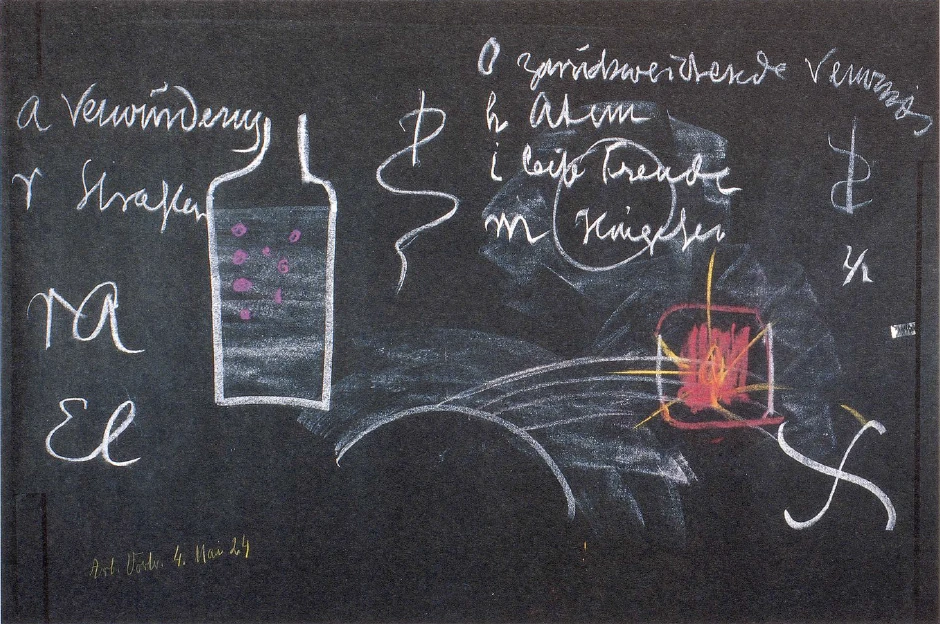
[ 6 ] Well, you just have to create a clear mental image of what such a hollowing out of space means. If you have—I’ve used this comparison before—a bottle of seltzer water, then the bottle is filled with water, and you can hardly see the water at all; you know there’s water inside, but you can see the bubbles very clearly. But you know this: When you pour out the water, the bubbles disappear; they’re actually air. As air, they’re less dense than the water. You don’t see anything that’s denser than water, but you do see the less dense air inside. That’s how it is with the sun up there. Everything surrounding the sun is actually denser than the sun itself, and the sun is less dense than what surrounds it; that is why you can see the sun. So it’s an illusion to believe that the sun is, so to speak, something in space. There’s actually nothing there in space; there’s a big hole there, just as with seltzer water—wherever there’s a bubble, there’s air, there’s a hole.
[ 7 ] From this you can already see: It cannot possibly be a matter of rays emanating from the hole. The rays are produced in an entirely different way. You can understand this as follows. Suppose you have a streetlight; there is light inside this streetlight. Now, if you’re walking down the street and you look at this streetlight, and it’s a fairly bright evening, you’ll see the streetlight with a steady, beautiful glow. But consider this: If it’s a foggy evening, with fog all around—it will seem to you as if rays were emanating from the lamp, from the light! So you’re actually seeing the rays inside. You simply don’t see the rays coming from the light itself; otherwise, on a truly clear evening, you’d have to see those rays as well. But those rays come from what’s all around; and the more fog there is, the more you see the rays. That’s why you don’t see the sun’s rays as reality either, but as something where you’re looking through fog toward something less dense, toward a void. Does that make sense?
[ 8 ] But let’s continue: When you look through fog into the distance, the object you’re looking at always appears to be in a different place than where it actually is. When you stand here on Earth and look through the air at the sun—which is actually empty—then, as you look at it, the sun appears to be lower than where it actually is—it appears to be lower in the emptiness of space. As a result, that which has no reality to begin with appears as if it were bent. So it is really only because one is looking through the mist. That is the reality in this case. One cannot help but be amazed time and again that physicists today describe things as if there were a sun there and rays were traveling from it, whereas neither the sun nor the rays are an external physical reality. And within that empty space, there is indeed something spiritual. And that is what must always be taken into account. That is what I can say regarding this question.
[ 9 ] Maybe someone else can think of something else?
[ 10 ] Question: Could you tell us a little about Freemasonry and its purpose?
[ 11 ] Dr. Steiner: Well, you see, gentlemen, Freemasonry today is, one might say, really just a shadow of what it once was. I have spoken about this here on several occasions: in the very early stages of human development, there were no schools as we know them today, nor churches, nor art institutions—rather, all of these were one and the same. In the ancient mysteries, as they were called, the school, the arts institution, and religion were all one and the same. It was only later that they diverged. So that, as far as our Central European regions are concerned, one could even say that things did not become this way until the 11th and 12th centuries; earlier, the monasteries were, I would say, a remnant of those ancient times. But in very ancient times, schools, churches, and art institutions were one and the same. However, in the Mysteries, everything that took place there was taken much more seriously than is the case today, for example, in our schools and also in our churches.
[ 12 ] The fact is, back then, you had to spend a long time preparing before you were allowed to study. Today, what really determines whether someone can study or not is, essentially, a principle that has absolutely nothing to do with learning. Isn’t that right? Today, the only thing that really matters is whether or not the money can be raised for the person who is supposed to learn! Of course, this has absolutely nothing to do with the abilities that person possesses. And things were quite different in the old days. Back then, people were selected from among all of humanity—and people had a better eye for this than they do today—who were, so to speak, the most capable. Of course, since people are, after all, selfish, the system fell into decline almost everywhere; but the original principle was to select those who possessed abilities. And only they were then granted the right to learn intellectually—not simply through drill, training, and the methods used in teaching today, but they were able to learn intellectually.
[ 13 ] This spiritual learning, however, is linked to the fact that, during the preparatory phase, one learns to develop very specific abilities. Just consider this: when you touch something in everyday life, you actually have a coarse sensation of it; and the most people can achieve today is that they can sometimes distinguish between different materials through sensation—that they feel things in this way and perceive some difference. But people’s sense of touch—I mean, their purely physical sense of touch—is actually quite coarse today; they distinguish between warmth and cold. At most, those who depend on it develop a finer sense of touch. These are, for example, the blind. There are, after all, blind people who learn to feel the shapes of letters when they run their fingers over the paper. Each letter is, after all, slightly indented into the paper. If the sense of touch in the fingers is finely developed, one can indeed feel the letters to some extent. These are the only people today who learn to feel things more finely, to perceive things more subtly. As a rule, this sense is not developed at all, but one learns an immense amount when one refines one’s sense of touch—and especially the sensation in the fingertips and fingers—to a very fine degree. Today, people do not distinguish between heat and cold solely through touch. Yes, they can do that even today, but only because they can read a thermometer; that reveals the subtle differences in heat and cold to them. But the thermometer, of course, was only invented over time. Before that, people had only their sense of touch. In the preparatory stages of the Mysteries, the senses—especially in the fingers and fingertips—were initially developed in a very special way. And it was through this that one learned to perceive in the most subtle manner.
[ 14 ] So who, in the Mysteries, was the one who had been prepared from the very beginning to perceive things with great subtlety? Well, the other people were not able to perceive things with such subtlety. Now suppose there was a Mystery somewhere else, in another place. People traveled a great deal in ancient times; they traveled almost as much as we do, and sometimes one is amazed at how fast they traveled. They didn’t have railroads; but they traveled because they were more agile, because they could walk faster, got less tired, walked a bit better, and so on. And so such people would meet along the way. Yes, when two such people, who were capable of subtle perception, shook hands, they sensed this in one another, and people would say: “They recognize each other by their more refined sensibility.” That is what is called the “grip”—the grip used when one attacked another in ancient times and realized, “This person has a more refined sensibility.”
[ 15 ] Now then, gentlemen, consider this second point: Once it was recognized that someone possessed a refined sensibility, people would go further, because they learned even more. In ancient times, people didn’t write as much as they do today; in fact, they wrote only very rarely, and only about the most sacred matters. Admittedly, a form of correspondence already existed in antiquity; but even this correspondence consisted mostly of various symbols. And so many symbols were created for all sorts of things. It was also the case that people who did not belong to the Mysteries—that is, who were not the “wise ones,” as they were called—traveled only within a small radius; they did not go very far. But the scholars, the sages, traveled extensively. They would actually have had to know not only all languages but all dialects. It is, of course, difficult—even if you are from northern Germany—to master the Swiss dialect. But for these people in the Mysteries, in addition to the language they spoke, there were certain signs for all the things that interested them. They made signs. For example, let’s say the common gesture that one already feels intuitively was further developed: “I understand”—; or: “That’s nothing you’re telling me”—; or: “We get along well with each other.”—They would draw a cross into it. So there was a fully developed sign language specifically among the ancient sages, and they incorporated everything they knew into such signs. So you can see: All the people who were in the high schools of that time, in the Mysteries, had specific signs for everything. Let’s say, for example, they wanted to record these signs. Then they first drew them. That is how the drawn signs came into being.
[ 16 ] It is indeed interesting that even today there are certain scripts that clearly reveal their origins in symbols. One example is the ancient Indian script, Sanskrit. In it, one can see everywhere that everything originated from curved and straight lines. Curved lines: dissatisfaction with something, antipathy; straight lines: sympathy. Just think about it: Someone knows that straight lines mean sympathy and curved lines mean antipathy. Now I want to tell him something. I have my own symbol for that. He wants to tell me something; that might go well at first, but later things could take a turn for the worse. See, things are still going well there; later, he draws a serpentine line: that’s when things can go wrong. And so there were specific signs for everything. Those who were initiated into the Mysteries communicated with one another through these signs. So that one had the sign at one’s fingertips.
[ 17 ] Well, in the past, people used to see something very special in words. You see, when people speak words today, they actually have no idea anymore what words are all about. But one can still sense something that is already contained within the sounds themselves. You’ll easily be able to sense it when someone is in a certain situation and begins with: A—that has something to do with wonder. A—the letter A is wonder. Now take the letter R: within it lies rolling and radiating: R = radiating. A = wonder, R = rolling, radiating.
[ 18 ] Now, however, we know what we just said about the sun’s rays. But even if the sun’s rays are only an illusion—even if they are not real—it looks as if they were streaming down. Now imagine someone saying: Up there is something that casts something toward me here on Earth, which, when it appears to me in the morning, arouses wonder. He expresses this wonder with an A, but the fact that it comes from above with an R; so he expresses it as: RA. Yes, that is what the ancient Egyptians called the sun god: Ra! Each of these letters contains a specific feeling, and we have combined the letters into words. So there was a very widespread feeling embedded in them. That has long since been forgotten today. You can sense something like this in various things. Take, for example: I. That is something like a quiet joy; one comes to terms with what one experiences and perceives: I. That is why laughter is also expressed as: hihi. That is a quiet joy. So every letter has something specific within it. And there is a knowledge through which one can virtually form words if one understands the sounds contained within them.
[ 19 ] Now you will say one thing, gentlemen: Yes, if that were the case, there could actually be only one language! — Originally, there was indeed a single language among humankind; when people still had a sense for these sounds, these letters, there was only one language. Languages became different when people scattered. But originally, people sensed this, and in the Mysteries it was taught correctly how to sense sounds and letters and form them into words. That is why there was a distinct language in the Mysteries. Everyone spoke this language among themselves. They did not speak dialects to one another, but this language—everyone understood it. If one person said “Ra,” the other knew that meant the sun. If, for example, someone says “E”—just feel it: I recoil slightly; that doesn’t sit right with me; “E” = I have a slight fear, something like fear! Now, take “L”: It’s as if something is fading away, as if something is flowing, and “EL”—yes, that’s something that flows away and causes one to recoil, something one fears. Thus, in Babylon, “El” meant “God.” Everything was designated according to this principle. Or take the Bible: When you say: O—that is a sense of wonder, a sudden wonder that one cannot resist. With A—there is a feeling one likes, a sense of wonder one likes; O—there one wants to recoil; H, Ch is the breath. So that one can say: O = recoiling wonder; H = breath; I = there you point toward it, you rejoice in it; it is quiet joy = I. And M—that is: you want to go into it yourself. You feel, when you pronounce M: M—there the breath goes out, and you feel as if you’re literally running after the breath; so M is: going away. Now let’s put this together: El—we’ve already seen this—is the spirit coming on the wind, El; O = that is the receding sense of wonder; H = the breath; so this is already the more subtle spirit that acts as breath; I is the quiet joy; M is the moving toward. There you have Elohim, with which the Bible begins; there you have these sounds within it. So that one can say: What are the Elohim? - The Elohim are beings in the wind, whom one fears a little, from whom one recoils a little, but who, through the breath, bring joy to people, and who find joy in moving toward people: Elohim. And so, originally, one must study the words according to their sounds, according to their letters, to understand what the words actually mean. People today no longer sense at all what this is actually like.
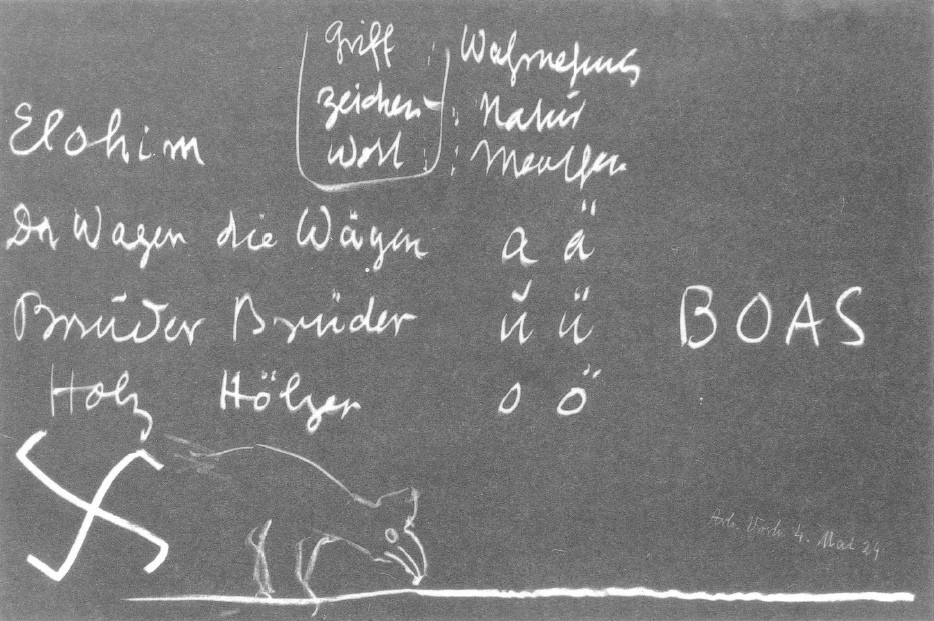
[ 20 ] What is the plural of “Wagen” here in Switzerland? Is it also “Wagen,” or is it “die Wägen”? (Answer: “Die Wagen”! This answer is incorrect. In Swiss German, it’s “Wäge,” as Dr. Steiner surmised.) — People still say “die Wagen.” So it’s already become muddled; the original form would be: “der Wagen,” “die Wägen”! With plurals, we see this in all sorts of ways; for example, we have: “der Bruder,” “die Brüder.” But surely that’s the case in Switzerland, too! You don’t say “die Bruder,” do you? So: der Bruder, die Brüder. Or take “das Holz, die Hölzer.” You certainly don’t say “die Holzer” here either. Das Holz, die Hölzer. You see, gentlemen, when the plural is formed, an umlaut is added: ainä, uinü, oinö. Why does this happen? Well, the umlaut expresses that the meaning becomes unclear! When I see a brother, he is clearly there as a single person; when I see several brothers, it becomes unclear—I have to distinguish one from the other, and if I can’t do that, it becomes unclear. You have to look at one after the other. This loss of clarity is indicated everywhere by the umlaut. So wherever there’s an umlaut anywhere in a word, something is unclear.
[ 21 ] So there is something in language by which one can truly recognize the whole person; the whole person is there. And so people also expressed how, just as in the letters one wrote down, certain meanings lie within these signs. A has always signified wonder. So when the ancient Jew wrote down the letter x, he said to himself: Who marvels in the earthly world? Animals do not really marvel—only human beings do. That is why he called human beings, in general, “wonder.” When he wrote down his aleph—the x, the Hebrew A—it also signified human beings.
[ 22 ] And so it was that each letter simultaneously signified a specific thing or being. All of this, in turn, was known to those who were initiated into the mysteries. So when one person traveled and met another, and they shared this knowledge, they recognized one another by their words. So one can say: In ancient times, it was the case that people who had studied—that is, who knew a great deal—recognized one another by touch, signs, and words. Yes, but, gentlemen, there was something to it! There really was all of that learning contained within these signs, gestures, and words. For by learning to feel, one learned to distinguish between objects. By having these signs, one had a way of imitating all that constituted the mysteries of nature. And through words, one came to know the inner human being. So one can say: In touch lay perception; in signs lay nature; and in words lay the human being—his inner wonder or his recoiling, his joy, and so on. Thus, one had nature and the human being and rendered them in signs, touch, and words.
[ 23 ] Well, in the course of human development, what emerged was, on the one hand, the university and later the schools, and on the other hand, the church and the arts. All three no longer understood what had originally existed; and touch, sign, and word were completely lost. Only those who then realized: “Good heavens, these ancient sages—they had a certain power precisely because they knew this!” understood it. That is a justified power that a person possesses when they know something, for it benefits their fellow human beings; if no one knew how to build a locomotive, humanity would simply never have a locomotive! So when someone knows something, it benefits people; that is a justified power. Later, however, people simply appropriated that power by imitating the outward signs. Just as this or that sign once meant something and later lost its meaning, so all of that lost its meaning. And then, I would say, through imitation of the ancient mysteries, all sorts of things developed in which people only have the outward form of the matter. What did people do? They no longer had that subtle sensibility, but they agreed on a sign by which they could recognize one another. They shake hands in a certain way, by which one knows: that person belongs to this covenant. That is how they recognized one another by the handshake. Then they also make a sign in some way. The sign and the handshake differ depending on whether one is in the first, second, or third degree. That is how the people recognize one another. But there is nothing more to it than just a distinguishing mark. And likewise, they have specific words for each degree that they can utter in certain Masonic lodges; they have, let’s say, for the first degree, for example, if one wants to know: What is the word? — [the password] Jachin. You know he learned the word Jachin in the Masonic lodge; otherwise, he wouldn’t be in the first degree. That is just a password. And likewise, he then makes the sign and so on.
[ 24 ] Well, actually, this form of Freemasonry only developed after everything else from the mysteries had been forgotten; and certain elements of the old traditions, which were no longer understood, were imitated. As a result, most of what Freemasonry has adopted in terms of ritual is no longer understood by Freemasons today; nor do they understand the signs, handshakes, and words, because they do not know what all of this is about. For example, they do not know that when they speak the word of the second degree from Tablet 21—Boas—the B stands for a house; O is, as I have told you, that reserved sense of wonder; A is the pleasant sense of wonder; and $ is the symbol for the serpent. With this, you have expressed: We recognize the world as that which is a great house built by the great Architect of the world, a house that inspires both fearful and comforting wonder, and in which evil—the serpent—also exists. —Yes, such things were known in ancient times; back then, people observed nature and humanity through this lens. Today, in certain Masonic lodges, those who have attained the second degree utter the word “Boas” without a clue as to its meaning. Likewise, isn’t it true that when, in the third degree, people placed their fingers on the pulse, this was truly a recognition that the person in question possessed a refined sensibility? One could tell this by the way the finger rested on the pulse. This later became the handshake for the third degree. Today, people only know that if someone comes up and takes their hand like that, they’re a Freemason. So in these things there is actually something ancient, venerable, and grand—something that embodies all the learning of the past; but now it has been reduced entirely to a formula, reduced to nothingness. So today the Masonic Order has such things; it also has ceremonies, a ritual: this dates back to the times when everything was also expressed through ritual and ceremonies, so that it would have a more profound impact on people. Freemasons still do this today. So in this inner sense, the Masonic Order really has no significance anymore.
[ 25 ] But for many people, it was terribly boring to participate in such alliances when they were formed, because it actually degenerated into a kind of game. So something was needed that could be poured back into Freemasonry. And this led to the Freemasons becoming more or less political, or, in turn, spreading more or less religious Enlightenment teachings. The unenlightened Roman doctrine was administered by Rome. The doctrine that opposed Rome was then spread by Freemasonry. That is why Rome, the Roman cult, and Freemasonry are the greatest of enemies. This has nothing to do anymore with what the rite, signs, handshake, and password used to be among the Freemasons; rather, this has simply come in between. In France, the order was not called an “order” but the “Orient de France,” because everything is taken from the Orient—“Grand Orient de France”—that is the great French Masonic order. The other elements—signs, handshakes, and passwords—serve only to keep the people together; they are what identify them to one another. The communal ritual is where they gather under particularly solemn circumstances; just as others gather in church, these Freemasons gather during ceremonies that stem from ancient mysteries. This is what binds the people together.
[ 26 ] It was, after all, customary—especially in Italy at certain times when secret political societies formed—to recognize one another and gather together through specific ceremonies, signs, and handshakes. Political leagues and political associations have always drawn upon this ancient esoteric knowledge. And it is quite remarkable today as well: if you go, for example, to certain regions of Poland and Austria, you will find posters; on these posters are strange symbols and strange letters that then form words; at first you don’t know what the poster means—but such a poster, which is now posted everywhere in Polish and Austrian regions, is the outward sign of a society formed by certain nationalist groups among the youth. They proceed in the same way. It is actually very, very widespread, and people know quite well that the symbol also possesses a certain powerful force. There are organizations—the German Nationalists, for example—that use an ancient Indian symbol: two intertwined snakes, or, if you will, a wheel that has been transformed into a swastika. They use this as their emblem today. And you will often hear that the swastika, in turn, is adopted as a symbol by certain chauvinistic nationalist circles. This is because of the tradition that such symbols were used by the ancients to express their authority. And this has always been the case on a large scale within the Masonic Order. The Masonic Order actually exists to unite certain people, and it does so through ceremonies, symbols, handshakes, and passwords. And then it pursues secret goals by preserving certain secrets among all those who are bound by these ceremonies, symbols, handshakes, and passwords. Of course, secret goals can only be pursued if not everyone knows about them; and so it is with Masonic lodges that they often pursue political, cultural, and similar goals.
[ 27 ] But there is one more thing you can say, gentlemen. You see, the people who are members of Masonic lodges are by no means to be criticized for doing so; on the contrary, they sometimes have the very best and noblest intentions. They simply believe that there is no other way to win people over to such a cause than through such lodges, and that is why most Masonic lodges also aim to practice charity on a large scale. It is wonderful to practice charity and humanity. This is, in fact, something that these lodges carry out on a large scale. Therefore, it is no wonder that Freemasons can always point out that an immense amount of extraordinarily humane and charitable work is founded and established precisely by Masonic lodges. One simply has to tell oneself: In this day and age, all such things are actually no longer in keeping with the times. For, isn’t it true that what we must primarily reject in such matters today is the separation? This soon gives rise to a spiritual aristocracy, which should not exist. And the democratic principle, which must increasingly come to the fore, actually runs completely counter to the Masonic order just as much as it does to closed priesthoods. So one can say: It is certainly true that anyone who can still understand today what is contained in certain Masonic ceremonies for the first, second, and third degrees—in things that the Masons themselves often do not understand—can recognize that they frequently draw on very ancient wisdom; but this is not of great significance. What is of great significance is that today, in many Masonic organizations and alliances, there are indeed many political or other social and charitable endeavors. Yet the Catholic Church and the Freemasons are locked in a bitter struggle. This, however, has only emerged over the course of time.
[ 28 ] Well, it’s very easy, of course, to misunderstand such things. And that’s exactly what happened: Freemasons wear specific attire during their ceremonies; for example, they wear a lambskin apron—the “lambskin apron.” Some people have said: Freemasonry is nothing more than a play on the masonry trade, because the mason wears a lambskin apron. But that is not true. And that apron is there—and it has always originally been made of lambskin—to show that the person who belongs to such brotherhoods should not be a hot-tempered fellow when it comes to the passions; so the genitals are to be covered by the apron, and that is the sign of this. So it was, after all, something that expressed human character through symbols. And this is true of many symbols found in clothing as well.
[ 29 ] There are also higher degrees in which a robe very similar to that of a priest is worn; in these, every detail has a specific meaning. For example, I have told you that, in addition to the physical body, human beings also have an etheric body. And just as the priest wears a white linen robe, a shirt-like garment, to symbolize the etheric body, so too do certain high degrees of Freemasonry have such a garment; and for the astral body—which is colorful—there is a toga, an outer robe; all of this symbolizes those aspects. And the cloak, which was then connected to the helmet, symbolized the power of the “I.”
[ 30 ] All these things can be traced back to ancient, very meaningful, and significant customs that have lost their significance today. If someone likes Freemasonry, they shouldn’t take what I’ve said as something derogatory. I simply wanted to explain how it is. Of course, there can be a Masonic order that brings together exceptionally good people and so on. And in this day and age, something like that can become particularly important. Really, what people usually learn today when they become doctors or lawyers—well, that doesn’t touch their hearts. And that is why many lawyers and doctors still become Freemasons—because then they at least have the solemnity of the ancient ceremonies and something about which they may not be able to think much, but which is still something: signs, handshakes, and words—all of which point to the fact that human beings do not live solely in the external, material world.
[ 31 ] That's what I wanted to tell you. Is there anything else you'd like to ask?
[ 32 ] Question: In America, there is something called the “Ku Klux Klan.” What is that all about? Could the doctor tell us a little about what it means? You read about it all the time.
[ 33 ] Dr. Steiner: Yes, you see, the Ku Klux Klan is one of the most recent inventions in this area—and indeed, one that should be taken more seriously than it usually is. As you know, gentlemen, enthusiasm for a certain kind of cosmopolitanism was actually prevalent only a few decades ago. Today, of course, it still exists among the working class and among social democrats—who are an international element—but in bourgeois circles and elsewhere, nationalism is running rampant, and the sentiment in favor of nationalism is indeed very strong. And you will also recall that those people who stood behind Woodrow Wilson—he himself was, after all, merely a sort of straw man—actually counted on this nationalism; they wanted nation-states everywhere, sought to stir up nationalism everywhere, and so on. Yes, one can certainly have one’s own views on that! But now there are people who are developing a tendency everywhere to take nationalism to the extreme. And in this effort to take nationalism to the extreme, the Ku Klux Klan has emerged in America. It now operates using methods such as symbols, in the sense that I have described.
[ 34 ] Now, when you consider such connections, you have to realize that symbols do indeed possess a certain hypnotic power. You know, if you have a chicken (it’s being drawn), and you let it peck at the ground with its beak, and then you draw a chalk line from there, the chicken will follow the chalk line! It’s hypnotized; it follows the line! You just have to make it peck at the starting point first, and then it follows the chalk line because it’s hypnotized by the line. Thus, every symbol—not just the straight line for the chicken—has a meaning, a certain soporific meaning, if one sets out to use it that way. And certain secret societies, in turn, exploit this by deliberately choosing precisely such symbols to bewitch and lull other people into a trance, so that they do not exercise their own judgment. And it is precisely such secret societies that operate through these means. In America, this includes the Ku Klux Klan. Now, the Ku Klux Klan is dangerous for the reason that such organizations do not limit themselves to a single nation; rather, they seek to establish the nationalist principle everywhere. No one can say: “The Ku Klux Klan need only remain an American institution because it aims specifically to promote American nationalism.”—A Ku Klux Klan follower does not say that; instead, he says: “Nationalism should be promoted everywhere—in Hungary, in Germany, in France.” —Very well! Americanism is not what matters to him; he is not a patriot, but rather he sees in this clamour for nationalism something that, when it combines across the most diverse nations, brings about what he wants to achieve: namely, to plunge people into utter chaos. That’s what he wants: He wants to plunge everything into chaos! It’s pure destructive fury at its core. And that’s why the Ku Klux Klan is particularly dangerous—because it can spread to every country. And you can’t say, if it ever tries to spread here in Switzerland, that it’s an American institution; rather, it would then be a Swiss national institution.
[ 35 ] And that was essentially how the Masonic lodges were as well; they were international, but always nationalistic within their respective countries. But they didn’t place much importance on that; rather, they did it more for the outside world—to go along with what was happening in the outside world. And one might now say: But aren’t such people actually insane, who want to stir up something like an absolutely nationalistic principle and who want to destroy everything? One can’t really say that either. Of course, if you ask, the answer is: “Naturally, one doesn’t go along with such things.”—But people tell themselves: “Everything is so corrupt today”—the leaders say this about the others who follow in their wake—“it doesn’t matter to the others at all, so there’s no point in upholding the things that exist today.” First, you have to treat humanity like a chaotic mass. Then people will come to their senses again, and then they’ll learn to behave properly once more. So people do have an idea, and the Ku Klux Klan, in particular, has an idea in this regard.
[ 36 ] You mean: no?
[ 37 ] The questioner: Yes! But that's strange!
[ 38 ] Dr. Steiner: You see, many things in cultural life are strange, and we have already mentioned some things that seemed strange. But what is strange can sometimes be quite dangerous. It may seem strange to us, but it is sometimes extremely dangerous.
[ 39 ] Well, gentlemen, I have to travel again tomorrow—to Breslau. I’ll let you know then when our next session will be.