

Esoteric Considerations of Karmic Connections
Volume II
GA 236
11 May 1924, Dornach
Translated by Steiner Online Library
Ninth Lecture
[ 1 ] For some time to come, we will continue to examine the lawful interrelationships within the development of human karma, and today I will begin by elaborating somewhat on the inner structure of karma formation—specifically, that part of karma which primarily concerns the moral, ethical, and spiritual aspects of human life.
[ 2 ] You must simply bear in mind that the moment one looks beyond the physical world—and one does so, after all, by considering karma, and karmic connections are spiritual, even if they manifest in the physical realm, for example, in illnesses—then that which pertains to karma in an illness is, in fact, spiritually caused. So in all cases, one enters the spiritual realm when approaching the consideration of karma. But today we want to focus particularly on the ethical-spiritual, the soul-related aspect of karma.
[ 3 ] I have already pointed out how karma—the formation of karma—is connected to those beings on Earth who were present on Earth itself in the very early stages of Earth’s evolution and who then left Earth when the Moon separated from it, to continue living in the cosmos as a kind of lunar inhabitant—lunar beings—on the Moon itself.
[ 4 ] We must regard what we call the Moon—of which the physical part, which is usually described, is, I would say, merely a hint— we must indeed regard the Moon as the bearer of certain spiritual beings, the most important of whom are those who once inhabited the Earth as the great primordial teachers, who established on Earth that primordial wisdom among human beings of which I have often spoken. These beings were thus once on Earth. They were there when the Moon was not yet separated from the Earth. There, as I have described before, they instilled this primordial wisdom in human beings, so to speak, so that people came to this primordial wisdom through a kind of inner enlightenment. And the way these beings worked is quite different from the way people can work on Earth today.
[ 5 ] For you see, one would actually have to describe the nature of the influence exerted by these ancient teachers among humankind as a kind of magical effect—effects that occurred because the human will once had a far greater influence, even on what can happen externally, than it can have today. Today, after all, the will can only act upon the external world through physical transmission. If we want to push an object, we must exert our will; we must push the object with our arm and our hand. The direct effect of the will on external processes—which we would today call natural processes—was, however, still present in the time of the ancient Primordial Teachers in a way that we would today describe as magical effects. One might say, for example, that the last remnants of such effects of the human will extended into relatively recent times. For example, Rousseau tells us how, in certain warmer regions, he was able to paralyze—and even kill—toads that had come near him simply by fixing his gaze intently upon them. This power of the human will, which persisted in warmer regions well into the 18th century, has indeed dwindled more and more. It was still present in ancient Egyptian times as an influence of the human will on plant growth; the will could still promote the growth of plants. And when the ancient Primordial Teachers were on Earth, it was entirely possible to bring even inanimate natural processes under the control of the human will.
[ 6 ] These things, of course, depend—or depended—on having a precise, instinctive understanding of the interconnections of the world, which remain entirely hidden from today’s crude science. That, for example, thermal effects play a significant role in the effects of human will is evident from the fact that the same Rousseau, who was capable of killing toads in warmer regions with his gaze, later attempted in Lyon to look a toad in the face in such a way that he believed it would at least be paralyzed by his gaze. And lo and behold, it was not the toad that was paralyzed; it stared back at him with all its own intensity, and he was, in a certain sense, paralyzed and had to be revived by the doctor using snake venom. This way of unfolding the will is entirely connected to taking into account the instinctive perception of what is in a person’s surroundings.
[ 7 ] But even the ancient Primordial Teachers, drawing on their spiritual resources, possessed a completely different, more intense, and more profound understanding of nature than people do today. In short, these Primordial Teachers were indeed endowed with something that simply cannot be captured by the laws of nature. Even back then, when the primordial teachers reigned on Earth, there was no need to express it in terms of natural laws, for modern natural science did not, of course, exist at that time. It would also have seemed utterly worthless to the people of that era; they would not have been able to comprehend what purpose it served. For all their activity was based on a much more inner understanding and knowledge of things than is possible today.
[ 8 ] These Primordial Teachers, as mentioned, shifted the focus of their work from Earth to the Moon and now—since everything in the universe is interconnected—play a major role in the context of global events. And it is they who are extraordinarily involved with karma, with the formation of human karma. For an important component in the formation of karma is what we can observe when a person, after death—having shed their etheric body after a few days—relives their life—not their waking life, but their life in sleep. So when a person has passed through the gate of death, there is initially a vivid retrospective view—a vast tableau—of what the person has experienced in life. But this is a pictorial retrospective. After a few days, the etheric body dissolves into the general world ether, and then this retrospective view gradually fades away. But then a true looking back begins.
[ 9 ] Isn’t it true that our life during our earthly existence flows in such a way that, even though we perceive it as a single unit in our memory, this is naturally an illusion; for life does not flow as a single unit, but rather we always experience day consciously, night unconsciously, day consciously, night unconsciously, and so on. When a person then looks back on these experiences, they forget that the nights are always in between. During these nights, much takes place in the soul, in the astral body, and in the “I,” but the person knows nothing of it. What takes place there—that is, what a person unconsciously experiences during earthly life—is relived during a regression in such a way that time after death truly appears to be moving backward; there, the person then experiences the nights in full consciousness.
[ 10 ] That is why he experiences this decline—because we spend about one-third of our lives asleep, which is precisely one-third of our lifetime. So if someone has lived to be sixty years old, he has spent about twenty years asleep, and he then experiences this decline over the course of about twenty years. Then one enters the actual spiritual realm, and human beings begin to live in a different way. But this reliving—the observation of what happens during the nights—is something human beings first experience after death. They experience it in such a way that one cannot help but notice how vastly and significantly this reliving differs from the ordinary experience during the night.
[ 11 ] With the exception of dreams that surface from sleep—which, after all, do not faithfully reflect what is experienced in earthly life, but often portray it in a highly illusory, fantastical way—with the exception, that is, of what bubbles up from nocturnal life as dreams, human beings have little awareness of all the diverse processes taking place within them. I have, of course, described here in the past what happens to a person during sleep; but after death, a person experiences this with extraordinary clarity, with extraordinary vividness. So one can say that this life in the soul world after death is actually more vivid than earthly life. The images one experiences, the way one is personally immersed in this experience, is extraordinarily intense—not at all dreamlike, but extraordinarily intense. And one actually experiences everything in such a way that one experiences it, I would say, from the perspective of a kind of photographic negative. So if you have caused someone suffering during your earthly life, you yourself experienced the infliction of that suffering during your earthly life. You experienced and did that which emanated from you during your earthly life. But when you relive it there, you do not experience what you experienced during your earthly life; rather, as if slipping into the other person, you experience what the other person experienced—the one to whom you inflicted that suffering.
[ 12 ] So, to give a drastic example: when you slap someone, you do not experience—as you did during your earthly life—the act of intending to deliver that slap, in delivering that slap, or in the fact that the slap was painless for you—unless, of course, you inflicted pain on your own hand through great effort—but instead of what you experienced at that moment while delivering such a slap, you now experience, during this return, everything that the other person—the one you slapped—experienced. You experience it as your own experience, and you experience it with extraordinary vividness, to an even greater degree.
[ 13 ] So that, in fact, when a person undergoes this regression, they say to themselves: Oh, what I’m experiencing here is extraordinarily impressive! And no experience on Earth actually has as powerful an effect as the experiences of this backward-looking life after death during that third of one’s lifetime. So during this time, you actually experience the full karmic fulfillment of what you yourself have done in life; you experience all of this from the other’s perspective. So you experience the entire karmic fulfillment of your life, though not yet as an earthly life—you will do that in your next life—but you experience it, even if it is not as intense in terms of action as it will be later in earthly life; you experience it, in terms of the impression, even more strongly than could ever be the case in any earthly life.
[ 14 ] Well, that is something striking, my dear friends. It is truly—I would say—the intensity, the power of the experience that makes it something quite extraordinary, something remarkable.
[ 15 ] But if a person could develop within his ego and astral body the very power he possesses when he passes through the gate of death, he would experience this entire return journey, at most, as a very vivid dream. One might actually expect—immediately after earthly life, if one looks only at earthly life and at what earthly life can make of a person after death—that one would experience this return journey as a very, very vivid dream. But that is not the case at all. It is not a vivid dream; it is an extraordinarily intense experience, far more intense than earthly experiences are.
[ 16 ] Now, one does not have a physical body, nor does one have an etheric body, through which one nevertheless has one’s experiences on Earth. Just imagine what you would experience on Earth at all with ordinary consciousness if you had neither a physical body nor an etheric body. You would flit about the Earth in such a way that a dream would occur now and then; then you would fall back asleep, and so on.
[ 17 ] Now, one can certainly imagine that a dream a sixty-year-old has for twenty years after earthly life continues uninterrupted; but it is not a dream at all—it is a very vivid, intense experience. And where does this come from? You see, it comes from the fact that at the very moment a person has passed through the gate of death, has shed his etheric body—at that very moment when he begins this journey back after death—these inhabitants of the Moon immediately approach him, and it is they who, with their ancient magical power and the cosmic substance of his images, penetrate into him, into his experience.
[ 18 ] You see, what happens to a person in that situation is—if I may use an analogy—just like when I paint a picture. At first, I’m just painting a picture—that doesn’t hurt anyone, unless it’s truly hideous, and even then it’s only a moral impression—so it doesn’t hurt anyone. But imagine, for my own sake, that I were to paint three of you here in a picture, and because the picture would be imbued with a magical force, these three would step out of the picture and immediately carry out whatever they might be plotting against anyone here. They would appear more intense, more powerful, and more active than anthroposophists are accustomed to appearing. That is how it is. The entire experience is connected with tremendous activity, because these lunar beings permeate the images being experienced with their entire being—I would say, they permeate and saturate them with a “super-being.”
[ 19 ] So, after death, we pass through the region of these lunar beings. Through this, however, what we experience in this way—as the compensation for our own deeds, just as I have just described—is powerfully fixed in the world ether. And it is precisely this return—when one does not merely describe it in principle, as I did in my Theosophy, but when one attempts to describe it as concretely and vividly as I would like to do now—it is precisely this return that is extraordinarily interesting, just as the human being’s return immediately after death is, in general, an extraordinarily important part of life to begin with.
[ 20 ] In our time, indeed, the experiences a person can have are still complicated to a very special degree. Just think for a moment how fundamentally different the entire state of mind of these lunar beings actually is compared to that of Earth’s inhabitants. These lunar beings, with whom we—as I have described—have so much to do after death, gave humanity that primordial wisdom which has faded away precisely in our age; it actually persisted with some intensity only until the 3rd or 4th century A.D., then existed in tradition, but has since faded away completely. I have often explained how human beings could not have attained their freedom if the magnificent, powerful primordial wisdom of these primordial teachers had remained with them. So, it has faded away. Something else has taken its place: abstract thinking. Today, people think in terms that actually no longer have much to do with the spiritual world. I’d like to use a comparison here that I’ve used before: Aristotle established ten concepts that were, in fact, the remnants of the ancient wisdom: Being, Quantity, Quality, Relation, Position, Space, Time, Possession, Action, and Suffering. He called them the Categories. They are ten simple concepts. These ten simple concepts are, of course, standard in our school logic courses. High school students have to memorize them, and philosophy professors are familiar with them. But people know only these ten concepts: Being, Having, Position, Space, Time, and so on. But what does one know by knowing these ten concepts? These ten concepts are, of course, somewhat boring to people today, but for those who grasp their meaning, they are no more boring than the twenty-two or twenty-three letters of our alphabet.
[ 21 ] If you knew nothing of the alphabet except: a, b, c, d, e, f, g, and so on through z, imagine what Goethe’s Faust would be to you! You open the book and find these twenty-two letters scattered throughout it in all sorts of different combinations. After all, “Faust” contains nothing but these twenty-two letters, just arranged in different ways. But if you knew nothing else—if you had never learned to read, but simply opened the book and got to know these letters—think how different that would be from now, when you can read and are picking up Faust! That is something else entirely. But no book in the world that you can read contains anything other than these twenty-two characters, and yet—what do you do with these twenty-two letters once you can read! The entire sensory world is opened up to you through the way you juggle them, mix them up, and use these twenty-two letters. But the logicians who today have adopted ten categories—being, quantity, quality, relation, space, time, position, possession, action, and suffering—know no more about what these categories pertain to than someone who has never learned to read, but who sees only a, b, c, d, e, f, and so on in all the books in the world. It is exactly the same. For one must know these ten basic concepts—these ten logical concepts of Aristotle—in such a way that one can use them in the most varied ways, just as the letters are combined in the most varied ways in the physical world. Then one reads the spiritual world using these ten concepts. They are letters!
[ 22 ] But in our age, things have gradually come to such a pass that people are familiar only with concepts—which is the same as if, when it comes to the alphabet, one knew only the sequence of letters. Think about what you would miss if you could not read, but only saw a, b, c, d. Similarly, people miss out on everything that exists in the spiritual world if they cannot use Aristotle’s modified concepts in a variety of ways to “read” the spiritual world.
[ 23 ] In this regard, something fundamentally absurd has been happening to philosophers for a long time. In the middle of the Middle Ages, there was a very clever man, Raimundus Lullus, who still knew something from tradition about this shifting of logical categories—the basic logical concepts—and he made known what he knew, but in a figurative way, as was the custom of the time. But if he had spoken the truth plainly, he would have said: My contemporaries are all empty-headed, for they know only how to say a, b, c, d, not how to read using the root concepts, the fundamental concepts. One must learn to connect these fundamental concepts in one’s mind just as one otherwise connects letters to form words and sentences. Then one can read in the spiritual world. — But he didn’t say that so directly; that wasn’t the custom of the time. Instead, he said: Write down the fundamental concepts on slips of paper, then take a sort of roulette wheel, spin it, so that these concepts are shuffled together, and then read them. Then something will come of it.
[ 24 ] But that was just a metaphor, because he wasn’t actually referring to a “dead roulette,” but rather to the mind that is supposed to mix up these concepts. But those who have heard of it took the story seriously and have been laughing about it ever since. They think this was something incredibly childish on the part of Raimundus Lullus. However, it is only childish from the perspective of modern philosophy, which does not understand what this is all about.
[ 25 ] As you can see, almost everything that was conveyed to humanity in earlier times by these primordial teachers—whom we must now refer to as the inhabitants of the Moon—has in fact been lost. And it is actually during this retrograde journey immediately after death that human beings become acquainted with this different kind of knowledge in a special way. There, they actually come to know, in a certain way, how these primordial sages thought and knew. Hence the vividness, the way it appears so concretely.
[ 26 ] But it is precisely in our time that things are becoming somewhat complicated. They are complicated because there is a kind of misunderstanding between human beings—who now live here on Earth in their abstract concepts since primordial wisdom has faded—and between that which these primordial teachers now possess as their state of soul, having become connected to the lunar realm.
[ 27 ] This is indeed the case: when a modern natural scientist goes through this life, he speaks a different language than these primordial teachers, who—as I will describe in detail later—actually have a great deal to do with the formation of his karma. These Primordial Teachers and the people who die today as a result of modern-day culture and civilization do not really understand one another.
[ 28 ] It is extremely difficult to form opinions about such things, because observing what is happening to people is, after all, not particularly easy. But in characteristic cases, one can indeed gain insights. And so, for example, my dear friends, an insight may arise when one considers two people who, let’s say, died in recent times and who, in this way, have made the return journey after death—people who, in a certain sense, are fully immersed in modern cultural development and yet, at the same time, differ greatly from one another.
[ 29 ] You see, one can take a brilliant modern natural scientist—brilliant in his own way, but still just one of many—such as Du Bois-Reymond or someone like him, and observe this decline. But one can also consider another personality. And a very interesting personality for this descent through the world of the soul is the one that once came to mind when I was writing my Mysteries, as I was creating the character of Strader. Strader in the Mysteries is, after all, the reflection of a very specific individual who actually entered monastic life in his youth, but who later developed beyond monasticism and went on to work within a kind of modern Enlightenment philosophy, including as a university professor in this field of modern Enlightenment philosophy.
[ 30 ] Well, this figure—who has written a great many works—is actually quite abstract in the development of his concepts, with the kind of abstractness typical of a modern thinker, yet he is compelling, extraordinarily compelling, and very heartfelt. It’s actually quite refreshing when you encounter something heartfelt in a modern thinker.
[ 31 ] Of course, modern man is no longer as wholehearted as, for example, Hegel was—who presented even the most abstract concepts with immense emotion, but also with immense clarity; Hegel was, after all, a man who could chop wood with concepts—who could present concepts so firmly, so concretely, that he could chop wood with them—but modern man, of course, can no longer achieve that level of concreteness. But the man I’m referring to did possess a certain heartiness in his handling of abstract concepts. Well, naturally, because—as I said—I had this life in mind when I shaped the character of Strader in my Mysteries, I found the backward journey of life in this personality particularly interesting. It was very significant, then, that this personality, while thinking everything he thought, he nevertheless thought everything with a certain theological slant, quite abstractly, like a modern natural scientist or at least a natural philosopher on the one hand; yet on the other hand, he examined everything through a somewhat theological lens—which, of course, stems from earlier incarnations of the same personality—out of the awareness that one can at least speak of a real spiritual world.
[ 32 ] Thus, in a broader sense, this personality’s concepts are more closely related to the spiritual constitution of the lunar beings than those of an ordinary run-of-the-mill scholar, such as Du Bois-Reymond. And so one can see that for these run-of-the-mill scholars, passing through this world of the soul, through this lunar sphere, is truly a state of non-understanding—as if someone were living in a foreign country and never learning the language there: the others do not understand him, and he does not understand them. That is roughly how it is for a person who has grown entirely out of modern civilization when he now embarks on this journey back through life.
[ 33 ] But for this personality—I would say for the “archetype” of my Strader—things were somewhat different. And it was precisely in him, during the journey backward, that one could perceive how the beings belonging to the Moon—I must, of course, use earthly expressions, although they are immensely trivial in relation to the matter I must describe—how these beings developed a certain interest in the way he brought his thoughts, his abstract thoughts, into this world of souls. And he, in turn, experienced a strange, a very strange awakening—an awakening that seemed as if he were saying to himself: “Ah, everything I fought against there—and he fought against much of what was traditional—is not like that at all; it is, in fact, fundamentally quite different.” It just turned out that way little by little because the good old wisdom had become abstract words, and I was actually fighting windmills in many cases. But now I see realities.
[ 34 ] You see, this is where something begins—specifically in the case of such a personality (and in modern life one can identify a whole series of such personalities)—where this journey backward, in which karma is first established, becomes extraordinarily interesting for life.
[ 35 ] An even more striking figure in this regard is the philosopher who wrote Imagination as the Fundamental Principle of the World Process—I have mentioned him several times before—Jakob Frohschammer. He actually still possessed a great deal of inner immersion in abstract concepts, but he was also, much like the person I have just described, a kind of abstract thinker. But he himself could not tolerate the abstractions of modernism—and I do not mean modernism in the Catholic sense—to such an extent that he simply refused to accept these concepts as world-shaping forces, preferring instead to attribute that role to imagination. He saw imagination at work everywhere: plants grow, animals exist through imagination, and so on. In this regard, Frohschammer’s book is indeed extraordinarily interesting.
[ 36 ] It is truly wonderful: such a personality, who still possesses so much of what existed in the development of civilization before the whole modern, philistine, abstract way of thinking took hold, is still growing together in an even more intimate way with the substance of the lunar beings. And such studies are extraordinarily interesting because they provide a deeper insight into the laws of karmic development. And especially when one is drawn to such a personality with a certain affection—as is the case for me with regard to the archetype of Strader in the Mysteries—it is the warmth, the warmth of the soul, through which one is connected to such a personality that makes it possible to experience this particularly significant journey after death alongside them.
[ 37 ] In fact, the very fact that these impressions are so powerful for the one who experiences them after death has a lasting effect on the one who then observes them with understanding. And there is something very remarkable about this. It is precisely in such an observation that it becomes clear just how much more profound these experiences after death are than earthly experiences.
[ 38 ] For example, today I ask myself in all seriousness: Would it be possible for me—after having observed for quite some time precisely those visual transformations that this archetype of Strader has undergone since his death—if, for example, just as I created the four Mystery Dramas, I were to create a fifth one in the future, to depict the figure of Strader, to portray him further? It would not be possible for me at all, because the moment I want to depict the earthly form—which is far less intense in terms of impressions—the images are already there of the impressions that the archetype in question undergoes after death. These are much more intense; they erase what exists in earthly life.
[ 39 ] And I could definitely observe that in myself. While I also had an extraordinary interest in the life expressions of the person in question — as you can imagine, since she is, after all, the archetype of my Strade — I had an extraordinary interest in her while she was alive — she has since passed away —, my interest now in the impressions this person leaves after death far outweighs anything I can somehow uncover, describe, or the like about her during her lifetime.
[ 40 ] Yes, I must say, when I myself look back on my Mystery Dramas: through the vivid impressions of this archetype of my Strader figure in his life after death—unlike with the other figures, where this is hardly the case at all—what the figure of Strader represents fades away for me the most. There you see how, for a genuine, real observation, what is on earth and what is outside the earth truly stand side by side in reality, and how one can already judge from the effect such things have that this life after death, in its journey backward, is an immensely intense one: it completely erases earthly impressions.
[ 41 ] Yes, there’s actually even more to say about such things. For example, the following may be the case—and I’m not making anything up here, but rather describing actual realities—: You know a person very well here in earthly life, and then you experience what they have to go through during their journey backward, how everything takes on a different form, because the images of this journey backward are so extraordinarily intense. And one can even say that if one has taken an extraordinary interest—as was the case for me with a person who died a number of years ago—in that person’s earthly life, the entire relationship to that earthly life takes on a different form when one subsequently witnesses what that person goes through in the journey backward after death. It takes on a completely different form! And many aspects of earthly relationships only then reveal themselves in their full truth.
[ 42 ] This is all the more true when relationships in earthly life are not of a spiritual nature. Where they are of a spiritual nature, where they are imbued with the spiritual, there is, in fact, a kind of continuous further development. But if, for example, a human relationship exists without a shared set of views, then immediately after death, under certain circumstances, this human relationship may transform into something entirely different—into a completely different kind of emotional life and so on. This is actually brought about by the vividness of the images that arise.
[ 43 ] I describe such things so that I may evoke in you, my dear friends, a concrete idea of the way in which realities other than those that exist on Earth are present. There are, in fact, the most diverse kinds of realities. And the fact that the deeds of the lunar beings flow into all the images that human beings can create on their own—this reality is actually more wondrous to contemplate than the later one, when a person passes through the spiritual world, where, as a result of their earthly life, they come into contact with the higher hierarchies—which is much easier to understand because it is a kind of continuation. But this radical transformation of the human being after death—through coming into contact with beings who have long since left the Earth and established a kind of cosmic colony on the Moon—is something that, in an extraordinarily powerful way, familiarizes us with a reality that is very close to earthly reality—since one experiences it immediately after earthly life—and yet, at the same time, is fundamentally different from it.
[ 44 ] If people are too strongly attached to earthly things, they may even find it difficult to find their way into this region where the lunar beings are. What happens then is something I would like to describe as follows: Imagine that here is the Earth (see diagram, white), and there is the Moon (red). Now, the lunar influences—which are actually the reflected influences of the Sun—penetrate just far enough into the Earth, and then they cease to have an effect (yellow). The lunar influences do not penetrate very far into the Earth, but just far enough to reach as far as the plant roots extend into the soil. The lunar influences do not actually penetrate below the layer of plant roots—and this is, after all, a very thin layer.
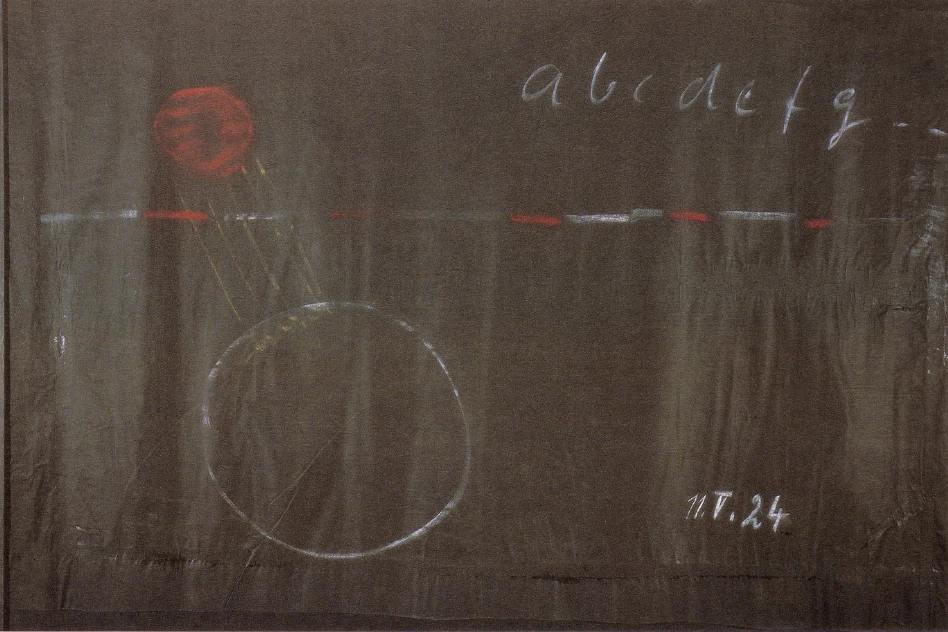
[ 45 ] And it’s really just a small shell up here where the moon’s effects are captured. The sun’s effects, of course, penetrate deep into the earth. The heat from the sun during the summer is retained; if you put potatoes in pits, you’ll still feel its effects during the winter. Much of the sun’s energy penetrates deep into the earth, whereas the moon’s effects reach only as far as the plant roots go—a thin layer.
[ 46 ] It can happen, however, that after death, when human beings are to enter the lunar region—the world of souls— yet are unable to truly understand the lunar beings; they are bound by this thin layer of lunar influences, which then, as it were, rise up from the Earth, and there they wander about—for a genuine sensory-supersensory perception—like a kind of ghost, like the aftereffects of the human being.
[ 47 ] The legends and stories that exist about such things are, after all, based entirely on reality. To be able to judge such things, one must simply be completely free of superstition, approach everything critically, and accept only those things that can be verified.
[ 48 ] During this phase, which lasts one-third of a human lifetime, karma is first laid the groundwork. For the lunar beings do indeed participate in these negative images that human beings create from their actions—including their thoughts—and these lunar beings have a good memory, since they record everything they experience with human beings in the world ether.
[ 49 ] We now pass through life between death and a new birth, and return once more. When we return to the lunar region, we find that everything has been recorded there. We bring this into our earthly life so that we may then carry it out in accordance with our earthly will.
[ 50 ] That, my dear friends, is the fundamental point I would like to present to you today. The formation of karma during the retrograde experience of the earthly life immediately after death